
 A SCHOLARLY BOOK REPOSITORY
4 start with E start with E
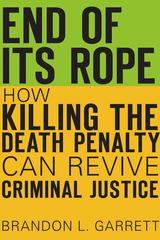
It isn’t enough to celebrate the death penalty’s demise. We must learn from it.
When Henry McCollum was condemned to death in 1984 in rural North Carolina, death sentences were commonplace. In 2014, DNA tests set McCollum free. By then, death sentences were as rare as lethal lightning strikes. To most observers this national trend came as a surprise. What changed? Brandon Garrett hand-collected and analyzed national data, looking for causes and implications of this turnaround. End of Its Rope explains what he found, and why the story of who killed the death penalty, and how, can be the catalyst for criminal justice reform.
No single factor put the death penalty on the road to extinction, Garrett concludes. Death row exonerations fostered rising awareness of errors in death penalty cases, at the same time that a decline in murder rates eroded law-and-order arguments. Defense lawyers radically improved how they litigate death cases when given adequate resources. More troubling, many states replaced the death penalty with what amounts to a virtual death sentence—life without possibility of parole. Today, the death penalty hangs on in a few scattered counties where prosecutors cling to entrenched habits and patterns of racial bias.
The failed death penalty experiment teaches us how inept lawyering, overzealous prosecution, race discrimination, wrongful convictions, and excessive punishments undermine the pursuit of justice. Garrett makes a strong closing case for what a future criminal justice system might look like if these injustices were remedied.
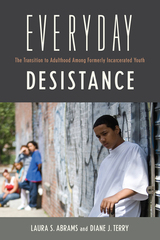
In Everyday Desistance, Laura Abrams and Diane J. Terry examine the lives of young people who spent considerable time in and out of correctional institutions as adolescents. These formerly incarcerated youth often struggle with the onset of adult responsibilities at a much earlier age than their more privileged counterparts. In the context of urban Los Angeles, with a large-scale gang culture and diminished employment prospects, further involvement in crime appears almost inevitable. Yet, as Abrams and Terry point out, these formerly imprisoned youth are often quite resilient and can be successful at creating lives for themselves after months or even years of living in institutions run by the juvenile justice system.
This book narrates the day-to-day experiences of these young men and women, focusing on their attempts to surmount the challenges of adulthood, resisting a return to criminal activity, and formulating long-term goals for a secure adult future.

Executing Democracy: Capital Punishment & the Making of America, 1683-1807 is the first volume of a rhetorical history of public debates about crime, violence, and capital punishment in America. This examination begins in 1683, when William Penn first struggled to govern the rowdy indentured servants of Philadelphia, and continues up until 1807, when the Federalists sought to impose law-and-order upon the New Republic.
This volume offers a lively historical overview of how crime, violence, and capital punishment influenced the settling of the New World, the American Revolution, and the frantic post-war political scrambling to establish norms that would govern the new republic.
By presenting a macro-historical overview, and by filling the arguments with voices from different political camps and communicative genres, Hartnett provides readers with fresh perspectives for understanding the centrality of public debates about capital punishment to the history of American democracy.

This eye-opening and well-researched companion to the first volume of Executing Democracy enters the death-penalty discussion during the debates of 1835 and 1843, when pro-death penalty Calvinist minister George Barrell Cheever faced off against abolitionist magazine editor John O’Sullivan. In contrast to the macro-historical overview presented in volume 1, volume 2 provides micro-historical case studies, using these debates as springboards into the discussion of the death penalty in America at large. Incorporating a wide range of sources, including political poems, newspaper editorials, and warring manifestos, this second volume highlights a variety of perspectives, thus demonstrating the centrality of public debates about crime, violence, and punishment to the history of American democracy. Hartnett’s insightful assessment bears witness to a complex national discussion about the political, metaphysical, and cultural significance of the death penalty.
READERS
Browse our collection.
PUBLISHERS
See BiblioVault's publisher services.
STUDENT SERVICES
Files for college accessibility offices.
RECENTLY PUBLISHED



UChicago Accessibility Resources
home | accessibility | search | about | contact us
BiblioVault ® 2001 - 2025
The University of Chicago Press