
 A SCHOLARLY BOOK REPOSITORY
7 start with F start with F

In Figurations of France: Literary Nation-Building in Times of Crisis (1550-1650), Marcus Keller explores the often indirect and subtle ways in which key texts of early modern French literature, from Joachim Du Bellay’s Défense et illustration de la langue française to Corneille’s Le Cid, contribute to the fiction of France as a nation. Through his fresh take on these and other classics, he shows that they not only create the French as an imaginary community but also provide venues for an incisive critique of the political and cultural construct that underpins the modern nation-state.
Current theories of nationhood, in particular the concepts of the nation form and fictive ethnicity (Étienne Balibar), inform the close readings of Du Bellay’s Défense, Ronsard’s Discours, d’Aubigné’s Tragiques, Montaigne’s Essays, Malherbe’s odes, and Corneille’s Le Cid and Horace. They reveal the imaginary power and unifying force of early modern figurations of France that come to bear in this heteregoneous corpus of French literature, with texts ranging from manifesto and epic poem to essay and tragedy. Situating each author and text in their particular historical context, the study suggests that the literary invention of France in the sixteenth and seventeenth centuries is as abundant as it is conceptually innovative: Du Bellay, for example, develops an idea of France by portraying the French language as a pruned and grafted tree while d’Aubigné proposes to think of the French as a nuclear but fatherless family. Blood functions as a highly charged metaphor of nationhood in all texts.
Opening up new perspectives on these canonical works, the focus on literary nation-building also puts them into unexpected and thought-provoking relationships to each other. Figurations of France deliberately crosses the fictive boundary between the sixteenth and the seventeenth centuries and argues that, in terms of imaginary nation-building, the contours that delineate the early modern period and separate it from what we call the modern era quickly begin to dissolve. Ultimately, the book makes the case for early modern literature as a creative and critical discourse, able to nourish and nuance our thinking about the nation as the postmodern nation-state is increasingly called into question by the economical, political, and cultural effects of globalization.
Published by University of Delaware Press. Distributed worldwide by Rutgers University Press.
“Essential reading.” —Erika Lee, author of The Making of Asian America
“A broadly thought-provoking book.” —Asian Review of Books
“Fascinating…[this book] indicates new avenues of research…[and] stands as a bellwether for shifting trajectories of analysis that invite micro-historical follow-up.” —H-Net Reviews
“[This book] offers an invaluable perspective… [it] not only intellectually satisfies the reader with a necessary and innovative view . . . but also makes us want to learn more about this essential and still insufficiently explored topic...will become a fundamental pillar within the discipline.” —Colonial Latin American Review
Between 1565 and 1815, the so-called Manila galleons monopolized trade between Spain’s Asian and American colonies. Sailing from the Philippines to Mexico and back, these Spanish ships also facilitated the earliest migrations and displacements of Asian peoples to the Americas. Hailing from Gujarat, Nagasaki, and many places in between, both free and enslaved Asians made the treacherous transpacific journey each year.
Diego Javier Luis chronicles this first sustained wave of Asian mobility to the Americas, shedding new light on the daily lives of those who disembarked at Acapulco. There, diverse ethnolinguistic populations officially became “chinos,” racialized as members of a single caste under colonial control. Luis shows how Asians resisted legal strictures, forging new connections across ethnic groups and continually adapting to adverse conditions.
Detailing an important era in the construction of race, The First Asians in the Americas vividly unfolds what it meant to be “chino” in the early modern Spanish empire and reveals the significance of colonial Latin America to Asian diasporic history.
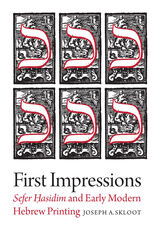
In 1538, a partnership of Jewish silk makers in the city of Bologna published a book entitled Sefer Hasidim, a compendium of rituals, stories, and religious instruction that primarily originated in medieval Franco-Germany. How these men, of Italian and Spanish descent, came to produce a book that would come to shape Ashkenazic culture, and Jewish culture more broadly, over the next four centuries is the basis of this kaleidoscopic study of the history of Hebrew printing in the sixteenth century.
During these early years of printing, the classic works of ancient and medieval Hebrew and Jewish literature became widely available to Jewish (and non-Jewish) readers for the first time. Printing, though, was not merely the duplication and distribution of pre-existing manuscripts, it was the creative adaptation and transformation of those manuscripts by printers. Ranging from Catholic Bologna to Protestant Basel to the Jewish heartland of the Polish-Lithuanian Commonwealth, Joseph A. Skloot uncovers the history of that creativity by examining the first two print editions of Sefer Hasidim. Along the way, he demonstrates how volumes that were long thought to be eternal and unchanging were in fact artifacts of historical agency and contingency, created by and for human beings.
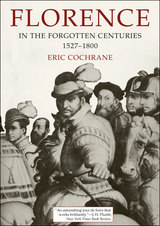
Eric Cochrane shows that the Florentines maintained their creativity long after they had lost their position as the cultural leaders of Europe. When their political philosophy and historiography ran dry, they turned to the practical problems of civil administration. When their artists finally yielded to outside influence, they turned to music and the natural sciences. Even during the darkest days of the great economic depression of the late seventeenth and early eighteenth centuries, they succeeded in preserving—almost alone in Europe—the blessings of external peace and domestic tranquility.
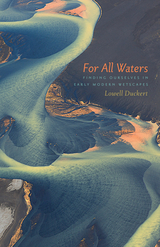
Recent years have witnessed a surge in early modern ecostudies, many devoted to Shakespearean drama. Yet in this burgeoning discipline, travel writing appears moored in historicization, inorganic subjects are far less prevalent than organic ones, and freshwater sites are hardly visited. For All Waters explores these uncharted wetscapes.
Lowell Duckert shows that when playwrights and travel writers such as Sir Walter Raleigh physically interacted with rivers, glaciers, monsoons, and swamps, they composed “hydrographies,” or bodily and textual assemblages of human and nonhuman things that dissolved notions of human autonomy and its singular narrativity. With a playful, punning touch woven deftly into its theoretical rigor, For All Waters disputes fantasies of ecological solitude that would keep our selves high and dry and that would try to sustain a political ecology excluding water and the poor. The lives of both humans and waterscapes can be improved simultaneously through direct engagement with wetness.
For All Waters concludes by investigating waterscapes in peril today—West Virginia’s chemical rivers and Iceland’s vanishing glaciers—and outlining what we can learn from early moderns’ eco-ontological lessons. By taking their soggy and storied matters to heart, and arriving at a greater realization of our shared wetness, we can conceive new directions to take within the hydropolitical crises afflicting us today.
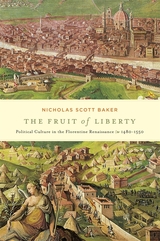
In the middle decades of the sixteenth century, the republican city-state of Florence--birthplace of the Renaissance--failed. In its place the Medici family created a principality, becoming first dukes of Florence and then grand dukes of Tuscany. The Fruit of Liberty examines how this transition occurred from the perspective of the Florentine patricians who had dominated and controlled the republic. The book analyzes the long, slow social and cultural transformations that predated, accompanied, and facilitated the institutional shift from republic to principality, from citizen to subject.
More than a chronological narrative, this analysis covers a wide range of contributing factors to this transition, from attitudes toward office holding, clothing, and the patronage of artists and architects to notions of self, family, and gender. Using a wide variety of sources including private letters, diaries, and art works, Nicholas Baker explores how the language, images, and values of the republic were reconceptualized to aid the shift from citizen to subject. He argues that the creation of Medici principality did not occur by a radical break with the past but with the adoption and adaptation of the political culture of Renaissance republicanism.
READERS
Browse our collection.
PUBLISHERS
See BiblioVault's publisher services.
STUDENT SERVICES
Files for college accessibility offices.
RECENTLY PUBLISHED




UChicago Accessibility Resources
home | accessibility | search | about | contact us
BiblioVault ® 2001 - 2025
The University of Chicago Press