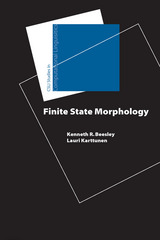
front cover of Finite-State Morphology
Finite-State Morphology
Kenneth R. Beesley and Lauri Karttunen
CSLI, 2003
The finite-state paradigm of computer science has provided a basis for natural-language applications that are efficient, elegant, and robust. This volume is a practical guide to finite-state theory and the affiliated programming languages lexc and xfst. Readers will learn how to write tokenizers, spelling checkers, and especially morphological analyzer/generators for words in English, French, Finnish, Hungarian, and other languages.

Included are graded introductions, examples, and exercises suitable for individual study as well as formal courses. These take advantage of widely-tested lexc and xfst applications that are just becoming available for noncommercial use via the Internet.
[more]

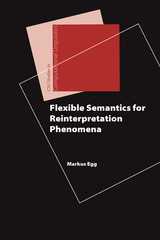
front cover of Flexible Semantics for Reinterpretation Phenomena
Flexible Semantics for Reinterpretation Phenomena
Markus Egg
CSLI, 2005
Deriving the correct meaning of such colloquial expressions as "I am parked out back" requires a unique interaction of knowledge about the world with a person's natural language tools, e.g., "I have a car that is parked in the back," and not the wrong literal one. In this volume, Markus Egg examines how natural language rules and world knowledge work together to produce correct understandings of expressions that cannot be fully understood through literal reading. An in-depth and exciting work on semantics and natural language, this volume will be essential reading for scholars in computational linguistics.
[more]

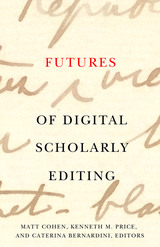
front cover of Futures of Digital Scholarly Editing
Futures of Digital Scholarly Editing
Matt Cohen
University of Minnesota Press, 2025

Exploring technology, ethics, and culture to unlock digital scholarship’s future

Futures of Digital Scholarly Editing navigates the ever-shifting terrain of digital academia, examining practical and ethical considerations as technology continues to evolve. In this indispensable collection, digital humanities practitioners and scholars work with a wide range of archival materials to confront key challenges surrounding the adaptation and sustainability of digital editorial projects as well as their societal impact.

Broaching essential questions at the nexus of technology and culture, Futures of Digital Scholarly Editing is organized around three principal frameworks: access, sustainability, and interoperability; ethics and community involvement; and the evolution of textual scholarship. From addressing outdated technical infrastructures to fostering new collaborations, this volume serves as a beacon guiding scholars and institutions through the complexities of digital editing in an era of profound technological and societal transformation.

Contributors: Stephanie P. Browner, The New School; Julia Flanders, Northeastern U; Ed Folsom, U of Iowa; Nicole Gray, U of Nebraska–Lincoln; Cassidy Holahan, U of Nevada, Las Vegas; Fotis Jannidis, U of Würzburg; Aylin Malcolm, U of Guelph; Sarah Lynn Patterson, U of Massachusetts Amherst; Elena Pierazzo, U of Tours; K.J. Rawson, Northeastern U; Whitney Trettien, U of Pennsylvania; John Unsworth, U of Virginia; Dirk Van Hulle, U of Oxford; Robert Warrior, U of Kansas; Marta L. Werner, Loyola U Chicago.

Retail e-book files for this title are screen-reader friendly with images accompanied by short alt text and/or extended descriptions.


[more]


Send via email Share on Facebook Share on Twitter