
 A SCHOLARLY BOOK REPOSITORY
14 start with F start with F
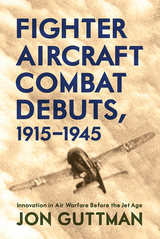
Of all military aircraft, fighter planes hold a mystique all their own. Perhaps it is because fighters can afford the least compromise: when the goal is to seize and maintain control of the air, the confrontation is direct. During World War I, the concept of air superiority took hold and in the ensuing decades the development of fighter aircraft became an ongoing back-and-forth battle, with adversaries trying to gain an upper hand through innovations in aerodynamics, powerplants, and armament. Fighter Aircraft Combat Debuts, 1915–1945: Innovation in Air Warfare Before the Jet Age by prominent aviation expert Jon Guttman explores the first combats for a variety of fighters of World War I, the conflicts of the so-called "interwar years," and World War II—a thirty-year period that saw the birth of the fighter concept and its maturity on the threshold of the Jet Age. Most of the aircraft described are fairly well known to aviation historians and a few names, such as Sopwith Camel, Fokker Triplane, Messerschmitt Me-109, Mitsubishi Zero, North American Mustang, and Supermarine Spitfire, are familiar even to the most nonaviation- minded persons. Not so well-known are the circumstances of their combat debuts, in which some, such as the Zero, made their mark almost from the outset, but in which others, like the British Bristol F.2A, showed rather less promise than they would ultimately realize. While a certain amount of space must be devoted to the technical development of these famous fighters, these studies of first combats serve as a reminder that it is the human factor, with all its special quirks, that inevitably came into play when these deadly flying machines first fired their guns. Profusely illustrated, Fighter Aircraft Combat Debuts is an authoritative history of one of the most enduring subjects in military aviation.

Despair at Gallipoli. Victory at Vimy Ridge. A European generation lost, an American spirit found. The First World War, the deadly herald of a new era, continues to captivate readers. In this lively book, Michael Neiberg offers a concise history based on the latest research and insights into the soldiers, commanders, battles, and legacies of the Great War.
Tracing the war from Verdun to Salonika to Baghdad to German East Africa, Neiberg illuminates the global nature of the conflict. More than four years of mindless slaughter in the trenches on the western front, World War I was the first fought in three dimensions: in the air, at sea, and through mechanized ground warfare. New weapons systems--tanks, bomber aircraft, and long-range artillery--all shaped the battle environment. Moving beyond the standard portrayal of the war's generals as "butchers and bunglers," Neiberg offers a nuanced discussion of officers constrained by the monumental scale of complex events. Diaries and letters of men serving on the front lines capture the personal stories and brutal conditions--from Alpine snows to Mesopotamian sands--under which these soldiers lived, fought, and died.
Generously illustrated, with many never-before-published photographs, this book is an impressive blend of analysis and narrative. Anyone interested in understanding the twentieth century must begin with its first global conflict, and there is no better place to start than with Fighting the Great War.
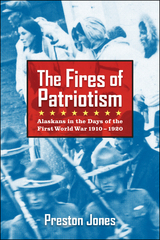
The Fires of Patriotism explores Alaska’s wartime experience, bringing to light new stories and new characters from a decade that shook the world. This multifaceted book explores the era through engaging stories and rare photos, offering a fresh perspective on World War I from a marginal land that forged its place in the greater unity of the country.
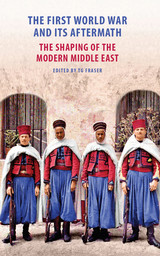
In addition to recounting the crucial international politics that drew fierce lines in the sands of the Middle East—a story of intrigue between the British, Russians, Ottomans, North Africans, Americans, and others—the contributors engage topics ranging from the war’s effects on women, the experience of the Kurds, sectarianism, the evolution of Islamism, and the importance of prominent intellectuals like Ziya Gökalp and Michel ‘Aflaq. They examine the dissolution of the Ottoman Empire, the exploitation of notions of Islamic unity and pan-Arabism, the influences of Woodrow Wilson and American ideals on Middle East leaders, and likewise the influence of Vladimir Lenin’s vision of a communist utopia. Altogether, they tell a story of promises made and promises broken, of the struggle between self-determination and international recognition, of centuries-old empires laying in ruin, and of the political poker of the twentieth century that carved up the region, separating communities into the artificial states we know today.
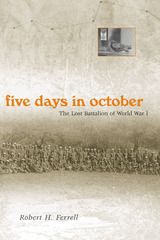
Now, in Five Days in October, historian Robert H. Ferrell presents new material—previously unavailable—about what really happened during those days in the forest. Despite the description of them as a lost battalion, the men were neither lost nor a battalion. The name was coined by a New York newspaper editor who, upon learning that a sizable body of troops had been surrounded, thought up the notion of a Lost Battalion—it possessed a ring sure to catch the attention of readers.
The trapped men actually belonged to companies from two battalions of the Seventy-seventh, and their exact placement was well known, reported by runners at the outset of the action and by six carrier pigeons released by their commander, Major Charles W. Whittlesey, during the five days his men were there. The causes of the entrapment were several, including command failures and tactical errors. The men had been sent ahead of the main division line without attention to flanks, and because of that failure, they were surrounded. Thus began a siege that took the lives of many men, leading to the collapse of the colonel of the 308th Infantry Regiment and, many believe, to the suicide of Major Whittlesey three years later.
This book grew out of Ferrell’s discovery of new material in the U.S. Army Military History Institute at the Army War College from the papers of General Hugh A. Drum and in the National Archives in College Park, Maryland. The Drum papers contain the court-martial record of the lieutenant of a machine-gun unit attached to the battalions, who advised Major Whittlesey to surrender, while the Seventy-seventh Division files contain full accounts of the taut relations between the Lost Battalion’s brigade commander and the Seventy-seventh’s division commander. By including this material, Ferrell gives a new accounting of this intriguing affair. Five Days in October will be welcomed by all those interested in a fuller understanding of the story of the Lost Battalion.

When, at the end of the First World War, Marshal Ferdinand Foch, soldier and popular hero, assumed the role of self-appointed peacemaker, he proved himself a source of embarrassment and irritation. Challenging Georges Clemenceau's right to negotiate the peace settlement, Foch attempted to arrange a peace which, according to him, would provide France with security, but which, according to his civilian superior, would have lost France's urgently needed allies.
French internal conflict in civil-military relations during the Versailles Peace Conference was thus primarily between Clemenceau and Foch, both inspired by the most patriotic of motives.
Foch versus Clemenceau gives a vivid account of the diplomatic maneuvers among France, its allies, and Germany during the period of the Conference. It sketches the Rhineland separatist movement in 1919--with Dorten's abortive, even amusing putsch, the Palatine-Rhineland Rebellion--as incidental background to the momentous struggle between Foch and his field commanders on the one hand and the President of the Council, Clemenceau, on the other over their differing conceptions of a realizable peace which could guarantee France's security.
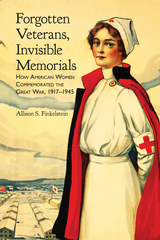
In Forgotten Veterans, Invisible Memorials: How American Women Commemorated the Great War, 1917–1945 Allison S. Finkelstein argues that American women activists considered their own community service and veteran advocacy to be forms of commemoration just as significant and effective as other, more traditional forms of commemoration such as memorials. Finkelstein employs the term “veteranism” to describe these women’s overarching philosophy that supporting, aiding, and caring for those who served needed to be a chief concern of American citizens, civic groups, and the government in the war’s aftermath. However, these women did not express their views solely through their support for veterans of a military service narrowly defined as a group predominantly composed of men and just a few women. Rather, they defined anyone who served or sacrificed during the war, including women like themselves, as veterans.
These women veteranists believed that memorialization projects that centered on the people who served and sacrificed was the most appropriate type of postwar commemoration. They passionately advocated for memorials that could help living veterans and the families of deceased service members at a time when postwar monument construction surged at home and abroad. Finkelstein argues that by rejecting or adapting traditional monuments or by embracing aspects of the living memorial building movement, female veteranists placed the plight of all veterans at the center of their commemoration efforts. Their projects included diverse acts of service and advocacy on behalf of people they considered veterans and their families as they pushed to infuse American memorial traditions with their philosophy. In doing so, these women pioneered a relatively new form of commemoration that impacted American practices of remembrance, encouraging Americans to rethink their approach and provided new definitions of what constitutes a memorial. In the process, they shifted the course of American practices, even though their memorialization methods did not achieve the widespread acceptance they had hoped it would.
Meticulously researched, Forgotten Veterans, Invisible Memorials utilizes little-studied sources and reinterprets more familiar ones. In addition to the words and records of the women themselves, Finkelstein analyzes cultural landscapes and ephemeral projects to reconstruct the evidence of their influence. Readers will come away with a better understanding of how American women supported the military from outside its ranks before they could fully serve from within, principally through action-based methods of commemoration that remain all the more relevant today.

For many of the 200,000 black soldiers sent to Europe with the American Expeditionary Forces in World War I, encounters with French civilians and colonial African troops led them to imagine a world beyond Jim Crow. They returned home to join activists working to make that world real. In narrating the efforts of African American soldiers and activists to gain full citizenship rights as recompense for military service, Adriane Lentz-Smith illuminates how World War I mobilized a generation.
Black and white soldiers clashed as much with one another as they did with external enemies. Race wars within the military and riots across the United States demonstrated the lengths to which white Americans would go to protect a carefully constructed caste system. Inspired by Woodrow Wilson’s rhetoric of self-determination but battered by the harsh realities of segregation, African Americans fought their own “war for democracy,” from the rebellions of black draftees in French and American ports to the mutiny of Army Regulars in Houston, and from the lonely stances of stubborn individuals to organized national campaigns. African Americans abroad and at home reworked notions of nation and belonging, empire and diaspora, manhood and citizenship. By war’s end, they ceased trying to earn equal rights and resolved to demand them.
This beautifully written book reclaims World War I as a critical moment in the freedom struggle and places African Americans at the crossroads of social, military, and international history.
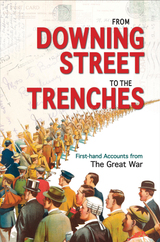
From Downing Street to the Trenches gathers eyewitness accounts and photographs that vividly convey this lived experience. The letters of Prime Minister H. H. Asquith show the strain of wartime leadership and shed light on his later downfall, while letters home from the young Harold Macmillan are suffused with his experiences in the trenches and mark the beginning of his road to Downing Street. Although it was forbidden to record cabinet discussions, Secretary of State Lewis Harcourt’s unauthorized diary provides a window into the government of the time, complete with character sketches of some of the leading figures, including Winston Churchill. In addition to political figures, the book draws on many local records, including the diary of an Essex rector, written to record the impact of the war on his community and parish.
Filled with fear and sorrow but also suffused with hope for the future, the accounts collected here paint a highly personal and immediate picture of the war as it was happening to real people of the time.
READERS
Browse our collection.
PUBLISHERS
See BiblioVault's publisher services.
STUDENT SERVICES
Files for college accessibility offices.
RECENTLY PUBLISHED





UChicago Accessibility Resources
home | accessibility | search | about | contact us
BiblioVault ® 2001 - 2025
The University of Chicago Press