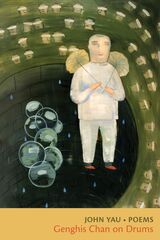
front cover of Genghis Chan on Drums
Genghis Chan on Drums
John Yau
Omnidawn, 2021
A diverse and cacophonous poetry collection tackling subjects from identity to current events.
 
At once comic and cantankerous, tender and discomfiting, piercing and irreverent, Genghis Chan on Drums is a shape-shifting book of percussive poems dealing with aging, identity, PC culture, and stereotypes about being Chinese. Employing various forms, John Yau’s poems traverse a range of subjects, including the 1930s Hollywood actress Carole Lombard, the Latin poet Catullus, the fantastical Renaissance painter Piero di Cosimo’s imaginary sister, and a nameless gumshoe. Yau moves effortlessly from using the rhyme scheme of a sixteenth-century Edmund Spenser sonnet to riffing on a well-known poem-rant by the English poet Sean Bonney, and to immersing himself in the words of condolence sent by a former president to the survivors of a school massacre. Yau’s poems are conduits through which many different, conflicting, and unsavory voices strive to be heard.
 
[more]

front cover of Ghost Of
Ghost Of
Diana Khoi Nguyen
Omnidawn, 2018
Ghost Of is a mourning song, not an exorcism or un-haunting of that which haunts, but attuned attention, unidirectional reaching across time, space, and distance to reach loved ones, ancestors, and strangers. By working with, in, and around the photographs that her brother left behind (from which he cut himself out before his death), Nguyen wrestles with what remains: memory, physical voids, and her family captured around an empty space.

Ghost Of was selected by Terrance Hayes to win Omnidawn’s Open Poetry Book Contest. It was also a finalist for the National Book Award and L.A. Times Book Prize.
 
[more]

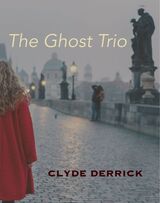
front cover of The Ghost Trio
The Ghost Trio
Clyde Derrick
Omnidawn, 2022
A story set in Prague that crosses the lines between the living and the dead.
 
The great love of your life is dead, but that doesn’t stop him from communicating with you—or luring you to join him in the afterlife. To remain safe in this world, you accept the help of a professional medium who develops his own emotional agenda.
 
The Ghost Trio that emerges takes us to pre- and post-World War II Prague where a poignant and chilling love triangle finds its resolution. There we meet great Czech creators of the past including Leoš Janácek and Karel Capek. Inspired by the ghost stories of Henry James and Daphne du Maurier, Clyde Derrick introduces three characters whose passions defy time and the accepted boundaries between the dead and the living. The author, who has lived in and visited purportedly haunted sites in advance of writing this novella, contends that this story and its characters found him. Meanwhile, his portrayal of two Pragues—one poised to fall to Hitler’s army, the other muted by Communist oppression—offers us insights into the past and reminds us to stay vigilant against dangerous politics. The Ghost Trio is a spiritual excursion in which we ponder the limitations and hazards of romantic love as well as the possibility of other lives in other times.
 
The Ghost Trio is the winner of the 2020 Omnidawn Fabulist Fiction Chapbook / Novelette Contest, chosen by Molly Gloss.
 
[more]

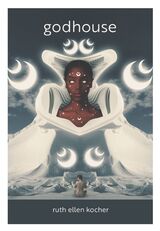
front cover of godhouse
godhouse
Ruth Ellen Kocher
Omnidawn, 2023
Poems that consider the human body as a meeting place of the infinite and the mortal.
 
Starting with the idea that the human experience is the universe looking back at itself, godhouse takes the notion a few steps further by centering cosmology within a raced and gendered body. Ruth Ellen Kocher’s poems envision this body as a union of god and soul that, within our material world, encompasses love and hate, joy and despair. The body is a site of divine presence made mortal, electrified with the resonance of both the infinite and the human. In godhouse, we encounter the body as a site where the universe is made personal and celebratory, where the celestial endure the complications of flesh and friction forms between the glorious and the monstrous aspects of personhood.
 
[more]

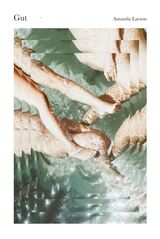
front cover of Gut
Gut
Amanda Larson
Omnidawn, 2021
These poems follow the aftermath of and recovery from trauma.
 
Amanda Larson’s Gut begins with an epigraph from Frank O’Hara: “Pain always produces logic, which is very bad for you.” From there, Larson launches an unflinching interrogation of how a young woman maintains agency in the wake of trauma, violence, and desire. Larson spins a conversation between works of feminist theory—including the those of Cathy Caruth, Susan Bordo, Patricia Hill Collins, Anne Carson, Hélène Cixous, and bell hooks—and her own experiences. The book moves through Larson’s recovery while questioning the limits of the very term and of language as a whole. She employs a variety of different forms, including prose, Q&A poems, and a timeline, reflecting both the speaker’s obsession with control and her growing willingness to let it go. With a measured voice, Larson finds a path for how to move beyond logic during processes of trauma and recovery.

Gut won the Omnidawn 1st/2nd Book Contest, selected by Jericho Brown. 
 
[more]


Send via email Share on Facebook Share on Twitter