front cover of Games and Theatre in Shakespeare's England
Games and Theatre in Shakespeare's England
Tom Bishop
Amsterdam University Press, 2021
Games and Theatre in Shakespeare's England brings together theories of play and game with theatre and performance to produce new understandings of the history and design of early modern English drama. Through literary analysis and embodied practice, an international team of distinguished scholars examines a wide range of games—from dicing to bowling to role-playing to videogames—to uncover their fascinating ramifications for the stage in Shakespeare’s era and our own. Foregrounding ludic elements challenges the traditional view of drama as principally mimesis, or imitation, revealing stageplays to be improvisational experiments and participatory explorations into the motive, means, and value of recreation. Delving into both canonical masterpieces and hidden gems, this innovative volume stakes a claim for play as the crucial link between games and early modern theatre, and for the early modern theatre as a critical site for unraveling the continued cultural significance and performative efficacy of gameplay today.
[more]

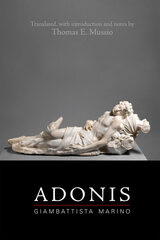
front cover of Giambattista Marino
Giambattista Marino
Adonis
Thomas E. Mussio
Arizona Center for Medieval and Renaissance Studies, 2019
This is the first complete translation in English of Giambattista Marino’s Adone, a poem of 20 cantos written in Italian and first published in 1623 in Paris. Although Marino’s work has been characterized as a mythological poem with the tragic tale of Venus and Adonis at its core and woven through with retellings of many Greek and Roman myths, it is clear that Marino strove to write more than an Italian version of Ovid’s Metamorphoses. The highly wrought descriptive passages that permeate the poem, the allusions to contemporary political figures and events, and the rich scientific, philosophical, and theological language of many passages reflect Marino’s particular poetic style, his broad interests, and his engagement with the political and intellectual scene of early seventeenth-century Europe. One of the goals of this translation is to provide a highly accessible version of the whole poem and to expand its readership to include not only students and scholars of the romance epic and the early modern period but also curious general readers. It is hoped that this modern, annotated translation will spur new research on Marino’s poem and bear new assessments of the poem’s relation to its sources, of its influence on later literature, and of its vital connection with key issues of Marino’s time, such as scientific advancement, discovery and exploration, and the power and influence of the Catholic Church.

Translated, with introduction and notes by Thomas E. Mussio.

[more]

front cover of The Golden Dream
The Golden Dream
Seekers Of El Dorado
Robert Silverberg
Ohio University Press, 1996

One of the most persistent legends in the annals of New World exploration is that of the Land of Gold. This mythical site was located over vast areas of South America (and later, North America); the search for it drove some men mad with greed and, as often as not, to their untimely deaths.

In this history of quest and adventure, Robert Silverberg traces the fate of Old World explorers lured westward by the myth of El Dorado. From the German conquistadores licensed by the Spanish king to operate out of Venezuela, to the journeys of Gonzalo Pizarro in the Amazon basin, and to the nearly miraculous voyage of Francisco Orellana to the mouth of the Amazon River, encountering the warlike women who gave the river its name, violence and bloodshed accompanied the determined adventurers. Sir Walter Raleigh and a host of other explorers spent small fortunes and many lives trying to locate Manoa, a city that was rumored to be El Dorado—City of Gold. Celebrated science fiction author Robert Silverberg recreates these legendary quests in The Golden Dream: Seekers of El Dorado.
[more]

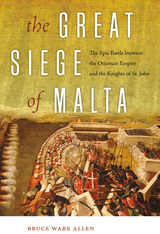
front cover of The Great Siege of Malta
The Great Siege of Malta
The Epic Battle between the Ottoman Empire and the Knights of St. John
Bruce Ware Allen
University Press of New England, 2017
In the spring of 1565, a massive fleet of Ottoman ships descended on Malta, a small island centrally located between North Africa and Sicily, home and headquarters of the crusading Knights of St. John and their charismatic Grand Master, Jean de Valette. The Knights had been expelled from Rhodes by the Ottoman sultan, Suleiman the Magnificent, and now stood as the last bastion against a Muslim invasion of Sicily, southern Italy, and beyond. The siege force of Turks, Arabs, and Barbary corsairs from across the Muslim world outnumbered the defenders of Malta many times over, and its arrival began a long hot summer of bloody combat, often hand to hand, embroiling knights and mercenaries, civilians and slaves, in a desperate struggle for this pivotal point in the Mediterranean. Bruce Ware Allen's The Great Siege of Malta describes the siege’s geopolitical context, explains its strategies and tactics, and reveals how the all-too-human personalities of both Muslim and Christian leaders shaped the course of events. The siege of Malta was the Ottoman empire’s high-water mark in the war between the Christian West and the Muslim East for control of the Mediterranean. Drawing on copious research and new source material, Allen stirringly recreates the two factions’ heroism and chivalry, while simultaneously tracing the barbarism, severity, and indifference to suffering of sixteenth-century warfare. The Great Siege of Malta is a fresh, vivid retelling of one of the most famous battles of the early modern world—a battle whose echoes are still felt today.
[more]


Send via email Share on Facebook Share on Twitter