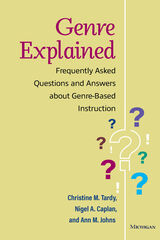
front cover of Genre Explained
Genre Explained
Frequently Asked Questions and Answers about Genre-Based Instruction
Christine M. Tardy, Nigel A. Caplan & Ann M. Johns
University of Michigan Press, 2023
The idea of teaching writing through genres—rather than, say, through prescriptive forms, templates, and rhetorical modes—is intuitively appealing. Yet many teachers have questions, and they are absolutely right to ask them: What are genres? What is genre-based instruction? What do students write if they don’t write essays? Isn’t it easier to teach and learn five-paragraph essays? What’s the role of language in genre teaching? And many more. These are all excellent questions and ones that new and experienced teachers alike have also struggled with. This book sets out to tackle some of the most common questions that teachers, teacher educators, and administrators may have when moving toward a genre-based teaching approach.  
[more]

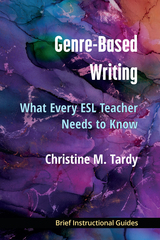
front cover of Genre-Based Writing
Genre-Based Writing
What Every ESL Teacher Needs to Know
Christine M. Tardy
University of Michigan Press, 2019
In Genre-Based Writing, author Christine Tardy defines genre and genre-based writing instruction and the five principles of a genre-based pedagogy. She then explains how to design genre-based writing activities. By discussing the genre-related practices and social and rhetorical aspects of genre, she is able to outline strategies for exploring rhetorical moves and playing with genre form in the classroom. In addition, the book provides general tips for bringing a genre approach into the writing classroom as well as several application activities and specific suggestions for classroom tasks.
[more]

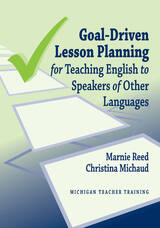
front cover of Goal-Driven Lesson Planning for Teaching English to Speakers of Other Languages
Goal-Driven Lesson Planning for Teaching English to Speakers of Other Languages
Marnie Reed and Christina Michaud
University of Michigan Press, 2010

This book is more than a collection of activities or ready-made lesson plans to add to a teaching repertoire. Instead, Goal-Driven Lesson Planning is intended to empower teachers and help them create a principled framework for their teaching—a framework that will shape the varied activities of the ESL classroom into a coherent teaching and learning partnership. After reading this book, teachers and prospective teachers will be able to articulate their individual teaching philosophies.
 
Goal-Driven Lesson Planning shows readers how to take any piece from English language materials—an assigned text, a random newspaper article, an ESL activity from a website, etc.—and use it to teach students something about language. Readers are walked through the process of reflecting on their role in diagnosing what that “something” is—what students really need—and planning how to get them there and how to know when they got there in a goal-driven principled manner.
 
This book has chapters on the theory of setting specific language goals for students; how to analyze learner needs (including an initial diagnostic and needs-analysis); templates to use when planning goal-driven English language lessons; explicit instruction on giving corrective feedback;  how to recognize and assess student progress; and the mechanics and logistics that facilitate the goal-driven language classroom.
[more]

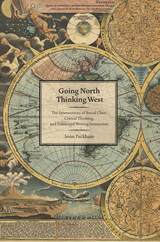
front cover of Going North Thinking West
Going North Thinking West
The Intersections of Social Class, Critical Thinking, and Politicized Writing Instruction
Irvin Peckham
Utah State University Press, 2010
A long-time writing program administrator and well-respected iconoclast, Irvin Peckham is strongly identified with progressive ideologies in education. However, in Going North Thinking West, Peckham mounts a serious critique of what is called critical pedagogy—primarily a project of the academic left—in spite of his own sympathies there.
            College composition is fundamentally a middle-class enterprise, and is conducted by middle-class professionals, while student demographics show increasing presence of the working class. In spite of best intentions to ameliorate inequitable social class relationships, says Peckham, critical pedagogies can actually contribute to reproducing those relationships in traditional forms—not only perpetuating social inequities, but pushing working class students toward self-alienation, as well.
            Peckham argues for more clarity on the history of critical thinking, social class structures and teacher identity (especially as these are theorized by Pierre Bourdieu), while he undertakes a critical inquiry of the teaching practices with which even he identifies.
            Going North Thinking West focuses especially on writing teachers who claim a necessary linkage between critical thinking and writing skills; these would include both teachers who promote the fairly a-political position that argumentation is the obvious and necessary form of academic discourse, and more controversial teachers who advocate turning a classroom into a productive site of social transformation.
            Ultimately, Peckham argues for a rereading of Freire (an icon of transformational pedagogy), and for a collaborative investigation of students’ worlds as the first step in a successful writing pedagogy. It is an argument for a pedagogy based on service to students rather than on transforming them.
[more]


Send via email Share on Facebook Share on Twitter