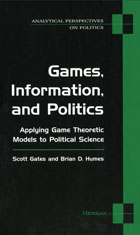
front cover of Games, Information, and Politics
Games, Information, and Politics
Applying Game Theoretic Models to Political Science
Scott Gates and Brian D. Humes
University of Michigan Press, 1997
To study the strategic interaction of individuals, we can use game theory. Despite the long history shared by game theory and political science, many political scientists remain unaware of the exciting game theoretic techniques that have been developed over the years. As a result they use overly simple games to illustrate complex processes. Games, Information, and Politics is written for political scientists who have an interest in game theory but really do not understand how it can be used to improve our understanding of politics. To address this problem, Gates and Humes write for scholars who have little or no training in formal theory and demonstrate how game theoretic analysis can be applied to politics. They apply game theoretic models to three subfields of political science: American politics, comparative politics, and international relations. They demonstrate how game theory can be applied to each of these subfields by drawing from three distinct pieces of research. By drawing on examples from current research projects the authors use real research problems--not hypothetical questions--to develop their discussion of various techniques and to demonstrate how to apply game theoretic models to help answer important political questions. Emphasizing the process of applying game theory, Gates and Humes clear up some common misperceptions about game theory and show how it can be used to improve our understanding of politics.
 
Games, Information, and Politics is written for scholars interested in understanding how game theory is used to model strategic interactions. It will appeal to sociologists and economists as well as political scientists.
 
Scott Gates is Assistant Professor of Political Science, Michigan State University. Brian D. Humes is Associate Professor of Political Science, University of Nebraska-Lincoln.

[more]

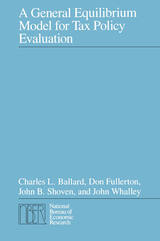
front cover of A General Equilibrium Model for Tax Policy Evaluation
A General Equilibrium Model for Tax Policy Evaluation
Charles L. Ballard, Don Fullerton, John B. Shoven, and John Whalley
University of Chicago Press, 1985

This book reports the authors' research on one of the most sophisticated general equilibrium models designed for tax policy analysis. Significantly disaggregated and incorporating the complete array of federal, state, and local taxes, the model represents the U.S. economy and tax system in a large computer package. The authors consider modifications of the tax system, including those being raised in current policy debates, such as consumption-based taxes and integration of the corporate and personal income tax systems. A counterfactual economy associated with each of these alternatives is generated, and the possible outcomes are compared.

[more]

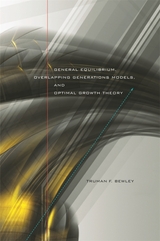
front cover of General Equilibrium, Overlapping Generations Models, and Optimal Growth Theory
General Equilibrium, Overlapping Generations Models, and Optimal Growth Theory
Truman F. Bewley
Harvard University Press, 2007
This book presents an original exposition of general equilibrium theory for advanced undergraduate and graduate-level students of economics. It contains detailed discussions of economic efficiency, competitive equilibrium, the first and second welfare theorems, the Kuhn-Tucker approach to general equilibrium, the Arrow-Debreu model, and rational expectations equilibrium and the permanent income hypothesis. Truman Bewley also treats optimal growth and overlapping generations models as special cases of the general equilibrium model. He uses the model and the first and second welfare theorems to explain the main ideas of insurance, capital theory, growth theory, and social security. It enables him to present a unified approach to portions of macro- as well as microeconomic theory. The book contains problems sets for most chapters.
[more]

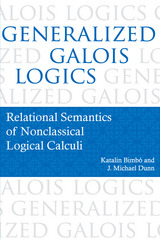
front cover of Generalized Galois Logics
Generalized Galois Logics
Relational Semantics of Nonclassical Logical Calculi
Katlin Bimbó and J. Michael Dunn
CSLI, 2008
Nonclassical logics have played an increasing role in recent years in disciplines ranging from mathematics and computer science to linguistics and philosophy. Generalized Galois Logics develops a uniform framework of relational semantics to mediate between logical calculi and their semantics through algebra. This volume addresses normal modal logics such as K and S5, and substructural logics, including relevance logics, linear logic, and Lambek calculi. The authors also treat less-familiar and new logical systems with equal deftness.
 
[more]

logo for Harvard University Press
Genius, Creativity, and Leadership
Historiometric Inquiries
Dean Keith Simonton
Harvard University Press, 1984

front cover of Ground Penetrating Radar
Ground Penetrating Radar
Improving sensing and imaging through numerical modeling
X. Lucas Travassos
The Institution of Engineering and Technology, 2021
Ground Penetrating Radar (GPR) is a powerful sensing technology widely used for the non-destructive assessment of a variety of structures with different properties including dimensions, electrical properties, and moisture.
[more]


Send via email Share on Facebook Share on Twitter