logo for Georgetown University Press
Haki bil-Libnani
Lebanese Arabic Online Textbook and Companion Website to Al-Kitaab Part One, Third Edition (Website Access Card)
Adnan Haydar
Georgetown University Press

Haki bil-Libnani provides students of Arabic with an opportunity to acquire substantial and systematic proficiency in Lebanese dialect and culture, and is designed to work either on its own or alongside the bestselling Arabic-language textbook Al-Kitaab Part One, Third Edition. This fully online textbook and interactive website features two video story components, designed to foster proficiency as students work through each lesson while practicing vocabulary, cultural expressions, and short dialogues. The first story recreates the stories of Maha and Khaled Abul'ila from Al-Kitaab, recast in a Lebanese context starring Yara and Jamil Haddad, who speak the Lebanese dialect and reference Lebanese institutions, places, and customs. A second storyline consists of an original series of short dialogue scenes involving three main characters: Jamal, Raghida, and John Douglas. Jamal and Raghida serve as cultural liaisons who help the Lebanese-American John navigate daily life in Lebanon -- buying groceries, taking cabs, and doing Arabic homework -- while John's linguistic and cultural struggles will resonate with many students.

The integration of speaking, listening, grammar, and cultural competency skills in Haki bil-Libnani: Lebanese Arabic Online Textbook and Companion Website to Al-Kitaab Part One, Third Edition, will facilitate the teaching and learning of Lebanese Arabic, while introducing students to Lebanon's vibrant and charming culture. All Modern Standard Arabic (MSA) drills and exercises from the Al-Kitaab Part One, Third Edition, website are included here, so that students using Haki bil-Libnani alongside the Al-Kitaab Part One, Third Edition, textbook will only need to purchase access to the Haki bil-Libnani companion website. Haki bil-Libnani will also be useful to individual learners with some proficiency in Arabic, who desire to learn Lebanese.

Companion Website Minimum System Requirements:
Operating System: Microsoft Windows XP, Vista, 7, 8, or Mac OS X
CPU: 233MHz
RAM: 128MB
Screen resolution: 1024 x 768 or higher
Browser: PC: Internet Explorer 7.x or higher, or Firefox version 3.x or higher, or Google Chrome. Mac: Firefox version 3.x or higher, or Safari 3.x or higher, or Google Chrome.
Network Connection: A high-speed connection with throughput of 256 Kbps or more is recommended to use audio and video components.
Equipment: You will need speakers or a headset to listen to audio and video components, and a microphone is necessary for recording activities. For best performance, we recommend you use a USB microphone for partner recording activities.
Plug-ins: You must have the latest version of Adobe Flash Player

[more]

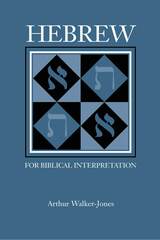
front cover of Hebrew for Biblical Interpretation
Hebrew for Biblical Interpretation
Arthur W. Walker-Jones
SBL Press, 2003
Hebrew for Biblical Interpretation teaches elementary Hebrew with a specific focus on the tasks of biblical exegesis. This innovative textbook combines the features of a traditional grammar with exercises in reading and interpreting the Hebrew Bible. Grammatical descriptions are clear, concise, and systematic, and vocabulary is introduced in descending order of frequency. All words occurring more than 100 times in the Hebrew Bible are taught, and attention to grammatical indicators reduces the need for rote memorization of paradigms. The integration of grammar and exegesis helps to motivate students and makes the textbook well-suited to seminary courses, while those who teach in university settings will find the textbook useful because the focus is on scholarly biblical exegesis, not theological interpretation.
[more]

front cover of Herman Gorter
Herman Gorter
Poems of 1890: A Selection
Herman Gorter
University College London, 2015
Commonly viewed as a revolutionary and propagandist Herman Gorter (1864–1927) is often overlooked despite his lasting contribution to Dutch poetry. This selection of thirty-one poems, translated by Paul Vincent, focuses on Gorter’s experimental love and nature lyrics in Poems of 1890, and the Introduction sets the poems in the context of his earlier seminal work 'Mei' (May) as well as his often neglected Socialist verse. The lyrical expansiveness, consistent use of rhyme and vivid imagery of the Dutch landscape that characterises 'Mei' evolves into more fragmentary verse in Poems of 1890, and the joyful celebratory tone of Gorter’s poetry increasingly co-exists with a sense of isolation and introspection. This can be viewed in the context of a rapidly changing political scene in Europe in the prelude to the First World War and the Russian Revolution. This is a valuable collection that revisits Gorter’s literary and political legacy, and introduces English-speaking readers to a selection of his most accessible and lyrical poems
[more]

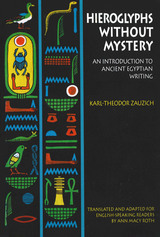
front cover of Hieroglyphs without Mystery
Hieroglyphs without Mystery
An Introduction to Ancient Egyptian Writing
By Karl-Theodor Zauzich
University of Texas Press, 1992

Marveling over the tomb treasures of Ramses II and Tutankhamen that have toured U.S. and European museums in recent years, visitors inevitably wonder what the mysterious hieroglyphs that cover their surfaces mean. Indeed, everyone who is fascinated by ancient Egypt sooner or later wishes for a Rosetta stone to unlock the secrets of hieroglyphic writing.

Hieroglyphs without Mystery provides the needed key. Written for ordinary people with no special language skills, the book quickly demonstrates that hieroglyphic writing can be read, once a few simple principles are understood. Zauzich explains the basic rules of the writing system and the grammar and then applies them to thirteen actual inscriptions taken from objects in European and Egyptian museums. By following his explanations and learning the most commonly used glyphs, readers can begin to decode hieroglyphs themselves and increase their enjoyment of both museum objects and ancient Egyptian sites.

Even for the armchair traveler, learning about hieroglyphs opens a sealed door into ancient Egyptian culture. In examining these inscriptions, readers will gain a better understanding of Egyptian art, politics, and religion, as well as language.

This book was originally published in Germany in 1980 as Hieroglyphen ohne Geheimnis.
[more]

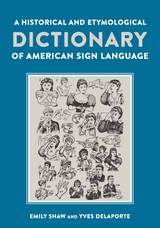
front cover of A Historical and Etymological Dictionary of American Sign Language
A Historical and Etymological Dictionary of American Sign Language
The Origin and Evolution of More Than 500 Signs
Emily Shaw
Gallaudet University Press, 2014
The story of how American Sign Language (ASL) came to be is almost mythic. In the early 19th century, a hearing American reverend, Thomas Hopkins Gallaudet, met a Deaf French educator, Laurent Clerc, who agreed to come to the United States and help establish the first school in America to use sign language to teach deaf children. The trail of ASL’s development meanders at this point. No documentation of early ASL was published until the late 19th century, almost seven decades after the school’s founding. While there are many missing pieces in the history of America’s sign language, plenty of data exist regarding ASL etymology. This book is the first to collect all known texts featuring illustrations of early ASL and historical images of French Sign Language—langue des signes française (LSF)—and link them with contemporary signs.

     Through rigorous study of historical texts, field research in communities throughout France and the U.S., and an in-depth analysis of the cultural groups responsible for the lexicon, authors Emily Shaw and Yves Delaporte present a compelling and detailed account of the origins of over 500 ASL signs, including regional variations. Organized alphabetically by equivalent English glosses, each sign is accompanied by a succinct description of its origin and an LSF sign where appropriate. Featuring an introductory chapter on the history of the development of ASL and the etymological methodology used by the authors, this reference resource breaks new ground in the study of America’s sign language.
[more]

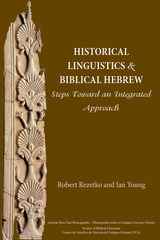
front cover of Historical Linguistics and Biblical Hebrew
Historical Linguistics and Biblical Hebrew
Steps Toward an Integrated Approach
Robert Rezetko
SBL Press, 2014

A philologically robust approach to the history of ancient Hebrew

In this book the authors work toward constructing an approach to the history of ancient Hebrew that overcomes the chasm of academic specialization. The authors illustrate how cross-textual variable analysis and variation analysis advance research on Biblical Hebrew and correct theories based on extra-linguistic assumptions, intuitions, and ideologies by focusing on variation of forms/uses in the Masoretic text and variation between the Masoretic text and other textual traditions.

Features:

  • A unique approach that examines the nature of the sources and the description of their language together
  • Extensive bibliography for further research
  • Tables of linguistic variables and parallels
[more]

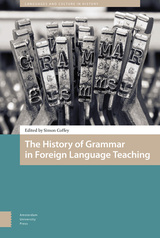
front cover of The History of Grammar in Foreign Language Teaching
The History of Grammar in Foreign Language Teaching
Simon Coffey
Amsterdam University Press, 2021
Taking a broadly chronological approach, this volume of original essays traces the origins of the concept of ‘grammar’. In doing so, it charts the social, moral and cultural factors that have shaped the development of grammar from Antiquity, via the Middle Ages, Renaissance and Modern Europe, to current education systems and language learning pedagogy. The chapters examine key turning points in the history of language teaching epistemology, focusing on grammar for language teaching across different European cultural contexts. Bringing together leading scholars of classical and modern languages education, The History of Grammar in Foreign Language Teaching offers the first single-source reference on the evolving concept of grammar across cultural and linguistic borders in Western language education. It therefore represents a valuable resource for teachers, teacher-educators and course designers, as well as students and scholars of historical linguistics, and of second and foreign language education.
[more]

front cover of Hittite Diplomatic Texts
Hittite Diplomatic Texts
Gary M. Beckman
SBL Press, 1999
This work presents full translations of more than 50 documents from the files of the "foreign office" of the Hittite Empire: 21 treaties, 18 diplomatic letters, and 18 royal edicts and miscellaneous records concerning the relations of the Hittites with their Anatolian and Syrian vassals, as well as with other great powers such as Egypt, Assyria, and Babylonia. Originally composed in Hittite or in the Akkadian lingua franca of the day, many of these texts have never before appeared in English. A short introduction places each document in its historical and cultural context, and a general essay acquaints the reader with the diplomatic practice of the Late Bronze Age. This collection of documents is a major source book for historians of the Ancient Near East and for students of cuneiform and Biblical law. It will also prove useful for those investigating the relationship between Biblical covenant theology and its possible antecedents in older Near Eastern treaty patterns.
[more]

front cover of Hittite Myths, Second Edition
Hittite Myths, Second Edition
Harry A. Hoffner
SBL Press, 1998
This work contains the first English translations of a collection of Hittite myths. The translations are based on the original tablets on which the myths were written and take into account recent textual discoveries and published studies on the texts. Revised and corrected, this second edition includes an additional newly published Hurrian myth. In addition to translations, the volume includes a series of brief introductions to the myths, a glossary of names and technical terms, and indexes of proper names and topics/subjects. Accessible to nonspecialists, the translations also preserve column and line count for the convenience of scholars.
[more]

front cover of Hoda Barakat's Sayyidi wa Habibi
Hoda Barakat's Sayyidi wa Habibi
The Authorized Abridged Edition for Students of Arabic, Abridged Edition
Laila Familiar, Editor. Hoda Barakat
Georgetown University Press, 2013

Sayyidi wa Habibi (My Master and My Love) is a novel by acclaimed Lebanese author Hoda Barakat, abridged in the original Arabic in this volume for learners of Arabic at the advanced low proficiency level. Designed as a supplementary text that adds variety and fun to a regular course on Arabic, it is complete with exercises that guide learners through the story and help them improve their Arabic skills, introducing learners of the language to the world of contemporary Arabic literature and improving their knowledge of Arabic culture.

Set against the backdrop of the Lebanese Civil War, this intriguing novel relates the struggles of Wadie, a young man who leaves school and becomes corrupted by crime, and his wife, Samia, who flees with him to Cyprus. Universal questions of existence are masterfully portrayed through eloquent prose that keeps readers engaged until the last line. Laila Familiar provides introductory materials, a short biography of the author, and exercises that develop linguistic and cultural competencies. Audio files of Barakat reading five passages from the work, along with a recorded interview, are available free on the press website in order to help students improve their listening skills.

This authorized version of the abridged text of Sayyidi wa Habibi will be warmly embraced by college and university students of Arabic as well as by independent learners.
[more]

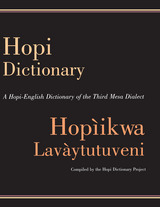
front cover of Hopi Dictionary/Hopìikwa Lavàytutuveni
Hopi Dictionary/Hopìikwa Lavàytutuveni
A Hopi-English Dictionary of the Third Mesa Dialect
Hopi Dictionary Project Hopi Dictionary Project
University of Arizona Press, 1998
Hopi culture has long received considerable attention from the outside world, but the Hopi language has remained much less well known. This is the first true dictionary of Hopi, containing approximately 30,000 entries. The dictionary is based on the dialect spoken today in villages on Third Mesa and was compiled in consultation with a large team of elder Hopi speakers. Its preparation has involved a comprehensive survey of the ethnographic and linguistic literature to identify Hopi vocabulary, and each item found has been checked against existing Third Mesa knowledge of Hopi. The dictionary is valuable not only for the number of its entries but also for its many illustrative sentences and its abundance of information on aspects of Hopi culture, such as often-misunderstood expressions concerning time and space. Main entries, presented for the simplest and most common forms of words, contain full information on inflection in addition to definitions and examples. Cross-references are made for inflected forms that are not easily predictable, such as plurals, less common variants, and combining forms. Many definitions are illustrated with line drawings. The volume also features an English-Hopi word-finder list and a sketch of Hopi grammar, which makes it possible for the user to determine the structure of almost any Hopi sentence. An invaluable reference in Uto-Aztecan languages, this dictionary permits informed reading of Hopi texts. It is a definitive source for understanding not only a language but also a way of life.
[more]

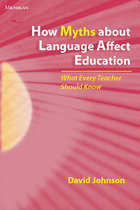
front cover of How Myths about Language Affect Education
How Myths about Language Affect Education
What Every Teacher Should Know
David Johnson
University of Michigan Press, 2013

How Myths about Language Affect Education: What Every Teacher Should Know clarifies some of the most common misconceptions about language, particularly those that affect teachers and the decisions they make when they teach English language learners. The chapters in this book address myths about language in general, about first and second language acquisition, about language and society, and about language and thinking. Each chapter concludes with activities for teachers that give examples, exercises, or simple questions that relate directly to teachers' everyday dealings with ELLs and language.

How Myths about Language Affect Education is not intended to be a complete introduction to linguistics; it does not contain information on phonetics or complex syntactic explanations, and technical jargon is kept to a minimum. The aim of this book is not to settle language issues but rather to highlight popular misconceptions and the ways that they influence debates regarding language and affect language policies in and out of the classroom.
[more]


Send via email Share on Facebook Share on Twitter