
 A SCHOLARLY BOOK REPOSITORY
101 books about Mathematical models and 4
start with H
101 books about Mathematical models and 4
101 books about Mathematical models
4 start with H start with H
4 start with H start with H

Handbook of Quantitative Ecology
Justin Kitzes
University of Chicago Press, 2022
An essential guide to quantitative research methods in ecology and conservation biology, accessible for even the most math-averse student or professional.
Quantitative research techniques have become increasingly important in ecology and conservation biology, but the sheer breadth of methods that must be understood—from population modeling and probabilistic thinking to modern statistics, simulation, and data science—and a lack of computational or mathematics training have hindered quantitative literacy in these fields. In this book, ecologist Justin Kitzes addresses those challenges for students and practicing scientists alike.
Requiring only basic algebra and the ability to use a spreadsheet, Handbook of Quantitative Ecology is designed to provide a practical, intuitive, and integrated introduction to widely used quantitative methods. Kitzes builds each chapter around a specific ecological problem and arrives, step by step, at a general principle through the process of solving that problem. Grouped into five broad categories—difference equations, probability, matrix models, likelihood statistics, and other numerical methods—the book introduces basic concepts, starting with exponential and logistic growth, and helps readers to understand the field’s more advanced subjects, such as bootstrapping, stochastic optimization, and cellular automata. Complete with online solutions to all numerical problems, Kitzes’s Handbook of Quantitative Ecology is an ideal coursebook for both undergraduate and graduate students of ecology, as well as a useful and necessary resource for mathematically out-of-practice scientists.
Quantitative research techniques have become increasingly important in ecology and conservation biology, but the sheer breadth of methods that must be understood—from population modeling and probabilistic thinking to modern statistics, simulation, and data science—and a lack of computational or mathematics training have hindered quantitative literacy in these fields. In this book, ecologist Justin Kitzes addresses those challenges for students and practicing scientists alike.
Requiring only basic algebra and the ability to use a spreadsheet, Handbook of Quantitative Ecology is designed to provide a practical, intuitive, and integrated introduction to widely used quantitative methods. Kitzes builds each chapter around a specific ecological problem and arrives, step by step, at a general principle through the process of solving that problem. Grouped into five broad categories—difference equations, probability, matrix models, likelihood statistics, and other numerical methods—the book introduces basic concepts, starting with exponential and logistic growth, and helps readers to understand the field’s more advanced subjects, such as bootstrapping, stochastic optimization, and cellular automata. Complete with online solutions to all numerical problems, Kitzes’s Handbook of Quantitative Ecology is an ideal coursebook for both undergraduate and graduate students of ecology, as well as a useful and necessary resource for mathematically out-of-practice scientists.
[more]
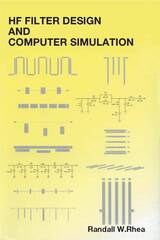
HF Filter Design and Computer Simulation
Randall W. Rhea
The Institution of Engineering and Technology, 1994
A book for engineers who design and build filters of all types, including lumped element, coaxial, helical, dielectric resonator, stripline and microstrip types. A thorough review of classic and modern filter design techniques, containing extensive practical design information of passband characteristics, topologies and transformations, component effects and matching. An excellent text for the design and construction of microstrip filters.
[more]
Hierarchy
Perspectives for Ecological Complexity
T. F. H. Allen and Thomas B. Starr
University of Chicago Press, 2017
Although complexity surrounds us, its inherent uncertainty, ambiguity, and contradiction can at first make complex systems appear inscrutable. Ecosystems, for instance, are nonlinear, self-organizing, seemingly chaotic structures in which individuals interact both with each other and with the myriad biotic and abiotic components of their surroundings across geographies as well as spatial and temporal scales. In the face of such complexity, ecologists have long sought tools to streamline and aggregate information. Among them, in the 1980s, T. F. H. Allen and Thomas B. Starr implemented a burgeoning concept from business administration: hierarchy theory. Cutting-edge when Hierarchy was first published, their approach to unraveling complexity is now integrated into mainstream ecological thought.
This thoroughly revised and expanded second edition of Hierarchy reflects the assimilation of hierarchy theory into ecological research, its successful application to the understanding of complex systems, and the many developments in thought since. Because hierarchies and levels are habitual parts of human thinking, hierarchy theory has proven to be the most intuitive and tractable vehicle for addressing complexity. By allowing researchers to look explicitly at only the entities and interconnections that are relevant to a specific research question, hierarchically informed data analysis has enabled a revolution in ecological understanding. With this new edition of Hierarchy, that revolution continues.
This thoroughly revised and expanded second edition of Hierarchy reflects the assimilation of hierarchy theory into ecological research, its successful application to the understanding of complex systems, and the many developments in thought since. Because hierarchies and levels are habitual parts of human thinking, hierarchy theory has proven to be the most intuitive and tractable vehicle for addressing complexity. By allowing researchers to look explicitly at only the entities and interconnections that are relevant to a specific research question, hierarchically informed data analysis has enabled a revolution in ecological understanding. With this new edition of Hierarchy, that revolution continues.
[more]

Human Fertility
Henri Leridon
University of Chicago Press, 1977
In this innovative and comprehensive work, expanded by one-third for the English-language edition, Henri Leridon integrates biology and demography to investigate human fertility, both natural and controlled. Traditionally, demographers have been concerned with birthrates in different populations under varying conditions, while biologists have limited themselves to the study of the reproductive process. Leridon has formulated the first coherent overview of the functioning of the human reproductive system in relation to the external conditions that affect fertility.
The book begins with a readable, authoritative review of human fertility in its natural state. Leridon summarizes and evaluates current knowledge, drawing together rare statistical data on physiological variables as well as demographic treatments of these data. After discussing the classical framework used by demographers, Leridon undertakes a "microdemographic" analysis in which he focuses on the individual and explicates the biological processes through which social, psychological, and economic factors affect fertility. He isolates its components—fecundability, intrauterine mortality, the physiological nonsusceptible period, and sterility—then reviews the composite effect of variation in any one component.
Leridon considers situations of controlled fertility: contraception, abortion, and sterilization. The author also presents valuable new data from his own investigations of varying risks of intrauterine mortality. Finally, he shows how the previous approaches can be complemented by the use of mathematical models.
The book begins with a readable, authoritative review of human fertility in its natural state. Leridon summarizes and evaluates current knowledge, drawing together rare statistical data on physiological variables as well as demographic treatments of these data. After discussing the classical framework used by demographers, Leridon undertakes a "microdemographic" analysis in which he focuses on the individual and explicates the biological processes through which social, psychological, and economic factors affect fertility. He isolates its components—fecundability, intrauterine mortality, the physiological nonsusceptible period, and sterility—then reviews the composite effect of variation in any one component.
Leridon considers situations of controlled fertility: contraception, abortion, and sterilization. The author also presents valuable new data from his own investigations of varying risks of intrauterine mortality. Finally, he shows how the previous approaches can be complemented by the use of mathematical models.
[more]
READERS
Browse our collection.
PUBLISHERS
See BiblioVault's publisher services.
STUDENT SERVICES
Files for college accessibility offices.
RECENTLY PUBLISHED







UChicago Accessibility Resources
home | accessibility | search | about | contact us
BiblioVault ® 2001 - 2025
The University of Chicago Press