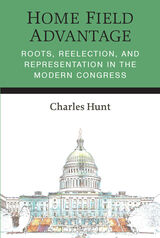
front cover of Home Field Advantage
Home Field Advantage
Roots, Reelection, and Representation in the Modern Congress
Charles Hunt
University of Michigan Press, 2022

Although partisan polarization gets much of the attention in political science scholarship about Congress, members of Congress represent diverse communities around the country. Home Field Advantage demonstrates the importance of this understudied element of American congressional elections and representation in the modern era: the local, place-based roots that members of Congress have in their home districts. Charles Hunt argues that legislators’ local roots in their district have a significant and independent impact on their campaigns, election outcomes, and more broadly on the relationship between members of the U.S. House of Representatives and their constituents. Drawing on original data, his research reveals that there is considerable variation in election outcomes, performance relative to presidential candidates, campaign spending, and constituent communication styles that are not fully explained by partisanship, incumbency, or other well-established theories of American political representation. Rather, many of these differences are the result of the depth of a legislator’s local roots in their district that predate their time in Congress. Hunt lays out a detailed “Theory of Local Roots” and their influence in congressional representation, demonstrating this influence empirically using multiple original measures of local roots over a full cross-section of legislators and a significant period of time.


[more]

logo for Ohio University Press
The House and Senate in the 1790s
Petitioning, Lobbying, and Institutional Development
Kenneth R. Bowling
Ohio University Press, 2002

Amid the turbulent swirl of foreign intrigue, external and internal threats to the young nation’s existence, and the domestic partisan wrangling of the 1790s, the United States Congress solidified its role as the national legislature. The ten essays in The House and Senate in the 1790s demonstrate the mechanisms by which this bicameral legislature developed its institutional identity. The first essay sets the scene for the institutional development of Congress by examining its constitutional origins and the efforts of the Founders to empower the new national legislature. The five following essays focus on two related mechanisms—petitioning and lobbying—by which citizens and private interests communicated with national lawmakers.

Although scholars tend to see lobbying as a later nineteenth-century development, the papers presented here clearly demonstrate the existence of lobbyists and lobbying in the 1790s. The final four papers examine other aspects of the institutional development of the House and the Senate, including the evolution of political parties and congressional leadership.

The essays in this collection, the third volume in the series Perspectives on the History of Congress, 1789-1801, originated in a series of conferences held by the United States Capitol Historical Society from 1994 to 2001.

[more]


Send via email Share on Facebook Share on Twitter