
 A SCHOLARLY BOOK REPOSITORY




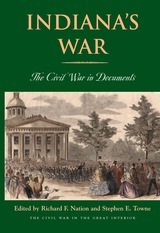
Indiana’s War is a primary source collection featuring the writings of Indiana’s citizens during the Civil War era. Using private letters, official records, newspaper articles, and other original sources, the volume presents the varied experiences of Indiana’s participants in the war both on the battlefield and on the home front. Starting in the 1850s, the documents show the sharp political divisions over issues such as slavery, race, and secession in Indiana, divisions that boiled over into extraordinary strife and violence in the state during the rebellion. This conflict touched all levels and members of society, including men, women, and children, whites and African Americans, native-born citizens and immigrants, farmers and city and town dwellers.
Collecting the writings of Indiana’s peoples on a wide range of issues, chapters focus on the politics of race prior to the war, the secession crisis, war fever in 1861, the experiences of soldiers at the front, homefront hardships, political conflict between partisan foes and civil and military authorities, reactions to the Emancipation Proclamation, and antiwar dissent, violence, and conspiracy.
Indiana’s War is an excellent accompanying primary source text for undergraduate and graduate courses on the American Civil War. It documents the experiences of Indiana’s citizens, from the African American soldier to the antiwar dissenter, from the prewar politician to the postwar veteran, from the battle-scarred soldier to the impoverished soldier’s wife, all showing the harsh realities of the war.
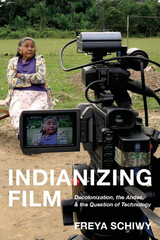
Schiwy argues that instead of solely creating entertainment through their work indigenous media activists are building communication networks that encourage interaction between diverse cultures. As a result, mainstream images are retooled, permitting communities to strengthen their cultures and express their own visions of development and modernization. Indianizing Film encourages readers to consider how indigenous media contributes to a wider understanding of decolonization and anticolonial study against the universal backdrop of the twenty-first century.
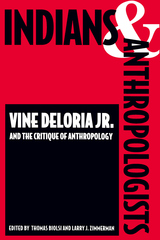
CONTENTS
Introduction: What's Changed, What Hasn't, Thomas Biolsi & Larry J. Zimmerman
Part One--Deloria Writes Back
Vine Deloria, Jr., in American Historiography, Herbert T. Hoover
Growing Up on Deloria: The Impact of His Work on a New Generation of Anthropologists, Elizabeth S. Grobsmith
Educating an Anthro: The Influence of Vine Deloria, Jr., Murray L. Wax
Part Two--Archaeology and American Indians
Why Have Archaeologists Thought That the Real Indians Were Dead and What Can We Do about It?, Randall H. McGuire
Anthropology and Responses to the Reburial Issue, Larry J. Zimmerman
Part Three-Ethnography and Colonialism
Here Come the Anthros, Cecil King
Beyond Ethics: Science, Friendship and Privacy, Marilyn Bentz
The Anthropological Construction of Indians: Haviland Scudder Mekeel and the Search for the Primitive in Lakota Country, Thomas Biolsi
Informant as Critic: Conducting Research on a Dispute between Iroquoianist Scholars and Traditional Iroquois, Gail Landsman
The End of Anthropology (at Hopi)?, Peter Whiteley
Conclusion: Anthros, Indians and Planetary Reality, Vine Deloria, Jr.
This expanded edition of Indians and Archaeology of Missouri gives an excellent introduction to the cultural development of Missouri’s Indians during the past twelve thousand years. Providing a new chapter on the Hunter Foragers of the Dalton period and substantial revision of other chapters to incorporate recent discoveries, the Chapmans present knowledge based upon decades of experience with archaeological excavations in an understandable and fascinating form.
The first edition of Indians and Archaeology of Missouri has been recognized in Missouri and nationally as one of the best books of its kind. The Missouri Historical Review called it “simply indispensable.” The Plains Anthropologist added similar praise: “Clearly written and exceptionally well illustrated…it is the answer to the amateur’s prayers.” Archaeology described it as “a boon to Missouri’s many amateur archaeologists, a useful source of information for professionals and interesting reading for the layman.”
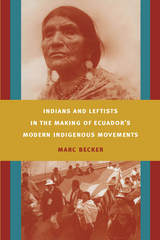
Becker explains how rural laborers and urban activists worked together in Ecuador, merging ethnic and class-based struggles for social justice. Socialists were often the first to defend Indigenous languages, cultures, and social organizations. They introduced rural activists to new tactics, including demonstrations and strikes. Drawing on leftist influences, Indigenous peoples became adept at reacting to immediate, local forms of exploitation while at the same time addressing broader underlying structural inequities. Through an examination of strike activity in the 1930s, the establishment of a national-level Ecuadorian Federation of Indians in 1944, and agitation for agrarian reform in the 1960s, Becker shows that the history of Indigenous mobilizations in Ecuador is longer and deeper than many contemporary observers have recognized.
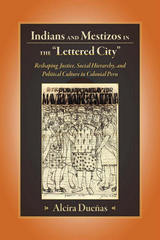
Scholars have long assumed that Spanish rule remained largely undisputed in Peru between the 1570s and 1780s, but educated elite Indians and mestizos challenged the legitimacy of Spanish rule, criticized colonial injustice and exclusion, and articulated the ideas that would later be embraced in the Great Rebellion in 1781. Their movement extended across the Atlantic as the scholars visited the seat of the Spanish empire to negotiate with the king and his advisors for social reform, lobbied diverse networks of supporters in Madrid and Peru, and struggled for admission to religious orders, schools and universities, and positions in ecclesiastic and civil administration.
Indians and Mestizos in the "Lettered City" explores how scholars contributed to social change and transformation of colonial culture through legal, cultural, and political activism, and how, ultimately, their significant colonial critiques and campaigns redefined colonial public life and discourse. It will be of interest to scholars and students of colonial history, colonial literature, Hispanic studies, and Latin American studies.
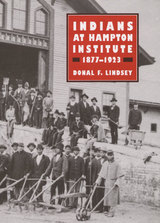
Founded in 1868, Hampton Institute educated almost 1400 members of sixty-five Native American peoples. Donal F. Lindsey examines the interactions among Indigenous people, Blacks, and whites at the nation’s premier industrial school for racial minorities.
Lindsey's analysis traces the rise and decline of the program for Indigenous Americans while analyzing the program’s impact on the campaign for Native education. Lindsey also examines how the two marginalized races at Hampton viewed each other and white society. Though integration prevailed in much of student life, it resulted in even greater accommodation to a racist society. The weaknesses and strengths attributed to one race were used with “tender violence” to remake the other, in a program in which the powerful and the powerless remained so regardless of segregation or integration.
Indian trader, rancher, harbor developer, oil impresario—these are the many worlds of one of the least chronicled but most fascinating characters of the American West. In the early, bustling years of the frontier, a brazen young man named William McDole Lee moved from Wisconsin to Kansas and then to Texas to forge a life for himself. Becoming a driving entrepreneurial force in Texas's development, Lee soon garnered the alliances and resources necessary to shape the financial destinies of disparate groups throughout the state. His story is expertly told in Donald F. Schofield's Indians, Cattle, Ships, and Oil.
Beginning in 1869 as a trader to the southern Cheyenne and Arapaho tribes and fort provisioner to troops garrisoned at Camp Supply, Indian Territory, Lee gained a partner and amassed a fortune in short order from trading buffalo hides and robes. Vast herds of buffalo grazing on the southern plains were killed largely on his order. When buffalo were no longer a profitable commodity, Lee tackled his next challenge—the cattle trade.
He began with herds branded LR that grazed on pastures near Fort Supply. Then came his LE herd in the Texas Panhandle. Another partnership, with noted cattle rancher Lucien Scott, resulted in the vast LS ranch, one of the most successful operations of its day. Lee even introduced a new breed of cattle, the Aberdeen-Angus, to the western range. But as his partnership faded, Lee moved on to his next undertaking—the development of Texas' first deep-water harbor.
In 1888, Lee and other financiers put up one million dollars to finance a dream: opening international trade from the waters of the Gulf of Mexico to the mainland at the mouth of the Brazos River. Their Brazos River Channel and Dock Company was to construct, own, and operate a deep-water harbor at Velasco, with a railroad link to Houston. Though threats of financial disaster loomed large, the Velasco facility was to welcome, in its day, tugs, barges, and three-masted schooners and to provide impetus for Houston's boom. Yet with success, the mercurial Lee turned to yet another challenge—oil.
Starting still another partnership, Lee committed himself to prospecting for oil on the West Columbia Ridge in Brazoria County. Lee and crew struck oil in 1907, developing one of the first producing wells of Brazoria County, but inadequate drilling equipment hampered further fruitful exploration. Lee moved his rigs to the famed Spindletop, where he perfected the technique of shallow drilling. Though spectacular success in the oil business eluded him, Lee's accomplishments set him squarely among the great entrepreneurs of the Texas oil industry.
Lee's exploits led him to roles in some of the most dramatic moments in Texas and the West—Indian uprisings, buffalo hunts, political scandals, cowboy strikes and shoot-outs, railroad promotions, oil-well blow-outs and gushers. The people he encountered are the famous and infamous of western history: Cheyenne Chief Little Robe and the outlaw "Hurricane Bill" Martin; Indian Agent John D. Miles and Major General John Pope; outlaws Tom Harris and William Bonney, and Sheriff Pat Garrett. Altogether, Lee's biography vividly shows one man's manipulation of people and events during the settlement of the American frontier.
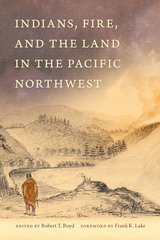
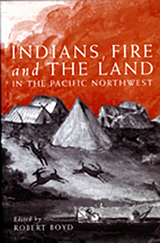
Instead of discovering a land blanketed by dense forests, early explorers of the Pacific Northwest encountered a varied landscape including open woods, meadows, and prairies. Far from a pristine wilderness, much of the Northwest was actively managed and shaped by the hands of its Native American inhabitants. Their primary tool was fire.
This volume takes an interdisciplinary approach to one of the most important issues concerning Native Americans and their relationship to the land. Over more than 10,000 years, Native Americans in the Northwest learned the intricacies of their local environments and how to use fire to create desired effects, mostly in the quest for food.
Drawing on historical journals, Native American informants, and ethnobotanical and forestry studies, this book’s contributors describe local patterns of fire use in eight ecoregions, representing all parts of the Native Northwest, from southwest Oregon to British Columbia and from Puget Sound to the Northern Rockies. Their essays provide glimpses into a unique understanding of the environment, one that draws on traditional ecological knowledge. Together, these writings also offer historical perspective on the contemporary debate over “prescribed burning” and management of public lands.
This updated edition includes a foreword by Frank K. Lake and a new epilogue by editor Robert T. Boyd. Contributors include Stephen Arno, Stephen Barrett, Theresa Ferguson, David French, Eugene Hunn, Leslie Johnson, Jeff LaLande, Estella Leopold, Henry Lewis, Helen H. Norton, Reg Pullen, William Robbins, John Ross, Nancy Turner, and Richard White.
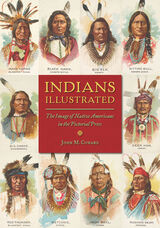

Working as merchants, skilled tradesmen, clerks, lawyers, and journalists, Indians formed the economic and administrative middle class in colonial Kenya. In general, they were wealthier than Africans, but were denied the political and economic privileges that Europeans enjoyed. Moreover, despite their relative prosperity, Indians were precariously positioned in Kenya. Africans usually viewed them as outsiders, and Europeans largely considered them subservient. Indians demanded recognition on their own terms. Indians in Kenya chronicles the competing, often contradictory, strategies by which the South Asian diaspora sought a political voice in Kenya from the beginning of colonial rule in the late 1890s to independence in the 1960s.
Indians’ intellectual, economic, and political connections with South Asia shaped their understanding of their lives in Kenya. Sana Aiyar investigates how the many strands of Indians’ diasporic identity influenced Kenya’s political leadership, from claiming partnership with Europeans in their mission to colonize and “civilize” East Africa to successful collaborations with Africans to battle for racial equality, including during the Mau Mau Rebellion. She also explores how the hierarchical structures of colonial governance, the material inequalities between Indians and Africans, and the racialized political discourses that flourished in both colonial and postcolonial Kenya limited the success of alliances across racial and class lines. Aiyar demonstrates that only by examining the ties that bound Indians to worlds on both sides of the Indian Ocean can we understand how Kenya came to terms with its South Asian minority.
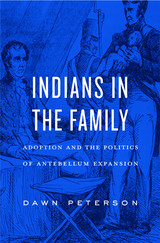
During his invasion of Creek Indian territory in 1813, future U.S. president Andrew Jackson discovered a Creek infant orphaned by his troops. Moved by an “unusual sympathy,” Jackson sent the child to be adopted into his Tennessee plantation household. Through the stories of nearly a dozen white adopters, adopted Indian children, and their Native parents, Dawn Peterson opens a window onto the forgotten history of adoption in early nineteenth-century America. Indians in the Family shows the important role that adoption played in efforts to subdue Native peoples in the name of nation-building.
As the United States aggressively expanded into Indian territories between 1790 and 1830, government officials stressed the importance of assimilating Native peoples into what they styled the United States’ “national family.” White households who adopted Indians—especially slaveholding Southern planters influenced by leaders such as Jackson—saw themselves as part of this expansionist project. They hoped to inculcate in their young charges U.S. attitudes toward private property, patriarchal family, and racial hierarchy.
U.S. whites were not the only ones driving this process. Choctaw, Creek, and Chickasaw families sought to place their sons in white households, to be educated in the ways of U.S. governance and political economy. But there were unintended consequences for all concerned. As adults, these adopted Indians used their educations to thwart U.S. federal claims to their homelands, setting the stage for the political struggles that would culminate in the Indian Removal Act of 1830.

The vast, pine-covered plateau now known as Yellowstone National Park has been lived in, traveled through, and exploited by humans for thousands of years. It is still possible to see the remnants of old camps and deep-rutted trails over which ancient peoples crossed the Park to reach the bison-rich plains.
When did humans first visit the area we now call Yellowstone?
Who lived there when the first Europeans entered the region?
What happened to the last of the early inhabitants?
How did the Nez Perce, fleeing across the northen of the newly established Park in 1877, escape U.S. troops?
How did Indians perceive the Park's geysers and hot springs?
These and other questions are answered in this popular history of the Park written by a professional archaeologist who is also a seasonal resident of West Yellowstone. Joel Janetski reconstructs past human events from archaeological evidence and historical sources to provide an engrossing story of the people who knew the area hundreds, even thousands, of years ago and who left their traces amidst the grandeur that is today's Yellowstone National Park.
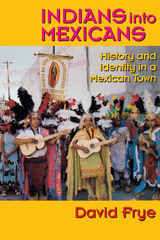
The people of Mexquitic, a town in the state of San Luis Potosí in rural northeastern Mexico, have redefined their sense of identity from "Indian" to "Mexican" over the last two centuries. In this ethnographic and historical study of Mexquitic, David Frye explores why and how this transformation occurred, thereby increasing our understanding of the cultural creation of "Indianness" throughout the Americas.
Frye focuses on the local embodiments of national and regional processes that have transformed rural "Indians" into modern "Mexicans": parish priests, who always arrive with personal agendas in addition to their common ideological baggage; local haciendas; and local and regional representatives of royal and later of national power and control. He looks especially at the people of Mexquitic themselves, letting their own words describe the struggles they have endured while constructing their particular corner of Mexican national identity.
This ethnography, the first for any town in northeastern Mexico, adds substantially to our knowledge of the forces that have rendered "Indians" almost invisible to European-origin peoples from the fifteenth century up to today. It will be important reading for a wide audience not only in anthropology and Latin American studies but also among the growing body of general readers interested in the multicultural heritage of the Americas.
Michael Blake's Dances with Wolves transformed denigrating Indian sterotypes and created widespread interest in Native American culture. The subsequent popularity of books on this topic underscores the power of a tale well told. While Blake's story relates the early chapters of Native Americans' survival struggles, later accounts of this struggle remain untold.
The Indians of Hungry Hollow authentically presents these later chapters. The days of Hungry Hollow have long passed, but the opportunity to capture its lessons of community, strong values, and an urge to thrive in matters of the heart and soul are still very much with us.
These are stories of survival, community, sharing, and caring. The situations are often dire: winter in the middle of the Depression; an Indian settlement illegally taken from its inhabitants and set on fire; boaters stranded by bad weather and threatened with death. But if the situations are extreme, the telling of the stories is consistently optimistic yet completely without self-pity or sentimentality, and the characters always find a way through the darkness.
Dunlop's unique style of storytelling is compelling and informative, and these historically significant stories help to elucidate the transition of the American Indian culture from post-tribal days to the present.
Bill Dunlop is a respected Ottawa elder and storyteller. Marcia Fountain-Blacklidge is a professional writer, counselor, and consultant.
Foster begins with a history of Lewis and Clark’s travels along the Missouri River adjacent to western Iowa. Next, he focuses on the tribes most connected to Iowa from prehistoric times to the present day: the Ioway, Meskwaki, Sauk, Omaha and Ponca, Otoe and Missouria, Pawnee and Arikara, Potawatomi, Illinois Confederacy, Santee and Yankton Sioux, and Winnebago. In between each tribal account, “closer look” essays provide details on Indian women in Iowa, traditional ways of life, Indian history and spirituality, languages and place-names, archaeology, arts and crafts, and houses and landscapes. Finally, Foster brings readers into the present with chapters called “Going to a Powwow,” “Do You Have Indian Blood?” and “Indians in Iowa Today.” The book ends with information about visiting Native American museums, historic sites, and communities in Iowa as well as tribal contacts and a selection of published and online resources.
The story of the Indians of Iowa is long and complicated. Illustrated with maps and stunning original art, Lance Foster’s absorbing, accessible overview of Iowa’s Indian tribes celebrates the rich native legacy of the Hawkeye State. It is essential reading for students, teachers, and everyone who calls Iowa home.
In presenting the lore and heritage of the Lenapes, Dr. M.R. Harrington does so through the eyes of a shipwrecked English boy who became a captive of the Indians, and was eventually adopted into the tribe. The narrative is lively reading, and the facts on which it is based are accurate. With the accompanying Clarence Ellsworth line drawings, the reader can understand and even reproduce many of the objects the author describes: the Lenape bows and arrows, muccasins and mats, baskets and bowls.
This new edition is a reissue of an often asked for an unavailable New Jersey classic, first published in 1938.
For this second edition, Harold Driver made extensive revisions in chapter content and organization, incorporating many new discoveries and interpretations in archeology and related fields. He also revised several of the maps and added more than 100 bibliographical items. Since the publication of the first edition, there has been an increased interest in the activities of Indians in the twentieth century; accordingly, the author placed much more emphasis on this period.
Indians of the Rio Grande Delta is the first single-volume source on these little-known peoples. Working from innumerable primary documents in various Texan and Mexican archives, Martin Salinas has compiled data on more than six dozen named groups that inhabited the area in the sixteenth through the eighteenth centuries. Depending on available information, he reconstructs something of their history, geographical range and migrations, demography, language, and culture. He also offers general information on various unnamed groups of Indians, on the lifeways of the indigenous peoples, and on the relations between the Indian groups and the colonial Spanish missions in the region.


Winner of a NWSA/University of Illinois Press First Book Prize
Nishant Upadhyay unravels Indian diasporic complicity in its ongoing colonialist relationship with Indigenous peoples, lands, and nations in Canada. Upadhyay examines the interwoven and simultaneous areas of dominant Indian caste complicity in processes of settler colonialism, antiblackness, capitalism, brahminical supremacy, Hindu nationalism, and heteropatriarchy. Resource extraction in British Columbia in the 1970s–90s and in present-day Alberta offer examples of spaces that illuminate the dispossession of Indigenous peoples and simultaneously reveal racialized, gendered, and casted labor formations. Upadhyay juxtaposes these extraction sites with examples of anticolonial activism and solidarities from Tkaronto. Analyzing silence on settler colonialism and brahminical caste supremacy, Upadhyay upends the idea of dominant caste Indian diasporas as racially victimized and shows that claiming victimhood denies a very real complicity in enforcing other power structures. Exploring stories of quotidian proximity and intimacy between Indigenous and South Asian communities, Upadhyay offers meditations on anticolonial and anti-casteist ways of knowledge production, ethical relationalities, and solidarities.Groundbreaking and ambitious, Indians on Indian Lands presents the case for holding Indian diasporas accountable for acts of violence within a colonial settler nation.
Contemporary indigenous peoples in North America confront a unique predicament. While they are reclaiming their historic status as sovereign nations, mainstream popular culture continues to depict them as cultural minorities similar to other ethnic Americans. These depictions of indigenous peoples as “Native Americans” complete the broader narrative of America as a refuge to the world’s immigrants and a home to contemporary multicultural democracies, such as the United States and Canada. But they fundamentally misrepresent indigenous peoples, whose American history has been not of immigration but of colonization.
Monika Siebert’s Indians Playing Indian first identifies this phenomenon as multicultural misrecognition, explains its sources in North American colonial history and in the political mandates of multiculturalism, and describes its consequences for contemporary indigenous cultural production. It then explores the responses of indigenous artists who take advantage of the ongoing popular interest in Native American culture and art while offering narratives of the political histories of their nations in order to resist multicultural incorporation.
Each chapter of Indians Playing Indian showcases a different medium of contemporary indigenous art—museum exhibition, cinema, digital fine art, sculpture, multimedia installation, and literary fiction—and explores specific rhetorical strategies artists deploy to forestall multicultural misrecognition and recover political meanings of indigeneity. The sites and artists discussed include the National Museum of the American Indian in Washington, DC; filmmakers at Inuit Isuma Productions; digital artists/photographers Dugan Aguilar, Pamela Shields, and Hulleah Tsinhnahjinnie; sculptor Jimmie Durham; and novelist LeAnne Howe.
An Economist Best Book of the Year
How India’s Constitution came into being and instituted democracy after independence from British rule.
Britain’s justification for colonial rule in India stressed the impossibility of Indian self-government. And the empire did its best to ensure this was the case, impoverishing Indian subjects and doing little to improve their socioeconomic reality. So when independence came, the cultivation of democratic citizenship was a foremost challenge.
Madhav Khosla explores the means India’s founders used to foster a democratic ethos. They knew the people would need to learn ways of citizenship, but the path to education did not lie in rule by a superior class of men, as the British insisted. Rather, it rested on the creation of a self-sustaining politics. The makers of the Indian Constitution instituted universal suffrage amid poverty, illiteracy, social heterogeneity, and centuries of tradition. They crafted a constitutional system that could respond to the problem of democratization under the most inhospitable conditions. On January 26, 1950, the Indian Constitution—the longest in the world—came into effect.
More than half of the world’s constitutions have been written in the past three decades. Unlike the constitutional revolutions of the late eighteenth century, these contemporary revolutions have occurred in countries characterized by low levels of economic growth and education, where voting populations are deeply divided by race, religion, and ethnicity. And these countries have democratized at once, not gradually. The events and ideas of India’s Founding Moment offer a natural reference point for these nations where democracy and constitutionalism have arrived simultaneously, and they remind us of the promise and challenge of self-rule today.
Sapna Thottathil calls on us to rethink the politics of organic food by focusing on what it means for the people who grow and sell it—what it means for their health, the health of their environment, and also their economic and political well-being. Taking readers to the state of Kerala in southern India, she shows us a place where the so-called “Green Revolution” program of hybrid seeds, synthetic fertilizers, and rising pesticide use had failed to reduce hunger while it caused a cascade of economic, medical, and environmental problems. Farmers burdened with huge debts from buying the new seeds and chemicals were committing suicide in troubling numbers. Farm laborers suffered from pesticide poisoning and rising rates of birth defects. A sharp fall in biodiversity worried environmental activists, and everyone was anxious about declining yields of key export crops like black pepper and coffee.
In their debates about how to solve these problems, farmers, environmentalists, and policymakers drew on Kerala’s history of and continuing commitment to grassroots democracy. In 2010, they took the unprecedented step of enacting a policy that requires all Kerala growers to farm organically by 2020. How this policy came to be and its immediate economic, political, and physical effects on the state’s residents offer lessons for everyone interested in agriculture, the environment, and what to eat for dinner. Kerala’s example shows that when done right, this kind of agriculture can be good for everyone in our global food system.
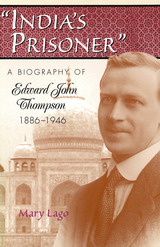
Edward John Thompson—novelist, poet, journalist, and historian of India—was a liberal advocate for Indian culture and political self-determination at a time when Indian affairs were of little general interest in England. As a friend of Nehru, Gandhi, and other Congress Party leaders, Thompson had contacts that many English officials did not have and did not know how to get. Thus, he was an excellent channel for interpreting India to England and England to India.
Thompson first went to India in 1910 as a Methodist missionary to teach English literature at Bankura Wesleyan College. It was there that he cultivated the literary circle of Rabindranath Tagore, as yet little known in England, and there Thompson learned of the political contradictions and deficiencies of India's educational system. His major conflict, personal and professional, was the lingering influence of Victorian Wesleyanism. In 1923, Thompson resigned and returned to teach at Oxford.
Interest in South Asia studies was minimal at Oxford, and Thompson turned increasingly to writing Indian history. That work, and his unique account of his experiences in the Mesopotamian campaign in World War I, supply a viewpoint found nowhere else, as well as personal views of literary figures such as Robert Graves and Robert Bridges. Thompson was also a major influence on the work of his son, E. P. Thompson, a modern historian of eighteenth-century England.
This important biography covers politically significant events between Thompson's arrival in India and up to his death, and casts considerable light on Thompson and his struggles with his religion and his relationship with India. The first biography of E. J. Thompson, "India's Prisoner" will have widespread appeal, especially to those interested in South Asian and English history, literature, and cultural history.

Gandhi's Quit India Movement of 1942 was the climax of a nationalist revolutionary movement which sought independence on India's own terms. Indian independence was attained through revolution, not through a benevolent grant from the British imperial regime. "The British left India because Indians had made it impossible for them to stay."
The bases for Francis Hutchins' thesis are new facts from hitherto unused sources: interviews with surviving participants in the movement, private papers from the Gandhi Memorial Museum and the Nehru Memorial Museum and Library, documents in the National Archives of India. In particular, he has studied the secret records of the British government, recently made available, which reveal for the first time the extent of the revolutionary movement and Britain's plans for dealing with it.
Of the British records Hutchins says, "No other regime has left such careful documentation of its strategies or compiled such extensive records revealing the way in which it was overthrown." Even though England had always proclaimed its hope that India would one day become independent, the tacit assumption was that this was a remote eventuality. Only after Gandhi's Quit India Movement did Britain's political parties resign themselves to the necessity to leave quickly, whether or not they believed India was "ready."
Obscured by censorship in India and by preoccupation with World War II, the significance of Gandhi's revolutionary technique was not appreciated at the time. Hutchins' impressive analysis uses the Indian case to develop a general theory of the revolutionary nature of colonial nationalism.
India’s Rise as an Asian Power examines India’s rise to power and the obstacles it faces in the context of domestic governance and security, relationships and security issues with its South Asian neighbors, and international relations in the wider Asian region. Instead of a straight-line projection based on traditional measures of power such as population size, economic growth rates, and military spending, Sandy Gordon’s nuanced view of India’s rise focuses on the need of any rising power to develop the means to deal with challenges in its domestic, neighborhood (South Asia), and regional (continental) spheres.
Terrorism, insurgency, border disputes, and water conflict and shortages are examples of some of India’s domestic and regional challenges. Gordon argues that before it can assume the mantle of a genuine Asian power or world power, India must improve its governance and security; otherwise, its economic growth and human development will continue to be hindered and its vulnerabilities may be exploited by competitors in its South Asian neighborhood or the wider region. This book will appeal to students and scholars of India and South Asia, security studies, foreign policy, and comparative politics, as well as country and regional specialists.


During the 1990s, films such as sex, lies, and videotape, The Crying Game, Pulp Fiction, Good Will Hunting, and Shakespeare in Love earned substantial sums at the box office along with extensive critical acclaim. A disproportionate number of these hits came from one company: Miramax. Indie, Inc. surveys Miramax’s evolution from independent producer-distributor to studio subsidiary, chronicling how one company transformed not just the independent film world but the film and media industries more broadly. As Alisa Perren illustrates, Miramax’s activities had an impact on everything from film festival practices to marketing strategies, talent development to awards campaigning.
Case studies of key films, including The Piano, Kids, Scream, The English Patient, and Life Is Beautiful, reveal how Miramax went beyond influencing Hollywood business practices and motion picture aesthetics to shaping popular and critical discourses about cinema during the 1990s. Indie, Inc. does what other books about contemporary low-budget cinema have not—it transcends discussions of “American indies” to look at the range of Miramax-released genre films, foreign-language films, and English-language imports released over the course of the decade. The book illustrates that what both the press and scholars have typically represented as the “rise of the American independent” was in fact part of a larger reconfiguration of the media industries toward niche-oriented products.

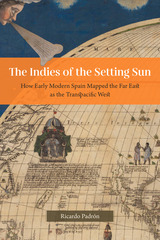
Narratives of Europe’s westward expansion often tell of how the Americas came to be known as a distinct landmass, separate from Asia and uniquely positioned as new ground ripe for transatlantic colonialism. But this geographic vision of the Americas was not shared by all Europeans. While some imperialists imagined North and Central America as undiscovered land, the Spanish pushed to define the New World as part of a larger and eminently flexible geography that they called las Indias, and that by right, belonged to the Crown of Castile and León. Las Indias included all of the New World as well as East and Southeast Asia, although Spain’s understanding of the relationship between the two areas changed as the realities of the Pacific Rim came into sharper focus. At first, the Spanish insisted that North and Central America were an extension of the continent of Asia. Eventually, they came to understand East and Southeast Asia as a transpacific extension of their empire in America called las Indias del poniente, or the Indies of the Setting Sun.
The Indies of the Setting Sun charts the Spanish vision of a transpacific imperial expanse, beginning with Balboa’s discovery of the South Sea and ending almost a hundred years later with Spain’s final push for control of the Pacific. Padrón traces a series of attempts—both cartographic and discursive—to map the space from Mexico to Malacca, revealing the geopolitical imaginations at play in the quest for control of the New World and Asia.
Through one state to another, from one country to the next Indifferent Cities traverses both distance and time to reconcile the most confounding reality of family: our people, sometimes, are the people we know least. Utilizing forms such as ekphrasis and epistolary, the collection sources photographs, postcards, and official documents as well as rumor, suspicion, and supposition to uncover the consequences, by choice or circumstance, of migration and immigration between Mexico and the United States across four generations.
Surveying the terrain of what one knows and does not know, what one inherits and disinherits, Indifferent Cities wrestles with every departure, each arrival, and the author’s inevitable return to determine where and to who he belongs.
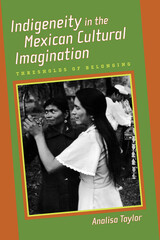
The book focuses on representations of indigenous peoples in post-revolutionary literary and intellectual history by examining key cultural texts. Using these analyses as a foundation, Analisa Taylor links her critique to national Indian policy, rights, and recent social movements in Southern Mexico. In addition, she moves beyond her analysis of indigenous peoples in general to take a gendered look at indigenous women ranging from the villainized Malinche to the highly romanticized and sexualized Zapotec women of the Isthmus of Tehuantepec.
The contradictory treatment of the Indian in Mexico’s cultural imagination is not unique to that country alone. Rather, the situation there is representative of a phenomenon seen throughout the world. Though this book addresses indigeneity in Mexico specifically, it has far-reaching implications for the study of indigenaety across Latin America and beyond. Much like the late Edward Said’s Orientalism, this book provides a glimpse at the very real effects of literary and intellectual discourse on those living in the margins of society.
This book’s interdisciplinary approach makes it an essential foundation for research in the fields of anthropology, history, literary critique, sociology, and cultural studies. While the book is ideal for a scholarly audience, the accessible writing and scope of the analysis make it of interest to lay audiences as well. It is a must-read for anyone seeking a deeper understanding of the politics of indigeneity in Mexico and beyond.
Based on her more than thirty years of fieldwork and activism on behalf of the Yanomami Indians, Ramos explains the complex ideology called indigenism. She evaluates its meaning through the relations of Brazilian Indians with religious and lay institutions, non-governmental organizations, official agencies such as the National Indian Foundation as well as the very discipline of anthropology. Ramos not only examines the imagery created by Brazilians of European descent—members of the Catholic church, government officials, the army and the state agency for Indian affairs—she also scrutinizes Indians' own self portrayals used in defending their ethnic rights against the Brazilian state.
Ramos’ thoughtful and complete analysis of the relation between indigenous people of Brazil and the state will be of great interest to lawmakers and political theorists, environmental and civil rights activists, developmental specialists and policymakers, and those concerned with human rights in Latin America.

This study of the Thai chan meters contends that Thai linguistic constraints and poetic principles determined the transformation of the Pali meters and stanzas into their Thai counterparts. Disproving the frequent claims that the old chan compositions ignored the sequencing of the particular syllable types required by the meters, the author determines why the meters became popular only during certain eras and just what the aesthetic conditions were that nurtured the use of the meters.
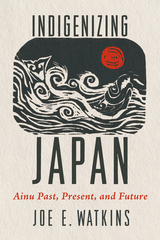
Relaying the deep history of the islands of Japan, Watkins tells the archaeological story from the earliest arrivals some 40,000 years ago to 16,000 years ago when local cultures began utilizing pottery and stone tools. About 2,300 years ago, another group of people immigrated from the Korean peninsula into the Japanese archipelago, bringing wet rice agriculture with them. They intermarried with the people who were there, forming the basis of the contemporary Japanese majority culture. As the Japanese state developed on the central Islands of Honshu, Ryukyu, and Shikoku, the people of Hokkaido continued developing along a different trajectory with minimal interaction with the mainland until colonization in the mid-nineteenth century, when the people known as the Ainu came under Japanese governmental policy.
Watkins’s insightful analysis highlights the Ainu’s enduring spirit and their resurgence as part of the global Indigenous movement. Key events such as the 1997 Nibutani Dam case and the 2007 recognition of the Ainu as Japan’s Indigenous people are explored in depth, showcasing the Ainu’s ongoing fight for cultural preservation and self-determination. By situating the Ainu’s experiences within broader global colonial histories, Indigenizing Japan underscores the shared struggles and resilience of Indigenous communities worldwide.

What happens when a Native or indigenous person turns a video camera on his or her own culture? Are the resulting images different from what a Westernized filmmaker would create, and, if so, in what ways? How does the use of a non-Native art-making medium, specifically video or film, affect the aesthetics of the Native culture?
These are some of the questions that underlie this rich study of Native American aesthetics, art, media, and identity. Steven Leuthold opens with a theoretically informed discussion of the core concepts of aesthetics and indigenous culture and then turns to detailed examination of the work of American Indian documentary filmmakers, including George Burdeau and Victor Masayesva, Jr. He shows how Native filmmaking incorporates traditional concepts such as the connection to place, to the sacred, and to the cycles of nature. While these concepts now find expression through Westernized media, they also maintain continuity with earlier aesthetic productions. In this way, Native filmmaking serves to create and preserve a sense of identity for indigenous people.

During the colonial and postcolonial eras, local people in lowland South America experienced exploitation from outsiders. But as new kinds of societies emerged from engagements between outside and Indigenous communities, Indigenous Amazonians formed strategic alliances to defend livelihoods, territory, and symbolic values, as well as to curb exploitation, predation, and threats.
The contributors in Indigenous Alliance Making bring together historical analyses with anthropological investigations to explore the organizational patterns, goals, and strategies through which Indigenous people have intentionally created various alliances, partnerships, and similar relations with outsiders in lowland South America. Emphasizing class, ethnicity, gender, and race, the chapters bring new dimensions to understanding a vital but understudied region.
Through missions, war, and broader conflict, as well as marriage and kinship, local people aimed to maintain control even as personal and collective transformations unfolded. This volume explores the formation of diverse historical relations across regional societies within past and contemporary contexts and contributes to a growing historiographical turn among anthropologists and historians that foregrounds agency in past and present understandings of Indigenous peoples’ engagements with others in lowland South America.
Contributors
Marta Amoroso
Elisa Frühauf Garcia
Mark Harris
Kris Lane
Camila Loureiro Dias
Cecilia McCallum
Gary Van Valen
Aparecida Vilaça
James Andrew Whitaker
Indigenous and Popular Thinking in América is a record of Kusch's attempt to immerse himself in the indigenous ways of knowing and being. At first glance, his methodology resembles ethnography. He speaks with and observes indigenous people and mestizos in Peru, Bolivia, and Argentina. He questions them about their agricultural practices and economic decisions; he observes rituals; he asks women in the market the meaning of indigenous talismans; he interviews shamans; he describes the spatial arrangement and the contents of shrines, altars, and temples; and he reproduces diagrams of archaeological sites, which he then interprets at length. Yet he does not present a "them" to a putative "us." Instead, he offers an inroad to a way of thinking and being that does not follow the logic or fit into the categories of Western social science and philosophy. In his introduction, Walter D. Mignolo discusses Kusch's work and its relation to that of other twentieth-century intellectuals, Argentine history, and contemporary scholarship on the subaltern and decoloniality.
Indigenous Archaeology in the Philippines highlights how collaborative archaeology and knowledge co-production among the Ifugao, an Indigenous group in the Philippines, contested (and continue to contest) enduring colonial tropes. Stephen B. Acabado and Marlon M. Martin explain how the Ifugao made decisions that benefited them, including formulating strategies by which they took part in the colonial enterprise, exploiting the colonial economic opportunities to strengthen their sociopolitical organization, and co-opting the new economic system. The archaeological record shows that the Ifugao successfully resisted the Spanish conquest and later accommodated American empire building.
This book illustrates how descendant communities can take control of their history and heritage through active collaboration with archaeologists. Drawing on the Philippine Cordilleran experiences, the authors demonstrate how changing historical narratives help empower peoples who are traditionally ignored in national histories.
Who has the right to represent Native history?
The past several decades have seen a massive shift in debates over who owns and has the right to tell Native American history and stories. For centuries, non-Native actors have collected, stolen, sequestered, and gained value from Native stories and documents, human remains, and sacred objects. However, thanks to the work of Native activists, Native history is now increasingly being repatriated back to the control of tribes and communities. Indigenous Archival Activism takes readers into the heart of these debates by tracing one tribe’s fifty-year fight to recover and rewrite their history.
Rose Miron tells the story of the Stockbridge-Munsee Mohican Nation and their Historical Committee, a group of mostly Mohican women who have been collecting and reorganizing historical materials since 1968. She shows how their work is exemplary of how tribal archives can be used strategically to shift how Native history is accessed, represented, written and, most importantly, controlled. Based on a more than decade-long reciprocal relationship with the Stockbridge-Munsee Mohican Nation, Miron’s research and writing is shaped primarily by materials found in the tribal archive and ongoing conversations and input from the Stockbridge-Munsee Historical Committee.
As a non-Mohican, Miron is careful to consider her own positionality and reflects on what it means for non-Native researchers and institutions to build reciprocal relationships with Indigenous nations in the context of academia and public history, offering a model both for tribes undertaking their own reclamation projects and for scholars looking to work with tribes in ethical ways.
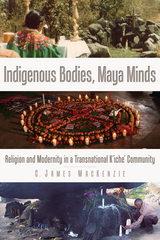
Indigenous Bodies, Maya Minds examines tension and conflict over ethnic and religious identity in the K’iche’ Maya community of San Andrés Xecul in the Guatemalan Highlands and considers how religious and ethnic attachments are sustained and transformed through the transnational experiences of locals who have migrated to the United States.
Author C. James MacKenzie explores the relationship among four coexisting religious communities within Highland Maya villages in contemporary Guatemala—costumbre, traditionalist religion with a shamanic substrate; “Enthusiastic Christianity,” versions of Charismaticism and Pentecostalism; an “inculturated” and Mayanized version of Catholicism; and a purified and antisyncretic Maya Spirituality—with attention to the modern and nonmodern worldviews that sustain them. He introduces a sophisticated set of theories to interpret both traditional religion and its relationship to other contemporary religious options, analyzing the relation among these various worldviews in terms of the indigenization of modernity and the various ways modernity can be apprehended as an intellectual project or an embodied experience.
Indigenous Bodies, Maya Minds investigates the way an increasingly plural religious landscape intersects with ethnic and other identities. It will be of interest to Mesoamerican and Mayan ethnographers, as well as students and scholars of cultural anthropology, indigenous cultures, globalization, and religion.

Told in vibrant detail, the narrative of the book conveys the importance of communalism as a value system present in all human groups and one at the center of Indigenous survival. Carolyn Smith-Morris draws on her work among the Akimel O'odham and the Wiradjuri to show how communal work and culture help these communities form distinctive Indigenous bonds. The results are not only a rich study of Indigenous relational lifeways, but a serious inquiry to the continuing acculturative atmosphere that Indigenous communities struggle to resist. Recognizing both positive and negative sides to the issue, she asks whether there is a global Indigenous communalism. And if so, what lessons does it teach about healthy communities, the universal human need for belonging, and the potential for the collective to do good?

With more than fifty contributors, Indigenous Critical Reflections on Traditional Ecological Knowledge offers important perspectives by Indigenous Peoples on Traditional Ecological Knowledge and Indigenous value systems. The book aims to educate and inspire readers about the importance of decolonizing how Indigenous Knowledges are considered and used outside of Native communities.
By including the work of Indigenous storytellers, poets, and scholars from around the globe, editor Lara Jacobs and chapter authors effectively explore the Indigenous value systems—relationships, reciprocity, and responsibility—that are fundamental to Indigenous Knowledge systems and cultures. Indigenous languages and positionality statements are featured for each of the contributors to frame their cultural and geographical background and to allow each Indigenous voice to lead discussions and contribute critical discourse to the literature on Indigenous Knowledges and value systems. By creating space for each of these individual voices, this volume challenges colonial extraction norms and highlights the importance of decolonial methods in understanding and protecting Indigenous Knowledges.
Indigenous Critical Reflections on Traditional Ecological Knowledge is an essential resource for students, academics, members of Tribal, state, and federal governments, Indigenous communities, and non-Indigenous allies as well as a valuable addition to environmental and Indigenous studies collections.
Contributors include: Melinda M. Adams, Joe Anderson, Coral Avery, Andrew Kalani Carlson, Kathryn Champagne, Brandie Makeba Cross, Joanna M. DeMeyer, Jonathan James Fisk, Pat Gonzales-Rogers, Celina Gray, Rhode Grayson, Zena Greenawald, Jennifer Grenz, Joy Harjo, Mandi Harris, Jessica Hernandez, Victor Hernandez, David Iniguez, Michelle M. Jacob, Lara A. Jacobs, Lydia L. Jennings, Eileen Jimenez, Stephanie Kelley, David G. Lewis, Tomás A. Madrigal, Tara McAllister, Lauren Wendelle Yowelunh McLester-Davis, Angeles Mendoza, Kat Milligan-McClellan, Todd A. Mitchell swəlítub, Don Motanic, ‘Alohi Nakachi, Kaikea Nakachi, Kobe , Natachu, Ululani Kekahiliokalani Brigitte Russo Oana, Jennifer R. O’Neal, Lily Painter, Britt Postoak, Leasi Vanessa Lee Raymond, Anamaq Margaret H. C. Rudolf, Oral Saulters, Sam Schimmel, Paulette Steeves, Joni Tobacco, Angelo Villagomez, Vivi Vold, Margaret Palaghicon Von Rotz, Luhui Whitebear, Joseph Gazing Wolf, Monique Wynecoop, and Cherry YEW Yamane.
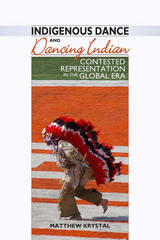
Considering four genres of dance in which indigenous people are represented--K'iche Maya traditional dance, powwow, folkloric dance, and dancing sports mascots--the book addresses both the ideational and behavioral dimensions of identity. Each dance is examined as a unique cultural expression in individual chapters, and then all are compared in the conclusion, where striking parallels and important divergences are revealed. Ultimately, Krystal describes how dancers and audiences work to construct and consume satisfying and meaningful identities through dance by either challenging social inequality or reinforcing the present social order.
Detailed ethnographic work, thorough case studies, and an insightful narrative voice make Indigenous Dance and Dancing Indian a substantial addition to scholarly literature on dance in the Americas. It will be of interest to scholars of Native American studies, social sciences, and performing arts.
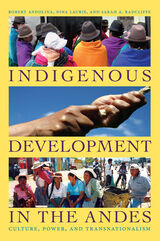
The authors argue that this reconfiguration of development policy and practice permits Ecuadorian and Bolivian indigenous groups to renegotiate their relationship to development as subjects who contribute and participate. Yet it also recasts indigenous peoples and their cultures as objects of intervention and largely fails to address fundamental concerns of indigenous movements, including racism, national inequalities, and international dependencies. Andean indigenous peoples are less marginalized, but they face ongoing dilemmas of identity and agency as their fields of action cross national boundaries and overlap with powerful institutions. Focusing on the encounters of indigenous peoples with international development as they negotiate issues related to land, water, professionalization, and gender, Indigenous Development in the Andes offers a comprehensive analysis of the diverse consequences of neoliberal development, and it underscores crucial questions about globalization, governance, cultural identity, and social movements.
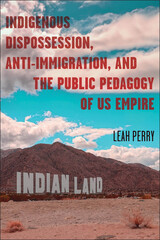
From the founding of the United States, enduringly consequential debates over Indigeneity and immigration have occurred on the battlefield and in Congress, in courtrooms, at territorial borders, and in mainstream culture. In Indigenous Dispossession, Anti-Immigration, and the Public Pedagogy of US Empire, Leah Perry traces the ways that the US created its empire through public pedagogies—which she defines as policy and media discourses—surrounding Indigenous dispossession, gendered state violence, and racialized immigration. These pedagogies have propelled the expansion of US empire, including the redrawing of the US as a neoliberal democracy. Perry argues that by changing the discourse around gender, race, immigration, and Indigeneity, the United States has continued its imperial project through different eras, always predicated on Indigenous dispossession.
In exploring crucial components of empire, such as welfare, eugenics, disability, sexual violence, foodways, queerness, and policing, Perry interrogates violence against Indigenous peoples and against immigrants, examining these not independently—as is so often the case—but as co-constitutive. Indigenous Dispossession, Anti-Immigration, and the Public Pedagogy of US Empire thus intervenes in and fills a gap in immigration studies, Indigenous studies, race and ethnic studies, gender and sexuality studies, and US history.

This absorbing text is the first book-length exploration foregrounding the environmental dimensions of cinema made by Indigenous peoples, including a particularly fascinating discussion on how Indigenous cinema’s ecological entanglements are a crucial and complementary aspect of its agenda of decolonialism.
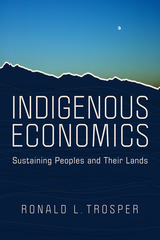
What does “development” mean for Indigenous peoples? Indigenous Economics lays out an alternative path showing that conscious attention to relationships among humans and the natural world creates flourishing social-ecological economies.
Economist Ronald L. Trosper draws on examples from North and South America, Aotearoa/New Zealand, and Australia to argue that Indigenous worldviews centering care and good relationships provide critical and sustainable economic models in a world under increasing pressure from biodiversity loss and climate change. He explains the structure of relational Indigenous economic theory, providing principles based on his own and others’ work with tribal nations and Indigenous communities. Trosper explains how sustainability is created at every level when relational Indigenous economic theory is applied—micro, meso, and macro.
Good relationships support personal and community autonomy, replacing the individualism/collectivism dichotomy with relational leadership and entrepreneurship. Basing economies on relationships requires changing governance from the top-down approaches of nation-states and international corporations; instead, each community creates its own territorial relationships, creating plurinational relational states. This book offers an important alternative to classic economic theory. In Indigenous Economics, support for Indigenous communities’ development and Indigenous peoples’ well-being go hand-in-hand.
Publication of this book is made possible in part by the Alfred P. Sloan Foundation Program in Public Understanding of Science.
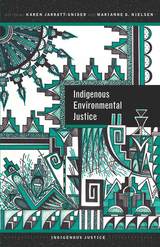
With focused essays on important topics such as the uranium mining on Navajo and Hopi lands, the Dakota Access Pipeline dispute on the Standing Rock Indian Reservation, environmental cleanup efforts in Alaska, and many other pertinent examples, this volume offers a timely view of the environmental devastation that occurs in Indian Country. It also serves to emphasize the importance of self-determination and sovereignty in victories of Indigenous environmental justice.
The book explores the ongoing effects of colonization and emphasizes Native American tribes as governments rather than ethnic minorities. Combining elements of legal issues, human rights issues, and sovereignty issues, Indigenous Environmental Justice creates a clear example of community resilience in the face of corporate greed and state indifference.
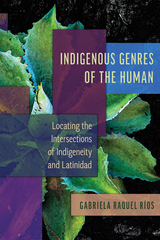
Addressing different genres of human and what contemporary indigeneity and reclaiming indigeneity looks like across Latin American contexts, chapters in this work examine digital bruja poetry, Aymara women’s Lucha Libre in Bolivia, Raramuri dance in Mexico, and Indigenous Khipu in the Andes. The author weaves her own story of being from southern Texas and traveling to Mexico throughout the book.
Bridging Sylvia Wynter’s theory of “genres of the human” with critical Latinx indigeneity studies, Chicana/o/x studies, decolonial theory, and rhetorical new materialisms, this book challenges readers to rethink what it means to be human, Indigenous, and Chicanx in the wake of colonial violence. Rather than reinforcing binaries defined by settler colonialism, Ríos proposes a framework that centers community knowledge and grounded practices. Her work opens space for dialogue, listening, and healing, emphasizing that reclaiming indigeneity requires attention to the stories, movements, and rhetorical practices that emerge from within communities themselves.
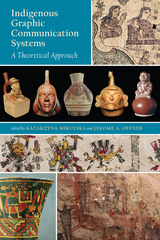
By examining case studies from across the Americas, the authors pursue an enhanced understanding of Native American graphic communication systems and how the study of graphic expression can provide insight into ancient cultures and societies, expressed in indigenous words. Focusing on examples from Central Mexico and the Andes, the authors explore the overlap among writing, graphic expression, and orality in indigenous societies, inviting reevaluation of the Western notion that writing exists only to record language (the spoken chain of speech) as well as accepted beliefs of Western alphabetized societies about the accuracy, durability, and unambiguous nature of their own alphabetized texts. The volume also addresses the rapidly growing field of semasiography and relocates it more productively as one of several underlying operating principles in graphic communication systems.
Indigenous Graphic Communication Systems reports new results and insights into the meaning of the rich and varied content of indigenous American graphic expression and culture as well as into the societies and cultures that produce them. It will be of great interest to Mesoamericanists, students, and scholars of anthropology, archaeology, art history, ancient writing systems, and comparative world history.
The research for and publication of this book have been supported in part by the National Science Centre of Poland (decision no. NCN-KR-0011/122/13) and the Houston Museum of Natural Science.
Contributors:
Angélica Baena Ramírez, Christiane Clados, Danièle Dehouve, Stanisław Iwaniszewski, Michel R. Oudijk, Katarzyna Szoblik, Loïc Vauzelle, Gordon Whittaker, Janusz Z. Wołoszyn, David Charles Wright-Carr
Reclaiming power and prophecy through California Indian intellectual resurgence and anticolonial resistance
Mark Minch-de Leon explores the anticolonial dimensions of California Indian intellectual and cultural resurgence in the aftermath of apocalypse in this compelling reexamination of Indigenous art, literature, and theory. Centering on a reinterpretation of the Ghost Dance, a ceremony first practiced in the nineteenth century, as a collective demonstration of prophecy and resilience, Indigenous Inhumanities envisions an expanded poetics of resistance through a reconfigured relationship to death and the dead. By dismantling the colonial frameworks of inclusion, recognition, and representation that reinforce settler-state power, Minch-de Leon shows how storytelling can be reclaimed as both research and as a tool for decolonization.
Taking up critical issues that the state has used to discipline California Indian relations to ancestors, such as the politics of human remains repatriation and the discourse around California Indian genocide, Minch-de Leon centers Indigenous knowledge and social systems while challenging legal and political definitions of violence, power, and the human. Rich case studies showcase the evocative art of Frank Day, the poetry of Tommy Pico, and the writings of Deborah Miranda, highlighting how these creators advance Indigenous theory and disrupt settler categories.
By refusing reconciliation and embracing Indigenous frameworks of radical relationality and the “inhuman” (what lies outside of human control), Minch-de Leon presents a bold vision of Indigenous antihumanist survival and resurgence. Indigenous Inhumanities illuminates the path toward decolonial futures by following the radical turn the ancestors made toward the powers of the dead to bring an end to the colonial world.
Retail e-book files for this title are screen-reader friendly with images accompanied by short alt text and/or extended descriptions.
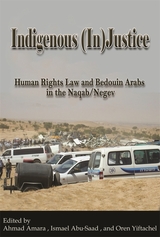
The indigenous Bedouin Arab population in the Naqab/Negev desert in Israel has experienced a history of displacement, intense political conflict, and cultural disruption, along with recent rapid modernization, forced urbanization, and migration. This volume of essays highlights international, national, and comparative law perspectives and explores the legal and human rights dimensions of land, planning, and housing issues, as well as the economic, social, and cultural rights of indigenous peoples. Within this context, the essays examine the various dimensions of the “negotiations” between the Bedouin Arab population and the State of Israel.
Indigenous (In)Justice locates the discussion of the Naqab/Negev question within the broader Israeli-Palestinian conflict and within key international debates among legal scholars and human rights advocates, including the application of the Declaration on the Rights of Indigenous Peoples, the formalization of traditional property rights, and the utility of restorative and reparative justice approaches. Leading international scholars and professionals, including the current United Nations Special Rapporteur on Violence against Women and the former United Nations Special Rapporteur on the Rights of Indigenous Peoples, are among the contributors to this volume.
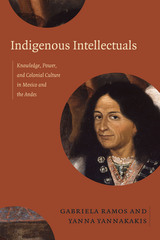
Contributors. Elizabeth Hill Boone, Kathryn Burns, John Charles, Alan Durston, María Elena Martínez, Tristan Platt, Gabriela Ramos, Susan Schroeder, John F. Schwaller, Camilla Townsend, Eleanor Wake, Yanna Yannakakis
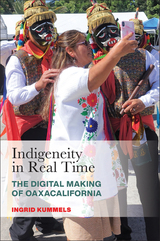
Indigenous Interfaces provides the first thorough examination of indigeneity at the interface of cyberspace. Correspondingly, it examines the impact of new media on the struggles for self-determination that Indigenous peoples undergo in Mexico and Central America. The volume’s contributors highlight the fresh approaches that Mesoamerica’s Indigenous peoples have given to new media—from YouTubing Maya rock music to hashtagging in Zapotec. Together, they argue that these cyberspatial activities both maintain tradition and ensure its continuity. Without considering the implications of new technologies, Indigenous Interfaces argues, twenty-first-century indigeneity in Mexico and Central America cannot be successfully documented, evaluated, and comprehended.
Indigenous Interfaces rejects the myth that indigeneity and information technology are incompatible through its compelling analysis of the relationships between Indigenous peoples and new media. The volume illustrates how Indigenous peoples are selectively and strategically choosing to interface with cybertechnology, highlights Indigenous interpretations of new media, and brings to center Indigenous communities who are resetting modes of communication and redirecting the flow of information. It convincingly argues that interfacing with traditional technologies simultaneously with new media gives Indigenous peoples an edge on the claim to autonomous and sovereign ways of being Indigenous in the twenty-first century.
Contributors
Arturo Arias
Debra A. Castillo
Gloria Elizabeth Chacón
Adam W. Coon
Emiliana Cruz
Tajëëw Díaz Robles
Mauricio Espinoza
Alicia Ivonne Estrada
Jennifer Gómez Menjívar
Sue P. Haglund
Brook Danielle Lillehaugen
Paul Joseph López Oro
Rita M. Palacios
Gabriela Spears-Rico
Paul Worley
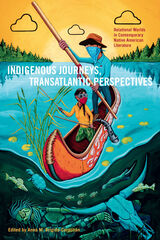
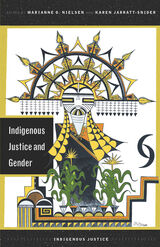
This new volume offers a broad overview of topics pertaining to gender-related health, violence, and healing. Employing a strength-based approach (as opposed to a deficit model), the chapters address the resiliency of Indigenous women and two-spirit people in the face of colonial violence and structural racism.
The book centers the concept of “rematriation”—the concerted effort to place power, peace, and decision making back into the female space, land, body, and sovereignty—as a decolonial practice to combat injustice. Chapters include such topics as reproductive health, diabetes, missing and murdered Indigenous women, Indigenous women in the academy, and Indigenous women and food sovereignty.
As part of the Indigenous Justice series, this book provides an overview of the topic, geared toward undergraduate and graduate classes.
Contributors
Alisse Ali-Joseph
Michèle Companion
Mary Jo Tippeconnic Fox
Brooke de Heer
Lomayumtewa K. Ishii
Karen Jarratt-Snider
Lynn C. Jones
Anne Luna-Gordinier
Kelly McCue
Marianne O. Nielsen
Linda M. Robyn
Melinda S. Smith
Jamie Wilson
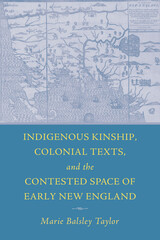
New England history often treats Indigenous people as minor or secondary actors within the larger colonial story. Focusing on those Native Americans who were sachems, or leaders, in local tribes when Europeans began arriving, Marie Balsley Taylor reframes stories of Indigenous and British interactions and illuminates the vital role that Indigenous kinship and diplomacy played in shaping the textual production of English colonial settlers in New England from the 1630s until King Philip’s War.
Taylor argues that genres like the conversion narrative, the post-sermon question and answer session, and scientific treatise—despite being written in English for European audiences—were jointly created by Indigenous sachems and settlers to facilitate interaction within the contested space of colonial New England. Analyzing the writings of Thomas Shepard, John Eliot, John Winthrop Jr., and Daniel Gookin and the relationships these English Protestants formed with Indigenous leaders like Wequash, Cutshamekin, Cassacinamon, and Waban, this innovative study offers a new approach to early American literature—indicating that Native thought and culture played a profound role in shaping the words and deeds of colonial writers.
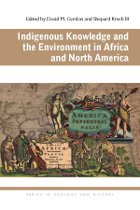
Indigenous knowledge has become a catchphrase in global struggles for environmental justice. Yet indigenous knowledges are often viewed, incorrectly, as pure and primordial cultural artifacts. This collection draws from African and North American cases to argue that the forms of knowledge identified as “indigenous” resulted from strategies to control environmental resources during and after colonial encounters.
At times indigenous knowledges represented a “middle ground” of intellectual exchanges between colonizers and colonized; elsewhere, indigenous knowledges were defined through conflict and struggle. The authors demonstrate how people claimed that their hybrid forms of knowledge were communal, religious, and traditional, as opposed to individualist, secular, and scientific, which they associated with European colonialism.
Indigenous Knowledge and the Environment offers comparative and transnational insights that disturb romantic views of unchanging indigenous knowledges in harmony with the environment. The result is a book that informs and complicates how indigenous knowledges can and should relate to environmental policy-making.
Contributors: David Bernstein, Derick Fay, Andrew H. Fisher, Karen Flint, David M. Gordon, Paul Kelton, Shepard Krech III, Joshua Reid, Parker Shipton, Lance van Sittert, Jacob Tropp, James L. A. Webb, Jr., Marsha Weisiger
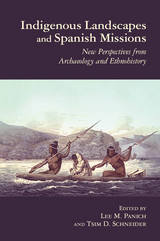
Offering thoughtful arguments and innovative perspectives, the editors organized the book around three interrelated themes. The first section explores power, politics, and belief, recognizing that Spanish missions were established within indigenous landscapes with preexisting tensions, alliances, and belief systems. The second part, addressing missions from the perspective of indigenous inhabitants, focuses on their social, economic, and historical connections to the surrounding landscapes. The final section considers the varied connections between mission communities and the world beyond the mission walls, including examinations of how mission neophytes, missionaries, and colonial elites vied for land and natural resources.
Indigenous Landscapes and Spanish Missions offers a holistic view on the consequences of missionization and the active negotiation of missions by indigenous peoples, revealing cross-cutting perspectives into the complex and contested histories of the Spanish borderlands. This volume challenges readers to examine deeply the ways in which native peoples negotiated colonialism not just inside the missions themselves but also within broader indigenous landscapes. This book will be of interest to archaeologists, historians, tribal scholars, and anyone interested in indigenous encounters with colonial institutions.
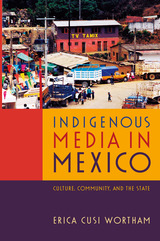
Drawing on her in-depth ethnographic research among indigenous mediamakers in Mexico, Wortham traces their shifting relationship with Mexican cultural agencies; situates their work within a broader, hemispheric network of indigenous media producers; and complicates the notion of a unified, homogeneous indigenous identity. Her analysis of projects from community-based media initiatives in Oaxaca to the transnational Chiapas Media Project highlights variations in cultural identity and autonomy based on specific histories of marginalization, accommodation, and resistance.
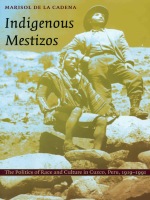
De la Cadena’s ethnographically and historically rich study examines how indigenous citizens of the city of Cuzco have been conceived by others as well as how they have viewed themselves and places these conceptions within the struggle for political identity and representation. Demonstrating that the terms Indian and mestizo are complex, ambivalent, and influenced by social, legal, and political changes, she provides close readings of everyday concepts such as marketplace identity, religious ritual, grassroots dance, and popular culture, as well as of such common terms as respect, decency, and education. She shows how Indian has come to mean an indigenous person without economic and educational means—one who is illiterate, impoverished, and rural. Mestizo, on the other hand, has come to refer to an urban, usually literate, and economically successful person claiming indigenous heritage and participating in indigenous cultural practices. De la Cadena argues that this version of de-Indianization—which, rather than assimilation, is a complex political negotiation for a dignified identity—does not cancel the economic and political equalities of racism in Peru, although it has made room for some people to reclaim a decolonized Andean cultural heritage.
This highly original synthesis of diverse theoretical arguments brought to bear on a series of case studies will be of interest to scholars of cultural anthropology, postcolonialism, race and ethnicity, gender studies, and history, in addition to Latin Americanists.
Wightman shows that the dismissal of the forasteros as marginalized rural poor is superficial at best, and through laborious and painstaking archival research she presents a clear picture of the transformation of traditional society as the native populations coped with the disruptions of the conquest—and in doing so, reveals the reciprocal adaptations of the colonial power. Her choice of Cuzco is particularly appropriate, as this was a “heartland” region crucial to both the Incan and Spanish empires. The questions addressed by Wightman are of great concern to current Andean ethnohistory, one of the liveliest areas of such research, and are sure to have an important impact.
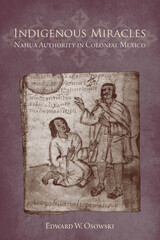
Indigenous Miracles is about how the Nahua elite of central Mexico secured political legitimacy through the administration of public rituals centered on miraculous images of Christ the King. Osowski argues that these images were adopted as community symbols and furthermore allowed Nahua leaders to “represent their own kingship,” protecting their claims to legitimacy. This legitimacy allowed them to act collectively to prevent the loss of many aspects of their culture. Osowski demonstrates how a shared religion admitted the possibility of indigenous agency and new ethnic identities.
Consulting both Nahuatl and Spanish sources, Osowski strives to fill a gap in the history of the Nahuas from 1760 to 1810, a momentous time when previously sanctioned religious practices were condemned by the viceroys and archbishops of the Bourbon royal dynasty. His approach synthesizes ethnohistory and institutional history to create a fascinating account of how and why the Nahuas protected the practices and symbols they had appropriated under Hapsburg rule. Ultimately, Osowski’s account contributes to our understanding of the ways in which indigenous agency was negotiated in colonial Mexico.
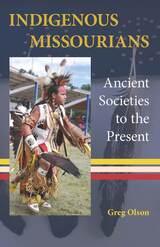
The history of Indigenous people in present-day Missouri is far more nuanced, complex, and vibrant than the often-told tragic stories of conflict with white settlers and forced Indian removal would lead us to believe. In this path-breaking narrative, Greg Olson presents the Show Me State’s Indigenous past as one spanning twelve millennia of Native presence, resilience, and evolution. While previous Missouri histories have tended to include Indigenous people only during periods when they constituted a threat to the state’s white settlement, Olson shows us the continuous presence of Native people that includes the present day.
Beginning thousands of years before the state of Missouri existed, Olson recounts how centuries of inventiveness and adaptability enabled Native people to create innovations in pottery, agriculture, architecture, weaponry, and intertribal diplomacy. Olson also shows how the resilience of Indigenous people like the Osages allowed them to thrive as fur traders, even as settler colonialists waged an all-out policy of cultural genocide against them.
Though the state of Missouri claimed to have forced Indigenous people from its borders after the 1830s, Olson uses U.S. Census records and government rolls from the allotment period to show that thousands remained. In the end, he argues that, with a current population of 27,000 Indigenous people, Missouri remains very much a part of Indian Country, and that Indigenous history is Missouri history.
READERS
Browse our collection.
PUBLISHERS
See BiblioVault's publisher services.
STUDENT SERVICES
Files for college accessibility offices.
RECENTLY PUBLISHED





UChicago Accessibility Resources
home | accessibility | search | about | contact us
BiblioVault ® 2001 - 2025
The University of Chicago Press