
 A SCHOLARLY BOOK REPOSITORY
Throughout Latin America, indigenous peoples are responding to state violence and pro-democracy social movements by asserting their rights to a greater measure of cultural autonomy and self-determination. This volume's rich case studies of movements in Colombia, Guatemala, and Brazil weigh the degree of success achieved by indigenous leaders in influencing national agendas when governments display highly ambivalent attitudes about strengthening ethnic diversity.
The contributors to this volume are leading anthropologists and indigenous activists from the United States and Latin America. They address the double binds of indigenous organizing and "working within the system" as well as the flexibility of political tactics used to achieve cultural goals outside the scope of state politics. The contributors answer questions about who speaks for indigenous communities, how indigenous movements relate to the popular left, and how conflicts between the national indigenous leadership and local communities play out in specific cultural and political contexts. The volume sheds new light on the realities of asymmetrical power relations and on the ways in which indigenous communities and their representatives employ Western constructions of subjectivity, alterity, and authentic versus counterfeit identity, as well as how they manipulate bureaucratic structures, international organizations, and the mass media to advance goals that involve distinctive visions of an indigenous future.

Contributors. Amber Meadow Adams, Alexandre Belmonte, Enrique Manuel Bernales Albites, Andrew Cowell, Ella Deloria, Leila Gómez, Sarah Hernandez, Penelope Kelsey, José Antonio Mazzotti, Javier Muñoz-Díaz, Craig Perez, Cheryl Savageau, Ángel Tuninetti, Christopher T. Vecsey

Contributors. Tone Bleie, Andrea Carmen, Jacqueline Gillis, Rauna Kuokkanen, Elifuraha Laltaika, Sheryl Lightfoot, David Bruce MacDonald, Toa Elisa Maldonado Ruiz, Binalakshmi “Bina” Nepram, Melissa Z. Patel, Manoel B. do Prado Junior, Hana Shams Ahmed, Elsa Stamatopoulou, Liubov Suliandziga, Rodion Sulyandziga, Yifat Susskind, Erika M. Yamada

Indigenous Peoples, National Parks, and Protected Areas integrates wide-ranging, multidisciplinary intellectual perspectives with detailed analyses of new kinds of protected areas in diverse parts of the world. Eleven geographers and anthropologists contribute nine substantive fieldwork-based case studies. Their contributions offer insights into experience with new conservation approaches in an array of countries, including Australia, Canada, Guatemala, Honduras, Nepal, Nicaragua, Peru, South Africa, and the United States.
This book breaks new ground with its in-depth exploration of changes in conservation policies and practices—and their profound ramifications for Indigenous peoples, protected areas, and social reconciliation.
Including a range of international indigenous voices from the US, Canada, Australia, Aotearoa (New Zealand) and Africa, the book takes an interdisciplinary approach, bridging Indigenous studies, media studies, and social justice studies. Including examples like Idle No More in Canada, Australian Recognise!, and social media campaigns to maintain Maori language, Indigenous Peoples Rise Up serves as one of the first studies of Indigenous social media use and activism.



From Joe Shunatona and the United States Indian Reservation Orchestra to Jim Pepper, from Buffy Saint-Marie to Robbie Robertson, from Joy Harjo to Lila Downs, Indigenous Pop vividly addresses the importance of Native musicians and popular musical genres, establishing their origins and discussing what they represent.
Arranged both chronologically and according to popular generic forms, the book gives Indigenous pop a broad new meaning. In addition to examining the transitive influences of popular music on Indigenous expressive forms, the contributors also show ways that various genres have been shaped by what some have called the “Red Roots” of American-originated musical styles. This recognition of mutual influence extends into the ways of understanding how music provides methodologies for living and survival.
Each in-depth essay in the volume zeros in on a single genre and in so doing exposes the extraordinary whole of Native music. This book showcases the range of musical genres to which Native musicians have contributed and the unique ways in which their engagement advances the struggle for justice and continues age-old traditions of creative expression.
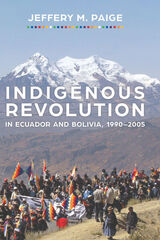
Uprisings by indigenous peoples of Ecuador and Bolivia between 1990 and 2005 overthrew the five-hundred-year-old racial and class order inherited from the Spanish Empire. It started in Ecuador with the Great Indigenous Uprising, which was fought for cultural and economic rights. A few years later massive indigenous mobilizations began in Bolivia, culminating in 2005 with the election of Evo Morales, the first indigenous president.
Jeffrey M. Paige, an internationally recognized authority on the sociology of revolutionary movements, interviewed forty-five indigenous leaders who were actively involved in the uprisings. The leaders recount how peaceful protest and electoral democracy paved the path to power. Through the interviews, we learn how new ideologies of indigenous socialism drew on the deep commonalities between the communal dreams of their ancestors and the modern ideology of democratic socialism. This new discourse spoke to the people most oppressed by both withering racism and neoliberal capitalism.
Emphasizing mutual respect among ethnic groups (including the dominant Hispanic group), the new revolutionary dynamic proposes a communal worldview similar to but more inclusive than Western socialism because it adds indigenous cultures and nature in a spiritual whole. Although absent in the major revolutions of the past century, the themes of indigenous revolution—democracy, indigeneity, spirituality, community, and ecology—are critically important.
Paige’s interviews present the powerful personal experiences and emotional intensity of the revolutionary leadership. They share the stories of mass mobilization, elections, and indigenous socialism that created a new form of twenty-first-century revolution with far-reaching applications beyond the Andes.
In this work, author Kelly S. McDonough addresses Nahua understanding of plants and animals, medicine and ways of healing, water and water control, alphabetic writing, and cartography. Interludes between the chapters offer short biographical sketches and interviews with contemporary Nahua scientists, artists, historians, and writers, accompanied by their photos. The book also includes more than twenty full-color images from sources including the Florentine Codex, a sixteenth-century collaboration between Indigenous and Spanish scholars considered the most comprehensive extant source on the pre-Hispanic and early colonial Aztec (Mexica) world.
In Mexico today, the terms “Indigenous” and “science and technology” are rarely paired together. When they are, the latter tend to be framed as unrecoverable or irreparably damaged pre-Hispanic traditions, relics confined to a static past. In Indigenous Science and Technology, McDonough works against such erroneous and racialized discourses with a focus on Nahua environmental engagements and relationalities, systems of communication, and cultural preservation and revitalization. Attention to these overlooked or obscured knowledges provides a better understanding of Nahua culture, past and present, as well as the entangled local and global histories in which they were—and are—vital actors.

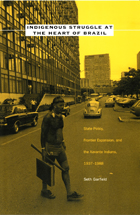
Garfield explains how state officials, eager to promote capital accumulation, social harmony, and national security on the western front, sought to delimit indigenous reserves and assimilate native peoples. Yet he also shows that state efforts to celebrate Indians as primordial Brazilians and nationalist icons simultaneously served to underscore and redefine ethnic difference. Garfield explores how various other social actors—elites, missionaries, military officials, intellectuals, international critics, and the Indians themselves—strove to remold this multifaceted project. Paying particular attention to the Xavante’s methods of engaging state power after experience with exile, territorial loss, and violence in the “white” world, Garfield describes how they emerged under military rule not as the patriotic Brazilians heralded by state propagandists but as a highly politicized ethnic group clamoring for its constitutional land rights and social entitlements.
Indigenous Struggle at the Heart of Brazil will interest not only historians and anthropologists but also those studying nationbuilding, Brazil, Latin America, comparative frontiers, race, and ethnicity.
Contributors. Noelani Arista, Tony Ballantyne, Alban Bensa, Keith Thor Carlson, Evelyn Ellerman, Isabel Hofmeyr, Emma Hunter, Arini Loader, Adrian Muckle, Lachy Paterson, Laura Rademaker, Michael P. J. Reilly, Bruno Saura, Ivy T. Schweitzer, Angela Wanhalla

A new perspective on religions and the environment emerges from this collection. The authors, a diverse group of indigenous and non-native scholars and environmental activists, address compelling and urgent questions facing indigenous communities as they struggle with threats to their own sovereignty, increased market and media globalization, and the conservation of endangered bioregions.
Drawing attention to the pressures threatening indigenous peoples and ways of life, this volume describes modes of resistance and regeneration by which communities maintain a spiritual balance with larger cosmological forces while creatively accommodating current environmental, social, economic, and political changes.
Reframing the study of Indigenous visual cultures, this volume explores how images and objects generate affect and relation in non-Western contexts, foregrounding alternative modes of material engagement and meaning-making.
While traditional approaches to Indigenous visual cultures have often centered on iconography and representation, this volume turns toward other ways that images and objects act in the world. Indigenous Visual Cultures in Latin America explores how material productions function not merely as signs that point elsewhere but as agents that help shape relationships, environments, and affective experience.
Spanning Mesoamerica, the Andes, and Amazonia from 1500 BCE to the present, the chapters examine how meaning may reside in materials themselves; how making is a form of exchange between maker and matter; and how visual forms participate in configuring relations among humans, ancestors, deities, and place. These works are not passive containers of meaning, but charged presences—generative forces within ongoing worlds. Attuned to Indigenous ways of knowing and being, the volume invites readers to think beyond the frame, beyond the image, and beyond representation itself.

Tekobbe’s methods for analyzing and understanding Indigenous knowledges online center Indigenous storytelling and “thick” (broad, deep, and complex) Indigenous meaning-making. Employing this thickness to interpret Indigenous knowledge ways resists the settler-colonial logics that tend to flatten complex Indigenous concepts into one-note representations of racial stereotypes. Native Americans’ use of social media and digital platforms to support social movements uniquely constructs Indigenous identities as living, producing, and culture-making people, which confronts the commonplace, one-dimensional narrative that Indigenous North Americans either live in isolation or are people of history resigned to the long-forgotten past. Tekobbe’s methods are applicable to additional online research to break through Western paradigms of oppositional critique, the colonial power matrix embedded in hierarchical and taxonomical classification systems, and participant objectification.
Indigenous Voices in Digital Spaces offers new methodological and epistemological opportunities to explore digital communities and technologies, problematizing conventional Western critique. This book is useful to instructors in Indigenous studies, internet studies, digital literacies, cultural studies, and communications, as well as Indigenous and internet studies researchers.

Indigenous Women and Violence is built on engaging case studies that highlight the individual and collective struggles that Indigenous women face from the racial and gendered oppression that structures their lives. Gendered violence has always been a part of the genocidal and assimilationist projects of settler colonialism, and it remains so today. These structures—and the forms of violence inherent to them—are driving criminalization and victimization of Indigenous men and women, leading to escalating levels of assassination, incarceration, or transnational displacement of Indigenous people, and especially Indigenous women.
This volume brings together the potent ethnographic research of eight scholars who have dedicated their careers to illuminating the ways in which Indigenous women have challenged communities, states, legal systems, and social movements to promote gender justice. The chapters in this book are engaged, feminist, collaborative, and activism focused, conveying powerful messages about the resilience and resistance of Indigenous women in the face of violence and systemic oppression.
Contributors: R. Aída Hernández-Castillo, Morna Macleod, Mariana Mora, María Teresa Sierra, Shannon Speed, Lynn Stephen, Margo Tamez, Irma Alicia Velásquez Nimatuj

While colonial sources that refer to indigenous women are not scant, documents in which women emerge as agents who actively participate in shaping their own identity are rare. Looking at this minority agency—or subaltern voice—in various religious discourses exposes some central themes. It shows that an indigenous identity recast in Catholic terms was able to be effectively recorded and that the religious participation of these women at a time when indigenous parishes were increasingly secularized lent cohesion to that identity.
Indigenous Writings from the Convent examines ways in which indigenous women participated in one of the most prominent institutions in colonial times—the Catholic Church—and what they made of their experience with convent life. This book will appeal to scholars of literary criticism, women’s studies, and colonial history, and to anyone interested in the ways that class, race, and gender intersected in the colonial world.
Documenting the rise and disillusionment of El Salvador’s postwar activists in the face of populist authoritarian politics.
The conclusion of El Salvador’s long civil war, in 1992, was supposed to bring about equality and political freedom. Leftist insurgents laid down arms, and the government formally embraced liberal ideals. Yet today, El Salvador is ruled by an authoritarian president who came to power via unconstitutional means. What went wrong?
Anthropologist and journalist Ellen Moodie embedded with indignados—young middle-class protestors, demanding that the government live up to its liberal commitments—to better understand the course of political change since the civil war. Yet the “post-postwar” generation is only the latest demographic disappointed with liberalism in practice. Moodie examines a nineteenth-century “racial liberalism” that saw descendants of colonists “civilizing” Indigenous people while dispossessing them of lands and mobilizing them for labor. Today, the failure to make good on the promises of postwar liberalism has inspired robust support for strongman Nayib Bukele. Moodie argues that El Salvador’s case, though inflected by local concerns, is not unique. Rather, it is another stark demonstration of how liberalism’s imaginary social contract gives rise to populist authoritarianism.

The experience of illness (both mental and physical) figures prominently in the critical thought and activism of the 1960s and 1970s, though it is largely overshadowed by practices of sexuality. Lisa Diedrich explores how and why illness was indeed so significant to the social, political, and institutional transformation beginning in the 1960s through the emergence of AIDS in the United States. A rich intervention—both theoretical and methodological, political and therapeutic—Indirect Action illuminates the intersection of illness, thought, and politics.
Not merely a revision of the history of this time period, Indirect Action expands the historiographical boundaries through which illness and health activism in the United States have been viewed. Diedrich explores the multiplicity illness–thought–politics through an array of subjects: queering the origin story of AIDS activism by recalling its feminist history; exploring health activism and the medical experience; analyzing psychiatry and self-help movements; thinking ecologically about counterpractices of generalism in science and medicine; and considering the experience and event of epilepsy and the witnessing of schizophrenia.
Indirect Action places illness in the leading role in the production of thought during the emergence of AIDS, ultimately showing the critical interconnectedness of illness and political and critical thought.

To demonstrate this, the author models the incentives that the initiative process creates for interests to organize and for how they communicate their preferences to policy makers. Interests that represent a broader range of the public are found to gain the most from the option to propose initiatives, implying that the set of organized interests in initiative states should reflect this advantage. Ironically, an effect of direct legislation is to potentially increase the effectiveness of special interest lobbying in state legislatures—in a sense, the opposite of the direct control that gives direct legislation its theoretical appeal. Yet, the clear effect is one of empowering voices that traditionally had very little effect in the legislative process. If greater representation is the goal of direct legislation, it is a clear success, even though that success does not really come in the act of ballot initiatives itself.

Reliving the overdoses of beloved friends, Malachi Black closes this book’s opening poem with a resuscitating command: “Doctor, / turn back. One of us lives.” Indirect Light is a testament to and apologia for this assertion of vitality, each eponymous poem an elegy dedicated to one of Black’s dearly departed. Though this book mourns an irretrievable past, it wages war against amnesia, refusing to let death erase the vibrancy of their lives. These poems preserve “the breath we left beside us on the train tracks,” “the watery inscriptions of nearby dogwood branches / dipped in shade,” “our bookbags’ mouths / pouting open on our laps,” “our street-scabbed bodies / briefly tinseled in the sun.”
Insofar as this collection returns to friends and kin to honor them by the indirect light of memory, it also seeks to memorialize the author’s personal experience of adolescence and addiction amidst the opioid epidemic. It is a lament for all that’s lost and a paean to the near misses and the just enough: a dim glow you can see by, a cup of coffee passed during NA, a prayer during detox to “be // as empty / as the sky” if floating means survival.


Published by Bucknell University Press. Distributed worldwide by Rutgers University Press.

Framed in response to Martin Heidegger’s influential account of the relation between technological modernity and theological tradition, The Indiscrete Image builds an understanding of creativity as conditioned by insurmountable unknowing and incalculable possibility through alternative readings of Christian theological tradition and technological culture—and the surprising resonance between these two. Carlson concludes that the always ongoing work of world creation, tied essentially to human self-creation, implies neither an idol’s closure nor an icon’s transcendence, but the “indiscrete image” whose love makes possible—by keeping open—both the human and its world.

Combining both historical research in theology (from Pseudo-Dionysius to Aquinas to Eckhart) and contemporary philosophical analysis (from Hegel and Nietzsche to Heidegger, Derrida, and Marion), Indiscretion will interest philosophers, theologians, and other scholars concerned with the possibilities and limits of language surrounding both God and human subjectivity.


The eleven essays that make up this collection show how, despite judicial, political, and public proclamations of support for freedom of expression, factors like tradition, gender stereotypes, religion, and fear of social unrest often led to narrow judicial and political protection for freedom of expression by people whose views upset the status quo. These views, expressed by abolitionists, suffragists, and labor leaders, challenged rigid cultural mores of the day, and many political and cultural leaders feared that extending freedom of expression to agitators would undermine society. The Civil War intensified questions about the duties and privileges of citizenship. After the war, key conflicts over freedom of expression were triggered by Reconstruction, suffrage, the Comstock Act, and questions about libel.
The volume’s contributors blend social, cultural, and intellectual history to untangle the complicated strands of nineteenth-century legal thought. By chronicling the development of modern-day notions of free speech, this timely collection offers both a valuable exploration of the First Amendment in nineteenth-century America and a useful perspective on the challenges we face today.
Often overlooked in labor history, the hoboes who rode the rails in search of seasonal work nevertheless secured a place in the American imagination. Frank Tobias Higbie weaves together history, anthropology, gender studies, and literary analysis to reposition these workers at the center of Progressive Era debates over class, race, manly responsibility, community, and citizenship. Combining incisive cultural criticism with labor history, Higbie illustrates how these so-called marginal figures were in fact integral to communities and to cultural conflicts over class, masculinity, and sexuality. He draws from life histories, the investigations of social reformers, and the organizing materials of the Industrial Workers of the World to present a complex portrait of hobo life, from its often violent and dangerous working conditions to its ethic of “transient mutuality” that enabled survival and resistance on the road.
Frank and compelling,Indispensable Outcasts examines hoboes within the sprawling story of American labor while meditating on writing history from the bottom up and the ways a fascination with personal narrative can color a historian's work.

The essays are intended to point to the continuity of an important theme in American fiction and to offer insight into the variety of philosophical and literary strategies utilized in significant works of significant authors in dealing with the question of the individual and the community.

Four in-depth studies of human-service sectors—child care, education, medical care, and long-term care for the elderly—are followed by six cross-sector studies that stimulate new ways of thinking about human services through the application of economic theory, institutional analysis, and the history of social policy.
The contributors include Kenneth J. Arrow, Martin Feldstein, Victor Fuchs, Alan M. Garber, Eric A. Hanushek, Christopher Jencks, Seymour Martin Lipset, Glenn Loury, Roger G. Noll, Paul M. Romer, Amartya Sen, and Theda Skocpol.
This timely study sheds important light on the tension between individual and social responsibility, and will appeal to economists and other social scientists and policymakers concerned with social policy issues.

This provocative volume, one of the most important interpretive works on the philosophical thought of the Renaissance, has long been regarded as a classic in its field. Ernst Cassirer here examines the changes brewing in the early stages of the Renaissance, tracing the interdependence of philosophy, language, art, and science; the newfound recognition of individual consciousness; and the great thinkers of the period—from da Vinci and Galileo to Pico della Mirandola and Giordano Bruno. The Individual and the Cosmos in Renaissance Philosophy discusses the importance of fifteenth-century philosopher Nicholas Cusanus, the concepts of freedom and necessity, and the subject-object problem in Renaissance thought.
“This fluent translation of a scholarly and penetrating original leaves little impression of an attempt to show that a ‘spirit of the age’ or ‘spiritual essence of the time’ unifies and expresses itself in all aspects of society or culture.”—Philosophy




In 1980 the ZANU/PF government of Robert Mugabe came to power after an extended war of liberation. They inherited a cluster of emergency laws similar to those available to the authorities in South Africa. It was also the beginning of the cynical South African state policy of destabilization of the frontline states. This led to a dangerous period of insurrection in Mashonaland and increased activity by Renamo.
Dr. Hatchard uses the case of Zimbabwe to ask questions about the use of authority in contemporary African states. He examines:
1. Whether and in what circumstances the declaration and retention of a state of emergency is justified;
2.The scope of emergency regulations and their impact on individual freedoms;
3.What safeguards are necessary in order to protect those freedoms during a state of emergency.
The relationship is studied from a political as well as a legal perspective. Dr. Hatchard examines the role law has played, is playing and may play. The author concludes that, even if the state of emergency is justified, this does not necessitate the curtailment of the exercise of individual freedoms.
There are many comparisons with the rest of Africa. The book is of practical importance for members of the judiciary, legal practitioners, politicians and human rights organizations. The difficult questions it poses make stimulating teaching material for students of the Third World who want to understand the reality of the exercise of power in fragile situations.


and Education, which focuses on the concepts of human nature and community
throughout American educational history. For the new edition, Karier has
added chapters on the major movements in American education from World
War II to the present and on the major Supreme Court cases involving educational
policy during the same period.
"This classic volume remains a remarkable study in the history of
ideas into which the implications for American schooling have been deftly
woven. It is balanced, thorough, and intelligently challenging."
--- Ann M. Keppel, College of Education, University of Hawaii at
Manoa
"This new edition should have great use as a primary text at the
graduate and advanced undergraduate levels."
--- Peter A. Sola, School of Education, Howard University
In this influential collection of writings, Nobel laureate Friedrich A. Hayek discusses topics from moral philosophy and the methods of the social sciences to economic theory as different aspects of the same central issue: free markets versus socialist planned economies. First published in the 1930s and '40s, these essays continue to illuminate the problems faced by economists, planners, government officials, and citizens in the changing, globalized economy of today.

In this collection of writings, Nobel laureate Friedrich A. Hayek discusses topics from moral philosophy and the methods of the social sciences to economic theory as different aspects of the same central issue: free markets versus socialist planned economies. First published in the 1930s and 40s, these essays continue to illuminate the problems faced by developing and formerly socialist countries.
F. A. Hayek, recipient of the Medal of Freedom in 1991 and winner of the Nobel Memorial Prize in Economics in 1974, taught at the University of Chicago, the University of London, and the University of Freiburg. Among his other works published by the University of Chicago Press is The Road to Serfdom, now available in a special fiftieth anniversary edition.
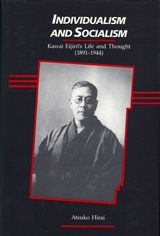
Kawai Eijirō was a controversial figure in Japan during the interwar years. Dedicated to the idea that the socialist aspiration for economic equality could be combined with a classical liberal commitment to individual political and civil rights, he antagonized both Marxists and Japanese nationalists. He was hounded by the government as a leftist and brought to trial during World War II.
This is the first study of Kawai in English. Atsuko Hirai examines the family and school influences that contributed to the development of Kawai’s thought, and analyzes the manner in which the ideas of such Western philosophers as Kant, Hegel, John Stuart Mill, Marx, T. H. Green, and the British labor ideologues were absorbed into a receptive and creative East Asian mind. The events of Kawai’s life are intertwined with the development of his idealist political philosophy, all culminating in a trial of unprecedented scale.

Many map users have wondered why Portugal, sharing with Spain the Iberian Peninsula, ever became a separate nation. That question is answered with remarkable clarity by Dan Stanislawski. This book also presents an analysis of the factors that produce separate nations and offers a study of the evolution of national cultures generally, especially as they apply to Portugal.

A leading expert on twins delves into the stories behind her research to reveal the profound joys and real-life traumas of twelve remarkable sets of twins, triplets, and quadruplets.
Indivisible by Two introduces us to an assortment of memorable characters, from the “Fireman Twins”—brothers who, though reared separately, are astonishingly similar in personality and behavioral traits—to the twin sisters who overcame one twin’s infertility by having the other serve as her surrogate mother. We meet one of the few identical brother–sister pairs in the world after one of two sisters was surgically transformed into a man, and identical triplet brothers, only one of whom is gay while the others are straight. We see uniquely blended families—identical twin brothers marrying identical twin sisters, and Chinese twins adopted by different Canadian families yet raised as sisters.
Being a twin can also render the experience of historical tragedy uniquely painful. We meet Stepha and Annetta, survivors of Josef Mengele’s heinous experiments in Auschwitz, and untangle the troubled lifelong tie between Jack and Oskar, born in the 1930s to a Jewish father and a German Gentile mother, one raised as a Jew in Trinidad and the other as a Catholic and a member of the Hitler Youth in Nazi Germany.
Nancy Segal unravels these stories and others with an eye for the challenges that life as a twin (or triplet or quadruplet) can pose to parents, friends, and spouses, as well as the twins themselves. These moving stories remind us how incompletely any theory explains real life—twin or not.

Tracing the echoes of ancient tongues—where language meets history.
This work translates Meillet’s classic philological study from the original 1908 French edition, which itself was based upon a course Meillet delivered at the Collège de France in 1906-1907. This edition includes the author's new introduction for the 1922 edition. Indexes, missing from the French editions, have been added by the translator for the convenience of the reader, as have bibliographical references to salient works from the half-century after original composition.
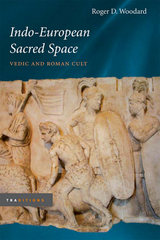
Looking closely at the organization of Roman religious activity, especially as regards sacrifices, festivals, and the hierarchy of priests, Woodard sheds new light on issues including the presence of the god Terminus in Jupiter's Capitoline temple, the nature of the Roman suovetaurilia, the Ambarvalia and its relationship to the rites of the Fratres Arvales, and the identification of the "Sabine" god Semo Sancus. Perhaps most significantly, this work also presents a novel and persuasive resolution to the long standing problem of "agrarian Mars."


Indonesia: Archipelago of Fear is a fascinating and at times unsettling journey into the world's most populous Muslim nation as it struggles to emerge from decades of dictatorship and the plunder of its natural resources.
Andre Vltchek brings together more than a decade of investigative journalism in and around Indonesia to chart the recent history of the country, from the revolution which overthrew General Suharto's genocidal dictatorship in 1998 to the present day. He covers the full breadth of the country from Islamic Aceh to mostly Catholic East Timor.
Tracing Indonesia's current problems back to Suharto's coup and the genocide of 1965 – and the support given by the West to Suharto – Vltchek provides an intimate and deeply humane insight into the hopes and fears of Indonesia's people.
Organized chronologically, the volume addresses early Indonesian civilizations; contact with traders from India, China, and the Arab Middle East; and the European colonization of Indonesia, which culminated in centuries of Dutch rule. Selections offer insight into Japan’s occupation (1942–45), the establishment of an independent Indonesia, and the post-independence era, from Sukarno’s presidency (1945–67), through Suharto’s dictatorial regime (1967–98), to the present Reformasi period. Themes of resistance and activism recur: in a book excerpt decrying the exploitation of Java’s natural wealth by the Dutch; in the writing of Raden Ajeng Kartini (1879–1904), a Javanese princess considered the icon of Indonesian feminism; in a 1978 statement from East Timor objecting to annexation by Indonesia; and in an essay by the founder of Indonesia’s first gay activist group. From fifth-century Sanskrit inscriptions in stone to selections related to the 2002 Bali bombings and the 2004 tsunami, The Indonesia Reader conveys the long history and the cultural, ethnic, and ecological diversity of this far-flung archipelago nation.

"How can such a gentle people as we are be so murderous?" a prominent Indonesian asks. That question--and the mysteries of the archipelago's vast contradictions--haunt Theodore Friend's remarkable work, a narrative of Indonesia during the last half century, from the postwar revolution against Dutch imperialism to the unrest of today. Part history, part meditation on a place and a past observed firsthand, Indonesian Destinies penetrates events that gave birth to the world's fourth largest nation and assesses the continuing dangers that threaten to tear it apart.
Friend reveals Sukarno's character through wartime collaboration with Japan, and Suharto's through the mass murder of communists that brought him to power for thirty-two years. He guides our understanding of the tolerant forms of Islam prevailing among the largest Muslim population in the world, and shows growing tensions generated by international terrorism. Drawing on a deep knowledge of the country's cultures, its leaders, and its ordinary people, Friend gives a human face and a sense of immediacy to the self-inflicted failures and immeasurable tragedies that cast a shadow over Indonesia's past and future. A clear and compelling passion shines through this richly illustrated work. Rarely have narrative history and personal historical witness been so seamlessly joined.

Indonesia, the world’s fourth most populous country, is a vast archipelago with a relatively short history of unified rule. The devolution of power to the provinces after 1998 has meant that regional social traditions and historical legacies are powerful forces in contemporary politics. South Sulawesi (Southwest Celebes), a crucial and understudied region of Indonesia, is no exception.
Starting in 1669, tensions between the Dutch East India Company’s cosmopolitan port town of Makassar and the aggressive, competitive dynasties of the interior began to shape peninsula politics. A strong ethnic Chinese community embodied the town’s wide horizons, while in the countryside, the nobility’s engagement with Islam ranged from symbiotic co-optation to hostility. Religion, rather than politics, framed the main challenges to authority. Finally integrated in 1965, the city and province remain among the most clientelist in the country, their politics personalized and transactional. Nevertheless, the large city of Makassar is booming. Dutch indirect rule and neocolonial strategies entrenched the power of local elites, who resisted changes imposed by Batavia or, after 1950, by Jakarta.
In this history, Heather Sutherland’s long-term perspective avoids dichotomies like continuity and change or autonomy and dependence, recognizing that trade-offs have always been fundamental to interaction within and between town and country and between the province and distant capitals.

The Indoor Gardener was first published in 1939. Minnesota Archive Editions uses digital technology to make long-unavailable books once again accessible, and are published unaltered from the original University of Minnesota Press editions.
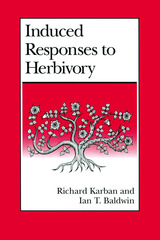
Over the past fifteen years, research on these induced responses to herbivory has flourished, and here Richard Karban and Ian T. Baldwin present the first comprehensive evaluation and synthesis of this rapidly developing field. They provide state-of-the-discipline reviews and highlight areas where new research will be most productive. Their comprehensive overview will be welcomed by a wide variety of theoretical and applied researchers in ecology, evolutionary biology, plant biology, entomology, and agriculture.


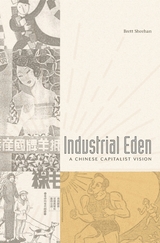
This illuminating study of the evolution of Chinese capitalism chronicles the fortunes of the Song family of North China under five successive authoritarian governments. Headed initially by Song Chuandian, who became rich by exporting hairnets to Europe and America in the early twentieth century, the family built a thriving business against long odds of rural poverty and political chaos.
A savvy political operator, Song Chuandian prospered and kept local warlords at bay, but his career ended badly when he fell afoul of the new Nationalist government. His son Song Feiqing—inspired by the reformist currents of the May Fourth Movement—developed a utopian capitalist vision that industry would redeem China from foreign imperialism and cultural backwardness. He founded the Dongya Corporation in 1932 to manufacture wool knitting yarn and for two decades steered the company through a constantly changing political landscape—the Nationalists, then Japanese occupiers, then the Nationalists again, and finally Chinese Communists. Increasingly hostile governments, combined with inflation, foreign competition, and a restless labor force, thwarted his ambition to create an “Industrial Eden.”
Brett Sheehan shows how the Song family engaged in eclectic business practices that bore the imprint of both foreign and traditional Chinese influences. Businesspeople came to expect much from increasingly intrusive states, but the position of private capitalists remained tenuous no matter which government was in control. Although private business in China was closely linked to the state, it was neither a handmaiden to authoritarianism nor a natural ally of democracy.
Ten original essays address topics including electronic trading and the "virtual"stock exchange; trading costs and liquidity on the London and Tokyo Stock Exchanges and in the German and Japanese government bond markets; international coordination among regulatory agencies; and the impact of changing margin requirements on stock prices, volatility, and liquidity.
This clear presentation of groundbreaking research will appeal to economists, lawyers, and legislators who seek a refreshingly new perspective on policy issues in the securities industry.
Through a dizzying array of references to subjects ranging from engineering to poetry, on-the-job experiences in academia and industry, conflicts between working-class and intellectual labor, the privatization of universities, and the contradictions of the modern environment, Joe Amato’s Industrial Poetics mounts a boisterous call for poetry communities to be less invested in artistic self-absorption and more concerned about social responsibility.
As Amato focuses on the challenges faced by American poets in creating a poetry that speaks to a public engineered into complacency by those industrial technologies, practices, and patterns of thought that we cannot seem to do without, he brings readers face to face with the conflicting realities of U.S. intellectual, academic, and poetic culture.
Formally adventurous and rhetorically lively, Industrial Poetics is best compared with the intellectually exploratory, speculative, risky, polemical work of other contemporary poet-critics including Kathleen Fraser, Joan Retallack, Bruce Andrews, Susan Howe, and Allen Grossman. Amato uses an exhilarating range of structural and rhetorical strategies: conventionally developed argument, abruptly juxtaposed aphorisms, personal narrative, manifesto-like polemic, and documentary reportage. With a critic’s sharply analytical mind, a poet’s verve, and a working-class intellectual’s sense of social justice, Amato addresses the many nonliterary institutions and environments in which poetry is inextricably embedded.
By connecting poetry to industry in a lively demonstration against the platitudes and habitudes of the twentieth century, Amato argues for a reenergized and socially forceful poetics—an industrial poetics, rough edges and all. Jed Rasula writes, “I can't say I pay much attention to talk radio, but this is what I imagine it might be like if the deejay were really smart, enviably well read, yet somehow retained the snarling moxie of the AM format.”


Industrial Relations in Urban Transportation was first published in 1937. Minnesota Archive Editions uses digital technology to make long-unavailable books once again accessible, and are published unaltered from the original University of Minnesota Press editions.
In the present era of industrial warfare and violence, this book points a "middle way" in employer-employee relations. It describes the remarkable achievement of the Amalgamated Association of Street, Electric Railway, and Motor Coach Employees of America, which for nearly fifty years has used the machinery of arbitration to settle all labor disputes without resort to strikes. Herein also is probably the first attempt to measure on a nation-wide scale the influence of a union in raising wages and reducing hours.
But this is much more than the story of a successful union. It is a complete history of urban transportation in the United States — the first such history to be written. It deals with technological, financial, and regulatory, as well as labor, aspects. The characteristics of transportation work and the type of men attracted to it are carefully analyzed, and there is a chapter devoted to the late nineteenth century conditions which gave birth to unionism.
This readable study will be of particular interest to owners, managers, and employees of local transportation systems, to investment bankers and investors, regulatory commissions and city aldermen, public mediators and arbitrators of labor disputes, and students of economic history.
How can workers retain job security in an industry currently experiencing extensive restructuring and retrenchment? In the United States, massive layoffs in the 1980s in industries like steel have resulted in increased worker demands for job security provisions in collective agreements and legal protections against layoffs. In many Western European countries, where private-sector practices ensuring strong job security and laws regulating layoff practices were well established, the 1980s brought strong pressure from business to relax job security in order to facilitate rapid restructuring.
Susan Houseman's book presents some of the first hard evidence on the economic effects of providing job security, evidence gathered during the restructuring of the European Community's steel industry in the 1970s and 1980s. The author reviews personnel practices by the Community's leading steel companies, basing her analysis on extensive interviews with employers, workers, and government officials in West Germany, France, Britain, Belgium, Luxembourg, Italy, and the Netherlands. Drawing on economic theory, she shows that the extent of workers' rights to job security will affect how an industry optimally adjusts to a decline in demand and to a situation of excess capacity.
Using detailed plant data, she shows that job security for workers affected decisions concerning employment, production, investment, and plant closures in the industry, While job security for workers may slow the process of industrial restructuring and result in lower productivity, the author points out that it also generates important social benefits, including community stability and a more equitable distribution of the risks and costs of economic change.
This book will draw the attention of policymakers in government and in international organizations such as the European Community, the OECD, and the ILO. It will also be of interest to scholars in labor economics, industrial relations, public policy, and business.
Sara A. Whaley Book Prize, National Women's Studies Association, 2017
AMEWS Book Award, Journal of Middle Eastern Studies, 2017
Millions of Egyptian men, women, and children first experienced industrial work, urban life, and the transition from peasant-based and handcraft cultures to factory organization and hierarchy in the years between the two world wars. Their struggles to live in new places, inhabit new customs, and establish and abide by new urban norms and moral and gender orders underlie the story of the making of modern urban life—a story that has not been previously told from the perspective of Egypt’s working class.
Reconstructing the ordinary urban experiences of workers in al-Mahalla al-Kubra, home of the largest and most successful Egyptian textile factory, Industrial Sexuality investigates how the industrial urbanization of Egypt transformed masculine and feminine identities, sexualities, and public morality. Basing her account on archival sources that no researcher has previously used, Hanan Hammad describes how coercive industrial organization and hierarchy concentrated thousands of men, women, and children at work and at home under the authority of unfamiliar men, thus intensifying sexual harassment, child molestation, prostitution, and public exposure of private heterosexual and homosexual relationships. By juxtaposing these social experiences of daily life with national modernist discourses, Hammad demonstrates that ordinary industrial workers, handloom weavers, street vendors, lower-class landladies, and prostitutes—no less than the middle and upper classes—played a key role in shaping the Egyptian experience of modernity.

Revelatory and multifaceted, Industrial Strength Bluegrass shares the inspiring story of a bluegrass hotbed and the people who created it.
Contributors: Fred Bartenstein, Curtis W. Ellison, Jon Hartley Fox, Rick Good, Lily Isaacs, Ben Krakauer, Mac McDivitt, Nathan McGee, Daniel Mullins, Joe Mullins, Larry Nager, Phillip J. Obermiller, Bobby Osborne, and Neil V. Rosenberg.

The Eastham-Thompson feud pitted a former Confederate against a member of the new business elite who was, as a northern Republican, his cultural and political opposite. For Lewis, their clash was one flashpoint in a larger phenomenon central to US history in the second half of the nineteenth century: the often violent imposition of new commercial and legal regimes over holdout areas stretching from Appalachia to the trans-Missouri West. Taking a ground-level view of these so-called “wars of incorporation,” Lewis’s powerful microhistory shows just how strongly local communities guarded traditional relationships to natural resources. Modernizers sought to convict Eastham of murder, but juries drawn from the traditionalist population refused to comply. Although the resisters won the courtroom battle, the modernizers eventually won the war for control of the state’s timber frontier.
Taiwan's export-led industrial development is often presented as a model of how state intervention promotes growth. Others see the same experience as a model of a private enterprise market at work. This study demonstrates that Taiwan policymakers varied their approach to development as circumstances changed. Export promotion of labor-intensive industries, which predominated in the 1960s, was supplemented by efforts to promote import-substituting heavy industries in the 1970s.
In the early 1980s there was a fundamental change in the economic environment as Taiwan's government reduced its active intervention in the economy and created a foundation for development based on information and other high-technology products. Taiwan's economy continued to prosper in the 1990s because policies and systems changed along with conditions.
The outcomes differed significantly owing to geographical location, government policies, and internal economic conditions. Industrialization in Late-Developing ASEAN Countries explores these differences through case studies based on an extended research program conducted by the Institute of Developing Economies in Tokyo, which offered insights into models of economic growth, and into the trajectories followed by the four countries examined.

São Paulo is one of the few places in the underdeveloped world where an advanced industrial system has grown out of a tropical raw-material-exporting economy. By 1960 there were 830,000 industrial workers in the state, producing $3.3 billion worth of goods. It had become Latin America’s largest industrial center.
This is a study of the early years of manufacturing in São Paulo: how it was influenced by the growth and decline of the coffee trade; where it found its markets, its credit, and its labor force; and how it confronted the competition of imports. The principal focus, however, is on the manufacturers themselves, whose perceptions of their opportunities determined how industrialization was brought about. Warren Dean discusses their social origins, their connections with other sectors of the elite, their attitudes toward workers and consumers, and their view of the potentialities of economic development. He analyzes the political activities of the manufacturers, to discover both how they promoted their interests and how they confronted the larger challenge of social and political transformation.
Paradoxically, the industrialization of São Paulo is not a “success story” of private entrepreneurship. Until after World War II manufacturing grew quite slowly, and its hallmarks were always low productivity, technical backwardness, and consumer hostility. More than half of the state’s present large-scale factory production and nearly all of its heavy industry was built by foreign capital or state enterprise, not by privately owned firms. Dean shows that this outcome is partly a consequence of the historical experience of domestic manufacture.
Throughout the book the author points out the “peculiar articulations” of the industrial system of São Paulo—the significant social and political interests that determined what kinds of development were possible. The result is an exposition of an unusual case study in twentieth-century economic development.
The construction of the Three Gorges Dam on China's Yangtze River. The transformation of the Amazon into a site for huge cattle ranches and aluminum smelters. The development of Nevada's Yucca Mountain into a repository for nuclear waste. The extensive irrigation networks of the Grand Coulee and Kuibyshev Dams. On the face of it, these massive projects are wonders of engineering, financial prowess, and our seldom-questioned ability to modify nature to suit our immediate needs. For nearly a century we have relied increasingly on science and technology to harness natural forces, but at what environmental and social cost?
In Industrialized Nature, historian Paul R. Josephson provides an original examination of the ways in which science, engineering, policy, finance, and hubris have come together, often with unforeseen consequences, to perpetuate what he calls "brute-force technologies"—the large-scale systems created to manage water, forest, and fish resources. Throughout the twentieth century, nations with quite different political systems and economic orientations all pursued this same technological subjugation of nature. Josephson compares the Soviet Union's heavy-handed efforts at resource management to similar projects undertaken in the United States, Norway, Brazil, and China. He argues that brute-force technologies require brute-force politics to operate. He shows how irresponsible—or well-intentioned but misguided—large-scale manipulation of nature has resulted in resource loss and severe environmental degradation.
Josephson explores the ongoing industrialization of nature that is happening in our own backyards and around the world. Both a cautionary tale and a call to action, Industrialized Nature urges us to consider how to develop a future for succeeding generations that avoids the pitfalls of brute-force technologies.
In Industrializing the Rockies, David A. Wolff places these deadly conflicts and strikes in the context of the Western coal industry from its inception in 1868 to the age of maturity in the early twentieth century. The result is the first book-length study of the emergence of coalfield labor relations and a general overview of the role of coal mining in the American West.
Wolff examines the coal companies and the owners' initial motivations for investment and how these motivations changed over time. He documents the move from speculation to stability in the commodities market, and how this was reflected in the development of companies and company towns.
Industrializing the Rockies also examines the workers and their workplaces: how the miners and laborers struggled to maintain mining as a craft and how the workforce changed, ethnically and racially, eventually leading to the emergence of a strong national union. Wolff shines light on the business of coal mining detailing the market and economic forces that influenced companies and deeply affected the lives of the workers.

The Mexican Revolution has long been considered a revolution of peasants. But Aurora Gómez-Galvarriato’s investigation of the mill towns of the Orizaba Valley reveals that industrial workers played a neglected but essential role in shaping the Revolution. By tracing the introduction of mechanized industry into the valley, she connects the social and economic upheaval unleashed by new communication, transportation, and production technologies to the political unrest of the revolutionary decade. Industry and Revolution makes a convincing argument that the Mexican Revolution cannot be understood apart from the changes wrought by the Industrial Revolution, and thus provides a fresh perspective on both transformations.
By organizing collectively on a wide scale, the spinners and weavers of the Orizaba Valley, along with other factory workers throughout Mexico, substantially improved their living and working conditions and fought to secure social and civil rights and reforms. Their campaigns fed the imaginations of the masses. The Constitution of 1917, which embodied the core ideals of the Mexican Revolution, bore the stamp of the industrial workers’ influence. Their organizations grew powerful enough to recast the relationship between labor and capital, not only in the towns of the valley, but throughout the entire nation.
The story of the Orizaba Valley offers insight into the interconnections between the social, political, and economic history of modern Mexico. The forces unleashed by the Mexican and the Industrial revolutions remade the face of the nation and, as Gómez-Galvarriato shows, their consequences proved to be enduring.

Industry and the Creative Mind takes a radically new look at the figure of the eccentric, alienated writer in American literature and entertainment from 1790 to 1860. Traditional scholarship takes for granted that the eccentric writer, modeled by such Romantic beings as Lord Byron and brought to life for American audiences by the gloomy person of Edgar Allan Poe, was a figure of rebellion against the excesses of modern commercial culture and industrial life. By contrast, Industry and the Creative Mind argues that in the United States myths of writerly moodiness, alienation, and irresponsibility predated the development of a commercial arts and entertainment industry and instead of forming a site of rebellion from this industry formed a bedrock for its development. Looking at the careers of a number of early American writers---Joseph Dennie, Nathaniel Parker Willis, Edgar Allan Poe, Fanny Fern, as well as a host of now forgotten souls who peopled the twilight worlds of hack fiction and industrial literature---this book traces the way in which early nineteenth-century American arts and entertainment systems incorporated writerly eccentricity in their "logical" economic workings, placing the mad, rebellious writer at the center of the industry's productivity and success.


The most extensive account yet of the lives of cybercriminals and the vast international industry they have created, deeply sourced and based on field research in the world’s technology-crime hotspots.
Cybercrime seems invisible. Attacks arrive out of nowhere, their origins hidden by layers of sophisticated technology. Only the victims are clear. But every crime has its perpetrator—specific individuals or groups sitting somewhere behind keyboards and screens. Jonathan Lusthaus lifts the veil on the world of these cybercriminals in the most extensive account yet of the lives they lead, and the vast international industry they have created.
We are long past the age of the lone adolescent hacker tapping away in his parents’ basement. Cybercrime now operates like a business. Its goods and services may be illicit, but it is highly organized, complex, driven by profit, and globally interconnected. Having traveled to cybercrime hotspots around the world to meet with hundreds of law enforcement agents, security gurus, hackers, and criminals, Lusthaus takes us inside this murky underworld and reveals how this business works. He explains the strategies criminals use to build a thriving industry in a low-trust environment characterized by a precarious combination of anonymity and teamwork. Crime takes hold where there is more technical talent than legitimate opportunity, and where authorities turn a blind eye—perhaps for a price. In the fight against cybercrime, understanding what drives people into this industry is as important as advanced security.
Based on seven years of fieldwork from Eastern Europe to West Africa, Industry of Anonymity is a compelling and revealing study of a rational business model which, however much we might wish otherwise, has become a defining feature of the modern world.

The industrialization process in Mexico began before that of any other nation in Latin America except Argentina, with the most rapid expansion of new industrial firms occurring in the 1930s and 1940s, and import substitution in capital goods evident as early as the late 1930s. Though Mexico’s trade relations have always been dependent on the United States, successive Mexican presidents in the postwar period attempted to control the penetration of foreign capital into Mexican markets.
In Industry, the State, and Public Policy in Mexico, Dale Story, recognizing the significance of the Mexican industrial sector, analyzes the political and economic role of industrial entrepreneurs in postwar Mexico. He uses two original data sets—industrial production data for 1929–1983 and a survey of the political attitudes of leaders of the two most important industrial organizations in Mexico—to address two major theoretical arguments relating to Latin American development: the meaning of late and dependent development and the nature of the authoritarian state. Story accepts the general relevance of these themes to Mexico but asserts that the country is an important variant of both.
With regard to the authoritarian thesis, the Mexican authoritarian state has demonstrated some crucial distinctions, especially between popular and elite sectors. The incorporation of the popular sector groups has closely fit the characteristics of authoritarianism, but the elite sectors have operated fairly independently of state controls, and the government has employed incentives or inducements to try to win their cooperation.
In short, industrialists have performed important functions, not only in accumulating capital and organizing economic enterprises but also by bringing together the forces of social change. Industrial entrepreneurs have emerged as a major force influencing the politics of growth, and the public policy arena has become a primary focus of attention for industrialists since the end of World War II.
READERS
Browse our collection.
PUBLISHERS
See BiblioVault's publisher services.
STUDENT SERVICES
Files for college accessibility offices.
RECENTLY PUBLISHED







UChicago Accessibility Resources
home | accessibility | search | about | contact us
BiblioVault ® 2001 - 2025
The University of Chicago Press