logo for University of Manitoba Press
In Good Relation
History, Gender, and Kinship in Indigenous Feminisms
Sarah Nickel
University of Manitoba Press, 2020

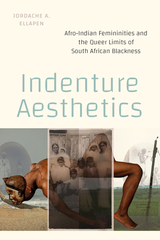
front cover of Indenture Aesthetics
Indenture Aesthetics
Afro-Indian Femininities and the Queer Limits of South African Blackness
Jordache A. Ellapen
Duke University Press, 2025
In Indenture Aesthetics, Jordache A. Ellapen examines the visual and performance art practices of feminist, queer, femme, and gender-nonconforming Afro-Indian and South African black artists to understand the paradoxes of freedom in contemporary South Africa. Tracing the afterlife of apartheid-era racial categories and revisiting Bantu Stephen Biko’s Black Consciousness, Ellapen theorizes South African blackness through the Indian Ocean World, showing how the development of an Afro-Indian identity after generations of indentured labor and segregation troubles persistent racial hierarchies. Staging unexpected encounters between artists such as Sharlene Khan, Mohau Modisakeng, Lebohang Kganye, and Reshma Chhiba, he analyzes how their works challenge these racial categories to create new imaginaries of freedom. Situated in a context in which the authentic (hetero)normative black subject of the post-apartheid state is bracketed from other formulations of blackness, these artists' aesthetic practices, alongside those of other artists like Ellapen himself, disrupt desires for national belonging and catalyze alternative and transgressive politics and subjects. By rethinking the relationship between blackness, Afro-Indianness, and Africanness, Ellapen highlights the role of the aesthetic in crafting a blueprint for coalitional building across difference in contemporary South Africa.
[more]

front cover of Informatics of Domination
Informatics of Domination
Zach Blas, Melody Jue, and Jennifer Rhee, editors
Duke University Press, 2025
Informatics of Domination is an experimental collection addressing formations of power that manifest through technical systems and white capitalist patriarchy in the twenty-first century. The volume takes its name from a chart in Donna J. Haraway’s canonical 1985 essay “A Manifesto for Cyborgs.” Haraway theorizes the informatics of domination as a feminist, diagrammatic concept for situating power and a world system from which the figure of the cyborg emerges. Informatics of Domination builds on Haraway’s chart as an open structure for thought, inviting fifty scholars, artists, and creative writers to unfold new perspectives. Their writings take on a variety of forms, such as essays on artificial intelligence, disability and protest, and transpacific imaginaries; conversations with an AI trained on Black oral history; a three-dimensional response to Mexico-US border tensions; hand-drawn images on queer autotheory; ecological fictions about gut microbiomes and wet markets; and more. Together, the writings take up the unfinished structure of the chart in order to proliferate critiques of white capitalist patriarchal power with the study of information systems, networks, and computation today. This volume includes an afterword by Haraway.

Contributors. Dalida María Benfield, Zach Blas, Ama Josephine Budge Johnstone, micha cárdenas, Amy Sara Carroll, Shu Lea Cheang, Jian Neo Chen, Heather Dewey-Hagborg, Ranjodh Singh Dhaliwal, Stephanie Dinkins, Ricardo Dominguez, Ashley Ferro-Murray, Matthew Fuller, Jacob Gaboury, Jennifer Gabrys, Alexander R. Galloway, Jennifer Mae Hamilton, Donna J. Haraway, Eva Hayward, Stefan Helmreich, Kathy High, Leon J. Hilton, Ho Rui An, Hi'ilei Julia Kawehipuaakahaopulani Hobart, Tung-Hui Hu, Caroline A. Jones, Melody Jue, Homay King, Larissa Lai, Lawrence Lek, Esther Leslie, Alexis Lothian, Isadora Neves Marques, Radha May (Elisa Giardina-Papa, Nupur Mathur, and Bathsheba Okwenje), Shaka McGlotten, Mahan Moalemi, madison moore, Astrida Neimanis, Bahar Noorizadeh, Luciana Parisi, Thao Phan, Ana Teixeira Pinto, Luiza Prado de O. Martins, Rita Raley, Patricia Reed, Jennifer Rhee, Bassem Saad, Ashkan Sepahvand, Justin Talplacido Shoulder, Lucy Suchman, Ollie Zhang
[more]

front cover of Insurgent Visions
Insurgent Visions
Feminism, Justice, Solidarity
Chandra Talpade Mohanty
Duke University Press, 2025
In a current era marked by carceral logics, authoritarianism, and white supremacy, there has never been a greater need for the tools and inspiration that radical feminism provides. In Insurgent Visions, Chandra Talpade Mohanty explores methods of anticapitalist resistance to radically transform everyday life. She presents insurgent feminism—a theory and praxis with which to contest and replace the practices of violence grounded in racialized gender relations. Insurgent feminism unsettles existing power structures in order to enact new relationships and forge new subjectivities, epistemologies, and communities. Drawing on organizing efforts in the US-Mexico borderlands, Palestine/Israel, and Kashmir, as well as on abolitionist and Dalit feminisms, Mohanty contends that the knowledge that emerges from the experiences of marginalized groups who are struggling for economic, racial, and social justice is key for imagining feminist futures. She also turns to the neoliberal landscape of higher education in the United States and the difficulties of instituting transformative antiracist and anti-imperialist feminist knowledge building. Mapping new challenges for radical praxis, Mohanty reconfigures feminist studies while offering a model for decolonial cross-border organizing and solidarity.
[more]

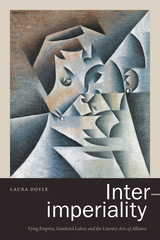
front cover of Inter-imperiality
Inter-imperiality
Vying Empires, Gendered Labor, and the Literary Arts of Alliance
Laura Doyle
Duke University Press, 2020
In Inter-imperiality Laura Doyle theorizes the co-emergence of empires, institutions, language regimes, stratified economies, and literary cultures over the longue durée. Weaving together feminist, decolonial, and dialectical theory, she shows how inter-imperial competition has generated a systemic stratification of gendered, racialized labor, while literary and other arts have helped both to constitute and to challenge this world order. To study literature is therefore, Doyle argues, to attend to world-historical processes of imaginative and material co-formation as they have unfolded through successive eras of vying empires. It is also to understand oral, performed, and written literatures as power-transforming resources for the present and future. To make this case, Doyle analyzes imperial-economic processes across centuries and continents in tandem with inter-imperially entangled literatures, from A Thousand and One Nights to recent Caribbean fiction. Her trenchant interdisciplinary method reveals the structural centrality of imaginative literature in the politics and possibilities of earthly life.
[more]

front cover of The International Relations of Middle-earth
The International Relations of Middle-earth
Learning from The Lord of the Rings
Abigail E. Ruane and Patrick James
University of Michigan Press, 2012

Based on their successful undergraduate course at the University of Southern California, Abigail E. Ruane and Patrick James provide an introduction to International Relations using J. R. R. Tolkien's fantastically popular trilogy The Lord of the Rings. Because Tolkien's major themes---such as good versus evil and human agency versus determinism---are perennially relevant to International Relations, The Lord of the Rings is well suited for application to the study of politics in our own world. This innovative combination of social science and humanities approaches to illustrate key concepts engages students and stimulates critical thinking in new and exciting ways.
[more]

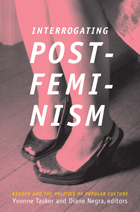
front cover of Interrogating Postfeminism
Interrogating Postfeminism
Gender and the Politics of Popular Culture
Yvonne Tasker and Diane Negra, eds.
Duke University Press, 2007
This timely collection brings feminist critique to bear on contemporary postfeminist mass media culture, analyzing phenomena ranging from action films featuring violent heroines to the “girling” of aging women in productions such as the movie Something’s Gotta Give and the British television series 10 Years Younger. Broadly defined, “postfeminism” encompasses a set of assumptions that feminism has accomplished its goals and is now a thing of the past. It presumes that women are unsatisfied with their (taken for granted) legal and social equality and can find fulfillment only through practices of transformation and empowerment. Postfeminism is defined by class, age, and racial exclusions; it is youth-obsessed and white and middle-class by default. Anchored in consumption as a strategy and leisure as a site for the production of the self, postfeminist mass media assumes that the pleasures and lifestyles with which it is associated are somehow universally shared and, perhaps more significantly, universally accessible.

Essays by feminist film, media, and literature scholars based in the United States and United Kingdom provide an array of perspectives on the social and political implications of postfeminism. Examining magazines, mainstream and independent cinema, popular music, and broadcast genres from primetime drama to reality television, contributors consider how postfeminism informs self-fashioning through makeovers and cosmetic surgery, the “metrosexual” male, the “black chick flick,” and more. Interrogating Postfeminism demonstrates not only the viability of, but also the necessity for, a powerful feminist critique of contemporary popular culture.

Contributors. Sarah Banet-Weiser, Steven Cohan, Lisa Coulthard, Anna Feigenbaum, Suzanne Leonard, Angela McRobbie, Diane Negra, Sarah Projansky, Martin Roberts, Hannah E. Sanders, Kimberly Springer, Yvonne Tasker, Sadie Wearing

[more]

front cover of Intersectional Chicana Feminisms
Intersectional Chicana Feminisms
Sitios y Lenguas
Aída Hurtado
University of Arizona Press, 2020
Chicana feminisms are living theory deriving value and purpose by affecting social change. Advocating for and demonstrating the importance of an intersectional, multidisciplinary, activist understanding of Chicanas, Intersectional Chicana Feminisms provides a much-needed overview of the key theories, thinkers, and activists that have contributed to Chicana feminist thought.

Aída Hurtado, a leading Chicana feminist and scholar, traces the origins of Chicanas’ efforts to bring attention to the effects of gender in Chicana and Chicano studies. Highlighting the innovative and pathbreaking methodologies developed within the field of Chicana feminisms—such as testimonio, conocimiento, and autohistoria—this book offers an accessible introduction to Chicana theory, methodology, art, and activism. Hurtado also looks at the newest developments in the field and the future of Chicana feminisms.

The book includes short biographies of key Chicana feminists, additional suggested readings, and exercises with each chapter to extend opportunities for engagement in classroom and workshop settings.

 
[more]

front cover of Is Feminist Philosophy Philosophy?
Is Feminist Philosophy Philosophy?
Emanuela Bianchi
Northwestern University Press, 1999
Drawing attention to the vexed relationship between feminist theory and philosophy, Is Feminist Philosophy Philosophy? demonstrates the spectrum of significant work being done at this contested boundary. The volume offers clear statements by seventeen distinguished scholars as well as a full range of philosophical approaches; it also presents feminist philosophers in conversation both as feminists and as philosophers, making the book accessible to a wide audience.
[more]


Send via email Share on Facebook Share on Twitter