
 A SCHOLARLY BOOK REPOSITORY
4 start with I start with I
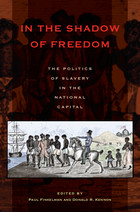
Few images of early America were more striking, and jarring, than that of slaves in the capital city of the world’s most important free republic. Black slaves served and sustained the legislators, bureaucrats, jurists, cabinet officials, military leaders, and even the presidents who lived and worked there. While slaves quietly kept the nation’s capital running smoothly, lawmakers debated the place of slavery in the nation, the status of slavery in the territories newly acquired from Mexico, and even the legality of the slave trade in itself.
This volume, with essays by some of the most distinguished historians in the nation, explores the twin issues of how slavery made life possible in the District of Columbia and how lawmakers in the district regulated slavery in the nation.
Contributors: David Brion Davis, Mary Beth Corrigan, A. Glenn Crothers, Jonathan Earle, Stanley Harrold, Mitch Kachun, Mary K. Ricks, James B. Stewart, Susan Zaeske, David Zarefsky

In this controversial book, Keith Krehbiel investigates and casts doubt upon a view of Congress held by many academics, journalists, and members of the lay public: that Congress is organized primarily to facilitate logrolling or "gains from trade" between legislators. The author puts forward an alternative "informational" theory that, unlike previous formal theories, highlights institutional needs and individual incentives for acquiring policy expertise. Using games with incomplete information, Krehbiel derives a set of unique and testable predictions about the organization of legislatures -- including the composition of committees and the procedures under which legislation is considered.
Krehbiel's creative illustrations and nonmathematical presentation of formal theories make this book accessible to a diverse set of readers. The political relevance and testability of games with incomplete information will be appreciated by game theorists and economists, while the book's findings make it essential reading for political scientists who study American politics, political institutions, or democratic legislatures.
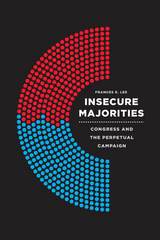
With Insecure Majorities, Frances E. Lee offers a controversial new perspective on the rise of congressional party conflict, showing how the shift in competitive circumstances has had a profound impact on how Democrats and Republicans interact. For nearly half a century, Democrats were the majority party, usually maintaining control of the presidency, the House, and the Senate. Republicans did not stand much chance of winning majority status, and Democrats could not conceive of losing it. Under such uncompetitive conditions, scant collective action was exerted by either party toward building or preserving a majority. Beginning in the 1980s, that changed, and most elections since have offered the prospect of a change of party control. Lee shows, through an impressive range of interviews and analysis, how competition for control of the government drives members of both parties to participate in actions that promote their own party’s image and undercut that of the opposition, including the perpetual hunt for issues that can score political points by putting the opposing party on the wrong side of public opinion. More often than not, this strategy stands in the way of productive bipartisan cooperation—and it is also unlikely to change as long as control of the government remains within reach for both parties.

On March 4, 1789, New York City's church bells pealed, cannons fired, and flags snapped in the wind to celebrate the date set for the opening of the First Federal Congress. In many ways the establishment of Congress marked the culmination of the American Revolution as the ship of state was launched from the foundation of the legislative system outlined in Article I of the Constitution.
Inventing Congress presents the latest scholarship on the interrelated intellectual, institutional, cultural, and political antecedents of the formation of the First Federal Congress. The first section covers the origins of the body, ranging in discussion from the question of how the founders' understanding of classical Greek and Roman republican precedent shaped their thinking, to the political lessons learned during the Continental and Confederation Congresses.
The second section concerns itself with the establishment of the First Federal Congress, examining several heretofore little-treated aspects of the most important Congress in history, including its relationship to the press, morality, the arts and sciences, and economic philosophy.
Inventing Congress represents the papers from the first two conferences sponsored by the United States Capitol Historical Society in its series, “Perspectives on the History of Congress, 1789-1801.”
READERS
Browse our collection.
PUBLISHERS
See BiblioVault's publisher services.
STUDENT SERVICES
Files for college accessibility offices.
RECENTLY PUBLISHED






UChicago Accessibility Resources
home | accessibility | search | about | contact us
BiblioVault ® 2001 - 2025
The University of Chicago Press