
 A SCHOLARLY BOOK REPOSITORY
11 start with J start with J
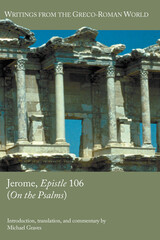
A fresh interpretation of the nature, purpose, and date of Jerome’s Epistle 106
In this volume of the Writings from the Greco-Roman World series, Michael Graves offers the first accessible English translation and commentary on Jerome’s Epistle 106, an important work of patristic biblical interpretation. In his treatise Jerome discusses different textual and exegetical options according to various Greek and Latin copies of the Psalms with input from the Hebrew. Epistle 106 provides insightful commentary on the Gallican Psalter, Jerome’s translation of Origen’s hexaplaric edition. Jerome’s work offers a unique window into the complex textual state of the Psalter in the late fourth century and serves as an outstanding example of ancient philological scholarship on the Bible. Graves’s translation and commentary is an essential resource for scholars and students of patristic exegesis, biblical textual criticism, and late antique Christianity.
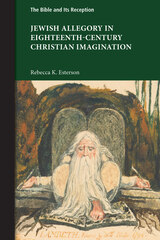
Rebecca K. Esterson explores how Christian methods of biblical interpretation shifted during the eighteenth century, producing a rhetorical rejection of allegory while embracing literalism. Under the influence of Enlightenment concepts of human reason and advances in the experimental sciences, Christian interpreters began casting Jewish biblical interpretation as allegorical, while presenting Christian interpretation as literal. This shift in self-understanding allowed Christians to portray their own interpretations as scientifically, philosophically, and historically superior, resulting in a new way of othering the Jewish people. This study of biblical exegesis, theology, philosophy, and the arts in English, Swedish, and German contexts is an essential resource for scholars interested in biblical reception history and the history of Jewish-Christian relations.
Greco-Roman antiquity’s premier Jewish historian.
Josephus, soldier, statesman, historian, was a Jew born at Jerusalem about AD 37. A man of high descent, he early became learned in Jewish law and Greek literature and was a Pharisee. After pleading in Rome the cause of some Jewish priests he returned to Jerusalem and in 66 tried to prevent revolt against Rome, managing for the Jews the affairs of Galilee. In the troubles that followed he made his peace with Vespasian. Present at the siege of Jerusalem by Titus, he received favors from these two as emperors and from Domitian, and assumed their family name Flavius. He died after 97.
As a historical source Josephus is invaluable. His major works are: History of the Jewish War, in seven books, from 170 BC to his own time, first written in Aramaic but translated by himself into the Greek we now have; and Jewish Antiquities, in twenty books, from the creation of the world to AD 66. The Loeb Classical Library edition of the works of Josephus, which is in thirteen volumes, also includes the autobiographical Life and his treatise Against Apion.
Greco-Roman antiquity’s premier Jewish historian.
Josephus, soldier, statesman, historian, was a Jew born at Jerusalem about AD 37. A man of high descent, he early became learned in Jewish law and Greek literature and was a Pharisee. After pleading in Rome the cause of some Jewish priests he returned to Jerusalem and in 66 tried to prevent revolt against Rome, managing for the Jews the affairs of Galilee. In the troubles that followed he made his peace with Vespasian. Present at the siege of Jerusalem by Titus, he received favors from these two as emperors and from Domitian, and assumed their family name Flavius. He died after 97.
As a historical source Josephus is invaluable. His major works are: History of the Jewish War, in seven books, from 170 BC to his own time, first written in Aramaic but translated by himself into the Greek we now have; and Jewish Antiquities, in twenty books, from the creation of the world to AD 66. The Loeb Classical Library edition of the works of Josephus, which is in thirteen volumes, also includes the autobiographical Life and his treatise Against Apion.
Greco-Roman antiquity’s premier Jewish historian.
Josephus, soldier, statesman, historian, was a Jew born at Jerusalem about AD 37. A man of high descent, he early became learned in Jewish law and Greek literature and was a Pharisee. After pleading in Rome the cause of some Jewish priests he returned to Jerusalem and in 66 tried to prevent revolt against Rome, managing for the Jews the affairs of Galilee. In the troubles that followed he made his peace with Vespasian. Present at the siege of Jerusalem by Titus, he received favors from these two as emperors and from Domitian, and assumed their family name Flavius. He died after 97.
As a historical source Josephus is invaluable. His major works are: History of the Jewish War, in seven books, from 170 BC to his own time, first written in Aramaic but translated by himself into the Greek we now have; and Jewish Antiquities, in twenty books, from the creation of the world to AD 66. The Loeb Classical Library edition of the works of Josephus, which is in thirteen volumes, also includes the autobiographical Life and his treatise Against Apion.
Greco-Roman antiquity’s premier Jewish historian.
Josephus, soldier, statesman, historian, was a Jew born at Jerusalem about AD 37. A man of high descent, he early became learned in Jewish law and Greek literature and was a Pharisee. After pleading in Rome the cause of some Jewish priests he returned to Jerusalem and in 66 tried to prevent revolt against Rome, managing for the Jews the affairs of Galilee. In the troubles that followed he made his peace with Vespasian. Present at the siege of Jerusalem by Titus, he received favors from these two as emperors and from Domitian, and assumed their family name Flavius. He died after 97.
As a historical source Josephus is invaluable. His major works are: History of the Jewish War, in seven books, from 170 BC to his own time, first written in Aramaic but translated by himself into the Greek we now have; and Jewish Antiquities, in twenty books, from the creation of the world to AD 66. The Loeb Classical Library edition of the works of Josephus, which is in thirteen volumes, also includes the autobiographical Life and his treatise Against Apion.
An accessible point of entry into the rich medieval religious landscape of Jewish biblical exegesis s
Medieval Judeo-Arabic translations of the Hebrew Bible and their commentaries provide a rich source for understanding a formative period in the intellectual, literary, and cultural history and heritage of Jews in Islamic lands. The carefully selected texts in this volume offer intriguing insight into Arabic translations and commentaries by Rabbanite and Karaite Jewish exegetes from the tenth to the twelfth centuries CE, arranged according to the three divisions of the Torah, the Former and Latter Prophets, and the Writings. Each text is embedded within an essay discussing its exegetical context, reception, and contribution.
Features:
- Focus on underrepresented medieval Jewish commentators of the Eastern world
- A list of additional resources, including major Judeo-Arabic commentators in the medieval period
- Previously unpublished texts from the Cairo Geniza
The first Greek text of the Epistle of Aristeas published in more than a century
The Greek text Epistle of Aristeas is a Jewish work of the late Hellenistic period that recounts the origins of the Septuagint. Long recognized as a literary fiction, the Epistle of Aristeas has been variously dated from the third century BCE to the first century CE. As a result, its epistolary features, and especially those in which the putative author, Aristeas, addresses his brother and correspondent, Philocrates, have largely been ignored. In light of more recent scholarship on epistolary literature in the Greco-Roman world, however, this volume presents for the first time a complete Greek text and English Translation with introduction, notes, and commentary of the Epistle of Aristeas with key testimonia from Philo, Josephus, and Eusebius, as well as other related examples of Jewish fictional letters from the Apocrypha and Pseudepigrapha.
Features
- Relevant excerpts from Eupolemus, 2 Maccabees, 3 Maccabees, and the Greek Additions to Esther with translations and introductions
- A critical introduction to ancient Greek letter-writing
- An outline of epistolary features in the text
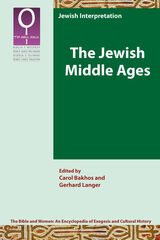
For many, the Middle Ages in general evokes a sense of the sinister and brings to mind a world of fear, superstition, and religious fanaticism. For Jews it was a period marked by persecutions, pogroms, and expulsions. Yet at the same time, the Middle Ages was also a time of lively cultural exchange and heightened creativity for Jews. In The Jewish Middle Ages, contributors explore the ways in which the stories of biblical women, including, Eve, Sarah, Hagar, Rebekah, Zipporah, Ruth, Esther, and Judith, make their way into the rich tapestry of medieval Jewish literature, mystical texts, and art, particularly in works emanating from Ashkenazic circles. Contributors include Carol Bakhos, Judith R. Baskin, Elisheva Baumgarten, Dagmar Börner-Klein, Constanza Cordoni, Rachel Elior, Meret Gutmann-Grün, Robert A. Harris, Yuval Katz-Wilfing, Sheila Tuller Keiter, Katrin Kogman-Appel, Gerhard Langer, Aurora Salvatierra Ossorio, and Felicia Waldman. These essays give us a glimpse into the role women played and the authority they assumed in medieval Jewish culture beyond the rabbinic centers of Palestine and Babylonia.
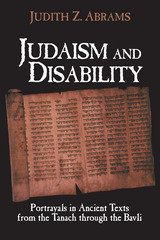
In Judaism and Disability, the archaic portrayals of mentally ill, mentally retarded, physically affected, deaf, blind, and other disabled people reflect the sharp contrast they presented compared to the unchanging Judaic ideal of the “perfect priest.” All of these sources describe this perfection as embodied in a person who is male, free, unblemished, with da’at (cognition that can be communicated), preferably learned, and a priest. The failure to have da’at stigmatized disabled individuals, who were also compromised by the treatment they received from nondisabled people, who were directing and constraining.
As the Judaic ideal transformed from the bodily perfection of the priest in the cult to intellectual prowess in the Diaspora, a parallel change of attitudes toward disabled persons gradually occurred. The reduced emphasis upon physical perfection as a prerequisite for a relationship with God eventually enabled the enfranchisement of some disabled people and other minorities. Scholars, students, and other readers will find the engrossing process disclosed in Judaism and Disability one that they can apply to a variety of other disciplines.
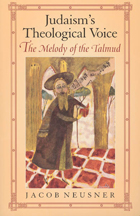
In his attempt to answer these questions, Neusner sets forth the character and the form of the Torah as sung theology. Israel, the holy community, meets God in the synagogue, while at prayer, and in the yeshiva, when studying the Torah—at the moment in each setting when the Torah is received. In both circumstances people do not read but sing out its words. With the written part of the Torah sung in the synagogue, and the oral part declaimed in centers of sacred learning, music provides the medium for Judaism's theological voice.
Neusner identifies a reciprocal exchange between the holy community Israel and God: Israel sings to God when the Torah is studied, and God sings to Israel when the Torah is declaimed. Through the metaphor of music, Neusner offers an account of how he believes those faithful to the Torah meet God in the Torah, and how they should listen to the melody of God's self-revelation. The result is an original theological reflection that will interest all students of Judaism.
READERS
Browse our collection.
PUBLISHERS
See BiblioVault's publisher services.
STUDENT SERVICES
Files for college accessibility offices.
RECENTLY PUBLISHED






UChicago Accessibility Resources
home | accessibility | search | about | contact us
BiblioVault ® 2001 - 2025
The University of Chicago Press