
 A SCHOLARLY BOOK REPOSITORY
6 start with L start with L
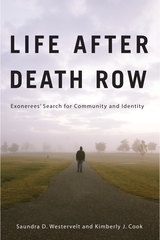
Life after Death Row examines the post-incarceration struggles of individuals who have been wrongly convicted of capital crimes, sentenced to death, and subsequently exonerated.
Saundra D. Westervelt and Kimberly J. Cook present eighteen exonerees’ stories, focusing on three central areas: the invisibility of the innocent after release, the complicity of the justice system in that invisibility, and personal trauma management. Contrary to popular belief, exonerees are not automatically compensated by the state or provided adequate assistance in the transition to post-prison life. With no time and little support, many struggle to find homes, financial security, and community. They have limited or obsolete employment skills and difficulty managing such daily tasks as grocery shopping or banking. They struggle to regain independence, self-sufficiency, and identity.
Drawing upon research on trauma, recovery, coping, and stigma, the authors weave a nuanced fabric of grief, loss, resilience, hope, and meaning to provide the richest account to date of the struggles faced by people striving to reclaim their lives after years of wrongful incarceration.
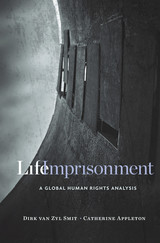
Life imprisonment has replaced capital punishment as the most common sentence imposed for heinous crimes worldwide. As a consequence, it has become the leading issue in international criminal justice reform. In the first global survey of prisoners serving life terms, Dirk van Zyl Smit and Catherine Appleton argue for a human rights–based reappraisal of this exceptionally harsh punishment. The authors estimate that nearly half a million people face life behind bars, and the number is growing as jurisdictions both abolish death sentences and impose life sentences more freely for crimes that would never have attracted capital punishment. Life Imprisonment explores this trend through systematic data collection and legal analysis, persuasively illustrated by detailed maps, charts, tables, and comprehensive statistical appendices.
The central question—can life sentences be just?—is straightforward, but the answer is complicated by the vast range of penal practices that fall under the umbrella of life imprisonment. Van Zyl Smit and Appleton contend that life imprisonment without possibility of parole can never be just. While they have some sympathy for the jurisprudence of the European Court of Human Rights, they conclude that life imprisonment, in many of the ways it is implemented worldwide, infringes on the requirements of justice. They also examine the outliers—states that have no life imprisonment—to highlight the possibility of abolishing life sentences entirely.
Life Imprisonment is an incomparable resource for lawyers, lawmakers, criminologists, policy scholars, and penal-reform advocates concerned with balancing justice and public safety.
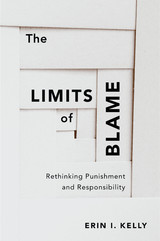
Faith in the power and righteousness of retribution has taken over the American criminal justice system. Approaching punishment and responsibility from a philosophical perspective, Erin Kelly challenges the moralism behind harsh treatment of criminal offenders and calls into question our society’s commitment to mass incarceration.
The Limits of Blame takes issue with a criminal justice system that aligns legal criteria of guilt with moral criteria of blameworthiness. Many incarcerated people do not meet the criteria of blameworthiness, even when they are guilty of crimes. Kelly underscores the problems of exaggerating what criminal guilt indicates, particularly when it is tied to the illusion that we know how long and in what ways criminals should suffer. Our practice of assigning blame has gone beyond a pragmatic need for protection and a moral need to repudiate harmful acts publicly. It represents a desire for retribution that normalizes excessive punishment.
Appreciating the limits of moral blame critically undermines a commonplace rationale for long and brutal punishment practices. Kelly proposes that we abandon our culture of blame and aim at reducing serious crime rather than imposing retribution. Were we to refocus our perspective to fit the relevant moral circumstances and legal criteria, we could endorse a humane, appropriately limited, and more productive approach to criminal justice.
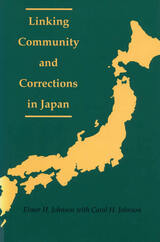
Completing Elmer H. Johnson’s impressive three-volume examination of corrections in Japan, Linking Community and Corrections in Japan (written with the assistance of Carol H. Johnson) focuses on the Rehabilitation Bureau’s responsibilities regarding probation, parole, and aftercare as well as the Correction Bureau’s role in Japan’s version of community-oriented corrections. Johnson first outlines the tasks of the Rehabilitation Bureau, then turns to historical and contemporary views of community and corrections. In discussions of the probation and parole system for both adults and juveniles, he describes in detail the Japanese version of supervision and the return of prisoners to the community. One strength of this study is Johnson’s impartiality. As an investigator, he functions as a "friend of the court," an adviser who is free to conduct an objective pursuit of the fundamental strengths and shortcomings of the Japanese prison system. He also follows the Foucauldian dictum: "With the prisons there would be no sense of limiting oneself to discourses about prisons; just as important are the discourses which arise within the prison, the decisions and regulations which are among its constituent elements, its means of functioning, along with its strategies."
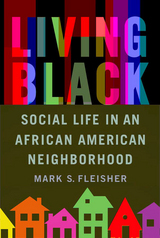
Mark S. Fleisher offers a window into daily life in this neighborhood, particularly through the stories of Mo and Memphis Washington, who fight to sustain a stable home for their children, and of Burpee, a local man who has returned to the North End to rebuild his life after years of crime and punishment in Chicago.
“Outstanding” books for public & secondary school libraries from university presses, American Library Association
READERS
Browse our collection.
PUBLISHERS
See BiblioVault's publisher services.
STUDENT SERVICES
Files for college accessibility offices.
RECENTLY PUBLISHED



UChicago Accessibility Resources
home | accessibility | search | about | contact us
BiblioVault ® 2001 - 2025
The University of Chicago Press