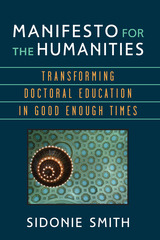
front cover of Manifesto for the Humanities
Manifesto for the Humanities
Transforming Doctoral Education in Good Enough Times
Sidonie Smith
University of Michigan Press, 2015
After a remarkable career in higher education, Sidonie Smith offers Manifesto for the Humanities as a reflective contribution to the current academic conversation over the place of the Humanities in the 21st century. Her focus is on doctoral education and opportunities she sees for its reform.
 
Grounding this manifesto in background factors contributing to current “crises” in the humanities, Smith advocates for a 21st century doctoral education responsive to the changing ecology of humanistic scholarship and teaching. She elaborates a more expansive conceptualization of coursework and dissertation, a more robust, engaged public humanities, and a more diverse, collaborative, and networked sociality.
[more]

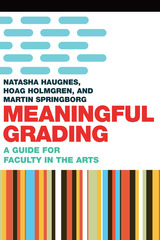
front cover of Meaningful Grading
Meaningful Grading
A Guide for Faculty in the Arts
Hoag Holmgren
West Virginia University Press, 2018

College and university faculty in the arts (visual, studio, language, music, design, and others) regularly grade and assess undergraduate student work but often with little guidance or support. As a result, many arts faculty, especially new faculty, adjunct faculty, and graduate student instructors, feel bewildered and must “reinvent the wheel” when grappling with the challenges and responsibilities of grading and assessing student work.

Meaningful Grading: A Guide for Faculty in the Arts enables faculty to create and implement effective assessment methodologies—research based and field tested—in traditional and online classrooms. In doing so, the book reveals how the daunting challenges of grading in the arts can be turned into opportunities for deeper student learning, increased student engagement, and an enlivened pedagogy.


[more]

front cover of Medieval History in the Modern Classroom
Medieval History in the Modern Classroom
Using Project-Based Learning to Engage Today’s Learners
Lane J. Sobehrad
Arc Humanities Press, 2022

Teaching medieval history should engage students in the real work of professional medievalists. However, many undergraduate courses rely on instructional strategies that only engage students in rote retention of medieval "stuff" and unsupported writing assignments. With trends in the USA and elsewhere showing declining undergraduate enrollment in the humanities and an increasing number of questions from university administrators regarding the utility of the liberal arts, historians need to reassess how they teach. Project-based learning (PBL) is one approach that may help medieval history instructors offer coursework that is more engaging for today's undergraduate students and provide administrators a clearer picture of the utility of studying the past. The pedagogy of PBL actively engages students in projects reflective of the real work being done by medievalists, allowing instructors to move beyond the traditional narrative found in many undergraduate survey courses. This book provides an overview of PBL theory, methods for incorporating PBL into an undergraduate medieval history course, instructional strategies, scalable assessment formats, and other resources useful for any history classroom.

[more]


Send via email Share on Facebook Share on Twitter