
 A SCHOLARLY BOOK REPOSITORY
6 start with M start with M
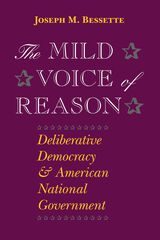
Drawing on original research, case studies of policymaking in Congress, and portraits of American lawmakers, Bessette demonstrates not only the limitations of nondeliberative explanations for how laws are made but also the continued vitality of genuine reasoning on the merits of public policy. Bessette discusses the contributions of the executive branch to policy deliberation, and looks at the controversial issue of the proper relationship of public opinion to policymaking.
Informed by Bessette's nine years of public service in city and federal government, The Mild Voice of Reason offers important insights into the real workings of American democracy, articulates a set of standards by which to assess the workings of our governing institutions, and clarifies the forces that promote or inhibit the collective reasoning about common goals so necessary to the success of American democracy.
"No doubt the best-publicized recent book-length work on Congress is columnist George Will's diatribe in praise of term limits in which the core of his complaint is that Congress does not deliberate in its decision-making. Readers who are inclined to share that fantasy would do well to consult the work of Joseph M. Bessette. He turns up massive amounts of material attesting to the centrality of deliberation in congressional life."—Nelson W. Polsby, Presidential Studies Quarterly
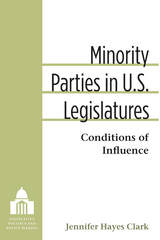
Challenging conventional assumptions that the majority party dominates the legislature, Jennifer Hayes Clark investigates precisely the ways in which—and under what conditions—members of the minority party successfully pursue their interests. For this study, Clark collects fine-grained data from both the U.S. Congress and state legislatures to get a close look at three key points in the legislative process: committee assignments, bill cosponsorship, and roll-call votes. She finds that minority party members are not systematically excluded throughout the policymaking process. Indeed, their capacity to shape legislative decision-making is enhanced when party polarization is low, when institutional prerogatives are broadly dispersed rather than centralized, and when staff resources are limited. Under these conditions, bipartisanship bill cosponsorship and voting coalitions are also more prevalent.
With the sharp increase of partisan polarization in state legislatures and in Congress, it is essential to understand how and when a minority party can effectively represent constituents.
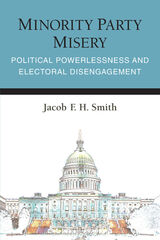
This book examines the role of minority party status on politicians’ engagement in electoral politics. Jacob Smith argues that politicians are more likely to be engaged in electoral politics when they expect their party to be in the majority in Congress after the next election and less likely when they anticipate their party will be in the minority. This effect is particularly likely to hold true in recent decades where parties disagree on a substantial number of issues. Politicians whose party will be in the majority have a clear incentive to engage in electoral politics because their preferred policies have a credible chance of passing if they are in the majority. In contrast, it is generally difficult for minority party lawmakers to get a hearing on—much less advance—their preferred policies, particularly when institutional rules inside Congress favor the majority party. Instead, minority party lawmakers spend most of their time fighting losing battles against policy proposals from the majority party. Minority Party Misery examines the consequences of the powerlessness that politicians feel from continually losing battles to the majority party in Congress. Its findings have important consequences for democratic governance, as highly qualified minority party politicians may choose to leave office due to their dismal circumstances rather than continue to serve until their party eventually reenters the majority.
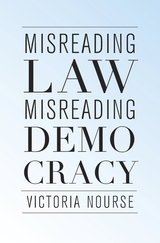
American law schools extol democracy but teach little about its most basic institution, the Congress. Interpreting statutes is lawyers’ most basic task, but law professors rarely focus on how statutes are made. This misguided pedagogy, says Victoria Nourse, undercuts the core of legal practice. It may even threaten the continued functioning of American democracy, as contempt for the legislature becomes entrenched in legal education and judicial opinions. Misreading Law, Misreading Democracy turns a spotlight on lawyers’ and judges’ pervasive ignorance about how Congress makes law.
Victoria Nourse not only offers a critique but proposes reforming the way lawyers learn how to interpret statutes by teaching legislative process. Statutes are legislative decisions, just as judicial opinions are decisions. Her approach, legislative decision theory, reverse-engineers the legislative process to simplify the task of finding Congress’s meanings when statutes are ambiguous. This theory revolutionizes how we understand legislative history—not as an attempt to produce some vague notion of legislative intent but as a surgical strike for the best evidence of democratic context.
Countering the academic view that the legislative process is irrational and unseemly, Nourse makes a forceful argument that lawyers must be educated about the basic procedures that define how Congress operates today. Lawmaking is a sequential process with political winners and losers. If lawyers and judges do not understand this, they may well embrace the meanings of those who opposed legislation rather than those who supported it, making legislative losers into judicial winners, and standing democracy on its head.

A data-rich, eye-opening look at how, when, and why political fundraising is consequential.
Over the last two decades, the number of competitive congressional races has declined precipitously. Yet candidates and officeholders dial for more and more dollars each election, and they do so earlier and earlier in the campaign cycle.
In The Money Signal, Danielle M. Thomsen offers a new perspective on the role of money in politics. She shows that fundraising matters because it is widely used as an indicator of a candidate’s viability and strength, which shapes subsequent donations, dropout decisions, media attention, and rewards in office. Put simply, money is a focal point that candidates, donors, journalists, and party leaders rally around. For candidates, fundraising is a highly public form of self-presentation that pays dividends long before the election and well after the votes are cast.
Thomsen draws on comprehensive fundraising data that spans more than four decades, in addition to interviews, surveys of candidates and donors, newspaper coverage, committee assignments, and analysis of legislative success. The Money Signal highlights the numerous ways that dollars influence the perceptions and behavior of key actors and observers throughout the election cycle.
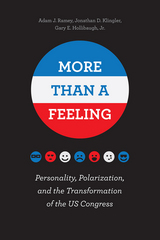
With More Than a Feeling, Adam J. Ramey, Jonathan D. Klingler, and Gary E. Hollibaugh, Jr. have developed an innovative framework incorporating what are known as the Big Five dimensions of personality—openness to experience, conscientiousness, extraversion, agreeableness, and neuroticism—to improve our understanding of political behavior among members of Congress. To determine how strongly individuals display these traits, the authors identified correlates across a wealth of data, including speeches, campaign contributions and expenditures, committee involvement, willingness to filibuster, and even Twitter feeds. They then show how we might expect to see the influence of these traits across all aspects of Congress members’ political behavior—from the type and quantity of legislation they sponsor and their style of communication to whether they decide to run again or seek a higher office. They also argue convincingly that the types of personalities that have come to dominate Capitol Hill in recent years may be contributing to a lot of the gridlock and frustration plaguing the American political system.
READERS
Browse our collection.
PUBLISHERS
See BiblioVault's publisher services.
STUDENT SERVICES
Files for college accessibility offices.
RECENTLY PUBLISHED




UChicago Accessibility Resources
home | accessibility | search | about | contact us
BiblioVault ® 2001 - 2025
The University of Chicago Press