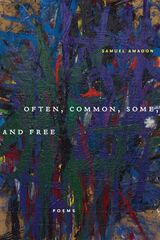
front cover of Often, Common, Some, and Free
Often, Common, Some, and Free
Samuel Amadon
Omnidawn, 2021
Poems considering ever-present transformations and resisting destruction.
 
This is a book about transformation. Moving across varied formal and aesthetic terrains, these poems take on the subject of change, considering the construction and demolition of buildings, roaming between cities, and drawing together an image of a world in flux. The speaker is in movement—walking, flying, swimming, and taking the train, while also constantly twisting in his sentences, turning into different versions of himself, and braiding his voice with others. These poems take on subjects that encompass creation and loss from Robert Moses’s career transforming the cityscape of New York to the robbery of works from Boston’s Gardner Museum. But, ultimately, these poems aim to resist destruction, to focus on the particular, and to hold still their world and their ever-shifting speaker.
 
[more]

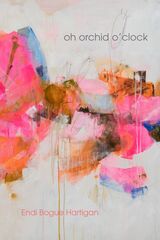
front cover of oh orchid o’clock
oh orchid o’clock
Endi Bogue Hartigan
Omnidawn, 2023
Poems that break down, expose, and reconsider our notions of time.
 
This collection speaks the language of the clock as a living instrument, exposing the sensory impacts of our obsession with time. In oh orchid o’clock, lyrics wind through histories like a nervous system through a body. The poems speak to how we let our days become over-clocked, over-transactional, and over-weaponed. With an instrumental sensibility, Endi Bogue Hartigan investigates what it is to be close to time—collective time, with its alarms and brutalities, and bodily time, intricate and familial. She considers how can we be both captured and complicit within systems of measurement, and she invites us to imagine how to break from, create, or become immune to them. Her poems use language to expose the face of the clock to reveal how gears press against interconnecting systems—economic, capitalist, astronomical, medical, governmental, and fantastical.
 
[more]

logo for Omnidawn
Omitting All That Is Usually Said
Robin Caton
Omnidawn, 2024
Poems that consider the complexities of human life and the ways that we perceive reality.
 
In Omitting All That is Usually Said, Robin Caton explores the nature of light, form, language, meaning, and thought, alongside the complexity of their interwoven relationships. Caton interrogates the workings of the human mind and explores the way we integrate disparate perceptions. Caton questions whether we can be certain that things really exist and that all we experience isn’t simply a play of light and shadow. She considers how we live with all the limitations and emotional turmoil imbedded in humanity, while also maintaining a sense of something we call perfection. The poems of Omitting All That is Usually Said investigate how we might capture the depths of conflicting experiences and lived knowledge in ways that we can comprehend, and they marvel at how we find delight in all of it.
 
[more]

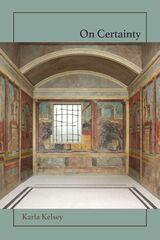
front cover of On Certainty
On Certainty
Karla Kelsey
Omnidawn, 2023
Lyrical poems that tell the story of a nameless woman navigating a technological dystopia.
 
In the poems of On Certainty, an unnamed woman in a strangely familiar dystopia narrates a story of power and decline, where the Tyrant has gained ascendency and the Philosopher is dying. Here, the Tyrant rules over a decimated ecology filled with android deer, burnt towns, and exhausted individuals dependent on virtual reality augmentation. In choosing whether to take the Philosopher’s place in a struggle against the Tyrant, the narrator must consider how her decision may perpetuate the currently existing catastrophic systems.
 
Weaving together speculative fiction, philosophical aphorism, lyric fragment, and documentary technique, On Certainty echoes the contemporary world that can feel simultaneously quotidian and strange.
[more]

front cover of On Spec
On Spec
Tyrone Williams
Omnidawn, 2007
Tyrone Williams reveals that every act of communication is a speculation, and that the spectacles we must use to see and assess it—those of our own particular condition and conditioning—are never without qualifying contour and coloration. Williams is a keen observer of the distortions of such lenses, as the titles of the two sections of this collection suggest—first is an “Eshuneutics” (interpretation purportedly infused with an Eshu’s sensibility). But the trickster’s eye can turn to mock even its own powers of analysis, as Williams deftly demonstrates by calling the second section “Pseudo-eshuneutics.” While the issues that Williams confronts come directly from an attempt say what it might mean to understand aspects of the African American condition of diaspora in the United States, these poems also implicate and illuminate the speculative enterprise that we each venture into whenever we attempt to articulate what we see and what we believe about it. At once immediately readable, intensely meditative, and brilliantly braced with philosophical reference, these tours through our human need to speak, and to understand, travel beyond the boundaries that constrain most poetry collections. Poems, plays, plays upon the making of such genre distinctions, are only some of the locations one will visit in these pages.
[more]

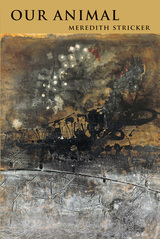
front cover of Our Animal
Our Animal
Meredith Stricker
Omnidawn, 2016
Our Animal hybridizes novel flaking into poetic forms like a gnat swarm, magnetic filings, or migratory flux. It’s a fierce inquiry into Othering, tracking Kafka’s life through his deep identification with animals, especially those hunted or outcast. Graphically complex with metamorphic text layers, the chapters shape-shift in relation to crows, dragonflies, a frog; there are deer, swallows, a goldfinch, humans, a hybrid Beast, wolf, Insekt, a small unidentified animal in its burrow. We are entangled in biography as biology— paradisiacal transfiguration that leaves out no being.

Our Animal is the winner of the 2014 Omnidawn Poetry Open Book Contest, selected by Mary Jo Bang.
[more]


Send via email Share on Facebook Share on Twitter