
 A SCHOLARLY BOOK REPOSITORY
308 start with P start with P
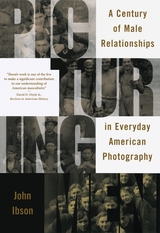
Such is the time John Ibson evokes in Picturing Men, a striking visual record of changes in attitudes about relationships between gentlemen, soldiers, cowboys, students, lumberjacks, sailors, and practical jokers. Spanning from 1850 to 1950, the 142 everyday photographs that richly illustrate Picturing Men radiate playfulness, humor, and warmth. They portray a lost world for American men: a time when their relationships with each other were more intimate than they commonly are today, regardless of sexual orientation. Picturing Men starkly contrasts the calm affection displayed in earlier photographs with the absence of intimacy in photos from the mid-1950s on. In doing so, this lively, accessible book makes a significant contribution to American history and cultural studies, gender studies, and the history of photography.
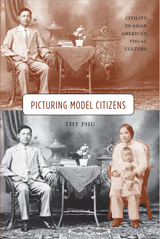
At the heart of the model minority myth—often associated with Asian Americans—is the concept of civility. In this groundbreaking book, Picturing Model Citizens, Thy Phu exposes the complex links between civility and citizenship, and argues that civility plays a crucial role in constructing Asian American citizenship.
Featuring works by Arnold Genthe, Carl Iwasaki, Toyo Miyatake, Nick Ut, and others, Picturing Model Citizens traces the trope of civility from the nineteenth to the twenty-first centuries. Through an examination of photographs of Chinese immigrants, Japanese internment camps, the Hiroshima Maidens project, napalm victims, and the SARS epidemic, Phu explores civility's unexpected appearance in images that draw on discourses of intimacy, cultivation, apology, and hygiene. She reveals how Asian American visual culture illustrates not only cultural ideas of civility, but also contests the contradictions of state-defined citizenship.

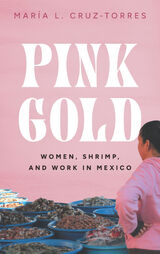
A rich, long-term ethnography of women seafood traders in Mexico.
The "shrimp ladies," locally known as changueras in southern Sinaloa, Mexico, sell seafood in open-air markets, forming an extralegal but key part of the economy built around this "pink gold.” Over time, they struggled to evolve from marginalized peddlers to local icons depicted in popular culture, even as they continue to work at an open-air street market.
Pink Gold documents the shrimp traders' resilience and resourcefulness, from their early conflicts with the city, state, and federal authorities and forming a union, to carving out a physical space for a seafood market, and even engaging in conflicts with the Mexican military. Drawing from her two decades of fieldwork, María L. Cruz-Torres explores the inspiring narrative of this overlooked group of women involving grassroots politics, trans-border and familial networking, debt and informal economic practices, personal sacrifices, and simple courage. She argues that, amid intense economic competition, their success relies on group solidarity that creates interlocking networks of mutual trust, or confianza, that in turn enable them to cross social and political boundaries that would typically be closed to them. Ultimately, Pink Gold offers fresh insights into issues of gender and labor, urban public space, the street economy, commodities, and globalization.

Who says you can’t be pious and fashionable? Throughout the Muslim world, women have found creative ways of expressing their personality through the way they dress. Headscarves can be modest or bold, while brand-name clothing and accessories are part of a multimillion-dollar ready-to-wear industry that caters to pious fashion from head to toe. In this lively snapshot, Liz Bucar takes us to Iran, Turkey, and Indonesia and finds a dynamic world of fashion, faith, and style.
“Brings out both the sensuality and pleasure of sartorial experimentation.”
—Times Literary Supplement
“I defy anyone not to be beguiled by [Bucar’s] generous-hearted yet penetrating observation of pious fashion in Indonesia, Turkey and Iran… Bucar uses interviews with consumers, designers, retailers and journalists…to examine the presumptions that modest dressing can’t be fashionable, and fashion can’t be faithful.”
—Times Higher Education
“Bucar disabuses readers of any preconceived ideas that women who adhere to an aesthetic of modesty are unfashionable or frumpy.”
—Robin Givhan, Washington Post
“A smart, eye-opening guide to the creative sartorial practices of young Muslim women… Bucar’s lively narrative illuminates fashion choices, moral aspirations, and social struggles that will unsettle those who prefer to stereotype than inform themselves about women’s everyday lives in the fast-changing, diverse societies that constitute the Muslim world.”
—Lila Abu-Lughod, author of Do Muslim Women Need Saving?
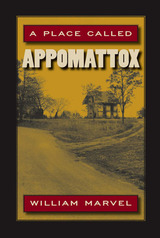
In A Place Called Appomattox, William Marvel turns his extensive Civil War scholarship toward Appomattox County, Virginia, and the village of Appomattox Court House, which became synonymous with the end of the Civil War when Robert E. Lee surrendered to Ulysses S. Grant there in 1865. Marvel presents a formidably researched and elegantly written analysis of the county from 1848 to 1877, using it as a microcosm of Southern attitudes, class issues, and shifting cultural mores that shaped the Civil War and its denouement.
With an eye toward correcting cultural myths and enriching the historical record, Marvel analyzes the rise and fall of the village and county from 1848 to 1877, detailing the domestic economic and social vicissitudes of the village, and setting the stage for the flight of Lee’s Army toward Appomattox and the climactic surrender that still resonates today.
Now available for the first time in paperback, A Place Called Appomattox reveals a new view of the Civil War, tackling some of the thorniest issues often overlooked by the nostalgic exaggerations and historical misconceptions that surround Lee’s surrender.

In A Place for Inquiry, A Place for Wonder, historian William Robbins turns his attention to the long-overlooked Andrews Forest and argues for its importance to environmental science and policy. From its founding in 1948, the experimental forest has been the site of wide-ranging research. Beginning with postwar studies on the conversion of old-growth timber to fast-growing young stands, research at the Andrews shifted in the next few decades to long-term ecosystem investigations that focus on climate, streamflow, water quality, vegetation succession, biogeochemical cycling, and effects of forest management. The Andrews has thus been at the center of a dramatic shift in federal timber practices from industrial, intensive forest management policies to strategies emphasizing biodiversity and healthy ecosystems.

This volume considers the significance of stone monuments in Preclassic Mesoamerica, focusing on the period following the precocious appearance of monumental sculpture at the Olmec site of San Lorenzo and preceding the rise of the Classic polities in the Maya region and Central Mexico.
By quite literally “placing” sculptures in their cultural, historical, social, political, religious, and cognitive contexts, the seventeen contributors utilize archaeological and art historical methods to understand the origins, growth, and spread of civilization in Middle America. They present abundant new data and new ways of thinking about sculpture and society in Preclassic Mesoamerica, and call into question the traditional dividing line between Preclassic and Classic cultures. They offer not only a fruitful way of rethinking the beginnings of civilization in Mesoamerica, but provide a series of detailed discussions concerning how these beginnings were dynamically visualized through sculptural programming during the Preclassic period.
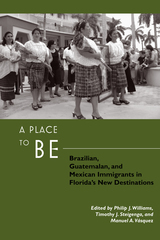
Contributors to this volume include Patricia Fortuny Loret de Mola, Carol Girón Solórzano, Silvia Irene Palma, Lúcia Ribeiro, Mirian Solfs Lizama, José Claúdio Souza Alves, Timothy J. Steigenga, Manuel A. Vásquez, and Philip J. Williams.
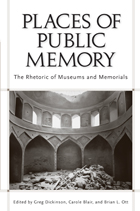
Though we live in a time when memory seems to be losing its hold on communities, memory remains central to personal, communal, and national identities. And although popular and public discourses from speeches to films invite a shared sense of the past, official sites of memory such as memorials, museums, and battlefields embody unique rhetorical principles.
Places of Public Memory: The Rhetoric of Museums and Memorials is a sustained and rigorous consideration of the intersections of memory, place, and rhetoric. From the mnemonic systems inscribed upon ancient architecture to the roadside accident memorials that line America’s highways, memory and place have always been deeply interconnected. This book investigates the intersections of memory and place through nine original essays written by leading memory studies scholars from the fields of rhetoric, media studies, organizational communication, history, performance studies, and English. The essays address, among other subjects, the rhetorical strategies of those vying for competing visions of a 9/11 memorial at New York City’s Ground Zero; rhetorics of resistance embedded in the plans for an expansion of the National Civil Rights Museum; representations of nuclear energy—both as power source and weapon—in Cold War and post–Cold War museums; and tours and tourism as acts of performance.
By focusing on “official” places of memory, the collection causes readers to reflect on how nations and local communities remember history and on how some voices and views are legitimated and others are minimized or erased.

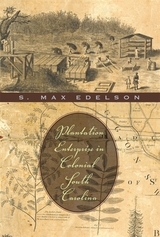
This impressive scholarly debut deftly reinterprets one of America's oldest symbols--the southern slave plantation. S. Max Edelson examines the relationships between planters, slaves, and the natural world they colonized to create the Carolina Lowcountry.
European settlers came to South Carolina in 1670 determined to possess an abundant wilderness. Over the course of a century, they settled highly adaptive rice and indigo plantations across a vast coastal plain. Forcing slaves to turn swampy wastelands into productive fields and to channel surging waters into elaborate irrigation systems, planters initiated a stunning economic transformation.
The result, Edelson reveals, was two interdependent plantation worlds. A rough rice frontier became a place of unremitting field labor. With the profits, planters made Charleston and its hinterland into a refined, diversified place to live. From urban townhouses and rural retreats, they ran multiple-plantation enterprises, looking to England for affirmation as agriculturists, gentlemen, and stakeholders in Britain's American empire. Offering a new vision of the Old South that was far from static, Edelson reveals the plantations of early South Carolina to have been dynamic instruments behind an expansive process of colonization.
With a bold interdisciplinary approach, Plantation Enterprise reconstructs the environmental, economic, and cultural changes that made the Carolina Lowcountry one of the most prosperous and repressive regions in the Atlantic world.
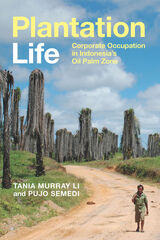


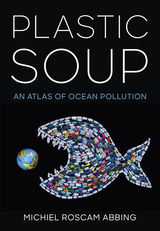
In Plastic Soup, Michiel Roscam Abbing of the Plastic Soup Foundation reveals the scope of the issue: plastic trash now lurks on every corner of the planet. With striking photography and graphics, Plastic Soup brings this challenge to brilliant life for readers. Yet it also sends a message of hope; although the scale of the problem is massive, so is the dedication of activists working to check it. Plastic Soup highlights a diverse array of projects to curb plastic waste and raise awareness, from plastic-free grocery stores to innovative laws and art installations.
According to some estimates, if we continue on our current path, the oceans will contain more plastic than fish by the year 2050. Created to inform and inspire readers, Plastic Soup is a critical tool in the fight to reverse this trend.
Imaginative and stimulating, Play and the Human Condition shows how play allows us to learn about our qualities and those of the world around us--and in so doing make sense of ourselves.
Published by Bucknell University Press. Distributed worldwide by Rutgers University Press.

"Play Redux excels in tying together intellectual traditions that are rooted in literary studies, cognitive science, play studies and several other fields, thereby creating a logical whole. Through this, the book makes service to several academic communities by pointing out their points of contact. This is clearly an important contribution to a growing academic field, and will no doubt become important in many future discussions about digital games and play."
---Frans Mäyrä, University of Tampere, Finland
"David Myers has researched video games longer than anyone else. Play Redux shows him continually relevant, never afraid of courting controversy."
---Jesper Juul, IT University of Copenhagen, Denmark
Play Redux is an ambitious description and critical analysis of the aesthetic pleasures of video game play, drawing on early twentieth-century formalist theory and models of literature. Employing a concept of biological naturalism grounded in cognitive theory, Myers argues for a clear delineation between the aesthetics of play and the aesthetics of texts. In the course of this study, Myers asks a number of interesting questions: What are the mechanics of human play as exhibited in computer games? Can these mechanisms be modeled? What is the evolutionary function of cognitive play, and is it, on the whole, a good thing? Intended as a provocative corrective to the currently ascendant, if not dominant, cultural and ethnographic approach to game studies and play, Play Redux will generate interest among scholars of communications, new media, and film.
David Myers is Reverend Aloysius B. Goodspeed Distinguished Professor at the School of Mass Communication, Loyola University New Orleans.
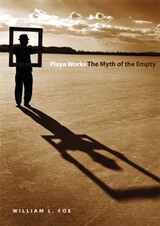
In eight brilliant essays, Fox explores many of the major playas of the American West , examining locations as diverse as Nellis Air Force Base and Frenchman Flat, where the federal government has tested experimental aircraft and atomic weaponry; the Great Salt Lake Desert, where land-speed records have been broken; and the Black Rock Desert of Northern Nevada, site of the colorful Burning Man arts festival. He analyzes the geological and climatological conditions that created the playas and the historical role that playas played in the exploration and settlement of the West. And he offers lucid and keenly perceptive discussions of the ways that artists have responded to the playas, from the ancient makers of geoglyphs to the work of contemporary artists who have found inspiration in these enigmatic spaces, including earthworks builder Michael Heizer, photographer Richard Misrach, and painter Michael Moore. The ensemble is a compelling combination of natural history, philosophy, and art criticism, a thoughtful meditation on humankind's aversion to and fascination with the void.
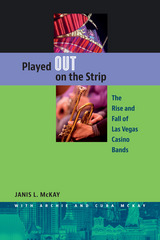
From 1940 to 1989, nearly every hotel on the Las Vegas Strip employed a full-time band or orchestra. After the late 1980s, when control of the casinos changed hands from independent owners to corporations, almost all of these musicians found themselves unemployed. Played Out on the Strip traces this major shift in the music industry through extensive interviews with former musicians.
In 1989, these soon-to-be unemployed musicians went on strike. Janis McKay charts the factors behind this strike, which was precipitated by several corporate hotel owners moving to replace live musicians with synthesizers and taped music, a strategic decision made in order to save money. The results of this transitional period in Las Vegas history were both long-lasting and far-reaching for the entertainment industry. With its numerous oral history interviews and personal perspectives from the era, this book will appeal to readers interested in Las Vegas history, music history, and labor issues.
Full of idiosyncratic characters and dramatic gameplay, Players and Pawns is a celebration of the fascinating world of serious chess.


Howard Nathan. A. J. Guyton. Sergio McClain. Marcus Griffin. Frank Williams. Shaun Livingston. This dazzling constellation of talent helped make Peoria a prep basketball hotbed from the 1980s to the 2000s. Jeff Karzen takes readers inside the lives of the players, coaches, and others who defined an era that produced six state titles and four Illinois Mr. Basketball winners.
Drawing on dozens of in-depth interviews, Karzen tells the stories behind the on-court triumphs while providing a panorama of the entire Peoria scene--the rivalries and relationships, the families and friendships, the hopes and hard work. Karzen also follows the players into their Division 1 and NBA careers and pays special attention to the pipeline that, by connecting Peoria to Champaign-Urbana, powered one of the most successful periods in Fighting Illini basketball history.
Intense and intimate, Playgrounds to the Pros chronicles a basketball golden age in America’s quintessential blue collar town.

As the Grim Reaper pulls a student out of class to be a “victim” of drunk driving in a program called “Every 15 Minutes,” Montana Miller observes the ritual through a folklorist’s lens. Playing Dead examines why hundreds of American schools and communities each year organize these mock tragedies without any national sponsorship or coordination. Often, the event is complete with a staged accident in the parking lot, a life-flight helicopter, and faux eulogies for the “dead” students read in school assemblies. Grounding her research in play theory, frame theory, and theory of folk drama, Miller investigates key aspects of this emergent tradition, paying particular attention to its unplanned elements—enabled by the performance’s spontaneous nature and the participants’ tendency to stray from the intended frame. Miller examines such variations in terms of the program as a whole, analyzing its continued popularity and weighing its success as perceived by participants. Her fieldwork reveals a surprising aspect of Every 15 Minutes that typical studies of ritual do not include: It can be fun. Playing Dead is volume two of the series Ritual, Festival, and Celebration, edited by Jack Santino.

Reproductive technology spans techniques ranging from cloning, surrogate motherhood, egg donation, and prenatal testing. In the early nineties, when public debate about this topic was new, the discourse focused on the moral and ethical issues that these new technologies evoked. Less than a decade later, the editors in Playing Dolly state, ethical questions seem less urgent. Enormous changes have taken place in the way that reproduction is represented, understood, and discussed.
The pieces, which range from the biomedical to the sociocultural and include even fiction, reflect the shift in public perception of these complex topics. They testify to the increasing acceptance of reproductive technology, and the resulting reduction in concern over the ethical issues raised by technological intervention.

In Playing Fans, Paul Booth argues that the more attention entertainment businesses pay to fans, the more mainstream fans have become popularized. But such mainstreaming ignores important creative fan work and tries to channel fandom into activities lucrative for the companies. Offering a new approach to the longstanding debate about the balance between manipulation and subversion in popular culture, the author argues that we can understand the current moment best through the concepts of pastiche and parody. This sophisticated alternative to conceiving of fans as either dupes of the media industry or rebels against it takes the discussion of “transformative” and “affirmative” fandom in a productive new direction.
With nuanced analyses of the Doctor Who Experience in Cardiff, the representations of fans in TV shows like Community and films like Fanboys, SuperWhoLock fans’ use of gifs, and the similarities in discussions of slash fandom and pornographic parody films, this book reveals how fans borrow media techniques and media industries mimic fan activities. Just as the entertainment industry needs fans to succeed, so too do fans need—and desire—the media, and they represent their love through gif fics, crowdfunding, and digital cosplay. Everyone who wants to understand how consumers are making themselves at home in the brave new world being built by the contemporary media should read this book.
"Beautifully written and brilliantly argued, The Playing Fields of Eton takes us on a three-century tour of modern mental and physical life. We visit gymnasiums and dueling fields, murderball courts and Olympic venues, and while immersed in thought-provoking stories of people wrestling with the twin pursuit of equality and excellence, we find ourselves learning what it might mean to be modern. With equal measures of erudition and gentle humor, Mika LaVaque-Manty convincingly refutes the view that egalitarian progress forecloses possibilities for human excellence."
---Elisabeth Ellis, Texas A&M University
"A very insightful and clearly written philosophical inquiry into the nature of sport."
---Marion Smiley, Brandeis University
"A marvelously original analysis of the tensions---and interdependence---between equality and excellence in modern political life. From eighteenth-century dueling to contemporary doping in sports, LaVaque-Manty illuminates the bodily life of democracy at play, and challenges us to think in new ways about the connections between achievement and autonomy. The Playing Fields of Eton is an important book that pushes liberal and democratic theory in fruitful new directions."
---Sharon Krause, Brown University
Can equality and excellence coexist? If we assert that no person stands above the rest, can we encourage and acknowledge athletic, artistic, and intellectual achievements? Perhaps equality should merely mean equality of opportunity. But then how can society reconcile inherent differences between men and women, the strong and the weak, the able-bodied and the disabled?
In The Playing Fields of Eton, Mika LaVaque-Manty addresses questions that have troubled philosophers, reformers, and thoughtful citizens for more than two centuries. Drawing upon examples from the eighteenth-century debate over dueling as a gentleman's prerogative to recent controversies over athletes' use of performance-enhancing drugs, LaVaque-Manty shows that societies have repeatedly redefined equality and excellence. One constant remains, however: sports provide an arena for working out tensions between these two ideals.
Just as in sports where athletes are sorted by age, sex, and professional status, in modern democratic society excellence has meaning only in the context of comparisons among individuals who are, theoretically, equals. LaVaque-Manty's argument will engage philosophers, and his inviting prose and use of familiar illustrations will welcome nonphilosophers to join the conversation.
Mika LaVaque-Manty is Associate Professor of Political Science at the University of Michigan.
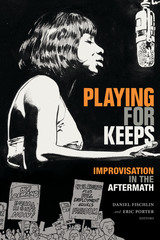
Contributors. Randy DuBurke, Rana El Kadi, Kevin Fellezs, Daniel Fischlin, Kate Galloway, Reem Abdul Hadi, Vijay Iyer, Mark Lomanno, Moshe Morad, Eric Porter, Sara Ramshaw, Matana Roberts, Darci Sprengel, Paul Stapleton, Odeh Turjman, Stephanie Vos

In this groundbreaking study, Marvin T. Chiles uncovers how amateur Black football and basketball in segregated Virginia became powerful tools of resistance against white supremacy. Spanning from the 1890s to the 1970s, Chiles reveals how sports at HBCUs and in Black communities fostered leadership, pride, and unity—laying cultural foundations for the Civil Rights Movement. A compelling read for anyone interested in the intersection of race, sports, and social change.
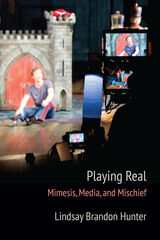
Playing Real: Mimesis, Media, and Mischief explores the integration and interaction of mimetic theatricality and representational media in twentieth- and twenty‑first-century performance. It brings together carefully chosen sites of performance—including live broadcasts of theatrical productions, reality television, and alternate-reality gaming—in which mediatization and mimesis compete and collude to represent the real to audiences. Lindsay Brandon Hunter reads such performances as forcing confrontation between notions of authenticity, sincerity, and spontaneity and their various others: the fake, the feigned, the staged, or the rehearsed.
Each site examined in Playing Real purports to show audiences something real—real theater, real housewives, real alternative scenarios—which is simultaneously visible as overtly constructed, adulterated by artifice and artificiality. The integration of mediatization and theatricality in these performances, Hunter argues, exploits the proclivities of both to conjure the real even as they risk corrupting the perception of authenticity by imbricating it with artifice and overt manipulation.
Although the performances analyzed obscure boundaries separating actual from virtual, genuine from artificial, and truth from fiction, Hunter rejects the notion that these productions imperil the “real.” She insists on uncertainty as a fertile site for productive and pleasurable mischief—including relationships to realness and authenticity among both audience and participants.

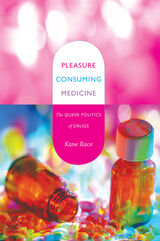
Race does not suggest that drug use is risk-free, good, or bad, but rather that the regulation of drugs has become a site where ideological lessons about the propriety of consumption are propounded. He argues that official discourses about drug use conjure a space where the neoliberal state can be seen to be policing the “excesses” of the amoral market. He explores this normative investment in drug regimes and some “counterpublic health” measures that have emerged in response. These measures, which Race finds in certain pragmatic gay men’s health and HIV prevention practices, are not cloaked in moralistic language, and they do not cast health as antithetical to pleasure.

Pleasure Grounds of Death considers the history of the rural cemetery in the United States throughout the duration of the nineteenth century as not only a critical cultural institution embedded in the formation of community and national identities, but also as major sites of contest over matters of burial reform, taste and respectability, and public behavior; issues concerning race, class, and gender; conflicts over the burial of the Civil War dead and formation of postwar memory; and what constituted the most appropriate ways to structure the landscape of the dead in a modern and progressive society. As cultural landscapes that served the needs of the living as well as the dead, rural cemeteries offer a mirror for the transformations and conflicts taking place throughout the nineteenth century in American society.
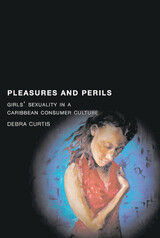
Curtis shows that girls are often caught between conflicting discourses of Christian teachings about chastity, public health cautions about safe sex, and media enticements about consumer delights. Sexuality's contradictions are exposed: power and powerless¡ness, self-determination and cultural control, violence and pleasure. Pleasures and Perils illuminates the methodological and ethical issues anthropologists face when they conduct research on sex, especially among girls. The sexually explicit narratives conveyed in this book challenge not only the reader's own thoughts on sexuality but also the broader limits and possibilities of ethnography.
Much has been written about the workings of communist governments in the USSR and the Soviet bloc, yet there is still a great deal to explore regarding their relationship to the everyday lives of the citizens living under them. This third volume builds on the editors’ Style and Socialism and Socialist Spaces, showing how the rise of consumer culture took a unique form in these countries.
Essays from top scholars address topics ranging from fashion and game shows to smoking and camping. The authors of the essays in this collection investigate the ways in which pleasurable activities, like many other facets of daily life, were both a space in which these communist governments tried to insinuate themselves and thereby further expand the reach of their authority,
and also an opportunity for people to assert their individuality.
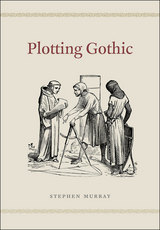
Plotting Gothic positions the rhetoric of the Gothic as a series of three interlocking plots: a spatial plot tied to the material construction of the churches, a social plot stemming from the collaborative efforts that made Gothic output possible, and a rhetorical plot involving narratives that treat the churches as objects of desire. Drawing on the testimony of three witnesses involved in church building—Abbot Suger of Saint-Denis, Gervase of Canterbury, and the image maker Villard de Honnecourt—and a range of secondary sources, Murray traces common patterns in the way medieval buildings were represented in words and images. Our witnesses provide vital information about the way the great churches of Gothic were built and the complexity of their meanings. Taking a fresh approach to Gothic architecture, Plotting Gothic offers an invigorating new way to understand some of the most lasting achievements of the medieval era.
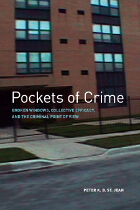
Why, even in the same high-crime neighborhoods, do robbery, drug dealing, and assault occur much more frequently on some blocks than on others? One popular theory is that a weak sense of community among neighbors can create conditions more hospitable for criminals, and another proposes that neighborhood disorder—such as broken windows and boarded-up buildings—makes crime more likely. But in his innovative new study, Peter K. B. St. Jean argues that we cannot fully understand the impact of these factors without considering that, because urban space is unevenly developed, different kinds of crimes occur most often in locations that offer their perpetrators specific advantages.
Drawing on Chicago Police Department statistics and extensive interviews with both law-abiding citizens and criminals in one of the city’s highest-crime areas, St. Jean demonstrates that drug dealers and robbers, for example, are primarily attracted to locations with businesses like liquor stores, fast food restaurants, and check-cashing outlets. By accounting for these important factors of spatial positioning, he expands upon previous research to provide the most comprehensive explanation available of why crime occurs where it does.

From the first, Enzensberger resisted the marginalization of literature–particularly poetry—by connecting it with ethical imperatives of the post-Holocaust era. Charlotte Ann Melin shows how Enzensberger has accomplished this by challenging prevailing aesthetic and social values. Departing from existing studies that focus on Enzensberger's political views or controversial texts, her book situates his full poetic program within contemporary discussions staged by various German writers, translators, and theorists, including Jürgen Habermas and Theodor Adorno. Melin proposes a framework for reading poetry by Enzensberger and his contemporaries—one that connects the radical evolution of poetic style with how questions about representation, identity, and ethical values developed under historical conditions unique to the second half of the twentieth century. Her account of postwar literary trends explores the fluidity of national literary boundaries and tastes after 1945, and reveals the relationship of such American poets as William Carlos Williams and Carolyn Forché to German verse. Essential to an understanding Enzensberger as an important literary figure, Poetic Maneuvers also offers invaluable insight into the status of recent postwar German literature and American-European literary relations.
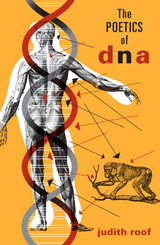
How has DNA come to be seen as a cosmic truth, representative of all life, potential for all cures, repository for all identity, and end to all stories? In The Poetics of DNA, Judith Roof examines the rise of this powerful symbol and the implications of its ascendancy for the ways we think—about ourselves, about one another, and about the universe.
Descriptions of DNA, Roof argues, have distorted ideas and transformed nucleic acid into the answer to all questions of life. This hyperbolized notion of DNA, inevitably confused or conflated with the “gene,” has become a vector through which older ways of thinking can merge with the new, advancing long-discredited and insidious ideas about such things as eugenics and racial selection and influencing contemporary debates, particularly the popular press obsession with the “gay gene.” Through metaphors of DNA, she contends, racist and homophobic ideology is masked as progressive science.
Grappling with twentieth-century intellectual movements as well as contemporary societal anxieties, The Poetics of DNA reveals how descriptions of DNA and genes typify a larger set of epistemological battles that play out not only through the assumptions associated with DNA but also through less evident methods of magical thinking, reductionism, and pseudoscience.
For the first time, Roof exposes the ideology and cultural consequences of DNA and gene metaphors to uncover how, ultimately, they are paradigms used to recreate prejudices.
Judith Roof is professor of English and film studies at Michigan State University. She is the author of several books, including All about Thelma and Eve: Sidekicks and Third Wheels.
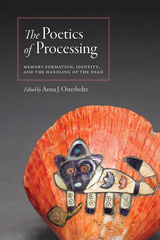
The contributors interpret postmortem treatment of the physical body through a poetics lens, examining body processing as a mechanism for the re-creation of cosmological events and processing’s role in the creation of social memory. They analyze methods of processing and the ways in which the living use the physical body to stratify society and gain power, as evidenced in rituals of body preparation and burial around the world, objects buried with the dead and the hierarchies of tomb occupancy, the dissection of cadavers by medical students, the appropriation of living spaces once occupied by the dead, and the varying treatments of the remains of social outsiders, prisoners of war, and executed persons.
The Poetics of Processing combines social theory and bioarchaeology to examine how the living manipulate the bodies of the dead for social purposes. These case studies—ranging from prehistoric to historic and modern and from around the globe—explore this complex material relationship that does not cease with physical death. This volume will be of interest to mortuary archaeologists, bioarchaeologists, and cultural anthropologists.
Contributors:
Dil Singh Basanti, Roselyn Campbell, Carlina de la Cova, Eric Haanstad, Scott Haddow, Christina Hodge, Christopher Knusel, Kristin Kuckelman, Clark Spencer Larsen, Debra Martin, Kenneth Nystrom, Adrianne Offenbecker, Megan Perry, Marin Pilloud, Beth K. Scaffidi, Mehmet Somel, Kyle D. Waller

Poetry after Cultural Studies elucidates the potential of poetry scholarship when joined with cultural studies. In eight searching essays covering an astonishing range of poetic practices, geographical regions, and methodological approaches, this volume reflects on what poetry can accomplish in the broadest social and cultural contexts. From Depression-era Iowa to the postcolonial landscape of French-speaking Martinique, whether appearing in newspapers, correspondences, birders’ field guides, cross-stitches, or television and the internet, the poetry under consideration here is rarely a private, lyrical endeavor. For a great number of people writing, reading, publishing, and using poetry over the past 150 years, verse has not been a retreat from modern life, but a way of engaging with, and even changing, it.
Poison in the Ivy challenges popular beliefs about the importance of cross-racial interactions as an antidote to racism in the increasingly diverse United States. He shows that it is the context and framing of such interactions on college campuses that plays an important role in shaping students’ beliefs about race and inequality in everyday life for the future political and professional leaders of the nation. Poison in the Ivy is an eye-opening look at race on elite college campuses, and offers lessons for anyone involved in modern American higher education.
Poker is an extraordinary worldwide phenomenon with major social, cultural, and political implications, and Poker: The Parody of Capitalism investigates the game of poker as a cultural expression of significance not unlike art, literature, film, or music. Tracing the history of poker and comparing the evolution of the game to the development of capitalism, Ole Bjerg complicates prevalent notions of “casino capitalism” and correspondingly facile and simplistic comparisons of late capitalism and poker. By employing Slavoj Žižek’s threefold distinction between imaginary-symbolic-real as a philosophical framework to analyze poker and to understand the basic strategies of the game, Bjerg explores the structural characteristics of poker in relation to other games, making a clear distinction between poker and other gambling games of pure chance such as roulette and craps. With its combination of social theory and empirical research, Poker offers an engaging exploration of a cultural trend.
"Poker is a theoretically sophisticated, highly original and innovative treatment of a contemporary social phenomenon, and contributes greatly to our understanding of the nature of contemporary capitalism."
—Charles Livingstone, Monash University Australia
An examination of the social and cultural repercussions of Jewish emigration from Poland to Argentina in the 1920s and 1930s
Between the 1890s and 1930s, Argentina, following the United States and Palestine, became the main destination for Eastern European Ashkenazi Jews seeking safety, civil rights, and better economic prospects. In the period between 1918 and 1939, sixty thousand Polish Jews established new homes in Argentina. They formed a strong ethnic community that quickly embraced Argentine culture while still maintaining their unique Jewish-Polish character. This mass migration caused the transformation of cultural, social, and political milieus in both Poland and Argentina, forever shaping the cultural landscape of both lands.
In Polacos in Argentina: Polish Jews, Interwar Migration, and the Emergence of Transatlantic Jewish Culture, Mariusz Kałczewiak has constructed a multifaceted and in-depth narrative that sheds light on marginalized aspects of Jewish migration and enriches the dialogue between Latin American Jewish studies and Polish Jewish Studies. Based on archival research, Yiddish travelogues on Argentina, and the Yiddish and Spanish-language press, this study recreates a mosaic of entanglements that Jewish migration wove between Poland and Argentina.
Most studies on mass migration fail to acknowledge the role of the country of origin, but this innovative work approaches Jewish migration to Argentina as a continuous process that took place on both sides of the Atlantic. Taken as a whole, Polacos in Argentina enlightens the heterogeneous and complex issue of immigrant commitments, belongings, and expectations. Jewish emigration from Poland to Argentina serves as a case study of how ethnicity evolves among migrants and their children, and the dynamics that emerge between putting down roots in a new country and maintaining commitments to the country of origin.

"This book is about the ramifications of raw corporate power going unchecked." -- John Conyers, Michigan congressman
"Racial class is a fundamental problem in America. But Poletown demonstrates that economic class is even more fundamental." -- Rev. Jesse Jackson
An updated edition of this essential work.
Since its initial publication, Policing Desire has proved to be an unparalleled analysis of “the cacophony of voices which sounds through every institution of our society on the subject of AIDS.” For the third edition Simon Watney has provided a new preface, a compelling new concluding essay, and a directory for AIDS information that includes electronic resources.
“A far-reaching analysis of images of AIDS and homosexuality in the media. . . . In Policing Desire, Simon Watney called the media on its own game, and the media actually changed its coverage of AIDS and queer issues.” Voice Literary Supplement“Simon Watney’s Policing Desire is essential reading for anyone who wants to press the question of how the media represents AIDS . . . it will stand as a great work of criticism written from the trenches.” New York Native“A landmark work in AIDS analysis because of the combination of emotional urgency and analytical insight that it manifests.” American Book ReviewWinner of the Gustavus Myers Prize for the Study of Human RightsISBN 0-8166-3024-0 Cloth $39.95xx CUSAISBN 0-8166-3025-9 Paper $16.95x CUSA000 pages 0 x 0 MarchMedia Studies/Social TheoryPolicing DesirePornography, AIDS and the MediaThird EditionSimon WatneyAn updated edition of this essential work. Since its initial publication, Policing Desire has proved to be an unparalleled analysis of “the cacophony of voices which sounds through every institution of our society on the subject of AIDS.” For the third edition Simon Watney has provided a new preface, a compelling new concluding essay, and a directory for AIDS information that includes electronic resources.“A far-reaching analysis of images of AIDS and homosexuality in the media. . . . In Policing Desire, Simon Watney called the media on its own game, and the media actually changed its coverage of AIDS and queer issues.” Voice Literary Supplement“Simon Watney’s Policing Desire is essential reading for anyone who wants to press the question of how the media represents AIDS . . . it will stand as a great work of criticism written from the trenches.” New York Native“A landmark work in AIDS analysis because of the combination of emotional urgency and analytical insight that it manifests.” American Book ReviewSimon Watney is the director of the Red Hot AIDS Charitable Trust, which distributes funds internationally for HIV/AIDS prevention and education. Watney lives in London, England.

A Smithsonian Best History Book of the Year
Winner of the Littleton-Griswold Prize
Winner of the Ralph Waldo Emerson Award
Winner of the Order of the Coif Award
Winner of the Sidney M. Edelstein Prize
Winner of the David J. Langum Sr. Prize in American Legal History
Winner of the Berkshire Conference of Women Historians Book Prize
“From traffic stops to parking tickets, Seo traces the history of cars alongside the history of crime and discovers that the two are inextricably linked.”
—Smithsonian
When Americans think of freedom, they often picture the open road. Yet nowhere are we more likely to encounter the long arm of the law than in our cars. Sarah Seo reveals how the rise of the automobile led us to accept—and expect—pervasive police power, a radical transformation with far-reaching consequences.
Before the twentieth century, most Americans rarely came into contact with police officers. But in a society dependent on cars, everyone—law-breaking and law-abiding alike—is subject to discretionary policing. Seo challenges prevailing interpretations of the Warren Court’s due process revolution and argues that the Supreme Court’s efforts to protect Americans did more to accommodate than limit police intervention. Policing the Open Road shows how the new procedures sanctioned discrimination by officers, and ultimately undermined the nation’s commitment to equal protection before the law.
“With insights ranging from the joy of the open road to the indignities—and worse—of ‘driving while black,’ Sarah Seo makes the case that the ‘law of the car’ has eroded our rights to privacy and equal justice…Absorbing and so essential.”
—Paul Butler, author of Chokehold
“A fascinating examination of how the automobile reconfigured American life, not just in terms of suburbanization and infrastructure but with regard to deeply ingrained notions of freedom and personal identity.”
—Hua Hsu, New Yorker

It was not long ago that scientists proclaimed victory over polio, the dread disease of the 1950s. More recently polio resurfaced, not conquered at all, spreading across the countries of Africa. As we once again face the specter of this disease, along with other killers like AIDS and SARS, this powerful book reminds us of the personal cost, the cultural implications, and the historical significance of one of modern humanity's deadliest biological enemies. In Polio and Its Aftermath Marc Shell, himself a victim of polio, offers an inspired analysis of the disease. Part memoir, part cultural criticism and history, part meditation on the meaning of disease, Shell's work combines the understanding of a medical researcher with the sensitivity of a literary critic. He deftly draws a detailed yet broad picture of the lived experience of a crippling disease as it makes it way into every facet of human existence.
Polio and Its Aftermath conveys the widespread panic that struck as the disease swept the world in the mid-fifties. It captures an atmosphere in which polio vied with the Cold War as the greatest cause of unrest in North America--and in which a strange and often debilitating uncertainty was one of the disease's salient but least treatable symptoms. Polio particularly afflicted the young, and Shell explores what this meant to families and communities. And he reveals why, in spite of the worldwide relief that greeted Jonas Salk's vaccine as a miracle of modern science, we have much more to fear from polio now than we know.
In The Political Economy of Stigma, Ally Day offers a compelling critique of neoliberal medical practices in the US by coupling an analysis of HIV memoir with a critical examination of narrative medicine practice. Using insights from feminist disability studies and crip theory, Day argues that stories of illness and disability—such as HIV memoirs—operate within a political economy of stigma, which she defines as the formal and informal circulation of personal illness and disability narratives that benefits some while hindering others. On the one hand, this system decreases access to appropriate medical care for those with chronic conditions by producing narratives of personal illness that frame one’s relationship to structural inequality as a result of personal failure. On the other hand, the political economy of stigma rewards those who procure such narratives and circulate them for public consumption.
The political economy of stigma is theorized from three primary research sites: a reading group with women living with HIV, a reading group with AIDS service workers, and participant observation research and critical close reading of practices in narrative medicine. Ultimately, it is the women living with HIV who provide an alternative way to understand disability and illness narratives, a practice of differential reading that can challenge stigmatizing tropes and reconceptualize the creation, reception, and circulation of patient memoir.

Using concepts and methods derived from the work of Michel Foucault, Crampton outlines a new mapping of cyberspace to help define the role of space in virtual worlds and to provide constructive ways in which humans can exist in another spatial dimension. He delineates the critical role maps play in constructing the medium as an object of knowledge and demonstrates that by processes of mapping we come to understand cyberspace. Maps, he argues, shape political thinking about cyberspace, and he deploys in-depth case studies of crime mapping, security maintenance, and geo-surveillance to show how we map ourselves onto cyberspace, inexorably, and indelibly.
Offering a powerful reinterpretation of technology and contemporary life, this innovative book will be an essential touchstone for the study of cartography and cyberspace in the twenty-first century.
The problem of inequality, Reid-Henry argues, is a problem that manifests between places as well as over time. This is one reason why it cannot be resolved by the usual arguments of left versus right, bound as they are to the national scale alone. Most of all, however, it is why the level of inequality that confronts us today is indicative of a more general crisis in political thought. Modern political discourse has no place for public reason or the common good. Equality is yesterday’s dream. Yet the fact that we now accept such a world—a world that values security over freedom, special treatment over universal opportunity, and efficiency over fairness—is ultimately because we have stopped even trying in recent decades to build the political architecture the world actually requires.
Our politics has fallen out of step with the world, then, and at the every moment it is needed more than ever. Yet it is within our power to address this. Doing so involves identifying and then meeting our political responsibilities to others, not just offering them the selective charity of the rich. It means looking beyond issues of economics and outside our national borders. But above all it demands of us that we reinvent the language of equality for a modern, global world: and then institute this. The world is not falling apart. Different worlds, we all can see, are colliding together. It is our capacity to act in concert that is falling apart. It is this that needs restoring most of all.
Between 1980 and 1994, Peru endured a bloody internal armed conflict, with some 69,000 people killed in clashes involving two insurgent movements, state forces, and local armed groups. In 2003, a government-sponsored “Truth and Reconciliation Committee” reported that the conflict lasted longer, affected broader swaths of the national territory, and inflicted higher costs in both human and economic terms than any other conflict in Peru’s history. Of those killed, 75 percent were speakers of an indigenous language, and almost 40 percent were among the poorest and most rural members of Peruvian society. These unequal impacts of the violence on the Peruvian people revealed deep and historical disparities within the country.
This collection of original essays by leading international experts on Peruvian politics, society, and institutions explores the political and institutional consequences of Peru’s internal armed conflict in the long 1980s. The essays are grouped into sections that cover the conflict itself in historical, comparative, and theoretical perspectives; its consequences for Peru’s political institutions; its effects on political parties across the ideological spectrum; and its impact on public opinion and civil society. This research provides the first systematic and nuanced investigation of the extent to which recent and contemporary Peruvian politics, civil society, and institutions have been shaped by the country’s 1980s violence.
The Politics of Deafness embarks upon a post-modern examination of the search for identity in deafness and its relationship to the prevalent hearing culture that has marginalized Deaf people. Author Owen Wrigley plainly states his intention to disrupt “normal” thought about the popularly considered condition of deafness as a physical deficiency. From his decade of experience working and living in the Deaf community in Thailand, he uses wide-ranging examples to go beyond disputing conventional theorists for their interpretation of deafness as the lack of a sensory function. By calling attention to the different lingual potential created by the instant visual expression of cyberspace, he explodes orthodox conceptualization of the nature of language as serially ordered and dependent upon sound.
In bold style, this provocative work poses the relationship of the bodies physical and mental of Deaf people as subject to a form of “colonialism” by the dominant Hearing culture. It proceeds to expose and attack presumptions and practices that derive from and descend upon deaf bodies. Related analysis also addresses tensions little noted in the current literature on deafness and on the popular move to reconstitute Deafness as a global culture.
Through displacement of logistical anchors, ironic stances, and disconcerting perspectives, The Politics of Deafness practices a form of de-naturalization to demand space within and between the normalizing frames of daily lives. By doing so, it offers an insightful and intriguing perspective on the meanings of Deafness, the politics of Deaf identity, and what it costs to be “unusual.”
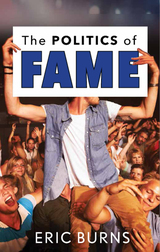
In search of answers, cultural historian Eric Burns delves deep into the biographies of some of the most famous figures in American history, from Benjamin Franklin to Fanny Kemble, Elvis Presley to Gene Tierney, and Michael Jordan to Oprah Winfrey. Through these case studies, he considers the evolution of celebrity throughout the ages. More controversially, he questions the very status of fame in the twenty-first century, an era in which thousands of minor celebrities have seen their fifteen minutes in the spotlight.
The Politics of Fame is a provocative and entertaining look at the lives and afterlives of America’s most beloved celebrities as well as the mad devotion they inspired. It raises important questions about what celebrity worship reveals about the worshippers—and about the state of the nation itself
An extensive introduction contains reflections on the significance of Europeans’ memories of World War II and a conclusion provides an analysis of the implications of the contributors’ findings for memory studies. These two pieces tease out some of the findings common to all seven countries: for instance, in each nation, the decade and a half between the late 1960s and the mid-1980s was the period of most profound change in the politics of memory. At the same time, the contributors demonstrate that Europeans understand World War II primarily through national frames of reference, which are surprisingly varied. Memories of the war have important ramifications for the democratization of Central and Eastern Europe and the consolidation of the European Union. This volume clarifies how those memories are formed and institutionalized.
Contributors. Claudio Fogu, Richard J. Golsan, Wulf Kansteiner, Richard Ned Lebow, Regula Ludi, Annamaria Orla-Bukowska, Heidemarie Uhl, Thomas C. Wolfe
Migration to new destinations in Europe and the United States has expanded dramatically over the past few decades. Within these destinations, there is a corresponding greater variety of ethnic, cultural, and/or religious diversity. This timely volume, The Politics of New Immigrant Destinations, considers the challenges posed by this proliferation of diversity for governments, majority populations, and immigrants.
The contributors assess the effectiveness of the policy and political responses that have been spawned by increasing diversity in four types of new immigrant destinations: “intermediate” destination countries—Ireland and Italy; culturally distinct regions experiencing new migration such as Catalonia in Spain or the American South; new destinations within traditional destination countries like the state of Utah and rural towns in England; and “early migration cycle” countries including Latvia and Poland.
The Politics of New Immigrant Destinations examines how these new destinations for immigrants compare to traditional destinations, with respect to their policy responses and success at integrating immigrants, offering perspectives from both immigrants and natives.
Contributors include: Dace Akule, Amado Alarcón, Rhys Andrews, Francesca Campomori, Tiziana Caponio, Scott Decker, Erica Dobbs, Melissa M. Goldsmith, Aleksandra Grzymała-Kazłowska, Claudio A. Holzner, Magdalena Lesińska, Paul Lewis, Helen B. Marrow, Laura Morales, Katia Pilati, Marie Provine, Monica Varsanyi, and the editors.
"Scheingold presents a clear, thoughtful discussion of the ways in which rights can both empower and constrain those seeking change in American society. While much of the writing on rights is abstract and obscure, The Politics of Rights stands out as an accessible and engaging discussion."
-Gerald N. Rosenberg, University of Chicago
"This book has already exerted an enormous influence on two generations of scholars. It has had an enormous influence on political scientists, sociologists, and anthropologists, as well as historians and legal scholars. With this new edition, this influence is likely to continue for still more generations. The Politics of Rights has, I believe, become an American classic."
-Malcolm Feeley, Boalt Hall School of Law, University of California, Berkeley, from the foreword
Stuart A. Scheingold is Professor Emeritus of Political Science at the University of Washington.

Drawing upon rarely examined archival data, Peterson demonstrates that widespread public backing for the common school existed in Atlanta, Chicago, and San Francisco. He finds little evidence of systematic discrimination against white immigrants, at least with respect to classroom crowding and teaching assignments. Instead, his research uncovers solid trade union and other working-class support for compulsory education, adequate school financing, and curricular modernization.
Urban reformers campaigned assiduously for fiscally sound, politically strong public schools. Often they had at least as much support from trade unionists as from business elites. In fact it was the business-backed machine politicians—from San Francisco's William Buckley to Chicago's Edward Kelly—who deprived the schools of funds. At a time when public schools are being subjected to searching criticism and when new educational ideas are gaining political support, The Politics of School Reform, 1870-1940 is a timely reminder of the strength and breadth of those groups that have always supported "free" public schools.
Looks at the ways social change is expressed through debates over identities and bodies
In bodies and selves, we can see politics, economics, and culture play out, and the tensions and crises of society made visible. The women’s movement, lobbies for the elderly, pro-choice and pro-life movements, AIDS research and education, pedophilia and repressed memory, global sports spectacles, organ donor networks, campaigns for safe sex, chastity, or preventive medicine—all are aspects of the contemporary politics of bodies and identities touched on in this book. Three broad themes run through the collection: how the body is constructed in various ways for different purposes, how the electronic media and its uses shape selves and sensualities and contribute to civic discourse, and how global capitalism acts as a direct force in these processes. By taking a distinctly cross-cultural and comparative approach, this volume explores more fully than ever the political, economic, institutional, and cultural settings of corporeality, identity, and representation.
Contributors: Antonella Fabri, John Jay College and New York Academy of Medicine; Eva Illouz, Hebrew U of Jerusalem; Philip W. Jenks, Portland State U; Lauren Langman, Loyola U; Timothy W. Luke, Virginia Polytechnic Institute and State U; Timothy McGettigan, Colorado State U, Pueblo; Margaret J. Tally, SUNY, Empire State College.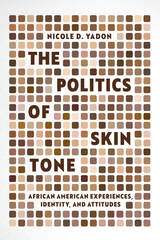
A nuanced examination of the salience of skin tone within African American politics.
Research shows that skin tone is associated with significant differences in life experiences. On average, African Americans with darker skin earn lower wages, suffer worse health outcomes, and endure more negative criminal justice experiences than lighter-skinned African Americans. Nicole D. Yadon conceptualizes skin tone as one facet of the multidimensional construct of race that powerfully influences racialized experiences which, in turn, can influence political identities and attitudes.
Drawing on evidence from one hundred in-depth interviews, multiple surveys, and a survey experiment, The Politics of Skin Tone investigates the political associations of skin tone. Yadon finds that skin tone correlates with political attitudes, particularly on issues where color-based disparities are especially pronounced such as criminal justice. Moreover, a sizable number of African Americans adopt a skin tone-based identity. In an era of shifting racial boundaries and growing color-based discrimination, The Politics of Skin Tone examines the implications for both scholars and policymakers.

In Politics of Touch, Manning develops a new way to conceive the role of the senses, and of touch in particular. Exploring concepts of violence, gender, sexuality, security, democracy, and identity, she traces the ways in which touch informs and reforms the body. Specifically considering tango-a tactile, rhythmic, and improvisational dance- she foregrounds movement as the sensing body's intervention into the political. With a fresh vision and an original theoretical basis, Manning shows the ontogenetic potential of the body, and in doing so, redefines our understanding of the sense of touch in philosophical and political terms.
Erin Manning is assistant professor of fine arts at Concordia University and the author of Ephemeral Territories (Minnesota, 2003).
Each case shows how the concrete actions of a group of citizens can prompt us to reflect on what is needed for a just and sustainable economic system. In one case, activists raised questions about the responsibilities of business, in the second about the significance of local economies, and in the third about the contributions of the public sector. Through these movements, Jane L. Collins maps a set of cultural conversations about the types of investments and activities that contribute to the health of the economy. Compelling and persuasive, The Politics of Value offers a new framework for viewing economic value, one grounded in thoughtful assessment of the social division of labor and the relationship of the state and the market to civil society.
Rather than focusing on types of medical interventions, The Politics of Women's Health asks what feminist health care ethics looks like if we start with women's experiences and concerns. It begins to unravel two key concepts of women's empowerment -- agency and autonomy -- that apply to all areas of concern to women.

Although it ended up as only one among a host of federal research policymaking agencies, the National Science Foundation was originally conceived as central to the federal research policymaking system. Kleinman’s historical examination of the National Science Foundation exposes the sociological and political workings of the system, particularly the way in which a small group of elite scientists shaped the policymaking process and defined the foundation’s structure and future. Beginning with Vannevar Bush’s 1945 manifesto The Endless Frontier, Kleinman explores elite and populist visions for a postwar research policy agency and shows how the structure of the American state led to the establishment of a fragmented and uncoordinated system for federal research policymaking. His book concludes with an analysis of recent efforts to reorient research policy and to remake federal policymaking institutions in light of the current "crisis" of economic competitiveness.
A particularly timely study, Politics on the Endless Frontier will be of interest to historians and sociologists of science and technology and to science policy analysts.
common characterizations of postcommunist politics as either a resurgence of
aggressive nationalism or an evolution toward Western-style democracy. Cohen
draws upon extensive field research to paint a picture of postcommunist
political life in which ideological labels are meaningless and exchangeable
at will, political parties appear and disappear regularly, and citizens
remain unengaged in the political process.
In contrast to the conventional wisdom, which locates the roots of widespread intranational strife in deeply rooted national identities from the past, Cohen argues that a profound ideological vacuum has fueled destructive tension throughout postcommunist Europe and the former Soviet Union. She uses Slovakia as a case study to reveal that communist regimes bequeathed an insidious form of historical amnesia to the majority of the political elite and the societies they govern. Slovakia was particularly vulnerable to communist intervention since its precommunist national consciousness was so weak and its only period of statehood prior to 1993 was as a Nazi puppet-state. To demonstrate her argument, Cohen focuses on Slovakia’s failure to forge a collective memory of the World War II experience. She shows how communist socialization prevented Slovaks from tying their individual family stories—of the Jewish deportations, of the anti-Nazi resistance, or of serving in the wartime government—to a larger historical narrative shared with others, leaving them bereft of historical or moral bearings.
Politics without a Past develops an analytical framework that will be important for future research in Eastern Europe, the former Soviet Union, and beyond. Scholars in political science, history, East European and post-Soviet studies will find Cohen’s methodology and conclusions enlightening. For policymakers, diplomats, and journalists who deal with the region, she offers valuable insights into the elusive nature of postcommunist societies.

"Polka Heartland" captures the beat that pulses in the heart of Midwestern culture--the polka--and offers up the fascinating history of how "oompah-pah" came to be the sound of middle America. From the crowded dance tent at Pulaski Polka Days to an off-the-grid Mexican polka dance in small-town Wisconsin, "Polka Heartland" explores the people, places, and history behind the Midwest's favorite music.
From polka's surprising origin story as a cutting-edge European fad to an exploration of the modern-day polka scene, author Rick March and photographer Dick Blau take readers on a joyful romp through this beloved, unique, and richly storied genre. "Polka Heartland" describes the artists, venues, instruments, and music-makers who have been pivotal to polka's popularity across the Midwest and offers six full-color photo galleries to immerse readers in today's vibrant polka scene.
When parole first emerged as a corrections strategy in the nineteenth century, work was supposed to keep ex-prisoners out of trouble. This strategy foundered in the changing economy after World War II. What followed was a rehabilitative strategy, where the clinical expertise of the parole agent replaced the discipline of the industrial labor market in defining and controlling criminal deviance. Today, Simon argues, as drastic changes in the economy have virtually locked out an entire class, rehabilitation has given way to mere management. The effect is isolation of the offender, either in jail or in an underclass community; the result is an escalating cycle of imprisonment, destabilization, and insecurity.
No significant improvement in the current penal crisis can be expected until we better understand the relationship between punishment and social order, a relationship which this book explores in theoretical, historical, and practical detail.
Drawn from presentations at the annual Experience Music Project Pop Conference—hailed by Robert Christgau as “the best thing that’s ever happened to serious consideration of pop music”—the essays in this book include inquiries into the sonic dimension of war in Iraq; the cultural life of jazz in post-Katrina New Orleans; Isaac Hayes’s reappropriation of a country song, “By the Time I Get to Phoenix,” as a symbol of black nationalism; and punk rock pranks played on record execs looking for the next big thing in central Virginia. Offering a diverse range of voices, perspectives, and approaches, this volume mirrors the eclecticism of pop itself.
Contributors: Larry Blumenfeld , Austin Bunn, Nate Chinen, J. Martin Daughtry, Brian Goedde, Michelle Habell-Pallán, Jonathan Lethem, Eric Lott, Kembrew McLeod, Elena Passarello, Diane Pecknold, David Ritz, Carlo Rotella, Scott Seward, Tom Smucker, Greg Tate, Karen Tongson, Alexandra T. Vazquez, Oliver Wang, Eric Weisbard, Carl Wilson

The essays in this generously illustrated collection demonstrate how, after the scientific foundations of the eugenics movement had been weakened in the 1930s, eugenic beliefs spread into the popular media, including newspapers, movies, museum exhibits, plays, and novels, and even fashion shows and comic strips.
Popular Eugenics shows that eugenic thought persisted in science and culture as well as in social policy and goes a long way toward explaining the durability of eugenic thinking and its effects on social policy in the United States. Popular Eugenics will be of interest to scholars and students in a broad range of disciplines, especially American literature and history, popular culture, media studies, and the history of science.
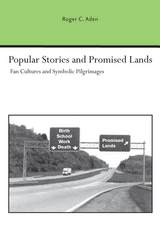
Popular Stories and Promised Lands enters a conversation about who we are, where we’ve been, and where we might be going by suggesting that possible answers to those questions can be found in the popular stories we encounter at the movies, on television, in popular magazines, and even on the funny pages.
As countless scholars and popular writers have noted, those of us living in the United States find ourselves at a cultural crossroads. We are increasingly aware that the stories that once permeated life in these United States, stories that tell us that social and economic progress comes from working hard, that everyone has an equal opportunity to experience such progress, do not resonate to the degree they once did. Because many Americans have traditionally defined themselves, others, and their unique sense of place through these stories, we find ourselves displaced socially, economically, politically, and/or culturally.
So, Roger Aden says, we go to places of our own making. Fans of the television series The X-Files return to the Funhouse each week for a dose of frightening fun. Fans of the weekly magazine Sports Illustrated play in the American Elysian Fields where democratic efforts at balancing work and play are valued. Fans of the movie Field of Dreams work as altruistic producers in an alternative garden spot.
Grounded in the author’s own experiences and reinforced by the voices of approximately two hundred additional fans of the four popular stories, this book offers a compelling case for understanding the alleged wasteland of popular culture as a fertile site of individually and communally created sacred places.

The essays in this collection address the historically and culturally varied interactions between porn and the archive. Topics range from library policies governing access to sexually explicit material to the growing digital archive of "war porn," or eroticized combat imagery; and from same-sex amputee porn to gay black comic book superhero porn. Together the pieces trace pornography as it crosses borders, transforms technologies, consolidates sexual identities, and challenges notions of what counts as legitimate forms of knowledge. The collection concludes with a valuable resource for scholars: a list of pornography archives held by institutions around the world.
Contributors. Jennifer Burns Bright, Eugenie Brinkema, Joseph Bristow, Robert Caserio, Ronan Crowley, Tim Dean, Robert Dewhurst, Lisa Downing, Frances Ferguson, Loren Glass, Harri Kahla, Marcia Klotz, Prabha Manuratne, Mireille Miller-Young, Nguyen Tan Hoang, John Paul Ricco, Steven Ruszczycky, Melissa Schindler, Darieck Scott, Caitlin Shanley, Ramon Soto-Crespo, David Squires, Linda Williams

The essays in this volume move beyond feminist debates and distinctions between a “good” erotica and a “bad” hard core. Contributors examine varieties of pornography from the tradition of the soft-core pin-up through the contemporary hard-core tradition of straight, gay, and lesbian videos and dvds to the burgeoning phenomenon of pornography on the Internet. They explore, as examples of the genre, individual works as divergent as The Starr Report, the pirated Tommy Lee/Pamela Anderson honeymoon video, and explicit Japanese “ladies’ comics” consumed by women. They also probe difficult issues such as the sexualization of race and class and the relationship of pornography to the avant-garde. To take pornography seriously as an object of analysis also means teaching it. Porn Studies thus includes a useful annotated bibliography of readings and archival sources important to the study of pornography as a cultural form.
Contributors. Heather Butler, Rich Cante, Jake Gerli, Minette Hillyer, Nguyen Tan Hoang, Despina Kakoudaki, Franklin Melendez, Ara Osterweil, Zabet Patterson, Constance Penley, Angelo Restivo, Eric Schaefer, Michael Sicinski, Deborah Shamoon, Maria St. John, Tom Waugh, Linda Williams
In this collection of path-breaking essays, thirteen respected scholars bring critical insights to the reality of porn and what it can tell us about ourselves sexually, culturally, and economically. Moving beyond simplistic feminist and religious positions that cast these films as categorical evils-a collective preserve of sexual perversion, misogyny, pedophilia, and racism-the contributors to this volume raise the bar of the debate and push porn studies into intriguing new territory.
The essays are divided into two sections. The first reprints important debates on the topic and traces the evolution of pornographic film, including comparing its development to that of Hollywood cinema. The second part presents new essays that consider current trends in the field, including pornography's expansion into new technologies.
This book separates this compelling genre from the sensation and shame that have long surrounded and obscured it. It will be of interest to general readers and film scholars alike.
Portals: A Treatise on Internet-Distributed Television pushes understandings of the business of television to keep pace with the considerable technological change of the last decade. It explains why shows such as Orange is the New Black or Transparent are indeed television despite coming to screens over internet connection and in exchange for a monthly fee. It explores how internet-distributed television is able to do new things – particularly, allow different people to watch different shows chosen from a library of possibilities. This technological ability allows new audience behaviors and new norms in making television.
Portals are the “channels” of internet-distributed television, and Portals identifies how the task of curating a library of shows differs from channels’ task of building a schedule. It explores the business model—subscriber funding—that supports many portals, and identifies the key differences from advertiser or direct purchase. Portals considers what we know about the future of television, even though we remain early in a process of transformative change.
Profiles of triumph and hardship amid massive inequality in Latin America.
Each chapter of Portraits of Persistence, a project of the University of Texas Urban Ethnography Lab, offers an intimate portrait of one or two individual lives. The subjects are a diverse group of individuals from across the continent: grassroots activists and political brokers, private security entrepreneurs, female drug dealers, shantytown dwellers, and rural farmers, as well as migrants finding routes into and out of the region. Through these accounts, the writers explore issues that are common throughout today's world: precarious work situations, gender oppression, housing displacement, experiences navigating the bureaucracy for asylum seekers, state violence, environmental devastation, and access to good and affordable health care. Carefully situating these experiences within the sociohistorical context of their specific local regions or countries, editor Javier Auyero and his colleagues consider how people make sense of the paths their lives have taken, the triumphs and hardships they have experienced, and the aspirations they hold for the future. Ultimately, these twelve compelling profiles offer unique and personal windows into the region’s complex and multilayered reality.
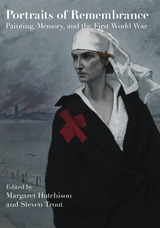
Although photography and moving pictures achieved ubiquity during the First World War as technological means of recording history, the far more traditional medium of painting played a vital role in the visual culture of combatant nations. The public’s appetite for the kind of up-close frontline action that snapshots and film footage could not yet provide resulted in a robust market for drawn or painted battle scenes.
Painting also figured significantly in the formation of collective war memory after the armistice. Paintings became sites of memory in two ways: first, many governments and communities invested in freestanding panoramas or cycloramas that depicted the war or featured murals as components of even larger commemorative projects, and second, certain paintings, whether created by official artists or simply by those moved to do so, emerged over time as visual touchstones in the public’s understanding of the war.
Portraits of Remembrance: Painting, Memory, and the First World War examines the relationship between war painting and collective memory in Australia, Austria, Belgium, Canada, Croatia, France, Germany, Great Britain, New Zealand, Russia, Serbia, Turkey, and the United States. The paintings discussed vary tremendously, ranging from public murals and panoramas to works on a far more intimate scale, including modernist masterpieces and crowd-pleasing expressions of sentimentality or spiritualism. Contributors raise a host of topics in connection with the volume’s overarching focus on memory, including national identity, constructions of gender, historical accuracy, issues of aesthetic taste, and connections between painting and literature, as well as other cultural forms.

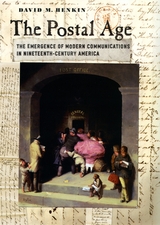
Americans commonly recognize television, e-mail, and instant messaging as agents of pervasive cultural change. But many of us may not realize that what we now call snail mail was once just as revolutionary. As David M. Henkin argues in The Postal Age, a burgeoning postal network initiated major cultural shifts during the nineteenth century, laying the foundation for the interconnectedness that now defines our ever-evolving world of telecommunications.
This fascinating history traces these shifts from their beginnings in the mid-1800s, when cheaper postage, mass literacy, and migration combined to make the long-established postal service a more integral and viable part of everyday life. With such dramatic events as the Civil War and the gold rush underscoring the importance and necessity of the post, a surprisingly broad range of Americans—male and female, black and white, native-born and immigrant—joined this postal network, regularly interacting with distant locales before the existence of telephones or even the widespread use of telegraphy. Drawing on original letters and diaries from the period, as well as public discussions of the expanding postal system, Henkin tells the story of how these Americans adjusted to a new world of long-distance correspondence, crowded post offices, junk mail, valentines, and dead letters.
The Postal Age paints a vibrant picture of a society where possibilities proliferated for the kinds of personal and impersonal communications that we often associate with more recent historical periods. In doing so, it significantly increases our understanding of both antebellum America and our own chapter in the history of communications.

Central Asia has long stood at the crossroads of history. It was the staging ground for the armies of the Mongol Empire, for the nineteenth-century struggle between the Russian and British empires, and for the NATO campaign in Afghanistan. Today, multinationals and nations compete for the oil and gas reserves of the Caspian Sea and for control of the pipelines. Yet “Stanland” is still, to many, a terra incognita, a geographical blank.
Beginning in the mid-1990s, academic and journalist David Mould’s career took him to the region on Fulbright Fellowships and contracts as a media trainer and consultant for UNESCO and USAID, among others. In Postcards from Stanland, he takes readers along with him on his encounters with the people, landscapes, and customs of the diverse countries—Kazakhstan, Kyrgyzstan, Tajikistan, and Uzbekistan—he came to love. He talks with teachers, students, politicians, environmental activists, bloggers, cab drivers, merchants, Peace Corps volunteers, and more.
Until now, few books for a nonspecialist readership have been written on the region, and while Mould brings his own considerable expertise to bear on his account—for example, he is one of the few scholars to have conducted research on post-Soviet media in the region—the book is above all a tapestry of place and a valuable contribution to our understanding of the post-Soviet world.
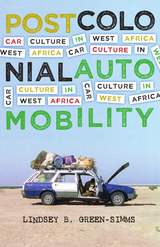
For more than a century cars have symbolized autonomous, unfettered mobility and an increasingly global experience. And yet, they are often used differently outside the centers of global capitalism. This pioneering book considers how, through the lens of the automobile, we can assess the pleasures, dangers, and limits of global modernity in West Africa. Through new and provocative readings of famous plays, novels, and films, as well as recent popular videos, Postcolonial Automobility reveals the surprising ways in which automobility in the region is, at once, an everyday practice, an ethos, a fantasy of autonomy, and an affective activity intimately tied to modern social life.
Lindsey B. Green-Simms begins with the history of motorization in West Africa from the colonial era to the decolonizing decades after World War II, and addresses the tragedy of car accidents through a close reading of Wole Soyinka’s 1965 postindependence play The Road. Shifting to screen media, she discusses Ousmane Sembene’s Xala and Jean-Pierre Bekolo’s Quartier Mozart and reviews popular, low-budget Nollywood films. Finally, Green-Simms considers how feminist texts rewrite and work in dialogue with the male-centered films and novels where the car stands in for patriarchal power and capitalist achievement.
Providing a unique perspective on technology in Africa—one refusing to be confined to narratives of either underdevelopment or inevitable progress—and covering a broad range of interdisciplinary material, Postcolonial Automobility will appeal not only to scholars and students of African literature and cinema but also to those in postcolonial and globalization studies.
Often examined separately, play and hauntings in fact act together to frame postcolonial issues. Sushmita Chatterjee showcases their braided workings in social and political fabrics. Drawing on this intertwined idea of play and hauntings, Chatterjee goes to the heart of conundrums within transnational postcolonial feminisms by examining the impossible echoes of translations, differing renditions of queer, and the possibilities of solidarity beyond the fraternal friendships that cement nation-states. Meaning-plays, or slippages through language systems as we move from one language to another, play a pivotal role in a global world. As Chatterjee shows, an attentiveness to meaning-plays discerns the past and present, here and there, and moves us toward responsive ethics in our theories and activisms.
Insightful and stimulating, Postcolonial Hauntings centers the inextricable work of play and hauntings as a braided ethics for postcolonial transnational struggles.
Contributors
Helen Appleton
Karen Bäckstrand
Lucille H. Brockway
Stephen B. Brush
Judith Carney
Committee on Women, Population, and the Environment
Arturo Escobar
Maria E. Fernandez
Ward H. Goodenough
Susantha Goonatilake
Sandra Harding
Steven J. Harris
Betsy Hartmann
Cori Hayden
Catherine L. M. Hill
John M. Hobson
Peter Mühlhäusler
Catherine A. Odora Hoppers
Consuelo Quiroz
Jenny Reardon
Ella Reitsma
Ziauddin Sardar
Daniel Sarewitz
Londa Schiebinger
Catherine V. Scott
Colin Scott
Mary Terrall
D. Michael Warren
Drawing on more than a decade of research—in molecular biology labs, commercial startups, governmental agencies, and civic spaces—Reardon demonstrates how the extensive efforts to transform genomics from high tech informatics practiced by a few to meaningful knowledge beneficial to all exposed the limits of long-cherished liberal modes of knowing and governing life. Those in the American South challenged the value of being included in genomics when no hospital served their community. Ethicists and lawyers charged with overseeing Scottish DNA and data questioned how to develop a system of ownership for these resources when their capacity to create things of value—new personalized treatments—remained largely unrealized. Molecular biologists who pioneered genomics asked whether their practices of thinking could survive the deluge of data produced by the growing power of sequencing machines. While the media is filled with grand visions of precision medicine, The Postgenomic Condition shares these actual challenges of the scientists, entrepreneurs, policy makers, bioethicists, lawyers, and patient advocates who sought to leverage liberal democratic practices to render genomic data a new source of meaning and value for interpreting and caring for life. It brings into rich empirical focus the resulting hard on-the-ground questions about how to know and live on a depleted but data-rich, interconnected yet fractured planet, where technoscience garners significant resources, but deeper questions of knowledge and justice urgently demand attention.

Synthetic creativity, organic computers, genetic modification, intelligent machines--such ideas are deeply challenging to many of our traditional assumptions about human uniqueness and superiority. But, ironically, it is our very capacity for technological invention that has secured us so dominant a position in the world which may lead ultimately to (as some have put it) 'The End of Man'. If we are really capable of creating entities that exceed our own skills and intellect then the consequences for humanity are almost inconceivable. Nevertheless, we must now face up to the possibility that attributes like intelligence and consciousness may be synthesised in non-human entities--perhaps within our lifetime. Would such entities have human-like emotions; would they have a sense of their own being?
The Posthuman Condition argues that such questions are difficult to tackle given the concepts of human existence that we have inherited from humanism, many of which can no longer be sustained. New theories about nature and the operation of the universe arising from sophisticated computer modelling are starting to demonstrate the profound interconnections between all things in reality where previously we had seen only separations. This has implications for traditional views of the human condition, consciousness, the way we look at art, and for some of the oldest problems in philosophy.
First published in the 1990s, this important text has been completely revised by the author with the addition of new sections and illustrations.
For further information see: www.post-human.net
In the fifth volume in the Studies in American Sociology Series, Stanford M. Lyman offers commentaries on and critiques of postmodernism, poststructuralism, and deconstruction, posing questions concerning theoretical and epistemological problems arising from what appears to be a “nouvelle vague.”
Postmodernism, poststructuralism, and deconstructionism are interrelated aspects of the newest theoretical development in sociology and the social sciences. This new wave of thought challenges virtually all paradigms currently in use. In this, his fifth volume in the Studies in American Sociology Series, Stanford M. Lyman offers commentaries on and critiques of this new perspective, posing questions concerning theoretical and epistemological problems arising from what appears to be a nouvelle vague.
Among the basic themes and issues explored are the allegation that modernity has defaulted on the promise of the Enlightenment; the question of whether the rational basis for knowledge and action is still valid; the controversy over the place of metanarratives and macrosociological outlooks; and newer concerns over race, gender, sexual preferences, the self, and the “Other.”
Professor Lyman provides empirically based and historically specific analyses of the relation of the race question to the problem of otherness and to the legal construction of racial identity in American court proceedings. Focusing on the issues of citizenship affecting European, Middle Eastern, and Asian immigrants; African Americans; and the special cases of the Chinese and Native Americans, he relates major public problems to the modern as well as the postmodern perspectives on justice. The debate over assimilation and multiculturalism, the dynamics of gender-specific emotions as expressed in six decades of Hollywood films, and the postmodern approach to deviance are each examined. He also offers proposals for a social science attuned to, but critical of, postmodernism and poststructuralism. Such a sociology might offer a perspective that treats the drama of social relations in the routine as well as the remarkable aspects of everyday life. Professor Lyman provides not only a new understanding of postmodernism but also a program of how to proceed with respect to its challenges.
READERS
Browse our collection.
PUBLISHERS
See BiblioVault's publisher services.
STUDENT SERVICES
Files for college accessibility offices.
RECENTLY PUBLISHED




UChicago Accessibility Resources
home | accessibility | search | about | contact us
BiblioVault ® 2001 - 2025
The University of Chicago Press