front cover of Punctuations
Punctuations
How the Arts Think the Political
Michael J. Shapiro
Duke University Press, 2019
In Punctuations Michael J. Shapiro examines how punctuation—conceived not as a series of marks but as a metaphor for the ways in which artists engage with intelligibility—opens pathways for thinking through the possibilities for oppositional politics. Drawing on Theodor Adorno, Alain Robbe-Grillet, and Roland Barthes, Shapiro demonstrates how punctuation's capacity to create unexpected rhythmic pacing makes it an ideal tool for writers, musicians, filmmakers, and artists to challenge structures of power. In works ranging from film scores and jazz compositions to literature, architecture, and photography, Shapiro shows how the use of punctuation reveals the contestability of dominant narratives in ways that prompt readers, viewers, and listeners to reflect on their acceptance of those narratives. Such uses of punctuation, he theorizes, offer models for disrupting structures of authority, thereby fostering the creation of alternative communities of sense from which to base political mobilization.
[more]

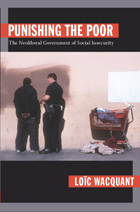
front cover of Punishing the Poor
Punishing the Poor
The Neoliberal Government of Social Insecurity
Loïc Wacquant
Duke University Press, 2009
The punitive turn of penal policy in the United States after the acme of the Civil Rights movement responds not to rising criminal insecurity but to the social insecurity spawned by the fragmentation of wage labor and the shakeup of the ethnoracial hierarchy. It partakes of a broader reconstruction of the state wedding restrictive “workfare” and expansive “prisonfare” under a philosophy of moral behaviorism. This paternalist program of penalization of poverty aims to curb the urban disorders wrought by economic deregulation and to impose precarious employment on the postindustrial proletariat. It also erects a garish theater of civic morality on whose stage political elites can orchestrate the public vituperation of deviant figures—the teenage “welfare mother,” the ghetto “street thug,” and the roaming “sex predator”—and close the legitimacy deficit they suffer when they discard the established government mission of social and economic protection. By bringing developments in welfare and criminal justice into a single analytic framework attentive to both the instrumental and communicative moments of public policy, Punishing the Poor shows that the prison is not a mere technical implement for law enforcement but a core political institution. And it reveals that the capitalist revolution from above called neoliberalism entails not the advent of “small government” but the building of an overgrown and intrusive penal state deeply injurious to the ideals of democratic citizenship.

Visit the author’s website.

[more]

front cover of Punishment and Inequality in America
Punishment and Inequality in America
Bruce Western
Russell Sage Foundation, 2006
Over the last thirty years, the prison population in the United States has increased more than seven-fold to over two million people, including vastly disproportionate numbers of minorities and people with little education. For some racial and educational groups, incarceration has become a depressingly regular experience, and prison culture and influence pervade their communities. Almost 60 percent of black male high school drop-outs in their early thirties have spent time in prison. In Punishment and Inequality in America, sociologist Bruce Western explores the recent era of mass incarceration and the serious social and economic consequences it has wrought. Punishment and Inequality in America dispels many of the myths about the relationships among crime, imprisonment, and inequality. While many people support the increase in incarceration because of recent reductions in crime, Western shows that the decrease in crime rates in the 1990s was mostly fueled by growth in city police forces and the pacification of the drug trade. Getting "tough on crime" with longer sentences only explains about 10 percent of the fall in crime, but has come at a significant cost. Punishment and Inequality in America reveals a strong relationship between incarceration and severely dampened economic prospects for former inmates. Western finds that because of their involvement in the penal system, young black men hardly benefited from the economic boom of the 1990s. Those who spent time in prison had much lower wages and employment rates than did similar men without criminal records. The losses from mass incarceration spread to the social sphere as well, leaving one out of ten young black children with a father behind bars by the end of the 1990s, thereby helping perpetuate the damaging cycle of broken families, poverty, and crime. The recent explosion of imprisonment is exacting heavy costs on American society and exacerbating inequality. Whereas college or the military were once the formative institutions in young men's lives, prison has increasingly usurped that role in many communities. Punishment and Inequality in America profiles how the growth in incarceration came about and the toll it is taking on the social and economic fabric of many American communities.
[more]

front cover of purplish
purplish
poetry anger publics
José Felipe Alvergue
University of Iowa Press, 2025
José Felipe Alvergue examines anger in American poetry, while reflecting on the permissible/policed cultural affects of our time. By way of BIPOC and QTPOC poets engaging with negativity—frustration, anger, distress—Alvergue argues that affects that reflect a counternarrative to benevolence challenge the colonial underpinnings of “American publics” as a concept of democratic participation and practice of community. Purple politics play out daily within spaces we rely on for shared comfort and belonging, namely neighborhoods, dinner tables, school board meetings, and social media. Purplish America describes the uncertain terrain of potential violence, potential conflict, distrust, and post-factualism upon which language and soma are still expected to thrive.
        purplish challenges the idea of an objective or unbiased cultural rationale to purple regions in America by historicizing how anger has been systemically cleansed from the collective sentiments regarding nation-building throughout key moments of our national heritage.
 
[more]

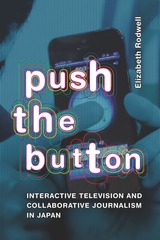
front cover of Push the Button
Push the Button
Interactive Television and Collaborative Journalism in Japan
Elizabeth Rodwell
Duke University Press, 2024
In Push the Button, Elizabeth Rodwell follows a battle over what interactivity will mean for Japanese television, as major media conglomerates took on independent media professionals developing interactive forms from new media. Rodwell argues that at the dawn of a potentially transformative moment in television history, content conservatism has triumphed over technological innovation. Despite the ambition and idealism of Japanese TV professionals and independent journalists, corporate media worked to squelch interactive broadcast projects such as smartphone-playable television and live-streamed and open press conferences before they caught on. Instead, interactive programming in the hands of major TV networks retained the structure and qualities of most other television and maintained conventional barriers between audiences and the actual space of broadcast. Despite their lack of success, the innovators behind these experiments nonetheless sought to expand the possibilities for mass media, national identity, and open journalism.
[more]

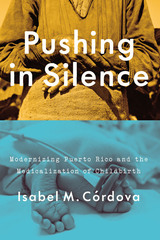
front cover of Pushing in Silence
Pushing in Silence
Modernizing Puerto Rico and the Medicalization of Childbirth
By Isabel M. Córdova
University of Texas Press, 2017

As Puerto Rico rapidly industrialized from the late 1940s until the 1970s, the social, political, and economic landscape changed profoundly. In the realm of heath care, the development of medical education, new medical technologies, and a new faith in science radically redefined childbirth and its practice. What had traditionally been a home-based, family-oriented process, assisted by women and midwives and “accomplished” by mothers, became a medicalized, hospital-based procedure, “accomplished” and directed by biomedical, predominantly male, practitioners, and, ultimately reconfigured, after the 1980s, into a technocratic model of childbirth, driven by doctors’ fears of malpractice suits and hospitals’ corporate concerns.

Pushing in Silence charts the medicalization of childbirth in Puerto Rico and demonstrates how biomedicine is culturally constructed within regional and historical contexts. Prior to 1950, registered midwives on the island outnumbered registered doctors by two to one, and they attended well over half of all deliveries. Isabel M. Córdova traces how, over the next quarter-century, midwifery almost completely disappeared as state programs led by scientifically trained experts and organized by bureaucratic institutions restructured and formalized birthing practices. Only after cesarean rates skyrocketed in the 1980s and 1990s did midwifery make a modest return through the practices of five newly trained midwives. This history, which mirrors similar patterns in the United States and elsewhere, adds an important new chapter to the development of medicine and technology in Latin America.
[more]

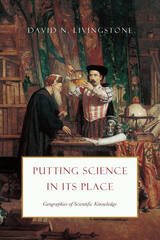
front cover of Putting Science in Its Place
Putting Science in Its Place
Geographies of Scientific Knowledge
David N. Livingstone
University of Chicago Press, 2003
We are accustomed to thinking of science and its findings as universal. After all, one atom of carbon plus two of oxygen yields carbon dioxide in Amazonia as well as in Alaska; a scientist in Bombay can use the same materials and techniques to challenge the work of a scientist in New York; and of course the laws of gravity apply worldwide. Why, then, should the spaces where science is done matter at all? David N. Livingstone here puts that question to the test with his fascinating study of how science bears the marks of its place of production.

Putting Science in Its Place establishes the fundamental importance of geography in both the generation and the consumption of scientific knowledge, using historical examples of the many places where science has been practiced. Livingstone first turns his attention to some of the specific sites where science has been made—the laboratory, museum, and botanical garden, to name some of the more conventional locales, but also places like the coffeehouse and cathedral, ship's deck and asylum, even the human body itself. In each case, he reveals just how the space of inquiry has conditioned the investigations carried out there. He then describes how, on a regional scale, provincial cultures have shaped scientific endeavor and how, in turn, scientific practices have been instrumental in forming local identities. Widening his inquiry, Livingstone points gently to the fundamental instability of scientific meaning, based on case studies of how scientific theories have been received in different locales. Putting Science in Its Place powerfully concludes by examining the remarkable mobility of science and the seemingly effortless way it moves around the globe.

From the reception of Darwin in the land of the Maori to the giraffe that walked from Marseilles to Paris, Livingstone shows that place does matter, even in the world of science.
[more]

front cover of The Puzzle of Judicial Behavior
The Puzzle of Judicial Behavior
Lawrence Baum
University of Michigan Press, 1997
From local trial courts to the United States Supreme Court, judges' decisions affect the fates of individual litigants and the fate of the nation as a whole. Scholars have long discussed and debated explanations of judicial behavior. This book examines the major issues in the debates over how best to understand judicial behavior and assesses what we actually know about how judges decide cases. It concludes that we are far from understanding why judges choose the positions they take in court.
Lawrence Baum considers three issues in examining judicial behavior. First, the author considers the balance between the judges' interest in the outcome of particular cases and their interest in other goals such as personal popularity and lighter workloads. Second, Baum considers the relative importance of good law and good policy as bases for judges' choices. Finally Baum looks at the extent to which judges act strategically, choosing their own positions after taking into account the positions that their fellow judges and other policy makers might adopt. Baum argues that the evidence on each of these issues is inconclusive and that there remains considerable room for debate about the sources of judges' decisions. Baum concludes that this lack of resolution is not the result of weaknesses in the scholarship but from the difficulty in explaining human behavior. He makes a plea for diversity in research.
This book will be of interest to political scientists and scholars in law and courts as well as attorneys who are interested in understanding judges as decision makers and who want to understand what we can learn from scholarly research about judicial behavior.
Lawrence Baum is Professor of Political Science, Ohio State University.
[more]


Send via email Share on Facebook Share on Twitter