
 A SCHOLARLY BOOK REPOSITORY
14 start with P start with P
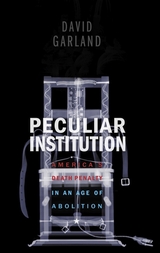
The U.S. death penalty is a peculiar institution, and a uniquely American one. Despite its comprehensive abolition elsewhere in the Western world, capital punishment continues in dozens of American states– a fact that is frequently discussed but rarely understood. The same puzzlement surrounds the peculiar form that American capital punishment now takes, with its uneven application, its seemingly endless delays, and the uncertainty of its ever being carried out in individual cases, none of which seem conducive to effective crime control or criminal justice. In a brilliantly provocative study, David Garland explains this tenacity and shows how death penalty practice has come to bear the distinctive hallmarks of America’s political institutions and cultural conflicts.
America’s radical federalism and local democracy, as well as its legacy of violence and racism, account for our divergence from the rest of the West. Whereas the elites of other nations were able to impose nationwide abolition from above despite public objections, American elites are unable– and unwilling– to end a punishment that has the support of local majorities and a storied place in popular culture.
In the course of hundreds of decisions, federal courts sought to rationalize and civilize an institution that too often resembled a lynching, producing layers of legal process but also delays and reversals. Yet the Supreme Court insists that the issue is to be decided by local political actors and public opinion. So the death penalty continues to respond to popular will, enhancing the power of criminal justice professionals, providing drama for the media, and bringing pleasure to a public audience who consumes its chilling tales.
Garland brings a new clarity to our understanding of this peculiar institution– and a new challenge to supporters and opponents alike.
When parole first emerged as a corrections strategy in the nineteenth century, work was supposed to keep ex-prisoners out of trouble. This strategy foundered in the changing economy after World War II. What followed was a rehabilitative strategy, where the clinical expertise of the parole agent replaced the discipline of the industrial labor market in defining and controlling criminal deviance. Today, Simon argues, as drastic changes in the economy have virtually locked out an entire class, rehabilitation has given way to mere management. The effect is isolation of the offender, either in jail or in an underclass community; the result is an escalating cycle of imprisonment, destabilization, and insecurity.
No significant improvement in the current penal crisis can be expected until we better understand the relationship between punishment and social order, a relationship which this book explores in theoretical, historical, and practical detail.
A lucid guide to the radical politics of prison abolitionists
There is growing recognition that mass incarceration is unjust and undemocratic, but prison abolition continues to be dismissed as naïve, idealistic, and out of touch with reality. Anna Terwiel challenges this view, carefully examining the work of abolitionist thinkers and activists since the 1960s to argue that prison abolition is a realist political project. Abolition, Terwiel shows, is oriented toward practical realities and offers concrete proposals for radical democratic change.
Based on insightful readings of renowned abolitionists such as Michel Foucault, Liat Ben-Moshe, and Angela Y. Davis, Prison Abolition for Realists illuminates the realist aspects of their approaches as well as the important differences between them. Distinguishing between paranoid, purist, and agonistic styles of abolitionism, Terwiel argues that an agonistic approach holds the most promise for democratic change to carceral systems. Embodied in the work of Davis, agonistic abolitionism combines radical critique with efforts to build new democratic institutions while accepting that all political achievements will be imperfect. Pursuing examples of what this looks like in practice, Terwiel explores grassroots transformative justice efforts, like those of Communities Against Rape and Abuse. She also proposes a “right to comfort” to support incarcerated people’s demands for air conditioners in extremely hot prisons, showing how state institutions, civil law, and rights claims can be potential resources for abolitionists.
Nuanced and illuminating, Prison Abolition for Realists affirms abolition’s viability during a time of multiple, ongoing crises. While many despair at the state of the world, Terwiel reveals how abolition offers an actionable politics of the possible. Far from being unrealistic, abolition is an indispensable part of a realist politics.
Retail e-book files for this title are screen-reader friendly with images accompanied by short alt text and/or extended descriptions.
Retail e-book files for this title are screen-reader friendly with images accompanied by short alt text and/or extended descriptions.

A pioneering history of incarceration in Western political thought.
The prison as we know it is a relatively new institution, established on a large scale in Europe and the United States only during the Enlightenment. Ideas and arguments about penal incarceration, however, long predate its widespread acceptance as a practice. The Prison before the Panopticon argues that debates over imprisonment are as old as Western political philosophy itself. This groundbreaking study examines the role of the prison in the history of political thought, detailing the philosophy of incarceration as it developed from Demosthenes, Plato, and Philo to Thomas More, Thomas Hobbes, and Jeremy Bentham.
Jacob Abolafia emphasizes two major themes that reappear in philosophical writing about the prison. The first is the paradox of popular authorization. This is the problem of how to justify imprisonment in light of political and theoretical commitments to freedom and equality. The second theme is the promise of rehabilitation. Plato and his followers insist that imprisonment should reform the prisoner and have tried to explain in detail how incarceration could have that effect.
While drawing on current historical scholarship to carefully situate each thinker in the culture and penal practices of his own time and place, Abolafia also reveals the surprisingly deep and persistent influence of classical antiquity on modern theories of crime and punishment. The Prison before the Panopticon is a valuable resource not only about the legitimacy of the prison in an age of mass incarceration but also about the philosophical justifications for penal alternatives like restorative justice.
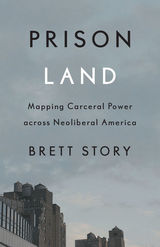
From broken-window policing in Detroit to prison-building in Appalachia, exploring the expansion of the carceral state and its oppressive social relations into everyday life
Prison Land offers a geographic excavation of the prison as a set of social relations—including property, work, gender, and race—enacted across various landscapes of American life. Prisons, Brett Story shows, are more than just buildings of incarceration bound to cycles of crime and punishment. Instead, she investigates the production of carceral power at a range of sites, from buses to coalfields and from blighted cities to urban financial hubs, to demonstrate how the organization of carceral space is ideologically and materially grounded in racial capitalism.
Story’s critically acclaimed film The Prison in Twelve Landscapes is based on the same research that informs this book. In both, Story takes an expansive view of what constitutes contemporary carceral space, interrogating the ways in which racial capitalism is reproduced and for which police technologies of containment and control are employed. By framing the prison as a set of social relations, Prison Land forces us to confront the production of new carceral forms that go well beyond the prison system. In doing so, it profoundly undermines both conventional ideas of prisons as logical responses to the problem of crime and attachment to punishment as the relevant measure of a transformed criminal justice system.

"Hawkins devotes a large portion of this relatively short book to a discussion of some of the really crucial policy activities that tend to stifle meaningful reform and then goes on to tell how at least some of these policies can be altered. . . . The book concludes with a chapter devoted to a discussion of impediments to change that should be required reading for all serious students of penology."—Choice
"Hawkins has added a much needed down-to-earch analysis of prison. . . . This is not a pessimistic book. It is a realistic book. It avoids the pitfall of utopian and single-factor solutions to an extremely complex problem."—Graeme R. Newman, Annals of the American Academy of Political and Social Science
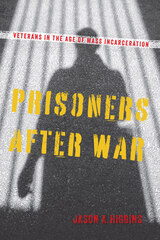
Winner of the 2025 Oral History Association Book Award
The United States has both the largest, most expensive, and most powerful military and the largest, most expensive, and most punitive carceral system in the history of the world. Since the American War in Vietnam, hundreds of thousands of veterans have been incarcerated after their military service.
Identifying the previously unrecognized connections between American wars and mass incarceration, Prisoners after War reaches across lines of race, class, and gender to record the untold history of incarcerated veterans over the past six decades. Having conducted dozens of oral history interviews, Jason A. Higgins traces the lifelong effects of war, inequality, disability, and mental illness, and explores why hundreds of thousands of veterans, from Vietnam to Afghanistan, were caught up in the carceral system. This original study tells an intergenerational history of state-sanctioned violence, punishment, and inequality, but its pages also resonate with stories of survival and redemption, revealing future possibilities for reform and reparative justice.
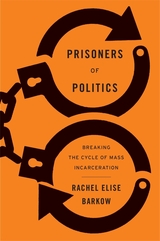
A CounterPunch Best Book of the Year
A Lone Star Policy Institute Recommended Book
“If you care, as I do, about disrupting the perverse politics of criminal justice, there is no better place to start than Prisoners of Politics.”
—James Forman, Jr., author of Locking Up Our Own
The United States has the highest rate of incarceration in the world. The social consequences of this fact—recycling people who commit crimes through an overwhelmed system and creating a growing class of permanently criminalized citizens—are devastating. A leading criminal justice reformer who has successfully rewritten sentencing guidelines, Rachel Barkow argues that we would be safer, and have fewer people in prison, if we relied more on expertise and evidence and worried less about being “tough on crime.” A groundbreaking work that is transforming our national conversation on crime and punishment, Prisoners of Politics shows how problematic it is to base criminal justice policy on the whims of the electorate and argues for an overdue shift that could upend our prison problem and make America a more equitable society.
“A critically important exploration of the political dynamics that have made us one of the most punitive societies in human history. A must-read by one of our most thoughtful scholars of crime and punishment.”
—Bryan Stevenson, author of Just Mercy
“Barkow’s analysis suggests that it is not enough to slash police budgets if we want to ensure lasting reform. We also need to find ways to insulate the process from political winds.”
—David Cole, New York Review of Books
“A cogent and provocative argument about how to achieve true institutional reform and fix our broken system.”
—Emily Bazelon, author of Charged

An international best seller dissects the globalization of penal policies “made in U.S.A.” as part of the spread of neoliberalism
In the early 1990s, Mayor Rudolph Giuliani launched a zero-tolerance campaign aimed at street disorders and petty offenders, incarnated in the infamous “squeegee man.” New York City soon became a planetary showcase for an aggressive approach to law enforcement that, despite its extravagant costs and the absence of connection to the crime drop, came to be admired and imitated by other cities in the United States, Western Europe, and Latin America.
In Prisons of Poverty, Loïc Wacquant tracks the incubation and internationalization of the slogans, theories, and measures composing this new punitive “common sense,” fashioned to curb mounting urban inequality and marginality in the metropolis. He finds that a network of Reagan-era conservative think tanks (led by the Manhattan Institute) forged them as weapons in their crusade to dismantle the welfare state and, in effect, to criminalize poverty. He traces their import and export through the agency of the media and the pro-market policy institutes that have mushroomed across the European Union, particularly in Tony Blair’s Britain. And he shows how academics helped smuggle U.S. techniques of penalization into their countries by dressing them up in scholarly garb.Now available in English for the first time in an expanded edition, Prisons of Poverty reveals how the Washington consensus on economic deregulation and welfare retrenchment was extended to encompass punitive crime control because the invisible hand of the market necessitates and calls forth the iron fist of the penal state.
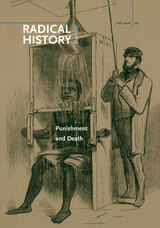
The issue’s contributors—comprising both academics and activists—examine the practices of punishment and death imposed upon citizens, particularly through penal systems. One contributor exposes how the indignation and outrage many Americans expressed toward the military torture at Abu Ghraib do not extend to similar instances of torture (beatings, “shower-baths,” sexual abuse, etc.) against inmates of color within the U.S. prison system. Another contributor reflects on the unexpected but effective alliance between antiprison activists and the environmental justice movement in California, which worked to stop the massive prison-building boom of the late twentieth and early twenty-first centuries. Bringing a longer sweep of Western colonialism into view, another essay reveals the racial prejudices within disciplinary processes of Puerto Rico that lingered even after the island’s emancipation from the Spanish American empire, leading to unequal distribution of punishment on both colonial and domestic subject populations.
Contributors. Ethan Blue, Rose Braz, Helena Cobban, Craig Gilmore, Alan Eladio Gómez, R. J. Lambrose, Heather Jane McCarty, Dylan Rodríguez, Kelvin Santiago-Valles, Carolyn Strange, Patrick Timmons

"Punishment and Modern Society is an outstanding delineation of the sociology of punishment. At last the process that is surely the heart and soul of criminology, and perhaps of sociology as well—punishment—has been rescued from the fringes of these 'disciplines'. . . . This book is a first-class piece of scholarship."—Graeme Newman, Contemporary Sociology
"Garland's treatment of the theorists he draws upon is erudite, faithful and constructive. . . . Punishment and Modern Society is a magnificent example of working social theory."—John R. Sutton, American Journal of Sociology
"Punishment and Modern Society lifts contemporary penal issues from the mundane and narrow contours within which they are so often discussed and relocates them at the forefront of public policy. . . . This book will become a landmark study."—Andrew Rutherford, Legal Studies
"This is a superbly intelligent study. Its comprehensive coverage makes it a genuine review of the field. Its scholarship and incisiveness of judgment will make it a constant reference work for the initiated, and its concluding theoretical synthesis will make it a challenge and inspiration for those undertaking research and writing on the subject. As a state-of-the-art account it is unlikely to be bettered for many a year."—Rod Morgan, British Journal of Criminology
Winner of both the Outstanding Scholarship Award of the Crime and Delinquency Division of the Society for the Study of Social Problems and the Distinguished Scholar Award from the American Sociological Association's Crime, Law, and Deviance Section
READERS
Browse our collection.
PUBLISHERS
See BiblioVault's publisher services.
STUDENT SERVICES
Files for college accessibility offices.
RECENTLY PUBLISHED



UChicago Accessibility Resources
home | accessibility | search | about | contact us
BiblioVault ® 2001 - 2025
The University of Chicago Press