
 A SCHOLARLY BOOK REPOSITORY
252 start with R start with R

As April R. Haynes shows, the crusade against female masturbation was rooted in a generally shared agreement on some major points: that girls and women were as susceptible to masturbation as boys and men; that “self-abuse” was rooted in a lack of sexual information; and that sex education could empower women and girls to master their own bodies. Yet the groups who made this education their goal ranged widely, from “ultra” utopians and nascent feminists to black abolitionists. Riotous Flesh explains how and why diverse women came together to popularize, then institutionalize, the condemnation of masturbation, well before the advent of sexology or the professionalization of medicine.

Many people move to Sedona because, they claim, they are called there by its special energy. But they are also often escaping job loss, family breakdown, or foreclosure. Spirituality, Crockford shows, offers a way for people to distance themselves from and critique current political and economic norms in America. Yet they still find themselves monetizing their spiritual practice as a way to both “raise their vibration” and meet their basic needs. Through an analysis of spirituality in Sedona, Crockford gives shape to the failures and frustrations of middle- and working-class people living in contemporary America, describing how spirituality infuses their everyday lives. Exploring millenarianism, conversion, nature, food, and conspiracy theories, Ripples of the Universe combines captivating vignettes with astute analysis to produce a unique take on the myriad ways class and spirituality are linked in contemporary America.
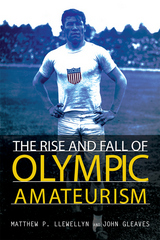
Matthew P. Llewellyn and John Gleaves analyze how this astonishing transformation took place. Drawing on Olympic archives and a wealth of research across media, the authors examine how an elite--white, wealthy, often Anglo-Saxon--controlled and shaped an enormously powerful myth of amateurism. The myth assumed an air of naturalness that made it seem unassailable and, not incidentally, served those in power. Llewellyn and Gleaves trace professionalism's inroads into the Olympics from tragic figures like Jim Thorpe through the shamateur era of under-the-table cash and state-supported athletes. As they show, the increasing acceptability of professionals went hand-in-hand with the Games becoming a for-profit international spectacle. Yet the myth of amateurism's purity remained a potent force, influencing how people around the globe imagined and understood sport.
Timely and vivid with details, The Rise and Fall of Olympic Amateurism is the first book-length examination of the movement's foundational ideal.

A remarkable anthology of key writings that parallels the history of fashion with modern life
Writing more than a century before Vogue, no less a figure than G. W. F. Hegel reviewed the fashion of his day and found it wanting because, in becoming outmoded so quickly, it drew attention away from the timeless beauty of the human form. And Hegel is not unique among philosophers in his interest in fashion’s role; for more than 250 years, social thinkers have considered fashion—its transitive nature, the conformity it inspires, the vast range of its influence—as a defining feature of modern life.
In The Rise of Fashion, Daniel Leonhard Purdy brings together key writings from the Enlightenment to the twentieth century that explore fashion as the ultimate expression of modernity. Making available many previously untranslated or otherwise unfamiliar works from French, German, and English, Purdy establishes an extraordinary lineage of fashion commentary dating back to Mandeville and Voltaire, which laid the groundwork for the writings on commodity culture of Adorno, Benjamin, and the Frankfurt School. From critiques of aristocratic excess to accounts of fashion’s influence on our ideals of masculinity or femininity, from the figure of the dandy and the eroticism of clothing to the class politics of fashion, this landmark reader includes works by philosophers (Carlyle, Rousseau, Georg Simmel) and social theorists (Herbert Spencer, Veblen), as well as writers (Goethe, Baudelaire, Mallarmé, Wilde) and critics (Karl Kraus, Adolf Loos, Simone de Beauvoir).Collecting and contextualizing many of the earliest and most significant formulations of fashion theory, The Rise of Fashion provocatively examines the proposition that to be modern is to be fashionable.
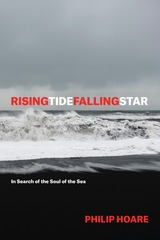
Many of us visit the sea. Admire it. Even profess to love it. But very few of us live it. Philip Hoare does. He swims in the sea every day, either off the coast of his native Southampton or his adopted Cape Cod. He watches its daily and seasonal changes. He collects and communes with the wrack—both dead and never living—that it throws up on the shingle. He thinks with, at, through the sea.
All of which should prepare readers: RISINGTIDEFALLINGSTAR is no ordinary book. It mounts no straight-ahead argument. It hews to no single genre. Instead, like the sea itself, it moves, flows, absorbs, transforms. In its pages we find passages of beautiful nature and travel writing, lyrical memoir, seams of American and English history and much more. We find Thoreau and Melville, Bowie and Byron, John Waters and Virginia Woolf, all linked through a certain refusal to be contained, to be strictly defined—an openness to discovery and change. Running throughout is an air of elegy, a reminder that the sea is an ending, a repository of lost ships, lost people, lost ways of being. It is where we came from; for Hoare, it is where he is going.
“Every swim is a little death,” Hoare writes, “but it is also a reminder that you are alive.” Few books have ever made that knife’s edge so palpable. Read RISINGTIDEFALLINGSTAR. Let it settle into the seabed of your soul. You’ll never forget it.
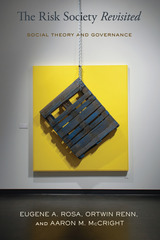
Risk is a part of life. How we handle uncertainty and deal with potential threats influence decision making throughout our lives. In The Risk Society Revisited, Eugene A. Rosa, Ortwin Renn, and Aaron M. McCright offer the first book to present an integrated theory of risk and governance.
The authors examine our sociological understanding of risk and how we reconcile modern human conditions with our handling of risk in our quest for improved quality of life. They build a new framework for understanding risk—one that provides an innovative connection between social theory and the governance of technological and environmental risks and the sociopolitical challenges they pose for a sustainable future.
Showing how our consciousness affects risk in the decisions we make—as individuals and as members of a democratic society—The Risk Society Revisited makes an important contribution to the literature of risk research.
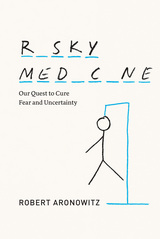
Exploring the transformation of health care over the last several decades that has led doctors to become more attentive to treating risk than treating symptoms or curing disease, Aronowitz shows how many aspects of the health system and clinical practice are now aimed at risk reduction and risk control. He argues that this transformation has been driven in part by the pharmaceutical industry, which benefits by promoting its products to the larger percentage of the population at risk for a particular illness, rather than the smaller percentage who are actually affected by it. Meanwhile, for those suffering from chronic illness, the experience of risk and disease has been conflated by medical practitioners who focus on anticipatory treatment as much if not more than on relieving suffering caused by disease. Drawing on such controversial examples as HPV vaccines, cancer screening programs, and the cancer survivorship movement, Aronowitz argues that patients and their doctors have come to believe, perilously, that far too many medical interventions are worthwhile because they promise to control our fears and reduce uncertainty.
Risky Medicine is a timely call for a skeptical response to medicine’s obsession with risk, as well as for higher standards of evidence for risk-reducing interventions and a rebalancing of health care to restore an emphasis on the actual curing of and caring for people suffering from disease.
Risky Rhetoric: AIDS and the Cultural Practices of HIV Testing is the first book-length study of the rhetoric inherent in and surrounding HIV testing. In addition to providing a history of HIV testing in the United States from 1985 to the present, J. Blake Scott explains how faulty arguments about testing’s power and effects have promoted unresponsive and even dangerous testing practices for so-called healthy subjects as well as those deemed risky.A new afterword to the paperback edition discusses changes in testing technology, treatments, and public health responses in the last ten years. The ultimate goal of Risky Rhetoric is to offer strategies to policy makers, HIV educators and test counselors, and other rhetors for developing more responsive and egalitarian testing-related rhetorics and practices.
Ranging widely across time and geography, Rites of Place is to date the most comprehensive and diverse example of memory studies in the field of Russian and East European studies. Leading scholars consider how public rituals and the commemoration of historically significant sites facilitate a sense of community, shape cultural identity, and promote political ideologies. The aims of this volume take on unique importance in the context of the tumultuous events that have marked Eastern European history—especially the revolutions of 1905 and 1917, World War II, and the collapse of the Soviet Union. With essays on topics such as the founding of St. Petersburg, the battle of Borodino, the Katyn massacre, and the Lenin cult, this volume offers a rich discussion of the uses and abuses of memory in cultures where national identity has repeatedly undergone dramatic shifts and remains riven by internal contradictions.

Cities have been built alongside rivers throughout history. These rivers can shape a city’s success or cause its destruction. At the same time, city-building reshapes rivers and their landscapes. Cities have harnessed, modified, and engineered rivers, altering ecologies and creating new landscapes in the process of urbanization. Rivers are also shaped by the development of cities as urban landscapes, just as the cities are shaped by their relationship to the river.
In the river city, the city river is a dynamic contributor to the urban landscape with its flow of urban economies, geographies, and cultures. Yet we have rarely given these urban landscapes their due. Building on emerging interest in the resilience of cities, this book and the original symposium consider river cities and city rivers to explore how histories have shaped the present and how they might inform our visions of the future.
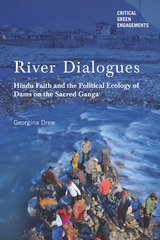
India’s sacred Ganga River is arguably one of the most iconic sites for worship, with a continuity of rituals for the living and the dead that span over two millennia. Along the river, from high in the Himalaya to the vast plains below, people gather daily to worship the Ganga through prayer and song. But large government-sponsored dams threaten to upend these practices.
In River Dialogues, Georgina Drew offers a detailed ethnographic engagement with the social movements contesting hydroelectric development on the Ganga. The book examines the complexity of the cultural politics that, on the one hand, succeeded in influencing an unprecedented reversal of government plans for three contested hydroelectric projects, and how, on the other hand, this decision sparked ripples of discontent after being paired with the declaration of a conservation zone where the projects were situated.
The book follows the work of women who were initially involved in efforts to stop the disputed projects. After looking to their discourses and actions, Drew argues for the use of a political ecology analysis that incorporates the everyday practice and everyday religious connections that animated the cultural politics of development. Drew offers a nuanced understanding of the struggles that communities enact to assert their ways of knowing and caring for resources that serves as an example for others critically engaging with the growing global advocacy of the “green economy” model for environmental stewardship.
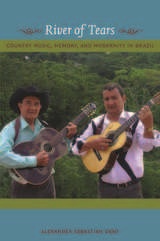
Since 1998, Alexander Sebastian Dent has analyzed rural music in the state of São Paulo, interviewing and spending time with listeners, musicians, songwriters, journalists, record-company owners, and radio hosts. Dent not only describes the production and reception of this music, he also explains why the genre experienced such tremendous growth as Brazil transitioned from an era of dictatorship to a period of intense neoliberal reform. Dent argues that rural genres reflect a widespread anxiety that change has been too radical and has come too fast. In defining their music as rural, Brazil’s country musicians—whose work circulates largely in cities—are criticizing an increasingly inescapable urban life characterized by suppressed emotions and an inattentiveness to the past. Their performances evoke a river of tears flowing through a landscape of loss—of love, of life in the countryside, and of man’s connections to the natural world.


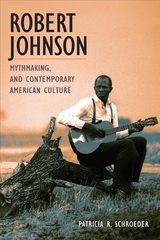
Merging literary analysis with cultural criticism and biographical study, Patricia R. Schroeder explores Johnson's ongoing role as a cultural icon. Schroeder's detailed analysis engages key images and myths about the blues musician (such as the Faustian crossroads exchange of his soul for guitar virtuosity). Navigating the many competing interpretations that swirl around him, Schroeder reveals the cultural purposes served by the stories and the storytellers. The result is a fascinating examination of the relationships among Johnson's life, its subsequent portrayals, and the forces that drove the representations.
Offering penetrating insights into both Johnson and the society that perpetuates him, Robert Johnson, Mythmaking, and Contemporary American Culture is essential reading for blues fans and cultural critics interested in a foundational musical figure.
Tracing the connections between human-like robots and AI at the site of dehumanization and exploited labor
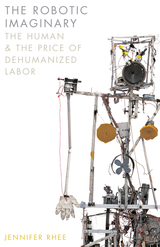
The word robot—introduced in Karel Čapek’s 1920 play R.U.R.—derives from rabota, the Czech word for servitude or forced labor. A century later, the play’s dystopian themes of dehumanization and exploited labor are being played out in factories, workplaces, and battlefields. In The Robotic Imaginary, Jennifer Rhee traces the provocative and productive connections of contemporary robots in technology, film, art, and literature. Centered around the twinned processes of anthropomorphization and dehumanization, she analyzes the coevolution of cultural and technological robots and artificial intelligence, arguing that it is through the conceptualization of the human and, more important, the dehumanized that these multiple spheres affect and transform each other.
Drawing on the writings of Alan Turing, Sara Ahmed, and Arlie Russell Hochschild; such films and novels as Her and The Stepford Wives; technologies like Kismet (the pioneering “emotional robot”); and contemporary drone art, this book explores anthropomorphic paradigms in robot design and imagery in ways that often challenge the very grounds on which those paradigms operate in robotics labs and industry. From disembodied, conversational AI and its entanglement with care labor; embodied mobile robots as they intersect with domestic labor; emotional robots impacting affective labor; and armed military drones and artistic responses to drone warfare, The Robotic Imaginary ultimately reveals how the human is made knowable through the design of and discourse on humanoid robots that are, paradoxically, dehumanized.
Paper is temporarily out of stock, Cloth (0-87972-368-8) is available at the paper price until further notice.

When you hear the words "Boston sports," does your mind flash to a place or to a person? Do you think of a fly ball arching over the Green Monster, a Celtic breaking across the parquet at Boston Garden, rowers skimming along the Charles River in autumn, or runners tackling the grueling stretch of "Heartbreak Hill" during the Boston Marathon? Or do you conjure faces--a smiling Babe Ruth, a bearded Bill Russell, a determined Rocky Marciano, a boyish and nimble Bobby Orr, or a defiant Pedro Martinez? Most likely, it is impossible to separate the two, impossible to imagine Bob Cousy on any court other than the Garden or Ted Williams playing at any field other than Fenway. Certain people and places are as inseparable as heads and tails on a penny.
The Rock, the Curse, and the Hub is a collection of original essays about the people and places that live in the minds and memories of Bostonians and all Americans. From the Boston of the young Bambino and even younger Francis Ouimet to the glories and agonies of 1986 and the struggles to keep the Patriots in town, each chapter focuses on the games and the athletes, but also on which sports have defined Boston and Bostonians. In a city of deep ethnic and class divisions, sports have provided a common ground, an intense shared experience. Pursuing the legend and the lore, these essays celebrate the players, the games, and the arenas that are at the heart of the city of Boston.
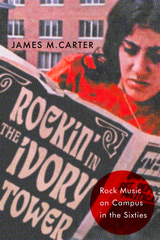
Histories of American rock music and the 1960s counterculture typically focus on the same few places: Woodstock, Monterey, Altamont. Yet there was also a very active college circuit that brought edgy acts like the Jefferson Airplane and the Velvet Underground to different metropolitan regions and smaller towns all over the country. These campus concerts were often programmed, promoted, and reviewed by students themselves, and their diverse tastes challenged narrow definitions of rock music.
Rockin’ in the Ivory Tower takes a close look at two smaller universities, Drew in New Jersey and Stony Brook on Long Island, to see how the culture of rock music played an integral role in student life in the late 1960s. Analyzing campus archives and college newspapers, historian James Carter traces connections between rock fandom and the civil rights protests, free speech activism, radical ideas, lifestyle transformations, and anti-war movements that revolutionized universities in the 1960s. Furthermore, he finds that these progressive students refused to segregate genres like folk, R&B, hard rock, and pop. Rockin’ in the Ivory Tower gives readers a front-row seat to a dynamic time for the music industry, countercultural politics, and youth culture.

Given the long history of feminism and its contested place in popular culture, important, practical questions arise: What effect, if any, have feminist ideas and practices had on the lives of young men and women who grew up with them? How do these individuals negotiate the realities of gender in their daily lives?
In Rockin’ Out of the Box, Mimi Schippers, employing the crucial feminist insight that gender is a constantly shifting performance and not an essential quality related to sex, explores the gender roles, assumptions, and transgressions of the men and women involved in the alternative hard rock scene. The author focuses on this sizable section of rock music both because it is widely inclusive of men and women and because it explicitly adopted feminism as its point of departure from mainstream music. Schippers uses the innovative term gender maneuvering to explain her observations that gender and sexuality are negotiated and always changing features of social relations. This process, she demonstrates, operates as a cultural practice and as an individual strategy of resistance to socially prescribed gender roles.
Schippers, who spent more than two years frequenting alternative hard rock clubs and concerts in Chicago, conducted extensive interviews with fans as well as musicians, including Ian MacKaye of Fugazi, Eddie Vedder of Pearl Jam, Kim Thayil of Soundgarden, Donita Sparks and Jennifer Finch of L7, Kat Bjelland and Lori Barbero of Babes in Toyland, Rose of Poster Children, Louise Post and Nina Gordon of Veruca Salt, and Liz Davis and Valerie Agnew of 7 Year Bitch. As it documents the development of a rock music genre that has so far received little academic attention, this book also demonstrates how this musical culture contributes to our understanding of the daily practices of gender relations among young people.
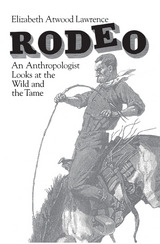
Based on extensive field work and drawing on comparative materials from other stock-tending societies, Rodeo is a major contribution to an understanding of the role of performance in society, the culturally constructed view of man's place in nature, and the structure and meaning of social relationships and their representations.
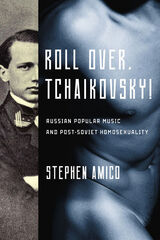
Centered on the musical experiences of homosexual men in St. Petersburg and Moscow, this ground-breaking study examines how post-Soviet popular music both informs and plays off of a corporeal understanding of Russian male homosexuality.
Drawing upon ethnography, musical analysis, and phenomenological theory, Stephen Amico offers an expert technical analysis of Russian rock, pop, and estrada music, dovetailing into an illuminating discussion of homosexual men's physical and bodily perceptions of music. He also outlines how popular music performers use song lyrics, drag, physical movements, images of women, sexualized male bodies, and other tools and tropes to implicitly or explicitly express sexual orientation through performance. Finally, Amico uncovers how such performances help homosexual Russian men to create their own social spaces and selves, in meaningful relation to others with whom they share a "nontraditional orientation."
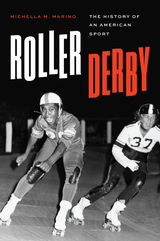
Since 1935, roller derby has thrilled fans and skaters with its constant action, hard hits, and edgy attitude. However, though its participants’ athleticism is undeniable, roller derby has never been accepted as a “real” sport. Michella M. Marino, herself a former skater, tackles the history of a sport that has long been a cultural mainstay for one reason both utterly simple and infinitely complex: roller derby has always been coed.
Richly illustrated and drawing on oral histories, archival materials, media coverage, and personal experiences, Roller Derby is the first comprehensive history of this cultural phenomenon, one enjoyed by millions yet spurned by mainstream gatekeepers. Amid the social constraints of the mid-twentieth century, roller derby’s emphasis on gender equality attracted male and female athletes alike, producing gender relations and gender politics unlike those of traditional sex-segregated sports. In an enlightening feminist critique, Marino considers how the promotion of pregnancy and motherhood by roller derby management has simultaneously challenged and conformed to social norms. Finally, Marino assesses the sport’s present and future after its resurgence in the 2000s.

In Romancing the Sperm, Diane Tober explores the intersections between sperm donation and the broader social and political environment in which “modern families” are created and regulated. Through tangible and intimate stories, this book provides a captivating read for anyone interested in family and kinship, genetics and eugenics, and how ever-expanding assisted reproductive technologies continue to redefine what it means to be human.
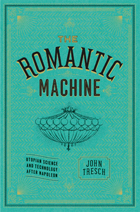
In the years immediately following Napoleon’s defeat, French thinkers in all fields set their minds to the problem of how to recover from the long upheavals that had been set into motion by the French Revolution. Many challenged the Enlightenment’s emphasis on mechanics and questioned the rising power of machines, seeking a return to the organic unity of an earlier age and triggering the artistic and philosophical movement of romanticism. Previous scholars have viewed romanticism and industrialization in opposition, but in this groundbreaking volume John Tresch reveals how thoroughly entwined science and the arts were in early nineteenth-century France and how they worked together to unite a fractured society.
Focusing on a set of celebrated technologies, including steam engines, electromagnetic and geophysical instruments, early photography, and mass-scale printing, Tresch looks at how new conceptions of energy, instrumentality, and association fueled such diverse developments as fantastic literature, popular astronomy, grand opera, positivism, utopian socialism, and the Revolution of 1848. He shows that those who attempted to fuse organicism and mechanism in various ways, including Alexander von Humboldt and Auguste Comte, charted a road not taken that resonates today.
Essential reading for historians of science, intellectual and cultural historians of Europe, and literary and art historians, The Romantic Machine is poised to profoundly alter our understanding of the scientific and cultural landscape of the early nineteenth century.
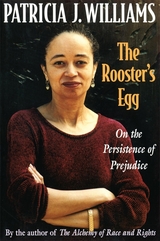
“Jamaica is the land where the rooster lays an egg…When a Jamaican is born of a black woman and some English or Scotsman, the black mother is literally and figuratively kept out of sight as far as possible, but no one is allowed to forget that white father, however questionable the circumstances of birth…You get the impression that these virile Englishmen do not require women to reproduce. They just come out to Jamaica, scratch out a nest and lay eggs that hatch out into ‘pink’ Jamaicans.”
—Zora Neale Hurston
We may no longer issue scarlet letters, but from the way we talk, we might as well: W for welfare, S for single, B for black, CC for children having children, WT for white trash. To a culture speaking with barely masked hysteria, in which branding is done with words and those branded are outcasts, this book brings a voice of reason and a warm reminder of the decency and mutual respect that are missing from so much of our public debate. Patricia J. Williams, whose acclaimed book The Alchemy of Race and Rights offered a vision for healing the ailing spirit of the law, here broadens her focus to address the wounds in America’s public soul, the sense of community that rhetoric so subtly but surely makes and unmakes.
In these pages we encounter figures and images plucked from headlines—from Tonya Harding to Lani Guinier, Rush Limbaugh to Hillary Clinton, Clarence Thomas to Dan Quayle—and see how their portrayal, encoding certain stereotypes, often reveals more about us than about them. What are we really talking about when we talk about welfare mothers, for instance? Why is calling someone a “redneck” okay, and what does that say about our society? When young women appear on Phil Donahue to represent themselves as Jewish American Princesses, what else are they doing? These are among the questions Williams considers as she uncovers the shifting, often covert rules of conversation that determine who “we” are as a nation.
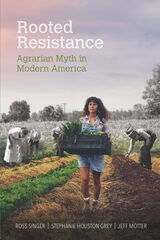
Through a careful examination of several case studies, Rooted Resistance traverses the ground of agrarian myth in modern America. The authors investigate key figures and movements in the history of modern agrarianism, including the World War I victory garden efforts, the postwar Country Life movement for the vindication of farmers’ rights, the Southern Agrarian critique of industrialism, and the practical and spiritual prophecy of organic farming put forth by J. I. Rodale. This critical history is then brought up to date with recent examples such as the contested South Central Farm in urban Los Angeles and the spectacular rise and fall of the Chipotle “Food with Integrity” branding campaign.
By examining a range of case studies, Singer, Grey, and Motter aim for a deeper critical understanding of the many applications of agrarian myth and reveal why it can help provide a pathway for positive systemic change in the food system.
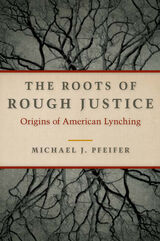
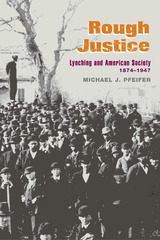

The Civil War thrust millions of men and women-rich and poor, soldiers and civilians, enslaved and free-onto the roads of the South. During four years of war, Southerners lived on the move. In the hands of Yael A. Sternhell, movement becomes a radically new means to perceive the full trajectory of the Confederacy's rise, struggle, and ultimate defeat.
By focusing not only on the battlefield and the home front but also on the roads and woods that connected the two, this pioneering book investigates the many roles of bodies in motion. We watch battalions of young men as they march to the front, galvanizing small towns along the way, creating the Confederate nation in the process. We follow deserters straggling home and refugees fleeing enemy occupation, both hoping to escape the burdens of war. And in a landscape turned upside down, we see slaves running toward freedom, whether hundreds of miles away or just beyond the plantation's gate.
Based on a vast array of documents, from slave testimonies to the papers of Confederate bureaucrats to the private letters of travelers from all walks of life, Sternhell unearths the hidden connections between physical movements and their symbolic meanings, individual bodies and entire armies, the reinvention of a social order and the remaking of private lives. Movement, as means of liberation and as vehicle of subjugation, lay at the heart of the human condition in the wartime South.
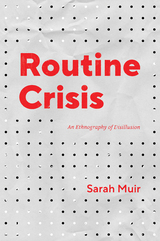
Anthropologist Sarah Muir offers a cogent meditation on the limits of critique at this historical moment, drawing on deep experience in Argentina but reflecting on a truly global condition. If we feel things are being upended in a manner that is ongoing, tumultuous, and harmful, what would we need to do—and what would we need to give up—to usher in a revitalized critique for today's world? Routine Crisis is an original provocation and a challenge to think beyond the limits of exhaustion and reimagine a form of criticism for the twenty-first century.

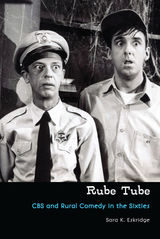
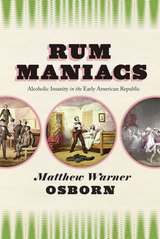
In Rum Maniacs, Matthew Warner Osborn reveals how and why pathological drinking became a subject of medical interest, social controversy, and lurid fascination in the early American republic. At the heart of that story is the disease that Poe suffered: delirium tremens. First described in 1813, delirium tremens and its characteristic hallucinations inspired sweeping changes in how the medical profession saw and treated the problems of alcohol abuse. Based on new theories of pathological anatomy, human physiology, and mental illness, the new diagnosis founded the medical conviction and popular belief that habitual drinking could become a psychological and physiological disease. By midcentury, delirium tremens had inspired a wide range of popular theater, poetry, fiction, and illustration. This romantic fascination endured into the twentieth century, most notably in the classic Disney cartoon Dumbo, in which a pink pachyderm marching band haunts a drunken young elephant. Rum Maniacs reveals just how delirium tremens shaped the modern experience of alcohol addiction as a psychic struggle with inner demons.
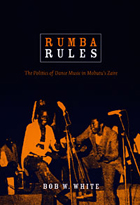
Drawing partly on his experiences as a member of a local dance band in the country’s capital city Kinshasa, White offers extraordinarily vivid accounts of the live music scene, including the relatively recent phenomenon of libanga, which involves shouting the names of wealthy or powerful people during performances in exchange for financial support or protection. With dynamic descriptions of how bands practiced, performed, and splintered, White highlights how the ways that power was sought and understood in Kinshasa’s popular music scene mirrored the charismatic authoritarianism of Mobutu’s rule. In Rumba Rules, Congolese speak candidly about political leadership, social mobility, and what it meant to be a bon chef (good leader) in Mobutu’s Zaire.
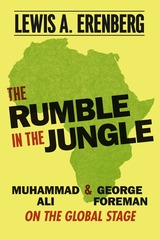
TheRumble in the Jungle orbits around Ali and Foreman, placing them at the convergence of the American Civil Rights movement and the Great Society, the rise of Islamic and African liberation efforts, and the ongoing quest to cast off the shackles of colonialism. With his far-reaching take on sports, music, marketing, and mass communications, Erenberg shows how one boxing match became nothing less than a turning point in 1970s culture.

2023 Marysa Navarro Best Book Prize, New England Council of Latin American Studies (NECLAS)
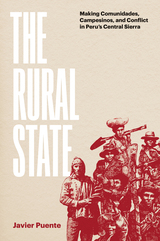
A study of the intersection of rural populations, state formation, and the origins of political conflict in Peru.
On the eve of the twentieth century, Peru seemed like a profitable and yet fairly unexploited country. Both foreign capitalists and local state makers envisioned how remote highland areas were essential to a sustainable national economy. Mobilizing Andean populations lay at the core of this endeavor. In his groundbreaking book, The Rural State, Javier Puente uncovers the surprising and overlooked ways that Peru’s rural communities formed the political nation-state that still exists today.
Puente documents how people living in the Peruvian central sierra in the twentieth century confronted emerging and consolidating powers of state and capital and engaged in an ongoing struggle over increasingly elusive subsistence and autonomies. Over the years, policy, politics, and social turmoil shaped the rural, mountainous regions of Peru until violent unrest, perpetrated by the Shining Path and other revolutionary groups, unveiled the extent, limits, and fractures of a century-long process of rural state formation. Examining the conflicts between one rural community and the many iterations of statehood in the central sierra of Peru, The Rural State offers a fresh perspective on how the Andes became la sierra, how pueblos became comunidades, and how indígenas became campesinos.

READERS
Browse our collection.
PUBLISHERS
See BiblioVault's publisher services.
STUDENT SERVICES
Files for college accessibility offices.
RECENTLY PUBLISHED




UChicago Accessibility Resources
home | accessibility | search | about | contact us
BiblioVault ® 2001 - 2025
The University of Chicago Press