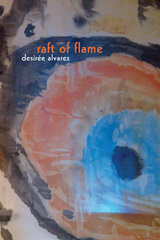
front cover of Raft of Flame
Raft of Flame
Desirée Alvarez
Omnidawn, 2019
A painter and poet, Desirée Alvarez engages with the powerful forces of lyric and rhythm to create a collection that moves across time and place. Inspired by Lorca’s passionate cante jondo, or “deep song,” and her own family history with Andalusian flamenco, Alvarez weaves together a time-travelling epic that searches through myth, culture, and nature for the roots of identity. Navigating both her Latina and European heritage through works by artists of the ancient Americas and Spain, Alvarez maps intersections between personal and political history. Searching narratives both fictitious and real, Raft of Flame includes imagined conversations between a conquistador and an Olmec sculpture, between Frida Kahlo and Velazquez, and between The Wizard of Oz’s Dorothy and Glinda the Good Witch.

In Raft of Flame, Alvarez constructs and fleshes out a fantastic narrative of personal and cultural history, offering glimpses into the art, history, and land that comprise her story. Her narrative explores how both nature and human populations continue to be trapped in the violence of colonialism. Vivid lyrics interrogate the complexities of mixed race, digging the dualities, upheavals, and casts of characters that underly Alvarez’s identity.

Raft of Flame won Omnidawn's 2018 Lake Merritt Prize. 
[more]

logo for Omnidawn
RAG
Julie Carr
Omnidawn, 2014
The question of civic lyric—the possibility of a politics of mourning—runs through this book-length aria-errancy-eros. All vectors of “rag” are at work: polemic political journal, syncopated turn-of-century song, menstrual blood, burial shroud, complaint, insult, a wiping cloth, the barest semblance of clothes, the slang word for woman. The energy running beneath this rag is human violence and sexual force erupting through fragments of film, fairy tale, news, novels: a father on fire, stranger in tears, prisoner who believes he’s a dog, women dressed in food, women refusing to eat, a body with no face, or a face with no skin. RAG spirals forward, picking up recurrent language, its narratives troubled by stutter, broken by what can’t be told.

[more]

front cover of Real Life
Real Life
An Installation
Julie Carr
Omnidawn, 2018
In a book rich with formal variety and lyric intensity, Carr takes up economic inequality, gendered violence, losses both personal and national, and the crisis of the body within all of these forces. Real Life: An Installation is a terrifying book, but one that keeps us close as it moves through the disruptions and eruptions of the real.
[more]

logo for Omnidawn
The Rendering
Anthony Cody
Omnidawn, 2023
A poetry collection that considers climate change and the possibility of wholeness within the Anthropocene.
 
Through a series of experimental poems centered on ecology, Anthony Cody’s The Rendering confronts the history of the Dust Bowl and its residual impacts on our current climate crisis, while acknowledging the complicities of capitalism. These poems grapple with questions of wholeness and annihilation in an Anthropocenic world where the fallout of settler colonialism continues to inflict environmental and cultural devastation. Cody encourages readers to participate in radical acts of refreshing and reimagining the page, poem, collection, and the self, and he invites us to reflect on what lies ahead should our climate continue on its current trajectory toward destruction.

These poems consider if wholeness, or a journey toward wholeness, can exist in the Anthropocene. And, if wholeness cannot exist in these times, we are invited to look at our lives and the world through and beyond annihilation.
 
[more]

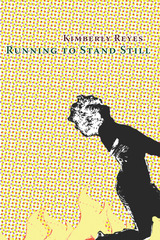
front cover of Running to Stand Still
Running to Stand Still
Kimberly Reyes
Omnidawn, 2019
Histories, stories, lyrics, aspirations, dreams, pressures, and images are spun into a musical tale through a site of convergence: the Black female body. Swarmed by external gazes and narratives, the inhabitant of this body uses her power to turn down this cacophony of noise and compose a symphonic space for herself. By breaching boundaries of racism, sexism, sizeism, colorism, and colonialism, these poems investigate the memories and realities of existing as Black in America. Building from poetic, journalistic, and musical histories, poet and essayist Kimberly Reyes constructs a complex and fantastic narrative in which she negotiates a path to claim her own power.

These poems teem with life, a life rich with many selves and many histories that populate in the voice of Reyes’s poetic narrator. They sway between negotiations of hypervisibility and erasure, the inevitable and the chosen, and the perceived and the constructed. Reyes’s poems offer sharp observations and lyrical movement to guide us in a ballad of reconciliation and becoming.
 
[more]


Send via email Share on Facebook Share on Twitter