
 A SCHOLARLY BOOK REPOSITORY
7 start with R start with R

The Covid-19 pandemic has tragically exposed how today’s welfare state cannot properly protect its citizens. Despite the valiant efforts of public sector workers, from under-resourced hospitals to a shortage of housing and affordable social care, the pandemic has tragically shown how decades of neglect has caused hundreds to die. In this bold new book, leading policy analyst Ursula Huws shows how we can create a welfare state that is fair, affordable, and offers security for all.
Huws focuses on some of the key issues of our time – the gig economy, universal, free healthcare, and social care, to criticize the current state of welfare provision. Drawing on a lifetime of research on these topics, she clearly explains why we need to radically rethink how it could change. With positivity and rigor, she proposes new and original policy ideas, including critical discussions of Universal Basic Income and new legislation for universal workers' rights.
She also outlines a 'digital welfare state' for the 21st century. This would involve a repurposing of online platform technologies under public control to modernize and expand public services, and improve accessibility.

Building on current scholarly work in digital rhetoric, software studies, and technical communication, Brock connects and continues ongoing conversations among rhetoricians, technical communicators, software studies scholars, and programming practitioners to demonstrate how software code and its surrounding discourse are highly rhetorical forms of communication. He considers examples ranging from large, well-known projects like Mozilla Firefox to small-scale programs like the “FizzBuzz” test common in many programming job interviews. Undertaking specific examinations of code texts as well as the contexts surrounding their composition, Brock illuminates the variety and depth of rhetorical activity taking place in and around code, from individual differences in style to changes in large-scale organizational and community norms.
Rhetorical Code Studies holds significant implications for digital communication, multimodal composition, and the cultural analysis of software and its creation. It will interest academics and students of writing, rhetoric, and software engineering as well as technical communicators and developers of all types of software.
According to Ben McCorkle, the rhetorical canon of delivery—traditionally seen as the aspect of oratory pertaining to vocal tone, inflection, and physical gesture—has undergone a period of renewal within the last few decades to include the array of typefaces, color palettes, graphics, and other design elements used to convey a message to a chosen audience. McCorkle posits that this redefinition, while a noteworthy moment of modern rhetorical theory, is just the latest instance in a historical pattern of interaction between rhetoric and technology. In Rhetorical
Delivery as Technological Discourse: A Cross-Historical Study, McCorkle explores the symbiotic relationship between delivery and technologies of writing and communication. Aiming to enhance historical understanding by demonstrating how changes in writing technology have altered our conception of delivery, McCorkle reveals the ways in which oratory and the tools of written expression have directly affected one another throughout the ages.
To make his argument, the author examines case studies from significant historical moments in the Western rhetorical tradition. Beginning with the ancient Greeks, McCorkle illustrates how the increasingly literate Greeks developed rhetorical theories intended for oratory that incorporated “writerly” tendencies, diminishing delivery’s once-prime status in the process. Also explored is the near-eradication of rhetorical delivery in the mid-fifteenth century—the period of transition from late manuscript to early print culture—and the implications of the burgeoning
print culture during the nineteenth century.
McCorkle then investigates the declining interest in delivery as technology designed to replace the human voice and gesture became prominent at the beginning of the 1900s. Situating scholarship on delivery within a broader postmodern structure, he moves on to a discussion of the characteristics of contemporary hypertextual and digital communication and its role in reviving the canon, while also anticipating the future of communication technologies, the likely shifts in attitude toward delivery, and the implications of both on the future of teaching rhetoric.
Rhetorical Delivery as Technological Discourse traces a long-view perspective of rhetorical history to present readers a productive reading of the volatile treatment of delivery alongside the parallel history of writing and communication technologies. This rereading will expand knowledge of the canon by not only offering the most thorough treatment of the history of rhetorical delivery available but also inviting conversation about the reciprocal impacts of rhetorical theory and written communication on each other throughout this history.
Rhetorical Machines addresses new approaches to studying computational processes within the growing field of digital rhetoric. While computational code is often seen as value-neutral and mechanical, this volume explores the underlying, and often unexamined, modes of persuasion this code engages. In so doing, it argues that computation is in fact rife with the values of those who create it and thus has powerful ethical and moral implications. From Socrates’s critique of writing in Plato’s Phaedrus to emerging new media and internet culture, the scholars assembled here provide insight into how computation and rhetoric work together to produce social and cultural effects.
This multidisciplinary volume features contributions from scholar-practitioners across the fields of rhetoric, computer science, and writing studies. It is divided into four main sections: “Emergent Machines” examines how technologies and algorithms are framed and entangled in rhetorical processes, “Operational Codes” explores how computational processes are used to achieve rhetorical ends, “Ethical Decisions and Moral Protocols” considers the ethical implications involved in designing software and that software’s impact on computational culture, and the final section includes two scholars’ responses to the preceding chapters. Three of the sections are prefaced by brief conversations with chatbots (autonomous computational agents) addressing some of the primary questions raised in each section.
At the heart of these essays is a call for emerging and established scholars in a vast array of fields to reach interdisciplinary understandings of human-machine interactions. This innovative work will be valuable to scholars and students in a variety of disciplines, including but not limited to rhetoric, computer science, writing studies, and the digital humanities.
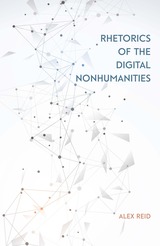
In Rhetorics of the Digital Nonhumanities, author Alex Reid fashions a potent vocabulary from new materialist theory, media theory, postmodern theory, and digital rhetoric to rethink the connections between humans and digital media. Addressed are the familiar concerns that scholars have with digital culture: how technologies affect attention spans, how digital media are used to compose, and how digital rhetoric is taught.
Rhetoric is now regularly defined as including human and nonhuman actors. Each actor influences the thoughts, arguments, and sentiments that journey through systems of processors, algorithms, humans, air, and metal. The author’s arguments, even though they are unnerving, orient rhetorical practices to a more open, deliberate, and attentive awareness of what we are truly capable of and how we become capable. This volume moves beyond viewing digital media as an expression of human agency. Humans, formed into new collectives of user populations, must negotiate rather than command their way through digital media ecologies.
Chapters centralize the most pressing questions: How do social media algorithms affect our judgment? How do smart phones shape our attention? These questions demand scholarly practice for attending the world around us. They explore attention and deliberation to embrace digital nonhuman composition. Once we see this brave new world, Reid argues, we are compelled to experiment.
READERS
Browse our collection.
PUBLISHERS
See BiblioVault's publisher services.
STUDENT SERVICES
Files for college accessibility offices.
RECENTLY PUBLISHED





UChicago Accessibility Resources
home | accessibility | search | about | contact us
BiblioVault ® 2001 - 2025
The University of Chicago Press