front cover of Sustainable Capitalism
Sustainable Capitalism
Essential Work for the Anthropocene
Edited by Inara Scott
University of Utah Press, 2024
Capitalism has been linked to climate change, racism and slavery, wealth inequality, and the decline of democracy. At the same time, capitalism may have been instrumental in lifting hundreds of millions of people out of poverty, facilitating vast technological innovations, and improving standards of living across the globe. As climate change accelerates and the world is threatened with existential crises, we must ask: Is capitalism incompatible with sustainability? While this question is as complex and urgent as it is resistant to simple answers, the contributors to this volume make the case that a more sustainable capitalism is within our reach.

Sustainable Capitalism takes on the challenge of sustainability from a uniquely interdisciplinary and diverse perspective, offering both theory and tools for action. Topics range from an analysis of the foundations and definition of capitalism to the specific regulatory mechanisms that may be necessary to rein in its current, unsustainable trajectory. Readers will find nuanced and important analyses of options and potential outcomes that are not available in any other work. This book is essential reading for anyone concerned about the path we are on and how we might improve the lives of people around the globe.

https://www.sustainablecapitalismbook.com/

[more]

front cover of Sustainable Failures
Sustainable Failures
Environmental Policy and Democracy in a Petro-dependent World
Sherry Cable
Temple University Press, 2012

Environmental policies fail in conspicuous and egregious ways to sustain the natural resource base and protect citizens from production-generated risky exposures. In her engaging study, Sustainable Failures, Sherry Cable asks, why does environmental policy seem to be a contributing cause rather than a partial solution to environmental problems? 

Melding a biophysical science perspective of environmental processes with sociological insights into human behavior, Cable examines the people, policies, and issues of petrochemical dependence and broader environment questions. She insists that our present policies around the manufacture and use of petroleum products violate rudimentary ecological principles—and do so in complicated ways.

Sustainable Failures is a blistering wake-up call to what is at stake not only regarding the failure of policy outcomes and grievous natural resource depletion and pollution, but also concerning democracy and ecological survival, and eventually, potentially, the existence of our species.

[more]

front cover of Sweating Saris
Sweating Saris
Indian Dance as Transnational Labor
Priya Srinivasan
Temple University Press, 2011

A groundbreaking book that seeks to understand dance as labor, Sweating Saris examines dancers not just as aesthetic bodies but as transnational migrant workers and wage earners who negotiate citizenship and gender issues. 
           
Srinivasan merges ethnography, history, critical race theory, performance and post-colonial studies among other disciplines to investigate the embodied experience of Indian dance. The dancers’ sweat stained and soaked saris, the aching limbs are emblematic of global circulations of labor, bodies, capital, and industrial goods.  Thus the sweating sari of the dancer stands in for her unrecognized labor.
         
Srinivasan shifts away from the usual emphasis on Indian women dancers as culture bearers of the Indian nation. She asks us to reframe the movements of late nineteenth century transnational Nautch Indian dancers to the foremother of modern dance Ruth St. Denis in the early twentieth century to contemporary teenage dancers in Southern California, proposing a transformative theory of dance, gendered-labor, and citizenship that is far-reaching.


[more]

front cover of Sweet Air
Sweet Air
Modernism, Regionalism, and American Popular Song
Edward Comentale
University of Illinois Press, 2013
Sweet Air rewrites the history of early twentieth-century pop music in modernist terms. Tracking the evolution of popular regional genres such as blues, country, folk, and rockabilly in relation to the growth of industry and consumer culture, Edward P. Comentale shows how this music became a vital means of exploring the new and often overwhelming feelings brought on by modern life. Comentale examines these rural genres as they translated the traumas of local experience--the racial violence of the Delta, the mass exodus from the South, the Dust Bowl of the Texas panhandle--into sonic form. Considering the accessibility of these popular music forms, he asserts the value of music as a source of progressive cultural investment, linking poor, rural performers and audiences to an increasingly vast network of commerce, transportation, and technology.

[more]

front cover of Sweet Dreams
Sweet Dreams
The World of Patsy Cline
Edited by Warren R. Hofstra
University of Illinois Press, 2013
One of the most influential and acclaimed female vocalists of the twentieth century, Patsy Cline (1932–63) was best known for her rich tone and emotionally expressive voice. Born Virginia Patterson Hensley, she launched her musical career during the early 1950s as a young woman in Winchester, Virginia, and her heartfelt songs reflect her life and times in this community. A country music singer who enjoyed pop music crossover success, Cline embodied the power and appeal of women in country music, helping open the lucrative industry to future female solo artists.
 
Bringing together noted authorities on Patsy Cline and country music, Sweet Dreams: The World of Patsy Cline examines the regional and national history that shaped Cline's career and the popular culture that she so profoundly influenced with her music. In detailed, deeply researched essays, contributors provide an account of Cline's early performance days in Virginia's Shenandoah Valley, analyze the politics of the split between pop and country music, and discuss her strategies for negotiating gender in relation to her public and private persona. Interpreting rich visual images, fan correspondence, publicity tactics, and community mores, this volume explores the rich and complex history of a woman whose music and image changed the shape of country music and American popular culture.
 
Contributors are Beth Bailey, Mike Foreman, Douglas Gomery, George Hamilton IV, Warren R. Hofstra, Joli Jensen, Bill C. Malone, Kristine M. McCusker, and Jocelyn R. Neal.
[more]

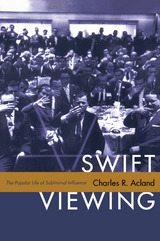
front cover of Swift Viewing
Swift Viewing
The Popular Life of Subliminal Influence
Charles R. Acland
Duke University Press, 2012
Since the late 1950s, the idea that hidden, imperceptible messages could influence mass behavior has been debated, feared, and ridiculed. In Swift Viewing, Charles R. Acland reveals the secret story of subliminal influence, showing how an obscure concept from experimental psychology became a mainstream belief about our vulnerability to manipulation in an age of media clutter. He chronicles the enduring popularity of the dubious claims about subliminal influence, tracking their migration from nineteenth-century hypnotism to twentieth-century front-page news. His expansive history of popular concern about subliminal messages shows how the notion of “hidden persuaders” became a vernacular media critique, one reflecting anxiety about a rapidly expanding media environment. Through a deep archive of eclectic examples, including educational technology in the American classroom, mind-control tropes in science fiction, Marshall McLuhan’s media theories, and sensational claims in the late 1950s about subliminal advertising, Acland establishes the subliminal as both a product of and a balm for information overload.
[more]

front cover of Swim Pretty
Swim Pretty
Aquatic Spectacles and the Performance of Race, Gender, and Nature
Jennifer A. Kokai
Southern Illinois University Press, 2017
Drawing on cultural associations with bodies of water, the spectacle of pretty women, and the appeal of the concept of “family-friendly” productions, performative aquatic spectacles portray water as an exotic fantasy environment exploitable for the purpose of entertainment. In Swim Pretty, Jennifer A. Kokai reveals the influential role of aquatic spectacles in shaping cultural perceptions of aquatic ecosystems in the United States over the past century. 

Examining dramatic works in water and performances at four water parks, Kokai shows that the evolution of these works and performances helps us better understand our ever-changing relationship with the oceans and their inhabitants. Kokai sorts the regard for and harnessing of water in aquatic spectacles into three categories—natural, tamed, and domesticated—and discusses the ways in which these modes of water are engaged in the performances throug an aesthetics of descension. Ultimately, this study links the uncritical love of aquatic spectacles to a disregard for the rights of marine animals and lack of concern for the marine environment.
 
[more]

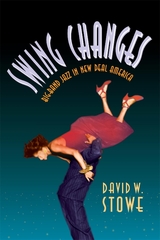
front cover of Swing Changes
Swing Changes
Big-Band Jazz in New Deal America
David W. Stowe
Harvard University Press, 1994
Bands were playing, people were dancing, the music business was booming. It was the big-band era, and swing was giving a new shape and sound to American culture. Swing Changes looks at New Deal America through its music and shows us how the contradictions and tensions within swing—over race, politics, its own cultural status, the role of women—mirrored those played out in the larger society. Drawing on memoirs, oral histories, newspapers, magazines, recordings, photographs, literature, and films, Swing Changes offers a vibrant picture of American society at a pivotal time, and a new perspective on music as a cultural force.
[more]

front cover of Swinging Single
Swinging Single
Representing Sexuality in the 1960s
Hilary Radner
University of Minnesota Press, 1999

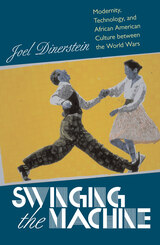
front cover of Swinging the Machine
Swinging the Machine
Modernity, Technology, and African American Culture between the World Wars
Joel Dinerstein
University of Massachusetts Press, 2003
In any age and any given society, cultural practices reflect the material circumstances of people's everyday lives. According to Joel Dinerstein, it was no different in America between the two World Wars-an era sometimes known as the "machine age"-when innovative forms of music and dance helped a newly urbanized population cope with the increased mechanization of modern life. Grand spectacles such as the Ziegfeld Follies and the movies of Busby Berkeley captured the American ethos of mass production, with chorus girls as the cogs of these fast, flowing pleasure vehicles.

Yet it was African American culture, Dinerstein argues, that ultimately provided the means of aesthetic adaptation to the accelerated tempo of modernity. Drawing on a legacy of engagement with and resistance to technological change, with deep roots in West African dance and music, black artists developed new cultural forms that sought to humanize machines. In "The Ballad of John Henry," the epic toast "Shine," and countless blues songs, African Americans first addressed the challenge of industrialization. Jazz musicians drew on the symbol of the train within this tradition to create a set of train-derived aural motifs and rhythms, harnessing mechanical power to cultural forms. Tap dance and the lindy hop brought machine aesthetics to the human body, while the new rhythm section of big band swing mimicked the industrial soundscape of northern cities. In Dinerstein's view, the capacity of these artistic innovations to replicate the inherent qualities of the machine-speed, power, repetition, flow, precision-helps explain both their enormous popularity and social function in American life.

[more]

front cover of The Sympathetic State
The Sympathetic State
Disaster Relief and the Origins of the American Welfare State
Michele Landis Dauber
University of Chicago Press, 2012
Even as unemployment rates soared during the Great Depression, FDR’s relief and social security programs faced attacks in Congress and the courts on the legitimacy of federal aid to the growing population of poor. In response, New Dealers pointed to a long tradition—dating back to 1790 and now largely forgotten—of federal aid to victims of disaster. In The Sympathetic State, Michele Landis Dauber recovers this crucial aspect of American history, tracing the roots of the modern American welfare state beyond the New Deal and the Progressive Era back to the earliest days of the republic when relief was forthcoming for the victims of wars, fires, floods, hurricanes, and earthquakes.
 
Drawing on a variety of materials, including newspapers, legal briefs, political speeches, the art and literature of the time, and letters from thousands of ordinary Americans, Dauber shows that while this long history of government disaster relief has faded from our memory today, it was extremely well known to advocates for an expanded role for the national government in the 1930s, including the Social Security Act. Making this connection required framing the Great Depression as a disaster afflicting citizens though no fault of their own. Dauber argues that the disaster paradigm, though successful in defending the New Deal, would ultimately come back to haunt advocates for social welfare. By not making a more radical case for relief, proponents of the New Deal helped create the weak, uniquely American welfare state we have today—one torn between the desire to come to the aid of those suffering and the deeply rooted suspicion that those in need are responsible for their own deprivation.
 
Contrary to conventional thought, the history of federal disaster relief is one of remarkable consistency, despite significant political and ideological change. Dauber’s pathbreaking and highly readable book uncovers the historical origins of the modern American welfare state.
[more]

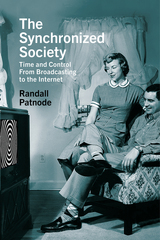
front cover of The Synchronized Society
The Synchronized Society
Time and Control From Broadcasting to the Internet
Randall Patnode
Rutgers University Press, 2023

The Synchronized Society traces the history of the synchronous broadcast experience of the twentieth century and the transition to the asynchronous media that dominate today. Broadcasting grew out of the latent desire by nineteenth-century industrialists, political thinkers, and social reformers to tame an unruly society by controlling how people used their time. The idea manifested itself in the form of the broadcast schedule, a managed flow of information and entertainment that required audiences to be in a particular place – usually the home – at a particular time and helped to create “water cooler” moments, as audiences reflected on their shared media texts. Audiences began disconnecting from the broadcast schedule at the end of the twentieth century, but promoters of social media and television services still kept audiences under control, replacing the schedule with surveillance of media use. Author Randall Patnode offers compelling new insights into the intermingled roles of broadcasting and industrial/post-industrial work and how Americans spend their time.

[more]

front cover of SynergiCity
SynergiCity
Reinventing the Postindustrial City
Edited by Paul Hardin Kapp and Paul J. Armstrong
University of Illinois Press, 2012
SynergiCity: Reinventing the Postindustrial City proposes a new and invigorating vision of urbanism, architectural design, and urban revitalization in twenty-first-century America. Culling transformative ideas from the realms of historic preservation, sustainability, ecological urbanism, and the innovation economy, Paul Hardin Kapp and Paul J. Armstrong present a holistic vision for restoring industrial cities suffering from population decline back into stimulating and productive places to live and work.
 
With a particular emphasis on the Rust Belt of the American Midwest, SynergiCity argues that cities such as Detroit, St. Louis, and Peoria must redefine themselves to be globally competitive. This revitalization is possible through environmentally and economically sustainable restoration of industrial areas and warehouse districts for commercial, research, light industrial, and residential uses. The volume's expert researchers, urban planners, and architects draw on the redevelopment successes of other major cities--such as the American Tobacco District in Durham, North Carolina, and the Milwaukee River Greenway--to set guidelines and goals for reinventing and revitalizing the postindustrial landscape.
 
Contributors are Paul J. Armstrong, Donald K. Carter, Lynne M. Dearborn, Norman W. Garrick, Mark Gillem, Robert Greenstreet, Craig Harlan Hullinger, Paul Hardin Kapp, Ray Lees, Emil Malizia, John O. Norquist, Christine Scott Thomson, and James Wasley.
[more]

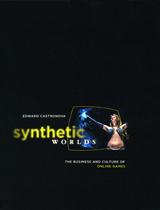
front cover of Synthetic Worlds
Synthetic Worlds
The Business and Culture of Online Games
Edward Castronova
University of Chicago Press, 2006
From EverQuest to World of Warcraft, online games have evolved from the exclusive domain of computer geeks into an extraordinarily lucrative staple of the entertainment industry. People of all ages and from all walks of life now spend thousands of hours—and dollars—partaking in this popular new brand of escapism. But the line between fantasy and reality is starting to blur. Players have created virtual societies with governments and economies of their own whose currencies now trade against the dollar on eBay at rates higher than the yen. And the players who inhabit these synthetic worlds are starting to spend more time online than at their day jobs.

In Synthetic Worlds, Edward Castronova offers the first comprehensive look at the online game industry, exploring its implications for business and culture alike. He starts with the players, giving us a revealing look into the everyday lives of the gamers—outlining what they do in their synthetic worlds and why. He then describes the economies inside these worlds to show how they might dramatically affect real world financial systems, from potential disruptions of markets to new business horizons. Ultimately, he explores the long-term social consequences of online games: If players can inhabit worlds that are more alluring and gratifying than reality, then how can the real world ever compete? Will a day ever come when we spend more time in these synthetic worlds than in our own? Or even more startling, will a day ever come when such questions no longer sound alarmist but instead seem obsolete?

With more than ten million active players worldwide—and with Microsoft and Sony pouring hundreds of millions of dollars into video game development—online games have become too big to ignore. Synthetic Worlds spearheads our efforts to come to terms with this virtual reality and its concrete effects.

“Illuminating. . . . Castronova’s analysis of the economics of fun is intriguing. Virtual-world economies are designed to make the resulting game interesting and enjoyable for their inhabitants. Many games follow a rags-to-riches storyline, for example. But how can all the players end up in the top 10%? Simple: the upwardly mobile human players need only be a subset of the world's population. An underclass of computer-controlled 'bot' citizens, meanwhile, stays poor forever. Mr. Castronova explains all this with clarity, wit, and a merciful lack of academic jargon.”—The Economist
 
Synthetic Worlds is a surprisingly profound book about the social, political, and economic issues arising from the emergence of vast multiplayer games on the Internet. What Castronova has realized is that these games, where players contribute considerable labor in exchange for things they value, are not merely like real economies, they are real economies, displaying inflation, fraud, Chinese sweatshops, and some surprising in-game innovations.”—Tim Harford, Chronicle of Higher Education

[more]


Send via email Share on Facebook Share on Twitter