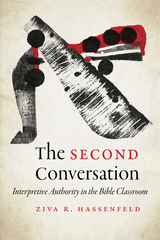
front cover of The Second Conversation
The Second Conversation
Interpretive Authority in the Bible Classroom
Ziva R. Hassenfeld
Brandeis University Press, 2024
A teacher reflects on her teaching practice, bringing literacy scholarship into the arena of Jewish education.
 
In The Second Conversation, university professor Ziva R. Hassenfeld returns to the middle school classroom to study her own seventh grade Bible class. The book explores dilemmas of practice she encountered around interpretive authority in the classroom. She analyzes the questions that came up in her teaching within the context of the most influential religious education scholarship, literacy scholarship, sociocultural theory and literary theory. She highlights the importance of two conversations about interpretive rules within the classroom, the first about the text’s meaning, and the second about competing conventions for determining its meaning. Instructors of any type of literature will benefit from Hassenfeld’s study, which offers rich ideas about when and how teachers enforce a classroom’s way of reading or follow a student’s line of inquiry toward more flexible interpretation.
[more]

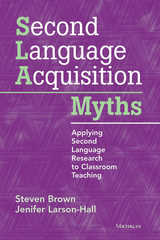
front cover of Second Language Acquisition Myths
Second Language Acquisition Myths
Applying Second Language Research to Classroom Teaching
Steven Brown and Jenifer Larson-Hall
University of Michigan Press, 2012

This volume was conceived as a first book in SLA for advanced undergraduate or introductory master’s courses that include education majors, foreign language education majors, and English majors. It’s also an excellent resource for practicing teachers. 

Both the research and pedagogy in this book are based on the newest research in the field of second language acquisition.  It is not the goal of this book to address every SLA theory or teach research methodology.  It does however address the myths and questions that non-specialist teacher candidates have about language learning.

Steven Brown is the co-author of the introductory applied linguistics textbook Understanding Language Structure, Interaction, and Variation  textbook (and workbook).

The myths challenged in this book are:
 

§  Children learn languages quickly and easily while adults are ineffective in comparison.

§  A true bilingual is someone who speaks two languages perfectly.

§  You can acquire a language simply through listening or reading.

§  Practice makes perfect.

§  Language students learn (and retain) what they are taught.

§  Language learners always benefit from correction.

§  Individual differences are a major, perhaps the major, factor in SLA.

§  Language acquisition is the individual acquisition of grammar.
[more]

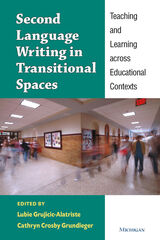
front cover of Second Language Writing in Transitional Spaces
Second Language Writing in Transitional Spaces
Teaching and Learning across Educational Contexts
Lubie Grujicic-Alatriste and Cathryn Crosby Grundleger
University of Michigan Press, 2020
This collection has been written to address the fact that there seems to be little concerted, systematic effort to understand what type of writing is taught across elementary, secondary, and college second language (L2) writing contexts and to understand how it is being taught on this long educational continuum (K–16). This book sets out to contribute to what is perceived as a lack of the full picture on the teaching of L2 writing from K–16. The impetus to look across educational settings, particularly at the places of transitions, stemmed in part from the recent state-wide educational reforms. Given the gap in the L2 research that straddles all educational settings, this volume addresses the need for a closer teacher collaboration and deeper, clearer understanding of writing goals in each of the educational settings and across them on the K–16 continuum.
 
The chapters examine the writing that English learners are producing because of the Common Core and the writing they are required to do once they reach the college or university, and then consider where the intersections exist—that is, what do educators think English learners ought to be writing across educational levels?
 
Each chapter describes the educational setting where the researchers were engaged, examines specific issues related to transitions, and offers—where relevant—recommendations for classroom practices, teaching strategies, and instructional materials that may be useful for practicing teachers and all others professionally engaged in educating writers across K–16.
 
 
[more]

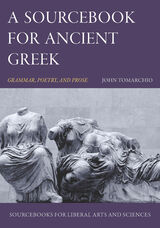
front cover of A Sourcebook for Ancient Greek
A Sourcebook for Ancient Greek
Grammar, Poetry, and Prose
John Tomarchio
Catholic University of America Press, 2022
This book was designed for students transitioning from the study of Greek grammar to translation of texts. It was developed in classroom use for classroom use, in the context of an integrated Great Books program in liberal arts and sciences. It is meant for students not only of Classics, but more, for students of Humanities interested in direct engagement of primary sources. Each Greek text offered for translation was chosen for its theoretical interest as well as the interest of its Greek. The selections of Greek literature offered in this Sourcebook are wide-ranging. The indisputable standard of excellence for classicists is of course the Attic dialect of Athens in its glory. However, this Sourcebook is meant for students of liberal arts and sciences whose interests range far more widely. Thus, it does not hesitate to extend not only backward to the archaic Greek of Homer, but also forward to the koine Greek of the Alexandrian and Roman empires. Greek works were chosen for being seminal to Western thinking today, chosen to give students of Western arts and sciences introductions to its Greek sources Naturally, Greek grammar is taught to the newcomer analytically and sequentially, but the continuing student needs to synthesize these distended enumerations of elements and principles. Accordingly, grammatical synopses are not appended as reference tables but placed front and center as objects of study. The grammar tables offer synoptic views of integral parts of Greek grammar to show the form and logic of the whole part of speech or part of a sentence. On the basis of these tables, detailed grammatical notes and commentary appended to Greek selections that follow are tailored for continuing students.
[more]

logo for Intellect Books
The Student Actor Prepares
Acting for Life
Gai Jones
Intellect Books, 2014
The Student Actor Prepares is a practical, interactive approach to a student actor’s journey. Each chapter includes acting principles, their importance to the process, and workbook entries for emotional work, script analysis, and applications to the study of theater. Topics cover a brief history of the art of acting and how the study of acting can be an advantage in numerous occupations; an actor’s discovery of emotional work; movement and mime practices for the actor; vocal practices for the actor; solo improvisational study; script analysis for the individual actor; rehearsal tips; monologue work; original solo work; audition information; working with an acting partner or in a production; acting resources; and research topics. 
[more]

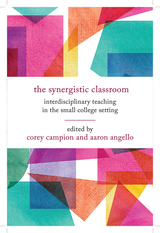
front cover of The Synergistic Classroom
The Synergistic Classroom
Interdisciplinary Teaching in the Small College Setting
Corey Campion
Rutgers University Press, 2021
Among the many challenges confronting the liberal arts today is a fundamental disconnect between the curricula that many institutions offer and the training that many students need. Discipline-specific models of teaching and learning can underprepare students for the kinds of interdisciplinary collaboration that employers now expect. Although aware of these expectations and the need for change, many small colleges and universities have struggled to translate interdisciplinarity into programs and curricula that better serve today’s students.

Written by faculty engaged in the design and delivery of interdisciplinary courses, programs, and experiential learning opportunities in the small college setting, The Synergistic Classroom addresses the many ways faculty can leverage their institutions' small size and openness to pedagogical experimentation to overcome the challenges of limited institutional resources and enrollment concerns and better prepare students for life and work in the twenty-first century. Taken together, the contributions in this volume invite reflection on a variety of important issues that attend the work of small college faculty committed to expanding student learning across disciplinary boundaries.
[more]


Send via email Share on Facebook Share on Twitter