
 A SCHOLARLY BOOK REPOSITORY
8 start with S start with S

Scanner Data and Price Indexes assesses both the promise and the challenges of using scanner data to produce economic statistics. Three papers present the results of work in progress at statistical agencies in the U.S., United Kingdom, and Canada, including a project at the U.S. Bureau of Labor Statistics to investigate the feasibility of incorporating scanner data into the monthly Consumer Price Index. Other papers demonstrate the enormous potential of using scanner data to test economic theories and estimate the parameters of economic models, and provide solutions for some of the problems that arise when using scanner data, such as dealing with missing data.
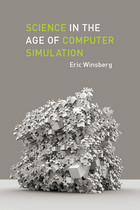
Computer simulation was first pioneered as a scientific tool in meteorology and nuclear physics in the period following World War II, but it has grown rapidly to become indispensible in a wide variety of scientific disciplines, including astrophysics, high-energy physics, climate science, engineering, ecology, and economics. Digital computer simulation helps study phenomena of great complexity, but how much do we know about the limits and possibilities of this new scientific practice? How do simulations compare to traditional experiments? And are they reliable? Eric Winsberg seeks to answer these questions in Science in the Age of Computer Simulation.
Scrutinizing these issue with a philosophical lens, Winsberg explores the impact of simulation on such issues as the nature of scientific evidence; the role of values in science; the nature and role of fictions in science; and the relationship between simulation and experiment, theories and data, and theories at different levels of description. Science in the Age of Computer Simulation will transform many of the core issues in philosophy of science, as well as our basic understanding of the role of the digital computer in the sciences.

With The Seductions of Quantification, leading legal anthropologist Sally Engle Merry investigates the techniques by which information is gathered and analyzed in the production of global indicators on human rights, gender violence, and sex trafficking. Although such numbers convey an aura of objective truth and scientific validity, Merry argues persuasively that measurement systems constitute a form of power by incorporating theories about social change in their design but rarely explicitly acknowledging them. For instance, the US State Department’s Trafficking in Persons Report, which ranks countries in terms of their compliance with antitrafficking activities, assumes that prosecuting traffickers as criminals is an effective corrective strategy—overlooking cultures where women and children are frequently sold by their own families. As Merry shows, indicators are indeed seductive in their promise of providing concrete knowledge about how the world works, but they are implemented most successfully when paired with context-rich qualitative accounts grounded in local knowledge.
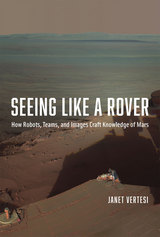
With Seeing Like a Rover, Janet Vertesi takes us behind the scenes to reveal the work that goes into creating our knowledge of Mars. Every photograph that the Rovers take, she shows, must be processed, manipulated, and interpreted—and all that comes after team members negotiate with each other about what they should even be taking photographs of in the first place. Vertesi’s account of the inspiringly successful Rover project reveals science in action, a world where digital processing uncovers scientific truths, where images are used to craft consensus, and where team members develop an uncanny intimacy with the sensory apparatus of a robot that is millions of miles away. Ultimately, Vertesi shows, every image taken by the Mars Rovers is not merely a picture of Mars—it’s a portrait of the whole Rover team, as well.
The ubiquity of social media has transformed the scope and scale of scholarly communication in the arts and humanities. The consequences of this new participatory and collaborative environment for humanities research has allowed for fresh approaches to communicating research. Social Knowledge Creation takes up the norms and customs of online life to reorient, redistribute, and oftentimes flatten traditional academic hierarchies. This book discusses the implications of how humanists communicate with the world and looks to how social media shapes research methods. This volume addresses peer-review, open access publishing, tenure and promotion, mentorship, teaching, collaboration, and interdisciplinarity as a comprehensive introduction to these rapidly changing trends in scholarly communication, digital pedagogy, and educational technology. Collaborative structures are rapidly augmenting disciplinary focus of humanities curriculum and the public impact of humanities research teams with new organizational and disciplinary thinking. Social Knowledge Creation represents a particularly dynamic and growing field in which the humanities seeks to find new ways to communicate the legacy and traditions of humanities based inquiry in a 21st century context.
New Technologies in Medieval and Renaissance Studies Volume 7.
Edited by Alyssa Arbuckle, Aaron Mauro, and Daniel Powell
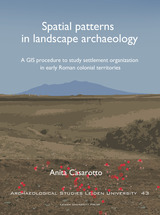
This book develops and applies a GIS procedure to use legacy survey data in settlement pattern analysis. It consists of two parts. One part regards the assessment of biases that can affect the spatial patterns exhibited by survey data. The other part aims to shed light on the location preferences and settlement strategy of ancient communities underlying site patterns. In this book, a case-study shows how the method works in practice. As part of the research by the Landscapes of Early Roman Colonization project (NWO, Leiden University, KNIR) site-based datasets produced by survey projects in central-southern Italy are examined in a comparative framework to investigate settlement patterns in the early Roman colonial period (3rd century B.C.).
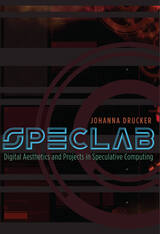
Nearly a decade ago, Johanna Drucker cofounded the University of Virginia’s SpecLab, a digital humanities laboratory dedicated to risky projects with serious aims. In SpecLab she explores the implications of these radical efforts to use critical practices and aesthetic principles against the authority of technology based on analytic models of knowledge.
Inspired by the imaginative frontiers of graphic arts and experimental literature and the technical possibilities of computation and information management, the projects Drucker engages range from Subjective Meteorology to Artists’ Books Online to the as yet unrealized ’Patacritical Demon, an interactive tool for exposing the structures that underlie our interpretations of text. Illuminating the kind of future such experiments could enable, SpecLab functions as more than a set of case studies at the intersection of computers and humanistic inquiry. It also exemplifies Drucker’s contention that humanists must play a role in designing models of knowledge for the digital age—models that will determine how our culture will function in years to come.

READERS
Browse our collection.
PUBLISHERS
See BiblioVault's publisher services.
STUDENT SERVICES
Files for college accessibility offices.
RECENTLY PUBLISHED





UChicago Accessibility Resources
home | accessibility | search | about | contact us
BiblioVault ® 2001 - 2025
The University of Chicago Press