
 A SCHOLARLY BOOK REPOSITORY
6 start with S start with S

A collection of medieval tales of Byzantine saints, including some rejected by the Church, translated into English for the first time.
The legends collected in Saints at the Limits, despite sometimes being viewed with suspicion by the Church, fascinated Christians during the Middle Ages—as related cults, multiple retellings, and contemporary translations attest. Their protagonists span the entire spectrum of Byzantine society, including foreigners, soldiers, ascetics, lustful women, beggars, and the sons and daughters of rulers. They travel to exotic lands, perform outlandish miracles, suffer extraordinary violence, reject family ties, save cities, destroy absolute rulers, and discover the divine. Some saints, like Markos the Athenian, are forgotten nowadays; others, like Saint George the Great Martyr, still command a wide appeal. Each, however, negotiates the limits of Byzantine imagination: the borders that separate the powerful from the outcasts, the real from the imaginary, the human from the beyond human. These stories, edited in Greek and translated into English here for the first time, continue to resonate with readers seeking to understand universal human fears and desires in their Byzantine guise.
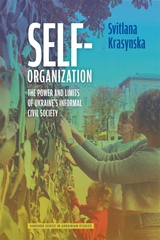
Using Ukraine as a case-in-point, Svitlana Krasynska engages diverse bodies of literature and rich empirical data to reveal the vital role and unique potential of below-the-radar civic engagement in contexts where informal practices abound—a phenomenon largely neglected by scholars of civil society who traditionally focus on formal civic organizations.
Civil society in Eastern Europe has long been labeled weak based on a general lack of citizen participation in formal civil society organizations—a key criterion for assessing civic engagement in comparative studies. However, such assessment of civil society fails to recognize the role and impact of informal civic engagement in contexts where informality permeates economic, political, and social spheres. Ukraine offers a valuable counterargument of the importance of informal civil society in Eastern Europe, especially in the post-Soviet countries.
Krasynska convincingly shows that informality constitutes an essential component of civil society, shaping popular approaches to addressing social, economic, and political issues. The trailblazing findings in Self-Organization will be of interest to scholars of democratization, informality, and area studies, and they will aid development practitioners and policy makers in determining a more effective approach to helping fledgling democracies around the world.

In extended commentaries on Gadamer, the Gadamer/Habermas debate, and Derrida, Schaeffer shows that Vico offers the possibility of analyzing social phenomena and constellations of power from within the humanist rhetorical tradition. Vico’s achievements have powerful implications for relating ethics and hermeneutics to the world of concrete social practice, particularly in an age in which the electronic media have replaced print as the primary means of communication and in which a “secondary orality” (a cast of mind similar to that of nonliterate peoples) is appearing within our literate civilization.
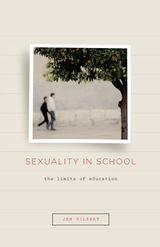
From concerns over the bullying of LGBTQ youth and battles over sex education to the regulation of sexual activity and the affirmation of queer youth identity, sexuality saturates the school day. Rather than understand these conflicts as an interruption to the work of education, Jen Gilbert explores how sexuality comes to bear on and to enliven teaching and learning.
Gilbert investigates the breakdowns, clashes, and controversies that flare up when sexuality enters spaces of schooling. Education must contain the volatility of sexuality, Gilbert argues, and yet, when education seeks to limit the reach of sexuality, it risks shutting learning down. Gilbert penetrates this paradox by turning to fiction, film, legal case studies, and personal experiences. What, she asks, can we learn about school from a study of sexuality?
By examining the strange workings of sexuality in schools, Gilbert draws attention to the explosive but also compelling force of erotic life in teaching and learning. Ultimately, this book illustrates how the most intimate of our experiences can come to shape how we see and act in the world.
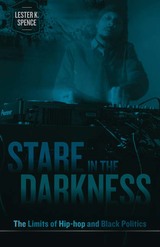
A growing number of black activists and artists claim that rap and hip-hop are the basis of an influential new urban social movement. Simultaneously, black citizens evince concern with the effect that rap and hip-hop culture exerts on African American communities. According to a recent Pew survey conducted on the opinions of Black Americans, 71 percent of blacks think that rap is a bad influence. To what extent are African American hopes and fears about hip-hop’s potential political power justified? In Stare in the Darkness, Lester K. Spence answers this question using a blend of neoliberal analysis, survey data, experiments, and case studies.
Spence finds that rap does in fact influence black political attitudes. However, rap also reproduces rather than critiques neoliberal ideology. Furthermore, black activists seeking to create an innovative model of hip-hop politics are hamstrung by their reliance on outmoded forms of organizing. By considering the possibilities inherent in the most prolific and prominent activities of hip-hop politics, Stare in the Darkness reveals, in a clear and practical manner, the political consequences of rap culture for black publics.
READERS
Browse our collection.
PUBLISHERS
See BiblioVault's publisher services.
STUDENT SERVICES
Files for college accessibility offices.
RECENTLY PUBLISHED





UChicago Accessibility Resources
home | accessibility | search | about | contact us
BiblioVault ® 2001 - 2025
The University of Chicago Press