front cover of Sacred Consumption
Sacred Consumption
Food and Ritual in Aztec Art and Culture
By Elizabeth Morán
University of Texas Press, 2016

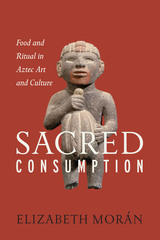
Making a foundational contribution to Mesoamerican studies, this book explores Aztec painted manuscripts and sculptures, as well as indigenous and colonial Spanish texts, to offer the first integrated study of food and ritual in Aztec art.

Aztec painted manuscripts and sculptural works, as well as indigenous and Spanish sixteenth-century texts, were filled with images of foodstuffs and food processing and consumption. Both gods and humans were depicted feasting, and food and eating clearly played a pervasive, integral role in Aztec rituals. Basic foods were transformed into sacred elements within particular rituals, while food in turn gave meaning to the ritual performance.

This pioneering book offers the first integrated study of food and ritual in Aztec art. Elizabeth Morán asserts that while feasting and consumption are often seen as a secondary aspect of ritual performance, a close examination of images of food rites in Aztec ceremonies demonstrates that the presence—or, in some cases, the absence—of food in the rituals gave them significance. She traces the ritual use of food from the beginning of Aztec mythic history through contact with Europeans, demonstrating how food and ritual activity, the everyday and the sacred, blended in ceremonies that ranged from observances of births, marriages, and deaths to sacrificial offerings of human hearts and blood to feed the gods and maintain the cosmic order. Morán also briefly considers continuities in the use of pre-Hispanic foods in the daily life and ritual practices of contemporary Mexico. Bringing together two domains that have previously been studied in isolation, Sacred Consumption promises to be a foundational work in Mesoamerican studies.
[more]

front cover of Sacrifice in the Modern World
Sacrifice in the Modern World
On the Particularity and Generality of Nazi Myth
David Pan
Northwestern University Press, 2012

A landmark book, David Pan’s Sacrifice in the Modern World seeks to explain the continuing emphasis, in modern times, on sacrifice. Pan specifically turns to the culture of sacrifice—ritualized and sanctified death—in Nazi Germany, showing how that regime co-opted an existing discussion of sacrifice and infused it with its own mythology. Pan suggests that sacrifice is a key value in every society but that there is a preponderance of association of sacrifice with Nazi culture and therefore a largely pejorative treatment of sacrifice.

Surveying the arguments of philosopher Alfred Baeumler and other symptomatic Nazi texts, Pan shows how the Nazis’ reactionary intellec­tual culture unraveled much of the Enlightenment project. In so doing, he is able to offer a compelling new perspective on basic theoretical concepts in the work of Kant, Nietzsche, Adorno, Bataille, Girard, and others. He posits that it is only by clearing our way through the Nazis’ misuse of sacrifice that we can understand the durability of sacrifi­cial structures that—following several of the theorists he discusses— establish the fundamental values by which we live our lives.

Rather than condemning the Nazi appeal to sacrifice itself, this book looks at the particular ways in which sacrifice was distributed and structured within that society. All cultures must grapple with the existential violence of the human condition, and they frequently do so through aesthetic treatments of sacrifice, rooted in myths and tradi­tions. Pan argues that our task is not to eradicate these traditions but to engage them by carefully evaluating the commitments and values that they imply.


[more]

front cover of Safari Nation
Safari Nation
A Social History of the Kruger National Park
Jacob S. T. Dlamini
Ohio University Press, 2020
Safari Nation opens new lines of inquiry in the study of national parks in Africa and the rest of the world. The Kruger National Park is South Africa’s most iconic nature reserve, renowned for its rich flora and fauna. According to author  Jacob Dlamini, there is another side to the park, a social history neglected by scholars and popular writers alike in which blacks (meaning Africans, Coloureds, and Indians) occupy center stage. Safari Nation details the ways  in which black people  devoted energies to conservation and to the park over the course of the twentieth century—engagement that transcends the stock (black) figure of the laborer and the poacher. By exploring the complex and dynamic ways in which blacks of varying class, racial, religious, and social backgrounds related to the Kruger National Park,  and with the help of previously unseen archival photographs, Dlamini’s narrative also sheds new light on how and why Africa’s national parks—often derided by scholars as colonial impositions—survived the end of white rule on the continent. Relying on oral histories, photographs, and archival research, Safari Nation engages both with African historiography and with ongoing debates about the “land question,” democracy, and citizenship in South Africa.
[more]

front cover of Saharan Winds
Saharan Winds
Energy Systems and Aeolian Imaginaries in Western Sahara
Allan, Joanna
West Virginia University Press, 2024

Winner, ASLE-UKI Critical Book Prize, 2025
Finalist, Ecocritical Book Award, 2025, Association for the Study of Literature and Environment (ASLE)
Longlisted, Bread and Roses Award for Radical Publishing, 2025

As climate crisis ensues, a transition away from fossil fuels becomes urgent. However, some renewable energy developments are propagating injustices such as landgrabs, colonial dispossession, and environmentally destructive practices. Changing the way we imagine and understand wind will help us ensure a globally just wind energy future. 

Saharan Winds contributes to a fairer energy horizon by illuminating the role of imaginaries--how we understand energy sources such as wind and the meanings we attach to wind--in determining the wider politics, whether oppressive or just, associated with energy systems. This book turns to various cultures and communities across different time periods in one space, Western Sahara, to explore how wind imaginaries affect the development, management, and promotion of windfarms; the distribution of energy that windfarms produce; and, vitally, the type of politics mediated by all these elements combined. Highlighting the wind-fueled oppression of colonial energy systems, the book shows the potential offered by nomadic, Indigenous wind imaginaries for contributing to a fairer energy future.

 
[more]

front cover of The Saloon and the Mission
The Saloon and the Mission
Addiction, Conversion, and the Politics of Redemption in American Culture
Eoin F. Cannon
University of Massachusetts Press, 2013
Since the middle of the nineteenth century, sobriety movements have flourished in America during periods of social and economic crisis. From the boisterous working-class temperance meetings of the 1840s to the quiet beginnings of Alcoholics Anonymous in the 1930s, alcoholics have banded together for mutual support. Each time they have developed new ways of telling their stories, and in the process they have shaped how Americans think about addiction, the self, and society.

In this book Eoin Cannon illuminates the role that sobriety movements have played in placing notions of personal and societal redemption at the heart of modern American culture. He argues against the dominant scholarly perception that recovery narratives are private and apolitical, showing that in fact the genre's conventions turn private experience to public political purpose. His analysis ranges from neglected social reformer Helen Stuart Campbell's embrace of the "gospel rescue missions" of postbellum New York City to William James's use of recovery stories to consider the regenerative capabilities of the mind, to writers such as Upton Sinclair and Djuna Barnes, who used this narrative form in much different ways.

Cannon argues that rather than isolating recovery from these realms of wider application, the New Deal–era Alcoholics Anonymous refitted the "drunkard's conversion" as a model of selfhood for the liberal era, allowing for a spiritual redemption story that could accommodate a variety of identities and compulsions. He concludes by considering how contemporary recovery narratives represent both a crisis in liberal democracy and a potential for redemptive social progress.
[more]

logo for University of Illinois Press
The Saloon
Public Drinking in Chicago and Boston, 1880-1920
Perry R. Duis
University of Illinois Press, 1983
This colorful and perceptive study presents persuasive evidence that the saloon, far from being a magnet for vice and crime, played an important role in working-class community life. Focusing on public drinking in "wide open" Chicago and tightly controlled Boston, Duis offers a provocative discussion of the saloon as a social institution and a locus of the struggle between middle-class notions of privacy and working-class uses of public space.
 
[more]

front cover of Salsa Consciente
Salsa Consciente
Politics, Poetics, and Latinidad in the Meta-Barrio
Andrés Espinoza Agurto
Michigan State University Press, 2021
This volume explores the significations and developments of the Salsa consciente movement, a Latino musico-poetic and political discourse that exploded in the 1970s but then dwindled in momentum into the early 1990s. This movement is largely linked to the development of Nuyolatino popular music brought about in part by the mass Latino migration to New York City beginning in the 1950s and the subsequent social movements that were tied to the shifting political landscapes. Defined by its lyrical content alongside specific sonic markers and political and social issues facing U.S. Latinos and Latin Americans, Salsa consciente evokes the overarching cultural-nationalist idea of Latinidad (Latin-ness). Through the analysis of over 120 different Salsa songs from lyrical and musical perspectives that span a period of over sixty years, the author makes the argument that the urban Latino identity expressed in Salsa consciente was constructed largely from diasporic, deterritorialized, and at times imagined cultural memory, and furthermore proposes that the Latino/Latin American identity is in part based on African and Indigenous experience, especially as it relates to Spanish colonialism. A unique study on the intersection of Salsa and Latino and Latin American identity, this volume will be especially interesting to scholars of ethnic studies and musicology alike.
[more]

front cover of Salsa Crossings
Salsa Crossings
Dancing Latinidad in Los Angeles
Cindy García
Duke University Press, 2013
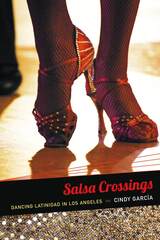
In Los Angeles, night after night, the city's salsa clubs become social arenas where hierarchies of gender, race, and class, and of nationality, citizenship, and belonging are enacted on and off the dance floor. In an ethnography filled with dramatic narratives, Cindy García describes how local salseras/os gain social status by performing an exoticized L.A.–style salsa that distances them from club practices associated with Mexicanness. Many Latinos in Los Angeles try to avoid "dancing like a Mexican," attempting to rid their dancing of techniques that might suggest that they are migrants, poor, working-class, Mexican, or undocumented. In L.A. salsa clubs, social belonging and mobility depend on subtleties of technique and movement. With a well-timed dance-floor exit or the lift of a properly tweezed eyebrow, a dancer signals affiliation not only with a distinctive salsa style but also with a particular conceptualization of latinidad.
[more]

front cover of Salvadorans in Costa Rica
Salvadorans in Costa Rica
Displaced Lives
Bridget Hayden
University of Arizona Press, 2003
During the political and economic upheaval that swept El Salvador in the 1980s, as many as 20,000 Salvadorans took refuge in Costa Rica. Despite similarities between the countries, most Salvadorans experienced El Salvador and Costa Rica as very different places; yet some 6,000 chose to remain after the violence in their country ended, re-establishing their lives successfully enough that they claimed that they now "felt Costa Rican." Bridget Hayden examines the ways in which these people integrated into Costa Rican society and the ambiguous sense of identity they developed, exploring their experience of the process and the cultural concepts they used to interpret those experiences.

Salvadorans in Costa Rica: Displaced Lives introduces readers to people from a wide range of class and educational backgrounds who had come to Costa Rica from all over El Salvador. All shared the experience of having become refugees and having settled in a new country under the same circumstances, and when the war in their own country ended, they shared a concern about the issues involved in deciding whether to return there. Their diversity allows Hayden to examine the ways in which the language of national identity played out in different contexts and sometimes contradictory ways.

Drawing on contemporary theories of migration and space, Hayden identifies the discourses, narratives, and concepts that Salvadorans in Costa Rica had in common and then analyzes the ways in which their experiences and their uses of those discourses varied. She focuses on key spatial concepts that Salvadorans used in talking about displacement and re-emplacement in order to show how they constructed the experience of settlement and how such variables as gender and age influenced their experiences. Because "nationality" was an idiom they used to relate their experiences, she pays particular attention to the role of national belonging and national difference—in terms of both the ways in which the Salvadorans were received by Costa Ricans and their reactions to their new lives in Costa Rica. A concluding chapter compares them with Salvadorans who emigrated to other countries.

The story of these displaced Salvadorans, focusing on the lives of real people, can give us a new understanding of how individuals feel a sense of belonging to a sociocultural space. By exploring many meanings of the nation and national belonging for different people under varying conditions, Hayden's study provides fresh insights into the dynamics of migration, gender, and nationalism.

[more]

front cover of Sampling and Remixing Blackness in Hip-Hop Theater and Performance
Sampling and Remixing Blackness in Hip-Hop Theater and Performance
Nicole Hodges Persley
University of Michigan Press, 2021

Sampling and Remixing Blackness is a timely and accessible book that examines the social ramifications of cultural borrowing and personal adaptation of Hip-hop culture by non-Black and non-African American Black artists in theater and performance. In a cultural moment where Hip-hop theater hits such as Hamilton offer glimpses of Black popular culture to non-Black people through musical soundtracks, GIFs, popular Hip-hop music, language, clothing, singing styles and embodied performance, people around the world are adopting a Blackness that is at once connected to African American culture--and assumed and shed by artists and consumers as they please. As Black people around the world live a racial identity that is not shed, in a cultural moment of social unrest against anti-blackness, this book asks how such engagements with Hip-hop in performance can be both dangerous and a space for finding cultural allies. Featuring the work of some of the visionaries of Hip-hop theater including Lin-Manuel Miranda, Sarah Jones and Danny Hoch, this book explores the work of groundbreaking Hip-hop theater and performance artists who have engaged Hip-hop's Blackness through popular performance. The book challenges how we understand the performance of race, Hip-hop and Blackness in the age of Instagram, TikTok and Facebook. In a cultural moment where racial identity is performed through Hip-hop culture's resistance to the status quo and complicity in maintaining it, Hodges Persley asks us to consider who has the right to claim Hip-hop's blackness when blackness itself is a complicated mixtape that offers both consent and resistance to transgressive and inspiring acts of performance.

[more]

front cover of The Sanctity of Social Life
The Sanctity of Social Life
Physician's Treatment of Critically Ill Patients
Diana Crane
Russell Sage Foundation, 1975
Reexamines the nature of death and dying as seen from the physician's point of view. Unlike other treatments of the subject, this study is concerned not with what physician's should do for the critically ill, but with their actual behavior. Based on extensive interviews with physicians in several medical specialties, more than 3000 questionnaires completed by physicians in four specialties, and studies of the records of actual hospital patients, the book shows that while withdrawal of treatment in certain types of cases is widespread, euthanasia is rare.
[more]

front cover of Sanctuary Everywhere
Sanctuary Everywhere
The Fugitive Sacred in the Sonoran Desert
Barbara Andrea Sostaita
Duke University Press, 2024
In Sanctuary Everywhere, Barbara Andrea Sostaita reimagines practices of sanctuary along the U.S.-Mexico border in order to explore the possibilities for radical fugitivity in the face of militarized border enforcement. After the 2016 presidential election, churches, universities, cities, and even states began declaring themselves sanctuaries. Sostaita proposes that these calls for expanded sanctuary are insufficient when dealing with the everyday workings of immigration enforcement. Through fieldwork in migrant clinics, shelters, and the Sonoran Desert, Sostaita demonstrates that, as a sacred practice, sanctuary cannot be fixed in any one destination or mandate. She turns to those working to create sanctuary on the move, from a deported nurse offering medical care on the border to incarcerated migrant women denying rules on touch in detention facilities to collectives set up to honor those who died crossing the border. Understanding sanctuary to be a set of fugitive practices that escapes the everyday, Sostaita shows us how, in the wake of extreme violence and loss, migrants create sanctuaries of their own to care for the living and the dead.
[more]

logo for The Ohio State University Press
The Sanitary Arts
Aesthetic Culture and the Victorian Cleanliness Campaigns
Eileen Cleere
The Ohio State University Press, 2014
Eileen Cleere argues in this interdisciplinary study that mid-century discoveries about hygiene and cleanliness not only influenced public health, civic planning, and medical practice but also powerfully reshaped the aesthetic values of the British middle class. By focusing on paintings, domestic architecture, and interior design, The Sanitary Arts: Aesthetic Culture and the Victorian Cleanliness Campaigns shows that the “sanitary aesthetic” significantly transformed the taste of the British public over the nineteenth century by equating robust health and cleanliness with new definitions of beauty and new experiences of aisthesis. Covering everything from connoisseurs to custodians, Cleere demonstrates that Victorian art critics, engineers, and architects—and even novelists from George Eliot to Charles Dickens, Charlotte Mary Young to Sarah Grand—all participated in a vital cultural debate over hygiene, cleanliness, and aesthetic enlightenment.
 
The Sanitary Arts covers the mid-forties controversy over cleaning the dirt from the pictures in the National Gallery, the debate over decorative “dust traps” in the overstuffed Victorian home, and the late-century proliferation of hygienic breeding principles as a program of aesthetic perfectibility, to demonstrate the unintentionally collaborative work of seemingly unrelated events and discourses. Bringing figures like Edwin Chadwick and John Ruskin into close conversation about the sanitary status of beauty in a variety of forms and environments, Cleere forcefully demonstrates that aesthetic development and scientific discovery can no longer be understood as separate or discrete forces of cultural change.

[more]

front cover of SARS Stories
SARS Stories
Affect and Archive of the 2003 Pandemic
Belinda Kong
Duke University Press, 2024
In SARS Stories, Belinda Kong delves into the cultural archive of the 2003 SARS pandemic, examining Chinese-language creative works and social practices at the epicenters of the outbreak in China and Hong Kong. As the COVID-19 pandemic has highlighted issues of anti-Asian racism and sinophobia, Kong traces how Chinese people navigated the SARS pandemic and created meaning amid crisis through cultures of epidemic expression. From sentimental romances and Cantopop songs to raunchy sex comedies and crowdsourced ghost tales, unexpected and minor genres and creators of Chinese popular culture highlight the resilience and humanity of those living through the pandemic. Rather than narrating pandemic life in terms of crisis and catastrophe, Kong argues that these works highlight Chinese practices of community, care, and love amid disease. She also highlights the persistence of orientalism in anglophone accounts of SARS index patients and global reporting on COVID-era China. Kong shows how the Chinese experiences of living with SARS can reshape global feelings toward pandemic social life and foster greater fellowship in the face of pandemics.
[more]

front cover of Sartorial Fandom
Sartorial Fandom
Fashion, Beauty Culture, and Identity
Elizabeth Affuso and Suzanne Scott, Editors
University of Michigan Press, 2023
In recent years, geeks have become chic, and the fashion and beauty industries have responded to this trend with a plethora of fashion-forward merchandise aimed at the increasingly lucrative fan demographic. This mainstreaming of fan identity is reflected in the glut of pop culture T-shirts lining the aisles of big box retailers as well as the proliferation of fan-focused lifestyle brands and digital retailers over the past decade. While fashion and beauty have long been integrated into the media industry with tie-in lines, franchise products, and other forms of merchandise, there has been limited study of fans’ relationship to these items and industries.  

Sartorial Fandom shines a spotlight on the fashion and beauty cultures that undergird fandoms, considering the retailers, branded products, and fan-made objects that serve as forms of identity expression.  This collection is invested in the subcultural and mainstream expression of style and in the spaces where the two intersect. Fan culture is, in many respects, an optimal space to situate a study of style because fandom itself is often situated between the subcultural and the mainstream. Collectively, the chapters in this anthology explore how various axes of lived identity interact with a growing movement to consider fandom as a lifestyle category, ultimately contending that sartorial practices are central to fan expression but also indicative of the primacy of fandom in contemporary taste cultures.

[more]

front cover of Satan's Playground
Satan's Playground
Mobsters and Movie Stars at America's Greatest Gaming Resort
Paul J. Vanderwood
Duke University Press, 2010
Satan’s Playground chronicles the rise and fall of the tumultuous and lucrative gambling industry that developed just south of the U.S.-Mexico border in the early twentieth century. As prohibitions against liquor, horse racing, gambling, and prostitution swept the United States, the vice industry flourished in and around Tijuana, to the extent that reformers came to call the town “Satan’s Playground,” unintentionally increasing its licentious allure. The area was dominated by Agua Caliente, a large, elegant gaming resort opened by four entrepreneurial Border Barons (three Americans and one Mexican) in 1928. Diplomats, royalty, film stars, sports celebrities, politicians, patricians, and nouveau-riche capitalists flocked to Agua Caliente’s luxurious complex of casinos, hotels, cabarets, and sports extravaganzas, and to its world-renowned thoroughbred racetrack. Clark Gable, Jean Harlow, Louis B. Mayer, the Marx Brothers, Bing Crosby, Charlie Chaplin, Gloria Swanson, and the boxer Jack Dempsey were among the regular visitors. So were mobsters such as Bugsy Siegel, who later cited Agua Caliente as his inspiration for building the first such resort on what became the Las Vegas Strip.

Less than a year after Agua Caliente opened, gangsters held up its money-car in transit to a bank in San Diego, killing the courier and a guard and stealing the company money pouch. Paul J. Vanderwood weaves the story of this heist gone wrong, the search for the killers, and their sensational trial into the overall history of the often-chaotic development of Agua Caliente, Tijuana, and Southern California. Drawing on newspaper accounts, police files, court records, personal memoirs, oral histories, and “true detective” magazines, he presents a fascinating portrait of vice and society in the Jazz Age, and he makes a significant contribution to the history of the U.S.-Mexico border.


[more]

front cover of Savage Exchange
Savage Exchange
Han Imperialism, Chinese Literary Style, and the Economic Imagination
Tamara T. Chin
Harvard University Press, 2014
Savage Exchange explores the politics of representation during the Han dynasty (206 BCE–220 CE) at a pivotal moment when China was asserting imperialist power on the Eurasian continent and expanding its local and long-distance (“Silk Road”) markets. Tamara T. Chin explains why rival political groups introduced new literary forms with which to represent these expanded markets. To promote a radically quantitative approach to the market, some thinkers developed innovative forms of fiction and genre. In opposition, traditionalists reasserted the authority of classical texts and advocated a return to the historical, ethics-centered, marriage-based, agricultural economy that these texts described. The discussion of frontiers and markets thus became part of a larger debate over the relationship between the world and the written word. These Han debates helped to shape the ways in which we now define and appreciate early Chinese literature and produced the foundational texts of Chinese economic thought. Each chapter in the book examines a key genre or symbolic practice (philosophy, fu-rhapsody, historiography, money, kinship) through which different groups sought to reshape the political economy. By juxtaposing well-known texts with recently excavated literary and visual materials, Chin elaborates a new literary and cultural approach to Chinese economic thought.
[more]

front cover of Saving Babies?
Saving Babies?
The Consequences of Newborn Genetic Screening
Stefan Timmermans and Mara Buchbinder
University of Chicago Press, 2012
It has been close to six decades since Watson and Crick discovered the structure of DNA and more than ten years since the human genome was decoded. Today, through the collection and analysis of a small blood sample, every baby born in the United States is screened for more than fifty genetic disorders. Though the early detection of these abnormalities can potentially save lives, the test also has a high percentage of false positives—inaccurate results that can take a brutal emotional toll on parents before they are corrected. Now some doctors are questioning whether the benefits of these screenings outweigh the stress and pain they sometimes produce. In Saving Babies?, Stefan Timmermans and Mara Buchbinder evaluate the consequences and benefits of state-mandated newborn screening—and the larger policy questions they raise about the inherent inequalities in American medical care that limit the effectiveness of this potentially lifesaving technology.
 
Drawing on observations and interviews with families, doctors, and policy actors, Timmermans and Buchbinder have given us the first ethnographic study of how parents and geneticists resolve the many uncertainties in screening newborns. Ideal for scholars of medicine, public health, and public policy, this book is destined to become a classic in its field.
[more]

front cover of Saving the Security State
Saving the Security State
Exceptional Citizens in Twenty-First-Century America
Inderpal Grewal
Duke University Press, 2017
In Saving the Security State Inderpal Grewal traces the changing relations between the US state and its citizens in an era she calls advanced neoliberalism. Marked by the decline of US geopolitical power, endless war, and increasing surveillance, advanced neoliberalism militarizes everyday life while producing the “exceptional citizens”—primarily white Christian men who reinforce the security state as they claim responsibility for protecting the country from racialized others. Under advanced neoliberalism, Grewal shows, others in the United States strive to become exceptional by participating in humanitarian projects that compensate for the security state's inability to provide for the welfare of its citizens. In her analyses of microfinance programs in the global South, security moms, the murders at a Sikh temple in Wisconsin, and the post-9/11 crackdown on Muslim charities, Grewal exposes the fissures and contradictions at the heart of the US neoliberal empire and the centrality of race, gender, and religion to the securitized state.
[more]

front cover of Saving the World
Saving the World
A Brief History of Communication for Devleopment and Social Change
Emile G. McAnany
University of Illinois Press, 2012
This far-reaching and long overdue chronicle of communication for development from a leading scholar in the field presents in-depth policy analyses to outline a vision for how communication technologies can impact social change and improve human lives. Drawing on the pioneering works of Daniel Lerner, Everett Rogers, and Wilbur Schramm as well as his own personal experiences in the field, Emile G. McAnany builds a new, historically cognizant paradigm for the future that supplements technology with social entrepreneurship.
 
McAnany summarizes the history of the field of communication for development and social change from Truman's Marshall Plan for the Third World to the United Nations' Millennium Development Goals. Part history and part policy analysis, Saving the World argues that the communication field can renew its role in development by recognizing large aid-giving institutions have a difficult time promoting genuine transformation. McAnany suggests an agenda for improving and strengthening the work of academics, policy makers, development funders, and any others who use communication in all of its forms to foster social change.
[more]

front cover of Scarlett Doesn't Live Here Anymore
Scarlett Doesn't Live Here Anymore
SOUTHERN WOMEN IN THE CIVIL WAR ERA
Laura F. Edwards
University of Illinois Press, 2000
Scarlett Doesn't Live Here Anymore is a dramatic history of the South in the years leading up to and following the Civil War: a history that focuses on the women, black and white, rich and poor, who made up the fabric of southern life before the war and remade themselves and their world after it.
Positing the household as the central institution of southern society, Edwards delineates the inseparable links between domestic relations and civil and political rights in ways that highlight women's active political role throughout the nineteenth century. She draws on diaries, letters, newspaper accounts, government records, legal documents, court proceedings, and other primary sources to explore the experiences and actions of individual women in the changing South, demonstrating how family, kin, personal reputation, and social context all merged with gender, race, and class to shape what particular women could do in particular circumstances.
Meet Harriet Jacobs, the escaped slave who hid in a tiny, unheated attic on her master's property for seven years until she could free her children and herself. Marion Singleton Deveaux Converse, the southern belle who leaped out a second-story window to escape her second husband's "discipline" and received temporary shelter from her slaves. Sarah Guttery, a white, poor, unwed mother of two, whose hard work and clean living earned her community's respect despite her youthful transgressions. Aunt Lucy, who led her fellow slaves in taking over her master's abandoned plantation and declared herself the new mistress.
Through vivid portraits of these and other slaves, free blacks, common whites, and the white elite, Edwards shows how women's domestic situations determined their lives before the war and their responses to secession and armed conflict. She also documents how women of various classes entered into the process of rebuilding, asserting new rights and exploring new roles after the war.
An ideal basic text on society in the Civil War era, Scarlett Doesn't Live Here Anymore demonstrates how women on every step of the social ladder worked actively throughout the period to shape southern society in ways that fulfilled their hopes for the future. They used the resources at their disposal to fashion their own positive identities, to create the social bonds that sustained them in difficult times, and to express powerful social critiques that helped them make sense of their lives.

 
[more]

front cover of The Scattered Court
The Scattered Court
Hindustani Music in Colonial Bengal
Richard David Williams
University of Chicago Press, 2023
Presents a new history of how Hindustani court music responded to the political transitions of the nineteenth century.
 
How far did colonialism transform north Indian music? In the period between the Mughal empire and the British Raj, how did the political landscape bleed into aesthetics, music, dance, and poetry? Examining musical culture through a diverse and multilingual archive, primarily using sources in Urdu, Bengali, and Hindi that have not been translated or critically examined before, The Scattered Court challenges our assumptions about the period. Richard David Williams presents a long history of interactions between northern India and Bengal, with a core focus on the two courts of Wajid Ali Shah (1822–1887), the last ruler of the kingdom of Awadh. He charts the movement of musicians and dancers between the two courts in Lucknow and Matiyaburj, as well as the transregional circulation of intellectual traditions and musical genres, and demonstrates the importance of the exile period for the rise of Calcutta as a celebrated center of Hindustani classical music. Since Lucknow is associated with late Mughal or Nawabi society and Calcutta with colonial modernity, examining the relationship between the two cities sheds light on forms of continuity and transition over the nineteenth century, as artists and their patrons navigated political ruptures and social transformations. The Scattered Court challenges the existing historiography of Hindustani music and Indian culture under colonialism by arguing that our focus on Anglophone sources and modernizing impulses has directed us away from the aesthetic subtleties, historical continuities, and emotional dimensions of nineteenth-century music.

[more]

front cover of The Scattered Family
The Scattered Family
Parenting, African Migrants, and Global Inequality
Cati Coe
University of Chicago Press, 2013
Today’s unprecedented migration of people around the globe in search of work has had a widespread and troubling result: the separation of families. In The Scattered Family, Cati Coe offers a sophisticated examination of this phenomenon among Ghanaians living in Ghana and abroad. Challenging oversimplified concepts of globalization as a wholly unchecked force, she details the diverse and creative ways Ghanaian families have adapted long-standing familial practices to a contemporary, global setting.

Drawing on ethnographic and archival research, Coe uncovers a rich and dynamic set of familial concepts, habits, relationships, and expectations—what she calls repertoires—that have developed over time, through previous encounters with global capitalism. Separated immigrant families, she demonstrates, use these repertoires to help themselves navigate immigration law, the lack of child care, and a host of other problems, as well as to help raise children and maintain relationships the best way they know how. Examining this complex interplay between the local and global, Coe ultimately argues for a rethinking of what family itself means. 
[more]

front cover of The Scene of Harlem Cabaret
The Scene of Harlem Cabaret
Race, Sexuality, Performance
Shane Vogel
University of Chicago Press, 2009

Harlem’s nightclubs in the 1920s and ’30s were a crucible for testing society’s racial and sexual limits. Normally tacit divisions were there made spectacularly public in the vibrant, but often fraught, relationship between performer and audience. The cabaret scene, Shane Vogel contends, also played a key role in the Harlem Renaissance by offering an alternative to the politics of sexual respectability and racial uplift that sought to dictate the proper subject matter for black arts and letters. Individually and collectively, luminaries such as Duke Ellington, Lena Horne, Langston Hughes, Claude McKay, Wallace Thurman, and Ethel Waters expanded the possibilities of blackness and sexuality in America, resulting in a queer nightlife that flourished in music, in print, and on stage.

Deftly combining performance theory, literary criticism, historical research, and biographical study, The Scene of Harlem Cabaret brings this rich moment in history to life, while exploring the role of nightlife performance as a definitive touchstone for understanding the racial and sexual politics of the early twentieth century.
[more]

front cover of Scenes From Postmodern Life
Scenes From Postmodern Life
Beatriz Sarlo
University of Minnesota Press, 2001

front cover of Scenescapes
Scenescapes
How Qualities of Place Shape Social Life
Daniel Aaron Silver and Terry Nichols Clark
University of Chicago Press, 2016
Let’s set the scene: there’s a regular on his barstool, beer in hand. He’s watching a young couple execute a complicated series of moves on the dance floor, while at the table in the corner the DJ adjusts his headphones and slips a new beat into the mix. These are all experiences created by a given scene—one where we feel connected to other people, in places like a bar or a community center, a neighborhood parish or even a train station. Scenes enable experiences, but they also cultivate skills, create ambiances, and nourish communities.

In Scenescapes, Daniel Aaron Silver and Terry Nichols Clark examine the patterns and consequences of the amenities that define our streets and strips. They articulate the core dimensions of the theatricality, authenticity, and legitimacy of local scenes—cafes, churches, restaurants, parks, galleries, bowling alleys, and more. Scenescapes not only reimagines cities in cultural terms, it details how scenes shape economic development, residential patterns, and political attitudes and actions. In vivid detail and with wide-angle analyses—encompassing an analysis of 40,000 ZIP codes—Silver and Clark give readers tools for thinking about place; tools that can teach us where to live, work, or relax, and how to organize our communities.

[more]

front cover of The Scent of Ancient Magic
The Scent of Ancient Magic
Britta K. Ager
University of Michigan Press, 2022
Magic was a fundamental part of the Greco-Roman world. Curses, erotic spells, healing charms, divination, and other supernatural methods of trying to change the universe were everyday methods of coping with the difficulties of life in antiquity. While ancient magic is most often studied through texts like surviving Greco-Egyptian spellbooks and artifacts like lead curse tablets, for a Greek or Roman magician a ritual was a rich sensual experience full of unusual tastes, smells, textures, and sounds, bright colors, and sensations like fasting and sleeplessness. Greco-Roman magical rituals were particularly dominated by the sense of smell, both fragrant smells and foul odors. Ritual practitioners surrounded themselves with clouds of fragrant incense and perfume to create a sweet and inviting atmosphere for contact with the divine and to alter their own perceptions; they also used odors as an instrumental weapon to attack enemies and command the gods. Elsewhere, odiferous herbs were used equally as medical cures and magical ingredients. In literature, scent and magic became intertwined as metaphors, with fragrant spells representing the dangers of sensual perfumes and conversely, smells acting as a visceral way of envisioning the mysterious action of magic.

The Scent of Ancient Magic explores the complex interconnection of scent and magic in the Greco-Roman world between 800 BCE and CE 600, drawing on ancient literature and the modern study of the senses to examine the sensory depth and richness of ancient magic. Author Britta K. Ager looks at how ancient magicians used scents as part of their spells, to put themselves in the right mindset for an encounter with a god or to attack their enemies through scent. Ager also examines the magicians who appear in ancient fiction, like Medea and Circe, and the more metaphorical ways in which their spells are confused with perfumes and herbs. This book brings together recent scholarship on ancient magic from classical studies and on scent from the interdisciplinary field of sensory studies in order to examine how practicing ancient magicians used scents for ritual purposes, how scent and magic were conceptually related in ancient literature and culture, and how the assumption that strong scents convey powerful effects of various sorts was also found in related areas like ancient medical practices and normative religious ritual.

[more]

front cover of School Yearbook
School Yearbook
The Untold Story of a Cringey Tradition and Its Digital Afterlife
Kate Eichhorn
University of Chicago Press, 2025
Why school yearbooks—as frivolous and cringey as they are—are far more than just objects of nostalgia.
 
We’re all familiar with the embarrassment that washes over us when recalling our high school yearbooks. Questionable fashion choices, gravity-defying hair, a melodramatic quote—what were we thinking? Even as school yearbooks decline in popularity among contemporary teens, they continue to impact our lives in shocking ways. Collected, digitized, aggregated, and recombined in ways that would have been impossible to imagine just a few decades ago, yearbooks are no longer bound personal archives of adolescent memories. In the twenty-first century, they are shaping our lives in surprising and sometimes disturbing ways. And what could be a more fitting afterlife for these cringey books?
 
In School Yearbook, cultural critic Kate Eichhorn investigates this ubiquitous object. On the surface, school yearbooks are easily dismissed as innocuous collections of embarrassing photographs and cheesy affirmations, but as Eichhorn reveals, there has never been anything innocent about the school yearbook tradition. Since the early twentieth century, yearbooks have circulated as forms of public relations, propaganda, and hate speech. They have been routinely used by police detectives, private investigators, and even the FBI to identify and profile suspects.  With over half a million yearbooks now available online, these books have also acquired the power to continue shaping our lives long after graduation. Would-be landlords, employers, and even creditors can now turn to data culled from their embarrassing pages to make judgments about who we are and what we merit.
 
In a digital era, school yearbooks have acquired the ability to keep judging us in perpetuity.   Both timely and insightful, School Yearbook explores how these books have always been used to rank and judge us.

[more]

front cover of Schooling Selves
Schooling Selves
Autonomy, Interdependence, and Reform in Japanese Junior High Education
Peter Cave
University of Chicago Press, 2016
Balancing the development of autonomy with that of social interdependence is a crucial aim of education in any society, but nowhere has it been more hotly debated than in Japan, where controversial education reforms over the past twenty years have attempted to reconcile the two goals. In this book, Peter Cave explores these reforms as they have played out at the junior high level, the most intense pressure point in the Japanese system, a time when students prepare for the high school entrance exams that will largely determine their educational trajectories and future livelihoods.
           
Cave examines the implementation of “relaxed education” reforms that attempted to promote individual autonomy and free thinking in Japanese classrooms. As he shows, however, these policies were eventually transformed by educators and school administrators into curricula and approaches that actually promoted social integration over individuality, an effect opposite to the reforms’ intended purpose. With vivid detail, he offers the voices of teachers, students, and parents to show what happens when national education policies run up against long-held beliefs and practices, and what their complex and conflicted interactions say about the production of self and community in education. The result is a fascinating analysis of a turbulent era in Japanese education that offers lessons for educational practitioners in any country. 

[more]

front cover of Schools & Social Justice
Schools & Social Justice
R. W. Connell
Temple University Press, 1993

Social justice, R.W. Connell contends, is an inextricable part of any educational system, and democratic societies should give priority to the educational needs of the disadvantaged. In this remarkable manifesto, one of education's most distinguished voices cautions that school systems dealing unjustly with their disadvantaged students degrade the quality of education for all.

The book's compelling, well-reasoned arguments call for new social policies. Drawing on research experience in the United States, Canada, Britain, and Australia, Connell demonstrates the weakness in programs that attempt merely to establish equal opportunity. He observes that scholarships, compensatory education, desegregation, and affirmative action focus on distributive justice, rather than on the nature of the education.

Curricular justice, Connell argues, is just as crucial as distributive justice. Considering race, class, and gender issues, he examines the relation between knowledge and its social content. He describes how curricular content, presentation, and means of student assessment can perpetuate social injustice. Tracing the elitist sources of various curricula, Schools and Social Justice urges reconceptualizing the curriculum from the point of view of the disadvantaged and offers examples of successful efforts to do this.

[more]

front cover of Schools in the Landscape
Schools in the Landscape
Localism, Cultural Tradition, and the Development of Alabama's Public Education System, 1865-1915
Edith M. Ziegler
University of Alabama Press, 2010

Where culture met classroom—how Alabama’s past shaped its public schools.

Schools in the Landscape offers a richly detailed and deeply contextualized history of public education in Alabama during the transformative half-century following the Civil War. In this groundbreaking study, Edith M. Ziegler examines how localism, cultural tradition, and social conservatism shaped the development of Alabama’s public school system between 1865 and 1915—a period marked by Reconstruction, Redemption, and the entrenchment of racial segregation.

Ziegler explores how Alabama’s rural, economically challenged, and culturally conservative communities influenced the structure and function of public education. Drawing on a wide range of archival sources, she investigates the roles of teachers, schoolhouses, funding mechanisms, and community rituals in shaping educational experiences. The book also delves into the dual system of Black and white schools, highlighting the systemic inequalities and the resilience of African American communities in the face of institutionalized racism.
Through chapters on Progressive Era reforms, local festivals, and the symbolic role of schools in civic life, Ziegler reveals how education in Alabama was not merely a top-down initiative but a deeply local and contested process. Her analysis underscores the importance of understanding regional identity and cultural values in the broader narrative of American educational history.

Schools in the Landscape is essential reading for scholars of Southern history, education policy, and cultural studies, offering a nuanced portrait of how public schooling evolved in one of the nation’s most complex and tradition-bound regions. 

[more]

front cover of Science
Science
Steve Fuller
University of Minnesota Press, 1998

front cover of Science among the Ottomans
Science among the Ottomans
The Cultural Creation and Exchange of Knowledge
By Miri Shefer-Mossensohn
University of Texas Press, 2015

Scholars have long thought that, following the Muslim Golden Age of the medieval era, the Ottoman Empire grew culturally and technologically isolated, losing interest in innovation and placing the empire on a path toward stagnation and decline. Science among the Ottomans challenges this widely accepted Western image of the nineteenth- and early twentieth-century Ottomans as backward and impoverished.

In the first book on this topic in English in over sixty years, Miri Shefer-Mossensohn contends that Ottoman society and culture created a fertile environment that fostered diverse scientific activity. She demonstrates that the Ottomans excelled in adapting the inventions of others to their own needs and improving them. For example, in 1877, the Ottoman Empire boasted the seventh-longest electric telegraph system in the world; indeed, the Ottomans were among the era’s most advanced nations with regard to modern communication infrastructure. To substantiate her claims about science in the empire, Shefer-Mossensohn studies patterns of learning; state involvement in technological activities; and Turkish- and Arabic-speaking Ottomans who produced, consumed, and altered scientific practices. The results reveal Ottoman participation in science to have been a dynamic force that helped sustain the six-hundred-year empire.

[more]

front cover of Science and Culture
Science and Culture
Popular and Philosophical Essays
Hermann von Helmholtz
University of Chicago Press, 1995
Hermann von Helmholtz was a leading figure of nineteenth-century European intellectual life, remarkable even among the many scientists of the period for the range and depth of his interests. A pioneer of physiology and physics, he was also deeply concerned with the implications of science for philosophy and culture.

From the 1850s to the 1890s, Helmholtz delivered more than two dozen popular lectures, seeking to educate the public and to enlighten the leaders of European society and governments about the potential benefits of science and technology to a developing modern society. David Cahan has selected fifteen of these lectures, which reflect the wide range of topics of crucial importance to Helmholtz and his audiences. Among the subjects discussed are the origins of the planetary system, the relation of natural science to science in general, the aims and progress of the physical sciences, the problems of perception, and academic freedom in German universities. This collection also includes Helmholtz's fascinating lectures on the relation of optics to painting and the physiological causes of harmony in music, which provide insight into the relations between science and aesthetics.

Science and Culture makes available again Helmholtz's eloquent arguments on the usefulness, benefits, and, intellectual pleasures of understanding the natural world. With Cahan's Introduction to set these essays in their broader context, this collection makes an important contribution to the philosophical and intellectual history of Europe at a time when science played an increasingly significant role in social, economic, and cultural life.

[more]

front cover of Science and Social Inequality
Science and Social Inequality
Feminist and Postcolonial Issues
Sandra Harding
University of Illinois Press, 2006

In Science and Social Inequality, Sandra Harding makes the provocative argument that the philosophy and practices of today's Western science, contrary to its Enlightenment mission, work to insure that more science will only worsen existing gaps between the best and worst off around the world. She defends this claim by exposing the ways that hierarchical social formations in modern Western sciences encode antidemocratic principles and practices, particularly in terms of their services to militarism, the impoverishment and alienation of labor, Western expansion, and environmental destruction. The essays in this collection--drawing on feminist, multicultural, and postcolonial studies--propose ways to reconceptualize the sciences in the global social order. 

At issue here are not only social justice and environmental issues but also the accuracy and comprehensiveness of our understandings of natural and social worlds. The inadvertent complicity of the sciences with antidemocratic projects obscures natural and social realities and thus blocks the growth of scientific knowledge. Scientists, policy makers, social justice movements and the consumers of scientific products (that is, the rest of us) can work together and separately to improve this situation.

[more]

logo for Harvard University Press
Science and the Soviet Social Order
Loren Graham
Harvard University Press, 1990

Within two generations the Soviet Union has made the transition from a peasant society to an industrialized superpower. Today it has the world's largest scientific and technical establishment, surpassing that of the United States by almost one third. Nevertheless, the modernization of the Soviet Union is uneven. Indeed, in many aspects of rural and urban life the Soviet Union displays characteristics of an underdeveloped nation, which suggests that science and technology are less significant social forces there than in the modernized West. This book is the first to attest that science and technology have in fact been integral to the development of Soviet culture.

Close scrutiny is given both to the unique mechanisms that have given science and technology their prominence and to the distinctive, and recently liberalizing, effects they have had on intellectual and political developments in the Soviet Union. Included are the perceptive views of a dozen leading scholars who take on an unusually wide spectrum of topics—from communications technology to environmental issues, to science fiction and art, to bioethics and technocracy—while maintaining a consistent concern with the humanistic dimensions of the gargantuan enterprise of science. Loren Graham's discerning introduction provides a broad context for examining the active role of science and technology in Soviet culture and politics.

This splendid volume will appeal to anyone searching for a deeper understanding of a superpower in ferment. It will be of special interest not only to historians of science and technology but also to psychologists, sociologists, anthropologists, and philosophers.


[more]

front cover of Science as a Carreer Choice
Science as a Carreer Choice
Theoretical and Empirical Studies
Bernice T. Ediuson
Russell Sage Foundation, 1974
How can we identify the young men and women who, as social and behavioral scientists of tomorrow, will do the needed research to resolve our burgeoning social problems? How can the most promising be attracted to an investigatory career? How can they become identified with the behaviors, attitudes and values that persons in science share? A provocative body of literature about the psychology of the scientist and his career emerged in the post-Sputnik era. Drs. Eiduson and Beckman bring together more than seventy of the most significant and representative studies. These range over childhood and family influences, academic experiences, motivations, interests, and intellectual and personality strengths that have been examined as precursors for choosing science as adult work. The psychological mechanisms involved in socializing a young person toward a scientific career are suggested in readings from the outstanding theoreticians in the field. Selections on scientific career lines, decisions and options at various stages of work, and factors influencing goals and career development contribute to the understanding of the psychological life of the highly endowed and well-functioning professional adult. Through showing the certain completeness of effort of what has been learned about the psychology of scientists to date, the authors anticipate a resurgence of interest in the creative individual, a renewed enthusiasm for application, and a refocusing of research on the issues unique to the social and behavioral research scientist.
[more]

front cover of Science as Power
Science as Power
Discourse and Ideology in Modern Society
Stanley Aronowitz
University of Minnesota Press, 1988

Science as Power was first published in 1988. Minnesota Archive Editions uses digital technology to make long-unavailable books once again accessible, and are published unaltered from the original University of Minnesota Press editions.

Science has established itself as not merely the dominant but the only legitimate form of human knowledge. By tying its truth claims to methodology, science has claimed independence from the influence of social and historical conditions. Here, Aronowitz asserts that the norms of science are by no means self-evident and that science is best seen as a socially constructed discourse that legitimates its power by presenting itself as truth.

Stanley Aronowitz is professor of sociology in the graduate school of City University of New York. His books include Working Class Hero: A New Strategy for Labor and, with Henry Giroux, Education Under Siege.

[more]

front cover of Science as Practice and Culture
Science as Practice and Culture
Edited by Andrew Pickering
University of Chicago Press, 1992
Science as Practice and Culture explores one of the newest and most controversial developments within the rapidly changing field of science studies: the move toward studying scientific practice—the work of doing science—and the associated move toward studying scientific culture, understood as the field of resources that practice operates in and on.

Andrew Pickering has invited leading historians, philosophers, sociologists, and anthropologists of science to prepare original essays for this volume. The essays range over the physical and biological sciences and mathematics, and are divided into two parts. In part I, the contributors map out a coherent set of perspectives on scientific practice and culture, and relate their analyses to central topics in the philosophy of science such as realism, relativism, and incommensurability. The essays in part II seek to delineate the study of science as practice in arguments across its borders with the sociology of scientific knowledge, social epistemology, and reflexive ethnography.

[more]

front cover of Science by the People
Science by the People
Participation, Power, and the Politics of Environmental Knowledge
Aya H. Kimura
Rutgers University Press, 2019
Longlisted for the Fleck Prize from the Society for Social Studies of Science (4S)

Citizen science—research involving nonprofessionals in the research process—has attracted both strong enthusiasts and detractors. Many environmental professionals, activists, and scholars consider citizen science part of their toolkit for addressing environmental challenges. Critics, however, contend that it represents a corporate takeover of scientific priorities. In this timely book, two sociologists move beyond this binary debate by analyzing the tensions and dilemmas that citizen science projects commonly face. Key lessons are drawn from case studies where citizen scientists have investigated the impact of shale oil and gas, nuclear power, and genetically engineered crops. These studies show that diverse citizen science projects face shared dilemmas relating to austerity pressures, presumed boundaries between science and activism, and difficulties moving between scales of environmental problems. By unpacking the politics of citizen science, this book aims to help people negotiate a complex political landscape and choose paths moving toward social change and environmental sustainability.

 
[more]

front cover of Science, Conservation, and National Parks
Science, Conservation, and National Parks
Edited by Steven R. Beissinger, David D. Ackerly, Holly Doremus, and Gary E. Machlis
University of Chicago Press, 2016
As the US National Park Service marks its centennial in 2016, parks and protected areas worldwide are under increasing threat from a variety of factors, including storms and fires of greater severity, plant and animal extinctions, the changing attitudes of a public that has become more urbanized, and the political pressures of narrow special interest groups. In the face of such rapid environmental and cultural changes, Science, Conservation, and National Parks gathers a group of renowned scholars—including Edward O. Wilson, Jane Lubchenco, Thomas Dietz, and Monica Turner, among many otherswho seek to address these problems and, in so doing, to secure a future for protected areas that will push forward the frontiers of biological, physical, and social science in and for parks.

Examining the major challenges of parks and protected areas throughout the world, contributors provide answers to a number of key conservation questions, such as: How should stewardship address climate change, urban encroachment and pollution, and invasive species? How can society, especially youth, become more engaged with nature and parks, and are there models to guide interactions between parks and their neighbors? What are appropriate conservation objectives for parks in the Anthropocene? Charting a course for the parks of the next century, Science, Conservation, and National Parks is certain not only to catalyze the continued evolution of US park conservation policy, but also to be an inspiration for parks, conservation, and management worldwide.

[more]

front cover of Science in Action
Science in Action
How to Follow Scientists and Engineers through Society
Bruno Latour
Harvard University Press, 1987

A foundational text of science and technology studies from the field’s most celebrated theorist.

Science and technology have an immense impact on every aspect of society, but how exactly are scientific facts produced? In this lively and authoritative classic, Bruno Latour reveals that social context is as important as technical content when it comes to understanding how science works.

Latour’s focus is not on what scientists say but on what they do, from the day-to-day practice of gathering data and writing technical papers to the travel and networking required to secure funding. Observing the scientific enterprise with the analytical distance of an ethnographer participating in a foreign culture, he argues that science is driven not by value-neutral discoveries of objective truths and natural laws but by the elaboration of longer and stronger networks encompassing both people and things. Only by mobilizing a wide range of human and nonhuman actors—fellow scientists, bureaucrats, specimens, instruments, calculation devices, texts, microbes—can “fact-builders” successfully accumulate the authority needed to convert a novel, tendentious claim into an accepted truth.

Setting a pioneering agenda for the social studies of science, Science in Action marshals a wealth of vivid examples to challenge conventional disciplinary boundaries and introduce readers to the disorienting conceptual universe of actor-network theory. Playful, irreverent, and unremittingly provocative, it remains among Latour’s most significant works.

[more]

front cover of Science in Latin America
Science in Latin America
A History
Edited by Juan José Saldaña
University of Texas Press, 2006

Science in Latin America has roots that reach back to the information gathering and recording practices of the Maya, Aztec, and Inca civilizations. Spanish and Portuguese conquerors and colonists introduced European scientific practices to the continent, where they hybridized with local traditions to form the beginnings of a truly Latin American science. As countries achieved their independence in the nineteenth century, they turned to science as a vehicle for modernizing education and forwarding "progress." In the twentieth century, science and technology became as omnipresent in Latin America as in the United States and Europe. Yet despite a history that stretches across five centuries, science in Latin America has traditionally been viewed as derivative of and peripheral to Euro-American science.

To correct that mistaken view, this book provides the first comprehensive overview of the history of science in Latin America from the sixteenth century to the present. Eleven leading Latin American historians assess the part that science played in Latin American society during the colonial, independence, national, and modern eras, investigating science's role in such areas as natural history, medicine and public health, the eighteenth-century Enlightenment, politics and nation-building, educational reform, and contemporary academic research. The comparative approach of the essays creates a continent-spanning picture of Latin American science that clearly establishes its autonomous history and its right to be studied within a Latin American context.

[more]

front cover of Science in the Marketplace
Science in the Marketplace
Nineteenth-Century Sites and Experiences
Edited by Aileen Fyfe and Bernard Lightman
University of Chicago Press, 2007
The nineteenth century was an age of transformation in science, when scientists were rewarded for their startling new discoveries with increased social status and authority.  But it was also a time when ordinary people from across the social spectrum were given the opportunity to participate in science, for education, entertainment, or both. In Victorian Britain science could be encountered in myriad forms and in countless locations: in panoramic shows, exhibitions, and galleries; in city museums and country houses; in popular lectures; and even in domestic conversations that revolved around the latest books and periodicals.

Science in the Marketplace
reveals this other side of Victorian scientific life by placing the sciences in the wider cultural marketplace, ultimately showing that the creation of new sites and audiences was just as crucial to the growing public interest in science as were the scientists themselves. By focusing attention on the scientific audience, as opposed to the scientific community or self-styled popularizers, Science in the Marketplace ably links larger societal changes—in literacy, in industrial technologies, and in leisure—to the evolution of “popular science.”

[more]

front cover of Science Incarnate
Science Incarnate
Historical Embodiments of Natural Knowledge
Edited by Christopher Lawrence and Steven Shapin
University of Chicago Press, 1998
Ever since Greek antiquity "disembodied knowledge" has often been taken as synonymous with "objective truth." Yet we also have very specific mental images of the kinds of bodies that house great minds—the ascetic philosopher versus the hearty surgeon, for example. Does truth have anything to do with the belly? What difference does it make to the pursuit of knowledge whether Einstein rode a bicycle, Russell was randy, or Darwin flatulent?

Bringing body and knowledge into such intimate contact is occasionally seen as funny, sometimes as enraging, and more often just as pointless. Vividly written and well illustrated, Science Incarnate offers concrete historical answers to such skeptical questions about the relationships between body, mind, and knowledge.

Focusing on the seventeenth century to the present, Science Incarnate explores how intellectuals sought to establish the value and authority of their ideas through public displays of their private ways of life. Patterns of eating, sleeping, exercising, being ill, and having (or avoiding) sex, as well as the marks of gender and bodily form, were proof of the presence or absence of intellectual virtue, integrity, skill, and authority. Intellectuals examined in detail include René Descartes, Isaac Newton, Charles Darwin, and Ada Lovelace.

Science Incarnate is at once very funny and deeply serious, addressing issues of crucial importance to present-day discussions about the nature of knowledge and how it is produced. It incorporates much that will interest cultural and social historians, historians of science and medicine, philosophers, sociologists, and anthropologists.
[more]

front cover of Science of Science and Reflexivity
Science of Science and Reflexivity
Pierre Bourdieu
University of Chicago Press, 2004
Over the last four decades, the French sociologist Pierre Bourdieu produced one of the most imaginative and subtle bodies of social theory of the postwar era. When he died two years ago, he was considered to be a thinker on a par with Foucault, Barthes, and Lacan—a public intellectual as influential to his generation as Sartre was to his.

Science of Science and Reflexivity will be welcomed as a companion volume to Bourdieu's now seminal An Invitation to Reflexive Sociology. In this posthumous work, Bourdieu declares that science is in danger of becoming a handmaiden to biotechnology, medicine, genetic engineering, and military research—that it risks falling under the control of industrial corporations that seek to exploit it for monopolies and profit.

Science thus endangered can become detrimental to mankind. The line between pure and applied science, therefore, must be subjected to intense theoretical scrutiny. Bourdieu's goals in Science of Science and Reflexivity are to identify the social conditions in which science develops in order to reclaim its objectivity and to rescue it from relativism and the forces that might exploit it. In the grand tradition of scientific reflections on science, Bourdieu provides a sociological analysis of the discipline as something capable of producing transhistorical truths; he presents an incisive critique of the main currents in the study of science throughout the past half century; and he offers a spirited defense of science against encroaching political and economic forces.

A masterful summation of the principles underlying Bourdieu's oeuvre and a memoir of his own scientific journey, Science of Science and Reflexivity is a capstone to one of the most important and prodigious careers in the field of sociology.
[more]

front cover of Science, Race, and Ethnicity
Science, Race, and Ethnicity
Readings from Isis and Osiris
Edited by John P. Jackson
University of Chicago Press, 2002
Recent scholarship has argued that "race" is a fairly recent concept in Western thought and arose concurrently with modern science. Yet, in recent decades, science has been a powerful tool employed against racialist thinking. How is it that science has been a factor for both the rise of racialist thinking and its demise? This volume of essays, drawn from the journals Isis and Osiris, demonstrates that race and political and social ideologies have interacted in complex and unexpected ways.
[more]

front cover of Science, Society, and the Search for Life in the Universe
Science, Society, and the Search for Life in the Universe
Bruce Jakosky
University of Arizona Press, 2006
Are we alone in the universe? As humans, are we unique or are we part of a greater cosmic existence? What is life’s future on Earth and beyond? How does life begin and develop? These are age-old questions that have inspired wonder and controversy ever since the first people looked up into the sky. With today’s technology, however, we are closer than ever to finding the answers.

Astrobiology is the relatively new, but fast growing scientific discipline that involves trying to understand the origin, evolution, and distribution of life within the universe. It is also one of the few scientific disciplines that attracts the public’s intense curiosity and attention. This interest stems largely from the deep personal meaning that the possible existence of extraterrestrial life has for so many. Whether this meaning relates to addressing the “Big Questions” of our existence, the possibility of encountering life on other planets, or the potential impact on our understanding of religion, there is no doubt that the public is firmly vested in finding answers.

In this broadly accessible introduction to the field, Bruce Jakosky looks at the search for life in the universe not only from a scientific perspective, but also from a distinctly social one. In lucid and engaging prose, he addresses topics including the contradiction between the public’s fascination and the meager dialogue that exists between those within the scientific community and those outside of it, and what has become some of the most impassioned political wrangling ever seen in government science funding.
[more]

front cover of Science under Fire
Science under Fire
Challenges to Scientific Authority in Modern America
Andrew Jewett
Harvard University Press, 2020

Americans have long been suspicious of experts and elites. This new history explains why so many have believed that science has the power to corrupt American culture.

Americans today are often skeptical of scientific authority. Many conservatives dismiss climate change and Darwinism as liberal fictions, arguing that “tenured radicals” have coopted the sciences and other disciplines. Some progressives, especially in the universities, worry that science’s celebration of objectivity and neutrality masks its attachment to Eurocentric and patriarchal values. As we grapple with the implications of climate change and revolutions in fields from biotechnology to robotics to computing, it is crucial to understand how scientific authority functions—and where it has run up against political and cultural barriers.

Science under Fire reconstructs a century of battles over the cultural implications of science in the United States. Andrew Jewett reveals a persistent current of criticism which maintains that scientists have injected faulty social philosophies into the nation’s bloodstream under the cover of neutrality. This charge of corruption has taken many forms and appeared among critics with a wide range of social, political, and theological views, but common to all is the argument that an ideologically compromised science has produced an array of social ills. Jewett shows that this suspicion of science has been a major force in American politics and culture by tracking its development, varied expressions, and potent consequences since the 1920s.

Looking at today’s battles over science, Jewett argues that citizens and leaders must steer a course between, on the one hand, the naïve image of science as a pristine, value-neutral form of knowledge, and, on the other, the assumption that scientists’ claims are merely ideologies masquerading as truths.

[more]

logo for Ohio University Press
Science Unfettered
A Philosophical Study in Sociohistorical Ontology
James E. McGuire
Ohio University Press, 2000

Working on a large canvas, Science Unfettered contributes to the ongoing debates in the philosophy of science. The ambitious aim of its authors is to reconceptualize the orientation of the subject, and to provide a new framework for understanding science as a human activity. Mobilizing the literature of the philosophy of science, the history of science, the sociology of science, and philosophy in general, Professors McGuire and Tuchanska build on these fields with the view of transforming their insights into a new epistemological and ontological basis for studying the enterprise of science.

In this approach, McGuire and Tuchanska have combined work from both Anglo-American and Continental traditions of philosophy. As a result, the works of Popper, Kuhn, Quine, and Lakatos, as well as Heidegger, Gadamer, Nietzsche, Foucault, and Feyerabend, are called into play. In addition, Science Unfettered deals extensively with history and historicity, offering a theory of historicity of science as it emerges in sociocultural contexts.

Unorthodox in its approach, Science Unfettered articulates an alternative that views science ontologically as a “practice,” a perspective from which traditional issues concerning the relationship of experiment to theory, the cognitive to the social, the relation between historical change and epistemic validity, the meaning of “objectivity” and the like can be addressed in a more fruitful way than is possible by starting with the traditional, ontological framework of subject and object.

[more]

front cover of Science Wars
Science Wars
Andrew Ross, ed.
Duke University Press, 1996
In the wake of the highly fractious Culture Wars, conservatives in science have launched a backlash against feminist, multiculturalist, and social critics in science studies. Paul Gross and Norman Levitt’s book Higher Superstition, presented as a wake-up call to scientists unaware of the dangers posed by the “science-bashers,” set the shrill tone of this reaction and led to the appearance of a growing number of scare stories about an “antiscience” movement in the op-ed sections of newspapers across the country. Unwilling to be political scapegoats for the decline in the public funding of science and the erosion of the public authority of scientists, many of these critics—natural scientists, sociologists, anthropologists, historians, and scholars in cultural studies and literary studies—have taken the opportunity to respond to the backlash in Science Wars.
At a time when scientific knowledge is systematically whisked out of the domain of education and converted into private capital, the essays in this volume are sharply critical of the conservative defense of a value-free science. They suggest that in a world steeped in nuclear, biogenic, and chemical overdevelopment, those who are skeptical of technology are more than entitled to ask for evidence of rationality in those versions of scientific progress that respond only to the managerial needs of state, corporate, and military elites. Whether uncovering the gender-laden assumptions built into the Western scientific method, redefining the scientific claim to objectivity, showing the relationship between science’s empirical worldview and that of mercantile capitalism, or showing how the powerful language of science exercises its daily cultural authority in our society, the essays in Science Wars announce their own powerful message. Analyzing the antidemocratic tendencies within science and its institutions, they insist on a more accountable relationship between scientists and the communities and environments affected by their research.
Revised and expanded from a recent issue of Social Text, Science Wars will provoke thought and controversy among scholars and general readers interested in science studies and current cultural politics.

Contributors. Stanley Aronowitz, Sarah Franklin, Steve Fuller, Sandra Harding, Roger Hart, N. Katherine Hayles, Ruth Hubbard, Joel Kovel, Les Levidow, George Levine, Richard Levins, Richard C. Lewontin, Michael Lynch, Emily Martin, Dorothy Nelkin, Hilary Rose, Andrew Ross, Sharon Traweek, Langdon Winner

[more]

front cover of Sciences from Below
Sciences from Below
Feminisms, Postcolonialities, and Modernities
Sandra Harding
Duke University Press, 2008
In Sciences from Below, the esteemed feminist science studies scholar Sandra Harding synthesizes modernity studies with progressive tendencies in science and technology studies to suggest how scientific and technological pursuits might be more productively linked to social justice projects around the world. Harding illuminates the idea of multiple modernities as well as the major contributions of post-Kuhnian Western, feminist, and postcolonial science studies. She explains how these schools of thought can help those seeking to implement progressive social projects refine their thinking to overcome limiting ideas about what modernity and modernization are, the objectivity of scientific knowledge, patriarchy, and Eurocentricity. She also reveals how ideas about gender and colonialism frame the conventional contrast between modernity and tradition. As she has done before, Harding points the way forward in Sciences from Below.

Describing the work of the post-Kuhnian science studies scholars Bruno Latour, Ulrich Beck, and the team of Michael Gibbons, Helga Nowtony, and Peter Scott, Harding reveals how, from different perspectives, they provide useful resources for rethinking the modernity versus tradition binary and its effects on the production of scientific knowledge. Yet, for the most part, they do not take feminist or postcolonial critiques into account. As Harding demonstrates, feminist science studies and postcolonial science studies have vital contributions to make; they bring to light not only the male supremacist investments in the Western conception of modernity and the historical and epistemological bases of Western science but also the empirical knowledge traditions of the global South. Sciences from Below is a clear and compelling argument that modernity studies and post-Kuhnian, feminist, and postcolonial sciences studies each have something important, and necessary, to offer to those formulating socially progressive scientific research and policy.

[more]

front cover of Scientists at War
Scientists at War
The Ethics of Cold War Weapons Research
Sarah Bridger
Harvard University Press, 2015

Scientists at War examines the ethical debates that severely tested the American scientific community during the Cold War. Sarah Bridger highlights the contributions of scientists to military technologies and strategic policymaking, from the dawning atomic age in the 1940s through the Strategic Defense Initiative (“Star Wars”) in the 1980s, which sparked a cross-generational opposition among scientists.

The Manhattan Project in the early 1940s and the crisis provoked by the launch of Sputnik in 1957 greatly enhanced the political clout of American scientists. Yet many who took up government roles felt a duty to advocate arms control. Bridger investigates the internal debate over nuclear weapons policy during the Eisenhower and Kennedy administrations, when scientific advisors did not restrict themselves to technical assessments but made an impassioned moral case for a nuclear test ban. The relationship between government and science began to fray further during the Vietnam War, as younger scientists inside and outside of government questioned the morality of using chemical defoliants, napalm, and other non-nuclear weapons. With campuses erupting in protest over classified weapons research conducted in university labs, many elder statesmen of science, who once believed they could wield influence from within, became alienated. The result was a coalition that opposed “Star Wars” during the 1980s—and a diminished role for scientists as counselors to future presidents.

[more]

logo for Harvard University Press
Scientists in Power
Spencer R. Weart
Harvard University Press, 1979

A small group of scientists in Paris was among the first in the world to take nuclear fission dead seriously. During one extraordinary year the team wrote a secret patent, sketched a workable device, and persuaded government and industry to underwrite their research.

The year was 1939.

The secret patent was a crude uranium bomb.

The device was a nuclear reactor.

Spencer Weart tells the astonishing story of how a few individuals at laboratory benches unleashed a power that has transformed our world. Weart's riveting account of the origins of nuclear energy--the first to be written by an author who is both physicist and historian--follows developments from Marie Curie's experiments with radium to the late 1940s when her son-in-law, Frédéric Joliot-Curie, launched France's atomic energy program, opening the age of nuclear arms proliferation. Focusing on the French work, which was often only days or even hours apart from similar breakthroughs in the United States and elsewhere, the author probes all parts of the discovery process. He covers not only the crucial steps from laboratory experiment to working reactor and bomb, but also the wider campaign of these French scientist-politicians to secure funds and materials on an unheard-of scale and to govern the outcome of their work through secrecy and patents. A rounded portrait of the French team's interaction with the rest of society, Scientists in Power reveals the close connections among laboratory breakthroughs, industrial and military interests, and the flow of politics and ideology.

The account ranges from lucid explanation of the technical challenges overcome by the scientists to suspenseful stories of escape and covert operations in World War II, such as the airlifting of hundreds of pounds of "heavy water" from Norway to France under the nose of an alerted Luftwaffe. Among the contributions of these scientists, who laid much of the groundwork for the Manhattan Project, are new perceptions about the sociology and politics of science. In short, Scientists in Power affords an outstandingly clear and readable exploration of the relations among science, society, and technology--relations at the fulcrum of modern history.


[more]

front cover of Scrap Theory
Scrap Theory
Reproductive Injustice in the Black Feminist Imagination
Mali D. Collins
The Ohio State University Press, 2025
Reproductive justice debates have often focused on the right to not have children, but rarely do they address the right to remember children lost to violence. Turning her attention to visual and written works by Black women documenting mother–child separation, Mali D. Collins invites us to deploy a theory of “scraps” to understand the ways that the lives of Black mothers and children are documentations of centuries of racialized and gendered torment. Focusing on creative works from the late twentieth century through the present, including the writings of Toni Cade Bambara, M. NourbeSe Philip, and Edwidge Danticat; the critical activism of Erica Garner; and visual/material art by Samaria Rice and Elizabeth Catlett, Collins argues that Black women’s creative work should be recognized as memory work that plays a crucial role in the cultural processing of racial and maternal trauma. By centering creative scraps—interstitial, fragmentary, or discarded elements—of maternal dispossession, Scrap Theory brings together theories of archival injustice and reproductive injustice to illuminate how the archival erasure of Black motherhood is an urgent concern for the movement for reproductive justice.
[more]

front cover of Screening Culture, Viewing Politics
Screening Culture, Viewing Politics
An Ethnography of Television, Womanhood, and Nation in Postcolonial India
Purnima Mankekar
Duke University Press, 1999
In Screening Culture, Viewing Politics Purnima Mankekar presents a cutting-edge ethnography of television-viewing in India. With a focus on the responses of upwardly-mobile, yet lower-to-middle class urban women to state-sponsored entertainment serials, Mankekar demonstrates how television in India has profoundly shaped women’s place in the family, community, and nation, and the crucial role it has played in the realignment of class, caste, consumption, religion, and politics.
Mankekar examines both “entertainment” narratives and advertisements designed to convey particular ideas about the nation. Organizing her study around the recurring themes in these shows—Indian womanhood, family, community, constructions of historical memory, development, integration, and sometimes violence—Mankekar dissects both the messages televised and her New Delhi subjects’ perceptions of and reactions to these messages. In the process, her ethnographic analysis reveals the texture of these women’s daily lives, social relationships, and everyday practices. Throughout her study, Mankekar remains attentive to the tumultuous historical and political context in the midst of which these programs’ integrationalist messages are transmitted, to the cultural diversity of the viewership, and to her own role as ethnographer. In an enlightening epilogue she describes the effect of satellite television and transnational programming to India in the 1990s.
Through its ethnographic and theoretical richness, Screening Culture, Viewing Politics forces a reexamination of the relationship between mass media, social life, and identity and nation formation in non-Western contexts. As such, it represents a major contribution to a number of fields, including media and communication studies, feminist studies, anthropology, South Asian studies, and cultural studies.

[more]

front cover of Screening Morocco
Screening Morocco
Contemporary Film in a Changing Society
Valérie K. Orlando
Ohio University Press, 2011
Since 1999 and the death of King Hassan II, Morocco has experienced adramatic social transformation. Encouraged by the more openly democraticclimate fostered by young King Mohammed VI, filmmakers have begunto explore the sociocultural and political debates of their country whilealso seeking to document the untold stories of a dark past.Screening Morocco: Contemporary Film in a ChangingSociety focuses on Moroccan films produced and distributedfrom 1999 to the present. Moroccan cinema serves as an all-inclusive medium that providesa sounding board for a society that is remaking itself.Male and female directors present the face of an engaged,multiethnic and multilingual society. Their cinematographypromotes a country that is dynamic and connected to theglobal sociocultural economy of the twenty-first century. Atthe same time, they seek to represent the closed, obscurepast of a nation’s history that has rarely been told, drawingon themes such as human rights abuse, the former incarcerationof thousands during the Lead Years, women’semancipation, poverty, and claims for social justice. Screening Morocco will introduce American readers to therichness in theme and scope of the cinematic production ofMorocco.
[more]

front cover of Screening Neoliberalism
Screening Neoliberalism
Transforming Mexican Cinema, 1988-2012
Ignacio M. Sánchez Prado
Vanderbilt University Press, 2014
Cavernous, often cold, always dark, with the lingering smell of popcorn in the air: the experience of movie-going is universal. The cinematic experience in Mexico is no less profound, and has evolved in complex ways in recent years. Films like Y Tu Mama Tambien, El Mariachi, Amores Perros, and the work of icons like Guillermo del Toro and Salma Hayek represent much more than resurgent interest in the cinema of Mexico. In Screening Neoliberalism, Ignacio Sanchez Prado explores precisely what happened to Mexico's film industry in recent decades. Far from just a history of the period, Screening Neoliberalism explores four deep transformations in the Mexican film industry: the decline of nationalism, the new focus on middle-class audiences, the redefinition of political cinema, and the impact of globalization. This analysis considers the directors and films that have found international notoriety as well as those that have been instrumental in building a domestic market. Screening Neoliberalism exposes the consequences of a film industry forced to find new audiences in Mexico's middle-class in order to achieve economic and cultural viability.
[more]

front cover of Screening Out the Past
Screening Out the Past
The Birth of Mass Culture and the Motion Picture Industry
Lary May
University of Chicago Press, 1983
"A scrupulously argued, clearly written account of Hollywood's role in bringing America skipping and giggling from the Victorian world into the twentieth century."—Philip French, London Sunday Observer

"It is impossible to follow a narrow trail through the movies. The vistas keep opening, and May, linking movies to mass society, finds and makes new perceptions on emerging women, the rise of the studios, the special growth and appeal of Los Angeles, the nature of studio leadership and the early and persistent imputed corrupting power of film."—Charles Champlin, Los Angeles Times

"Lary May . . . has provided a set of new and rich insights into the changing patterns of American culture, 1890-1929. . . . His concentration on social and cultural history indirectly provides answers to questions which have baffled political historians for several decades."—David W. Noble, Minneapolis Tribune

"[Screening Out the Past is] a scrupulously argued, clearly written account of Hollywood's role in bringing America skipping and giggling from the Victorian world into the twentieth century. May is splendid on the psychology of the immigrant movie moguls, on Douglas Fairbanks and Mary Pickford as post Great War role models, and many other things."—Philip French, London Sunday Observor

"Altogether, the book represents the most successful blending of movie and cultural history to date."—Benjamin McArthur, Journal of Social History

[more]

logo for University of Chicago Press
The Script of Life in Modern Society
Entry into Adulthood in a Changing World
Marlis Buchmann
University of Chicago Press, 1989
Social scientists generally agree that relations between the different life stages in advanced industrial societies are changing. Far less agreement exists over how to interpret these changes. Using an innovative approach to the study of life course, Marlis Buchmann explores the changes in educational, occupational, and family careers that threaten an end to familiar life patterns characteristic of the mid-twentieth century.
[more]

front cover of Scripted Affects, Branded Selves
Scripted Affects, Branded Selves
Television, Subjectivity, and Capitalism in 1990s Japan
Gabriella Lukács
Duke University Press, 2010
In Scripted Affects, Branded Selves, Gabriella Lukács analyzes the development of a new primetime serial called “trendy drama” as the Japanese television industry’s ingenious response to market fragmentation. Much like the HBO hit Sex and the City, trendy dramas feature well-heeled young sophisticates enjoying consumer-oriented lifestyles while managing their unruly love lives. Integrating a political-economic analysis of television production with reception research, Lukács suggests that the trendy drama marked a shift in the Japanese television industry from offering story-driven entertainment to producing lifestyle-oriented programming. She interprets the new televisual preoccupation with consumer trends not as a sign of the medium’s downfall, but as a savvy strategy to appeal to viewers who increasingly demand entertainment that feels more personal than mass-produced fare. After all, what the producers of trendy dramas realized in the late 1980s was that taste and lifestyle were sources of identification that could be manipulated to satisfy mass and niche demands more easily than could conventional marketing criteria such as generation or gender. Lukács argues that by capitalizing on the semantic fluidity of the notion of lifestyle, commercial television networks were capable of uniting viewers into new affective alliances that, in turn, helped them bury anxieties over changing class relations in the wake of the prolonged economic recession.
[more]

front cover of Scripted Culture
Scripted Culture
Digitalization and the Cultural Public Sphere
Edited by Ruedi Widmer and Ines Kleesattel
Diaphanes, 2018
When we look at the cultural public sphere through the lens of digitalization, a paradoxical picture emerges. In some ways, the digital age seems to have brought the goals of the Enlightenment to their fullest fruition, giving us boundless and instantaneous access to every kind of knowledge and art. But the internet and its platforms also frequently bring chaos, immersing us in a sphere of often unverified information whose scope is unimaginable. This book takes a tour through the current debates on digital culture, bringing together a wide array of perspectives from aesthetic theory, cultural studies, electronic media, and the arts.
[more]

front cover of Sea Level Rise
Sea Level Rise
A Slow Tsunami on America's Shores
Orrin H. Pilkey and Keith C. Pilkey
Duke University Press, 2019
The consequences of twenty-first-century sea level rise on the United States and its nearly 90,000 miles of shoreline will be immense: Miami and New Orleans will disappear; many nuclear and other power plants, hundreds of wastewater plants and toxic waste sites, and oil production facilities will be at risk; port infrastructures will need to be raised; and over ten million Americans fleeing rising seas will become climate refugees. In Sea Level Rise Orrin H. Pilkey and Keith C. Pilkey argue that the only feasible response along much of the U.S. shoreline is an immediate and managed retreat. Among many topics, they examine sea level rise's effects on coastal ecosystems, health, and native Alaskan coastal communities. They also provide guidelines for those living on the coasts or planning on moving to or away from them, as well as the steps local governments should take to prepare for this unstoppable, impending catastrophe.
[more]

front cover of The Sea
The Sea
Thalassography and Historiography
Peter N. Miller, Editor
University of Michigan Press, 2013
The Seabrings together a group of noted contributors to evaluate the different ways in which seas have served as subjects in historiography and asks how this has changed---and will change---the way history is written. The essays in this volume provide exemplary demonstrations of how a sea-based history-writing that focuses on connectivity, networks, and individuals describes the horizons and the potential of thalassography---the study of the world made by individuals embedded in networks of motion. As Peter N. Miller contends in his introduction, writing about the sea, today, is a way of partaking in the wider historiographical shift toward microhistory; exchange relations; networks; and, above all, materiality, both literally and figuratively. The Sea focuses not on questions of discipline and professionalization as much as on the practice of scholarship: the writing, and therefore the planning and organizing, of histories of the sea.
[more]

front cover of The Search for Medieval Music in Africa and Germany, 1891-1961
The Search for Medieval Music in Africa and Germany, 1891-1961
Scholars, Singers, Missionaries
Anna Maria Busse Berger
University of Chicago Press, 2020
This innovative book reassesses the history of musicology, unearthing the field’s twentieth-century German and global roots. In the process, Anna Maria Busse Berger exposes previously unseen historical relationships such as those between the modern rediscovery of medieval music, the rise of communal singing, and the ways in which African music intersected with missionary work in the German colonial period. Ultimately, Busse Berger offers a monumental new account of the early twentieth-century music culture in Germany and East Africa.

​The book unfolds in three parts. Busse Berger starts with the origins of comparative musicology circa 1900, when early proponents used ideas from comparative linguistics to test whether parallels could be drawn between nonwestern and medieval European music. She then turns to youth movements of the era—the Wandervogel, Jugendmusikbewegung, and Singbewegung—whose focus on joint music making influenced many musicologists. Finally, she considers case studies of Protestant and Catholic mission societies in what is now Tanzania, where missionaries—many of them musicologists and former youth-group members—extended the discipline via ethnographic research and a focus on local music and communities. In highlighting these long-overlooked transnational connections and the role of global music in early musicology, Busse Berger shapes a fresh conception of music scholarship during a pivotal part of the twentieth century.
[more]

front cover of Searching for a Different Future
Searching for a Different Future
The Rise of a Global Middle Class in Morocco
Shana Cohen
Duke University Press, 2004
By examining how neoliberal economic reform policies have affected educated young adults in contemporary Morocco, Searching for a Different Future posits a new socioeconomic formation: the global middle class. During Morocco’s postcolonial period, from the 1950s through the 1970s, development policy and nationalist ideology supported the formation of a middle class based on the pursuit of education, employment, and material security. Neoliberal reforms adopted by Morocco since the early 1980s have significantly eroded the capacity of the state to nurture the middle class, and unemployment and temporary employment among educated adults has grown. There is no longer an obvious correlation between the best interests of the state and those of the middle-class worker. As Shana Cohen demonstrates, educated young adults in Morocco do not look toward the state for economic security and fulfillment but toward the diffuse, amorphous global market.

Cohen delves into the rupture that has occurred between the middle class, the individual, and the nation in Morocco and elsewhere around the world. Combining institutional economic analysis with cultural theory and ethnographic observation including interviews with seventy young adults in Casablanca and Rabat, she reveals how young, urban, educated Moroccans conceive of their material, social, and political conditions. She finds that, for the most part, they perceive improvement in their economic and social welfare apart from the types of civic participation commonly connected with nationalism and national identity. In answering classic sociological questions about how the evolution of capitalism influences identity, Cohen sheds new light on the measurable social and economic consequences of globalization and on its less tangible effects on individuals’ perception of their place in society and prospects in life.

[more]

front cover of Searching for Solidarity
Searching for Solidarity
Revolutionary Dreams and Radical Social Movements
Noor Ghazal Aswad
The Ohio State University Press, 2025
In Searching for Solidarity, Noor Ghazal Aswad explores how the emancipatory qualities of transnational revolutionary struggle are often denied, misunderstood, and erased. Drawing on the stories of those in struggle, Searching for Solidarity reimagines solidarity as an affective, ethical, and political capacity that can thrive amid today’s volatile “political economy of emotion”—an environment marked by mistrust, fake news, and disinformation campaigns targeting those in resistance. At the heart of this book is the “radical subject,” which refers to those revolting against repressive forces to achieve liberatory change at the risk of death, injury, or disappearance. These radical subjects offer a new foundation for critical theory—one that rejects “negative solidarity,” the tendency to acquiesce to power or distance oneself from those fighting against systemic injustice. By immersing readers in the testimony, memory, and hopes of these subjects, each chapter reveals solidarity as an affective force capable of cutting through distortive narratives and binding us in a cross-cultural, decolonizing, and nonhierarchical collectivity. Solidarity, through this lens, emerges as a transformative stance that compels us to, as Yassin al-Haj Saleh writes, become “partners in word and deed to change power.”
[more]

front cover of Seaway to the Future
Seaway to the Future
American Social Visions and the Construction of the Panama Canal
Alexander Missal
University of Wisconsin Press, 2008
Realizing the century-old dream of a passage to India, the building of the Panama Canal was an engineering feat of colossal dimensions, a construction site filled not only with mud and water but with interpretations, meanings, and social visions. Alexander Missal’s Seaway to the Future unfolds a cultural history of the Panama Canal project, revealed in the texts and images of the era’s policymakers and commentators. Observing its creation, journalists, travel writers, and officials interpreted the Canal and its environs as a perfect society under an efficient, authoritarian management featuring innovations in technology, work, health, and consumption. For their middle-class audience in the United States, the writers depicted a foreign yet familiar place, a showcase for the future—images reinforced in the exhibits of the 1915 Panama-Pacific International Exposition that celebrated the Canal’s completion. Through these depictions, the building of the Panama Canal became a powerful symbol in a broader search for order as Americans looked to the modern age with both anxiety and anticipation.
            Like most utopian visions, this one aspired to perfection at the price of exclusion. Overlooking the West Indian laborers who built the Canal, its admirers praised the white elite that supervised and administered it. Inspired by the masculine ideal personified by President Theodore Roosevelt, writers depicted the Canal Zone as an emphatically male enterprise and Chief Engineer George W. Goethals as the emblem of a new type of social leader, the engineer-soldier, the benevolent despot. Examining these and other images of the Panama Canal project, Seaway to the Future shows how they reflected popular attitudes toward an evolving modern world and, no less important, helped shape those perceptions.

Best Books for Regional Special Interests, selected by the American Association of School Librarians, and Best Books for General Audiences, selected by the Public Library Association

“Provide[s] a useful vantage on the world bequeathed to us by the forces that set out to put America astride the globe nearly a century ago.”—Chris Rasmussen, Bookforum

[more]

front cover of The Second Great Emancipation
The Second Great Emancipation
The Mechanical Cotton Picker, Black Migration, and How They Shaped the Modern South
Donald Holley
University of Arkansas Press, 2000

In The Second Great Emancipation, Donald Holley uses statistical and narrative analysis to demonstrate that farm mechanization occurred in the Delta region of Arkansas, Louisiana, and Mississippi after the region’s population of farm laborers moved away for new opportunities. Rather than pushing labor off the land, Holley argues, the mechanical cotton picker enabled the continuation of cotton cultivation in the post-plantation era, opening the door for the civil rights movement, while ushering a period of prosperity into the South.

[more]

front cover of Secrecy and Insurgency
Secrecy and Insurgency
Socialities and Knowledge Practices in Guatemala
Silvia Posocco
University of Alabama Press, 2014
Secrecy and Insurgency deals with the experiences of guerrilla combatants of the Fuerzas Armadas Rebeldes (Rebel Armed Forces) in the aftermath of the peace accords signed in December 1996 between the Guatemalan government and guerrilla insurgents.

Drawing on a broad field of contemporary theory, Silvia Posocco’s Secrecy and Insurgency presents a vivid ethnographic account of secrecy as both sociality and a set of knowledge practices. Informed by multi-sited anthropological fieldwork among displaced communities with experiences of militancy in the guerrilla organization Fuerzas Armadas Rebeldes, the book traces the contours of dispersed and intermittent guerrilla social relations, unraveling the gendered dimensions of guerrilla socialities and subjectivities in a local context marked by violence and rapid social change.

The chapters chart shifting regimes of governance in the northern departamento of Petén; the inception of violence and insurgency; guerrilla practices of naming and secret relations; moral orders based on sameness and sharing; and forms of relatedness, embodiment, and subjectivity among the combatants. The volume develops new critical idioms for grappling with partiality, perspective, and incompleteness in ethnography and contributes to new thinking on the anthropology of Guatemala.

Secrecy and Insurgency will be of interest to social and cultural anthropologists, human geographers, and scholars in Latin American studies, human rights, women’s studies, and gender studies.

[more]

front cover of The Secret History of Emotion
The Secret History of Emotion
From Aristotle's Rhetoric to Modern Brain Science
Daniel M. Gross
University of Chicago Press, 2006
Princess Diana’s death was a tragedy that provoked mourning across the globe; the death of a homeless person, more often than not, is met with apathy. How can we account for this uneven distribution of emotion? Can it simply be explained by the prevailing scientific understanding? Uncovering a rich tradition beginning with Aristotle, The Secret History of Emotion offers a counterpoint to the way we generally understand emotions today.
 
Through a radical rereading of Aristotle, Seneca, Thomas Hobbes, Sarah Fielding, and Judith Butler, among others, Daniel M. Gross reveals a persistent intellectual current that considers emotions as psychosocial phenomena. In Gross’s historical analysis of emotion, Aristotle and Hobbes’s rhetoric show that our passions do not stem from some inherent, universal nature of men and women, but rather are conditioned by power relations and social hierarchies. He follows up with consideration of how political passions are distributed to some people but not to others using the Roman Stoics as a guide. Hume and contemporary theorists like Judith Butler, meanwhile, explain to us how psyches are shaped by power. To supplement his argument, Gross also provides a history and critique of the dominant modern view of emotions, expressed in Darwinism and neurobiology, in which they are considered organic, personal feelings independent of social circumstances.
 
The result is a convincing work that rescues the study of the passions from science and returns it to the humanities and the art of rhetoric.
[more]

front cover of See You in the Streets
See You in the Streets
Art, Action, and Remembering the Triangle Shirtwaist Factory Fire
Ruth Sergel
University of Iowa Press, 2016
2017 American Book Award Winner from the Before Columbus Foundation 

In 1911, a fire at the Triangle Shirtwaist Factory in New York City took the lives of 146 workers, most of them young immigrant women and girls. Their deaths galvanized a movement for social and economic justice then, but today’s laborers continue to battle dire working conditions. How can we bring the lessons of the Triangle fire back into practice today? For artist Ruth Sergel, the answer was to fuse art, activism, and collective memory to create a large-scale public commemoration that invites broad participation and incites civic engagement. See You in the Streets showcases her work.

It all began modestly in 2004 with Chalk, an invitation to all New Yorkers to remember the 146 victims of the fire by inscribing their names and ages in chalk in front of their former homes. This project inspired Sergel to found the Remember the Triangle Fire Coalition, a broad alliance of artists and activists, universities and unions—more than 250 partners nationwide—to mark the 2011 centennial of the infamous blaze. Putting the coalition together and figuring what to do and how to do it were not easy. This book provides a lively account of the unexpected partnerships, false steps, joyous collective actions, and sustainability of such large public works. Much more than an object lesson from the past, See You in the Streets offers an exuberant perspective on building a social art practice and doing public history through argument and agitation, creativity and celebration with an engaged public. 

[more]

front cover of Seeds of Power
Seeds of Power
Environmental Injustice and Genetically Modified Soybeans in Argentina
Amalia Leguizamón
Duke University Press, 2020
In 1996 Argentina adopted genetically modified (GM) soybeans as a central part of its national development strategy. Today, Argentina is the third largest global grower and exporter of GM crops. Its soybeans—which have been modified to tolerate being sprayed with herbicides—now cover half of the country's arable land and represent a third of its total exports. While soy has brought about modernization and economic growth, it has also created tremendous social and ecological harm: rural displacement, concentration of landownership, food insecurity, deforestation, violence, and the negative health effects of toxic agrochemical exposure. In Seeds of Power Amalia Leguizamón explores why Argentines largely support GM soy despite the widespread damage it creates. She reveals how agribusiness, the state,  and their allies in the media and sciences deploy narratives of economic redistribution, scientific expertise, and national identity as a way to elicit compliance among the country’s most vulnerable rural residents. In this way, Leguizamón demonstrates that GM soy operates as a tool of power to obtain consent, to legitimate injustice, and to quell potential dissent in the face of environmental and social violence.
[more]

front cover of Seeing Like a Smuggler
Seeing Like a Smuggler
Borders from Below
Mahmoud Keshavarz and Shahram Khosravi
Pluto Press, 2022

Stories of smuggling as acts of resistance and decolonization.

'This conceptually vivid book refreshes our vision' - Ruth Wilson Gilmore

The word smuggler often unleashes a simplified, negative image painted by the media and the authorities. Such state-centric perspectives hide many social, political, and economic relations generated by smuggling. This book looks at the practice through the eyes of the smugglers, revealing how their work can be productive, subversive, and deeply sociopolitical.

By tracing the illegalized movement of people and goods across borders, Seeing Like a Smuggler shows smuggling as a contradiction within the nation-state system, and in a dialectical relation with the national order of things. It raises questions about how smuggling engages and unsettles the ethics, materialities, visualities, histories, and the colonial power relations that form borders and bordering.

Covering a wide spectrum of approaches from personal reflections and ethnographies to historical accounts, cultural analysis, and visual essays, the book spans the globe from Colombia to Ethiopia, Singapore to Guatemala, Afghanistan to Zimbabwe, and from Kurdistan to Bangladesh, to show how people deal with global inequalities and the restrictions of poverty and immobility.

[more]

front cover of Seeing Stars
Seeing Stars
Sports Celebrity, Identity, and Body Culture in Modern Japan
Dennis J. Frost
Harvard University Press, 2010

In Seeing Stars, Dennis J. Frost traces the emergence and evolution of sports celebrity in Japan from the seventeenth through the twenty-first centuries. Frost explores how various constituencies have repeatedly molded and deployed representations of individual athletes, revealing that sports stars are socially constructed phenomena, the products of both particular historical moments and broader discourses of celebrity.

Drawing from media coverage, biographies, literary works, athletes’ memoirs, bureaucratic memoranda, interviews, and films, Frost argues that the largely unquestioned mass of information about sports stars not only reflects, but also shapes society and body culture. He examines the lives and times of star athletes—including sumo grand champion Hitachiyama, female Olympic medalist Hitomi Kinue, legendary pitcher Sawamura Eiji, and world champion boxer Gushiken Yokoō—demonstrating how representations of such sports stars mediated Japan’s emergence into the putatively universal realm of sports, unsettled orthodox notions of gender, facilitated wartime mobilization of physically fit men and women, and masked lingering inequalities in postwar Japanese society.

As the first critical examination of the history of sports celebrity outside a Euro-American context, this book also sheds new light on the transnational forces at play in the production and impact of celebrity images and dispels misconceptions that sports stars in the non-West are mere imitations of their Western counterparts.
[more]

front cover of Seeing Through the Eighties
Seeing Through the Eighties
Television and Reaganism
Jane Feuer
Duke University Press, 1995
The 1980s saw the rise of Ronald Reagan and the New Right in American politics, the popularity of programs such as thirtysomething and Dynasty on network television, and the increasingly widespread use of VCRs, cable TV, and remote control in American living rooms. In Seeing Through the Eighties, Jane Feuer critically examines this most aesthetically complex and politically significant period in the history of American television in the context of the prevailing conservative ideological climate. With wit, humor, and an undisguised appreciation of TV, she demonstrates the richness of this often-slighted medium as a source of significance for cultural criticism and delivers a compelling decade-defining analysis of our most recent past.
With a cast of characters including Michael, Hope, Elliot, Nancy, Melissa, and Gary; Alexis, Krystle, Blake, and all the other Carringtons; not to mention Maddie and David; even Crockett and Tubbs, Feuer smoothly blends close readings of well-known programs and analysis of television’s commercial apparatus with a thorough-going theoretical perspective engaged with the work of Baudrillard, Fiske, and others. Her comparative look at Yuppie TV, Prime Time Soaps, and made-for-TV-movie Trauma Dramas reveals the contradictions and tensions at work in much prime-time programming and in the frustrations of the American popular consciousness. Seeing Through the Eighties also addresses the increased commodification of both the producers and consumers of television as a result of technological innovations and the introduction of new marketing techniques. Claiming a close relationship between television and the cultures that create and view it, Jane Feuer sees the eighties through televison while seeing through television in every sense of the word.

[more]

front cover of Seeking a Future for the Past
Seeking a Future for the Past
Space, Power, and Heritage in a Chinese City
Philipp Demgenski
University of Michigan Press, 2024
Seeking a Future for the Past: Space, Power, and Heritage in a Chinese City examines the complexities and changing sociopolitical dynamics of urban renewal in contemporary China. Drawing on ten years of ethnographic fieldwork in the northeastern Chinese city of Qingdao, the book tells the story of the slow, fragmented, and contentious transformation of Dabaodao—an area in the city’s former colonial center—from a place of common homes occupied by the urban poor into a showcase of architectural heritage and site for tourism and consumption. The ethnography provides a nuanced account of the diverse experiences and views of a range of groups involved in shaping, and being shaped, by the urban renewal process—local residents, migrant workers, preservationists, planners, and government officials—foregrounding the voices and experiences of marginal groups, such as migrants in the city. Unpacking structural reasons for urban developmental impasses, it paints a nuanced local picture of urban governance and political practice in contemporary urban China. Seeking a Future for the Past also weighs the positives and negatives of heritage preservation and scrutinizes the meanings and effects of “preservation” on diverse social actors. By zeroing in on the seemingly contradictory yet coexisting processes of urban stagnation and urban destruction, the book reveals the multifaceted challenges that China faces in reforming its urbanization practices and, ultimately, in managing its urban future.
[more]

front cover of Seeking Common Ground
Seeking Common Ground
Public Schools in a Diverse Society
David Tyack
Harvard University Press, 2003

The American republic will survive only if its citizens are educated--this was an article of faith of its founders. But seeking common civic ground in public schools has never been easy in a society where schoolchildren followed different religions, adhered to different cultural traditions, spoke many languages, and were identified as members of different "races."

In this wise and enlightening book, filled with vivid characters and memorable incidents that make history but don't always make history books, David Tyack describes how each American generation grappled with the knotty task of creating political unity and social diversity.

Seeking Common Ground illuminates puzzles about democracy in education and chronic conflicts that continue to make news. Americans mistrusted government, yet they entrusted the civic education of their children to public schools. American history textbooks were notoriously dull, but they were also highly controversial. Although the people liked local control of schools, educational experts called it "democracy gone to seed" and campaigned to "take the schools out of politics." Reformers argued about whether it was more democratic to teach all students the same subjects or to tailor curriculum to individuals. And what was the best way to "Americanize" immigrants, asked educators: by forced-fed assimilation or by honoring their ethnic heritages?

With a broad perspective and an eye for telling detail, Tyack lets us see that debates about the civic purposes of schools are an essential part of a democratic culture, and integral to its future.

[more]

logo for Ohio University Press
Seeking the One Great Remedy
Francis George Shaw and Nineteenth-Century Reform
Lorien Foote
Ohio University Press, 2003

A radical abolitionist and early feminist, Francis George Shaw (1809–1882) was a prominent figure in American reform and intellectual circles for five decades. He rejected capitalism in favor of a popular utopian socialist movement; during the Civil War and Reconstruction, he applied his radical principles to the Northern war effort and to freedmen’s organizations.

A partnership with Henry George in the late 1870s provided an international audience for Shaw’s alternative vision of society. Seeking the One Great Remedy is the biography of this remarkable and influential man. In compelling detail, author Lorien Foote depicts the many aspects and exploits of the Shaw family. Their activities provide a perspective on the course of American reform that calls into question previous interpretations of the reform movement of this period.

Francis George Shaw is perhaps best known as the father of Robert Gould Shaw, subject of the movie Glory. Francis and his wife, Sarah Blake Shaw, achieved considerable notoriety for their activities, including their effort to shape public opinion during the Civil War. Turning the tragic death of their son into a public relations and propaganda triumph, they altered Northern opinion about the war and shaped a historical perception of the famous Massachusetts Fifty-fourth that continues today.

Seeking the One Great Remedy argues that social radicalism was pervasive among elite reformers before and after the Civil War and finds in the dramatic story of Francis George Shaw a model of that cause.

[more]

front cover of Seeking the Straight and Narrow
Seeking the Straight and Narrow
Weight Loss and Sexual Reorientation in Evangelical America
Lynne Gerber
University of Chicago Press, 2011
Losing weight and changing your sexual orientation are both notoriously difficult to do successfully. Yet many faithful evangelical Christians believe that thinness and heterosexuality are godly ideals—and that God will provide reliable paths toward them for those who fall short. Seeking the Straight and Narrow is a fascinating account of the world of evangelical efforts to alter our strongest bodily desires.
 
Drawing on fieldwork at First Place, a popular Christian weight-loss program, and Exodus International, a network of ex-gay ministries, Lynne Gerber explores why some Christians feel that being fat or gay offends God, what exactly they do to lose weight or go straight, and how they make sense of the program’s results—or, frequently, their lack. Gerber notes the differences and striking parallels between the two programs, and, more broadly, she traces the ways that other social institutions have attempted to contain the excesses associated with fatness and homosexuality. Challenging narratives that place evangelicals in constant opposition to dominant American values, Gerber shows that these programs reflect the often overlooked connection between American cultural obsessions and Christian ones.
[more]

front cover of Self-Build Homes
Self-Build Homes
Social Discourse, Experiences and Directions
Edited by Michaela Benson and Iqbal Hamiduddin
University College London, 2017
This collection on the self-build home movement connects burgeoning research in the United Kingdom with commentary from international figures. Focusing on community, dwelling, and identity, the chapters engender new dialogues on self-building, calling for more recognition of the social dimensions of the process. By investigating the development of structures, the practices that shape them, and the experiences of the residents, these essays offer policy planners tangible perspective on the affordable housing crisis and one potential response. 
[more]

front cover of Selfie Aesthetics
Selfie Aesthetics
Seeing Trans Feminist Futures in Self-Representational Art
Nicole Erin Morse
Duke University Press, 2022
In Selfie Aesthetics Nicole Erin Morse examines how trans feminine artists use selfies and self-representational art to explore transition, selfhood, and relationality. Morse contends that rather than being understood as shallow emblems of a narcissistic age, selfies can produce politically meaningful encounters between creators and viewers. Through close readings of selfies and other digital artworks by trans feminist artists, Morse details a set of formal strategies they call selfie aesthetics: doubling, improvisation, seriality, and nonlinear temporality. Morse traces these strategies in the work of Zackary Drucker, Vivek Shraya, Tourmaline, Alok Vaid-Menon, Zinnia Jones, and Natalie Wynn, showing how these artists present improvisational identities and new modes of performative resistance by conveying the materialities of trans life. Morse shows how the interaction between selfie creators and viewers constructs collective modes of being and belonging in ways that envision trans feminist futures. By demonstrating the aesthetic depth and political potential of selfie creation, distribution, and reception, Morse deepens understandings of gender performativity and trans experience.
[more]

front cover of Selling Science
Selling Science
Polio and the Promise of Gamma Globulin
Mawdsley, Stephen E
Rutgers University Press, 2016
Today, when many parents seem reluctant to have their children vaccinated, even with long proven medications, the Salk vaccine trial, which enrolled millions of healthy children to test an unproven medical intervention, seems nothing short of astonishing. In Selling Science, medical historian Stephen E. Mawdsley recounts the untold story of the first large clinical trial to control polio using healthy children—55,000 healthy children—revealing how this long-forgotten incident cleared the path for Salk’s later trial.
 
Mawdsley describes how, in the early 1950s, Dr. William Hammon and the National Foundation for Infantile Paralysis launched a pioneering medical experiment on a previously untried scale. Conducted on over 55,000 healthy children in Texas, Utah, Iowa, and Nebraska, this landmark study assessed the safety and effectiveness of a blood component, gamma globulin, to prevent paralytic polio. The value of the proposed experiment was questioned by many prominent health professionals as it harbored potential health risks, but as Mawdsley points out, compromise and coercion moved it forward. And though the trial returned dubious results, it was presented to the public as a triumph and used to justify a federally sanctioned mass immunization study on thousands of families between 1953 and 1954. Indeed, the concept, conduct, and outcome of the GG study were sold to health professionals, medical researchers, and the public at each stage. At a time when most Americans trusted scientists, their mutual encounter under the auspices of conquering disease was shaped by politics, marketing, and at times, deception.

Drawing on oral history interviews, medical journals, newspapers, meeting minutes, and private institutional records, Selling Science sheds light on the ethics of scientific conduct, and on the power of marketing to shape public opinion about medical experimentation.
 
[more]

front cover of The Selling Sound
The Selling Sound
The Rise of the Country Music Industry
Diane Pecknold
Duke University Press, 2007
Few expressions of popular culture have been shaped as profoundly by the relationship between commercialism and authenticity as country music has. While its apparent realism, sincerity, and frank depictions of everyday life are country’s most obvious stylistic hallmarks, Diane Pecknold demonstrates that commercialism has been just as powerful a cultural narrative in its development. Listeners have long been deeply invested in the “business side” of country. When fans complained in the mid-1950s about elite control of the mass media, or when they expressed their gratitude that the Country Music Hall of Fame served as a physical symbol of the industry’s power, they engaged directly with the commercial apparatus surrounding country music, not with particular songs or stars. In The Selling Sound, Pecknold explores how country music’s commercialism, widely acknowledged but largely unexamined, has affected the way it is produced, the way it is received by fans and critics, and the way it is valued within the American cultural hierarchy.

Pecknold draws on sources as diverse as radio advertising journals, fan magazines, Hollywood films, and interviews with industry insiders. Her sweeping social history encompasses the genre’s early days as an adjunct of radio advertising in the 1920s, the friction between Billboard and more genre-oriented trade papers over generating the rankings that shaped radio play lists, the establishment of the Country Music Association, and the influence of rock ‘n’ roll on the trend toward single-genre radio stations. Tracing the rise of a large and influential network of country fan clubs, Pecknold highlights the significant promotional responsibilities assumed by club organizers until the early 1970s, when many of their tasks were taken over by professional publicists.


[more]

front cover of Sense of History
Sense of History
The Place of the Past in American Life
David Glassberg
University of Massachusetts Press, 2001
As Americans enter the new century, their interest in the past has never been greater. In record numbers they visit museums and historic sites, attend commemorative ceremonies and festivals, watch historically based films, and reconstruct family genealogies. The question is, Why? What are Americans looking for when they engage with the past? And how is it different from what scholars call "history"? In this book, David Glassberg surveys the shifting boundaries between the personal, public, and professional uses of the past and explores their place in the broader cultural landscape. Each chapter investigates a specific encounter between Americans and their history: the building of a pacifist war memorial in a rural Massachusetts town; the politics behind the creation of a new historical festival in San Francisco; the letters Ken Burns received in response to his film series on the Civil War; the differing perceptions among black and white residents as to what makes an urban neighborhood historic; and the efforts to identify certain places in California as worthy of commemoration. Along the way, Glassberg reflects not only on how Americans understand and use the past, but on the role of professional historians in that enterprise. Combining the latest research on American memory with insights gained from Glassberg's more than twenty years of personal experience in a variety of public history projects, Sense of History offers stimulating reading for all who care about the future of history in America.
[more]

front cover of A Sense of Urgency
A Sense of Urgency
How the Climate Crisis Is Changing Rhetoric
Debra Hawhee
University of Chicago Press, 2023
A study of how the climate crisis is changing human communication from a celebrated rhetorician.
 

Why is it difficult to talk about climate change? Debra Hawhee argues that contemporary rhetoric relies on classical assumptions about humanity and history that cannot conceive of the present crisis. How do we talk about an unprecedented future or represent planetary interests without privileging our own species? A Sense of Urgency explores four emerging answers, their sheer novelty a record of both the devastation and possible futures of climate change. In developing the arts of magnitude, presence, witness, and feeling, A Sense of Urgency invites us to imagine new ways of thinking with our imperiled planet.

[more]

front cover of The Senses of Democracy
The Senses of Democracy
Perception, Politics, and Culture in Latin America
By Francine R. Masiello
University of Texas Press, 2018

In The Senses of Democracy, Francine R. Masiello traces a history of perceptions expressed in literature, the visual arts, politics, and history from the start of the nineteenth century to the present day. A wide transnational landscape frames the book along with an original and provocative thesis: when the discourse on democracy is altered—when nations fall into crisis or the increased weight of modernity tests minds and nerves—the representation of our sensing bodies plays a crucial role in explaining order and rebellion, cultural innovation, and social change.

Taking a wide arc of materials—periodicals, memoirs, political proclamations, and travel logs, along with art installations and fiction—and focusing on the technologies that supplement and enhance human perception, Masiello looks at the evolution of what she calls “sense work” in cultural texts, mainly from Latin America, that wend from the heights of romantic thought to the startling innovations of modernism in the early twentieth century and then to times of posthuman experience when cyber bodies hurtle through globalized space and human senses are reproduced by machines. Tracing the shifting debates on perceptions, The Senses of Democracy offers a new paradigm with which to speak of Latin American cultural history and launches a field for the comparative study of bodies, experience, pleasure, and pain over the continental divide. In the end, sense work helps us to understand how culture finds its location.

[more]

front cover of Sensory Experiments
Sensory Experiments
Psychophysics, Race, and the Aesthetics of Feeling
Erica Fretwell
Duke University Press, 2020
In Sensory Experiments, Erica Fretwell excavates the nineteenth-century science of psychophysics and its theorizations of sensation to examine the cultural and aesthetic landscape of feeling in nineteenth-century America. Fretwell demonstrates how psychophysics—a scientific movement originating in Germany and dedicated to the empirical study of sensory experience—shifted the understandings of feeling from the epistemology of sentiment to the phenomenological terrain of lived experience. Through analyses of medical case studies, spirit photographs, perfumes, music theory, recipes, and the work of canonical figures ranging from Kate Chopin and Pauline Hopkins to James Weldon Johnson and Emily Dickinson, Fretwell outlines how the five senses became important elements in the biopolitical work of constructing human difference along the lines of race, gender, and ability. In its entanglement with social difference, psychophysics contributed to the racialization of aesthetics while sketching out possibilities for alternate modes of being over and against the figure of the bourgeois liberal individual. Although psychophysics has largely been forgotten, Fretwell demonstrates that its importance to shaping social order through scientific notions of sensation is central to contemporary theories of new materialism, posthumanism, aesthetics, and affect theory.
[more]

front cover of Sensory Futures
Sensory Futures
Deafness and Cochlear Implant Infrastructures in India
Michele Ilana Friedner
University of Minnesota Press, 2022
Revealing inequalities and sensory hierarchies embedded in the latest medical technologies and global biotechnical markets

What happens when cochlear implants, heralded as the first successful bionic technologies, make their way around the globe and are provided by both states and growing private markets? As Sensory Futures follows these implants from development to domestication and their unequal distribution in India, Michele Ilana Friedner explores biotechnical intervention in the realm of disability and its implications for state politics in the Global South. 

A signing and speaking deaf bilateral cochlear implant user, Friedner weaves personal reflections into this fine-grained ethnography of everyday negotiations, activist aspirations, and the space of the family. She places sensory anthropology in conversation with disability studies to analyze how normative sensoria are cultivated and the pursuit of listening and speaking capability is enacted. She argues that the conditions of potentiality that have emerged through cochlear implantation have, in fact, resulted in ever narrower understandings of future life possibilities. Rejecting sensory hierarchies that privilege audition, Friedner calls for multisensory, multimodal, and multipersonal ways of relating to the world. 

Sensory Futures explores deaf people’s desires to create habitable worlds and grapple with what their futures might look like, in India and beyond, amid a surge in both biotechnical interventions and disability rights activism. With implications for a broad range of disability experiences, this sensitive, in-depth research focuses on the specific experiences of deaf people, both children and adults, and the structural, political, and social possibilities offered by both biotechnological and social “cures.”

[more]

front cover of Sensual Relations
Sensual Relations
Engaging the Senses in Culture and Social Theory
David Howes
University of Michigan Press, 2003
With audacious dexterity, David Howes weaves together topics ranging from love and beauty magic in Papua New Guinea to nasal repression in Freudian psychology and from the erasure and recovery of the senses in contemporary ethnography to the specter of the body in Marx. Through this eclectic and penetrating exploration of the relationship between sensory experience and cultural expression, Sensual Relations contests the conventional exclusion of sensuality from intellectual inquiry and reclaims sensation as a fundamental domain of social theory.
David Howes is Professor of Anthropology, Concordia University, Montreal, Quebec.

[more]

front cover of Settlement Ecology
Settlement Ecology
The Social and Spatial Organization of Kofyar Agriculture
Glenn Davis Stone
University of Arizona Press, 1996
What determines agrarian settlement patterns? Glenn Davis Stone addresses this question by analyzing the spatial aspects of agrarian ecology--the relationship between how farmers farm and where they settle--and how farming and settlement change as population density rises. Crosscutting the fields of cultural anthropology, archaeology, geography, and agricultural economics, Settlement Ecology presents a new perspective on the process of agricultural intensification and explores the relationships between intensification and settlement decision making. Stone insists that paleotechnic ("traditional") agriculture must be seen as a social process, with the social organization of agricultural work playing a key role in shaping settlement characteristics. These relationships are demonstrated in a richly documented case study of the Kofyar, who have been settling a frontier in the Nigerian savanna. The history of agricultural change and the development of the settlement pattern are reconstructed through ethnography, archival research, and aerial photos and are analyzed using innovative graphical methods. Stone also reflects on the limits of ecological determination of settlement, comparing the farming and settlement trajectories of the Kofyar and Tiv on the same frontier.
[more]

front cover of Settler Militarism
Settler Militarism
World War II in Hawai'i and the Making of US Empire
Juliet Nebolon
Duke University Press, 2024
Under martial law during World War II, Hawaiʻi was located at the intersection of home front and war front. In Settler Militarism, Juliet Nebolon shows how settler colonialism and militarization simultaneously perpetuated, legitimated, and concealed one another in wartime Hawaiʻi for the purposes of empire building in Asia and the Pacific Islands. She demonstrates how settler militarism operated through a regime of racial liberal biopolitics that purported to protect all people in Hawaiʻi, even as it intensified the racial and colonial differentiation of Kanaka Maoli, Asian settlers, and white settlers. Nebolon identifies settler militarism’s inherent contradiction: It depends on life, labor, and land to reproduce itself, yet it avariciously consumes, via violent and extractive projects, those same lives and natural resources that it needs to subsist. From vaccination and blood bank programs to the administration of internment and prisoner-of-war camps, Nebolon reveals how settler militarism and racial liberal biopolitics operated together in the service of capitalism. Collectively, the social reproduction of these regimes created the conditions for the late-twentieth-century expansion of US military empire.
[more]

front cover of Settling the Boom
Settling the Boom
The Sites and Subjects of Bakken Oil
Mary E. Thomas
University of Minnesota Press, 2023

Examines how settler colonial and sexist infrastructures and narratives order a resource boom

Over the past decade, new oil plays have unsettled U.S. energy landscapes and imaginaries. Settling the Boom studies how the disruptive forces of an oil boom in the northern Great Plains are contained through the extension of settler temporalities, reassertions of heteropatriarchy, and the tethering of life to the volatility of oil and its cruel optimisms.

This collection reveals the results of sustained research in Williston, North Dakota, the epicenter of the “Bakken Boom.” While the boom brought a rapid influx of capital and workers, the book questions simple timelines of before and after. Instead, Settling the Boom demonstrates how the unsettling forces of an oil play resolve through normative narratives and material and affective infrastructures that support settler colonialism’s violent extension and its gendered orders of time and space. Considering a wide range of evidence, from urban and regional policy, interviews with city officials, media, photography, and film, these essays analyze the ongoing material, aesthetic, and narrative ways of life and land in the Bakken.

Contributors: Morgan Adamson, Macalester College; Kai Bosworth, Virginia Commonwealth U; Thomas S. Davis, Ohio State U; Jessica Lehman, Durham U.


[more]

front cover of The Seven Day Circle
The Seven Day Circle
The History and Meaning of the Week
Eviatar Zerubavel
University of Chicago Press, 1989
"Days, months, and years were given to us by nature, but we invented the week for ourselves. There is nothing inevitable about a seven-day cycle, or about any other kind of week; it represents an arbitrary rhythm imposed on our activities, unrelated to anything in the natural order. But where the week exists—and there have been many cultures where it doesn't—it is so deeply embedded in our experience that we hardly ever question its rightness, or think of it as an artificial convention; for most of us it is a matter of 'second nature.'
[more]

front cover of The Seventies Now
The Seventies Now
Culture as Surveillance
Stephen Paul Miller
Duke University Press, 1999
Most would agree that American culture changed dramatically from the 1960s to the 1980s. Yet the 1970s, the decade “in between,” is still somehow thought of as a cultural wasteland. In The Seventies Now Stephen Paul Miller debunks this notion by examining a wide range of political and cultural phenomena—from the long shadow cast by Richard Nixon and the Watergate scandal to Andy Warhol and the disco scene—identifying in these phenomena a pivotal yet previously unidentified social trend, the movement from institutionalized external surveillance to the widespread internalization of such practices.
The concept of surveillance and its attendant social ramifications have been powerful agents in U.S. culture for many decades, but in describing how during the 1970s Americans learned to “survey” themselves, Miller shines surprising new light on such subjects as the women’s movement, voting rights enforcement, the Ford presidency, and environmental legislation. He illuminates the significance of what he terms “microperiods” and analyzes relevant themes in many of the decade’s major films—such as The Deer Hunter, Network, Jaws, Star Wars, and Apocalypse Now—and in the literature of writers including John Ashbery, Toni Morrison, Adrienne Rich, and Sam Shepard. In discussing the reverberations of the 1969 Stonewall riots, technological innovations, the philosophy of Michel Foucault, and a host of documents and incidents, Miller shows how the 1970s marked an important period of transition, indeed a time of many transitions, to the world we confront at the end of the millennium.
The Seventies Now will interest students and scholars of cultural studies, American history, theories of technology, film and literature, visual arts, and gay and lesbian studies.

[more]

front cover of Sex and Scientific Inquiry
Sex and Scientific Inquiry
Edited by Sandra Harding and Jean F. O'Barr
University of Chicago Press, 1987

front cover of Sex in the Middle East and North Africa
Sex in the Middle East and North Africa
L. L. Wynn
Vanderbilt University Press, 2022
Sex in the Middle East and North Africa examines the sexual practices, politics, and complexities of the modern Arab world. Short chapters feature a variety of experts in anthropology, sociology, health science, and cultural studies. Many of the chapters are based on original ethnographic and interview work with subjects involved in these practices and include their voices.

The book is organized into three sections: Single and Dating, Engaged and Married, and It's Complicated. The allusion to categories of relationship status on social media is at once a nod to the compulsion to categorize, recognition of the many ways that categorization is rarely straightforward, and acknowledgment that much of the intimate lives described by the contributors is mediated by online technologies.

[more]

front cover of Sex Isn't Real
Sex Isn't Real
The Invention of an Incoherent Binary
Beans Velocci
Duke University Press, 2026
In Sex Isn’t Real, Beans Velocci traces the history of current high stakes attempts to define sex and to create a world devoid of trans life. Drawing on lab notes, family genealogies, medical case studies, and more, Velocci follows scientists and clinicians from the mid-nineteenth through the mid-twentieth century and across five disciplines—zoology, eugenics, gynecology, statistical sexology, and transsexual medicine—as their ideas and practices created a definitional tangle. They demonstrate how the sorting of bodies into male and female persists not despite but because of sex’s incoherence: the defining features of these categories shift to contain various understandings of anatomy and physiology, theories of race, developments in research and medical methodologies, and bodies that cannot be accounted for in a binary framework. Exposing the endless work required to produce a world in which most people have a binary gender identity that neatly fits their binarily sexed body, Velocci demonstrates that it is not cis people who fit the categories; it’s the categories that flex to make them fit.
[more]

front cover of Sex Scene
Sex Scene
Media and the Sexual Revolution
Eric Schaefer, ed.
Duke University Press, 2014
Sex Scene suggests that what we have come to understand as the sexual revolution of the late 1960s and early 1970s was actually a media revolution. In lively essays, the contributors examine a range of mass media—film and television, recorded sound, and publishing—that provide evidence of the circulation of sex in the public sphere, from the mainstream to the fringe. They discuss art films such as I am Curious (Yellow), mainstream movies including Midnight Cowboy, sexploitation films such as Mantis in Lace, the emergence of erotic film festivals and of gay pornography, the use of multimedia in sex education, and the sexual innuendo of The Love Boat. Scholars of cultural studies, history, and media studies, the contributors bring shared concerns to their diverse topics. They highlight the increasingly fluid divide between public and private, the rise of consumer and therapeutic cultures, and the relationship between identity politics and individual rights. The provocative surveys and case studies in this nuanced cultural history reframe the "sexual revolution" as the mass sexualization of our mediated world.

Contributors. Joseph Lam Duong, Jeffrey Escoffier, Kevin M. Flanagan, Elena Gorfinkel, Raymond J. Haberski Jr., Joan Hawkins, Kevin Heffernan, Eithne Johnson, Arthur Knight, Elana Levine, Christie Milliken, Eric Schaefer, Jeffrey Sconce, Jacob Smith, Leigh Ann Wheeler, Linda Williams
 
[more]

front cover of Sex, Shame, and Violence
Sex, Shame, and Violence
A Revolutionary Practice of Public Storytelling in Poor Communities
Kathleen Cash
Vanderbilt University Press, 2016
Choice Outstanding Academic Title of 2017

For more than three decades, Kathleen Cash has lived and worked with impoverished people, learning about their lives. Listening to them talk about their feelings of shame, Cash heard how people suffered from being unable to change what was happening to them--HIV infection, sexual and domestic violence, violence toward children, and environmental degradation. She saw that many interventions lacked emotional and cultural integrity and thus did little to alleviate these hardships. So Cash went outside the conventional approaches to health promotion and social justice and devised a community narrative practice, a strategy for engaging people through storytelling. From numerous ethnographic interviews, she pieced together cultural stories in a way that resonated with community people and revealed the paradoxes in their suffering. Cash recruited local artists to illustrate the stories in a form resembling a graphic novel and distributed these booklets for community discussion. (This book includes excerpts from these illustrated stories.)

In Thailand, Bangladesh, Haiti, Uganda, and the United States, people learned to talk about forbidden subjects and say what they could never say before. They stood up to each other, reconciled, and made health-seeking decisions. By helping others, they repaired themselves. In cathartic conversations they acknowledged shame, which led to acts of courage and generosity.
[more]


Send via email Share on Facebook Share on Twitter