
 A SCHOLARLY BOOK REPOSITORY
4 start with T start with T

Equally at home in economic theory and political philosophy, John Roemer has written a unique book that critiques economists’ conceptions of justice from a philosophical perspective and philosophical theories of distributive justice from an economic one. He unites the economist’s skill in constructing precise, axiomatic models with the philosopher’s in exploring the assumptions of those models. His synthesis will enable philosophers and economists to engage each other’s ideas more fruitfully.
Roemer first shows how economists’ understanding of the fairness of various resource allocation mechanisms can be enriched. He extends the economic theory of social choice to show how individual preferences can be aggregated into social preferences over various alternatives. He critiques the standard applications of axiomatic bargaining theory to distributive justice, showing that they ignore information on available resources and preference orderings. He puts these variables in the models, which enable him to generate resource allocation mechanisms that are more consonant with our intuitions about distributive justice. He then critiques economists’ theories of utilitarianism and examines the question of the optimal population size in a world of finite resources.
Roemer explores the major new philosophical concepts of the theory of distributive justice—primary goods, functionings and capability, responsibility in its various forms, procedural versus outcome justice, midfare—and shows how they can be sharpened and clarified with the aid of economic analysis. He critiques and extends the ideas of major contemporary theories of distributive justice, including those of Rawls, Sen, Nozick, and Dworkin. Beginning from the recent theories of Arneson and G. A. Cohen, he constructs a theory of equality of opportunity. Theories of Distributive Justice contains important and original results, and it can also be used as a graduate-level text in economics and philosophy.


Donald W. Katzner begins with an extensive investigation of the distinction between potential surprise and probability. He presents a modified version of Shackle's model of decision-making in ignorance and examines in considerable detail its "comparative statics" and operationality properties. The meaning of aggregation and simultaneity under these conditions is also explored, and Shackle's model is applied to the construction of models of the consumer, the firm, microeconomics, and macroeconomics. Katzner concludes with discussions of the roles of history, hysteresis, and empirical investigation in economic inquiry.
Time, Ignorance, and Uncertainty in Economic Models will be of interest to economists and others engaged in the study of uncertainty, probability, aggregation, and simultaneity. Those interested in the microeconomics of consumer and firm behavior, general equilibrium, and macroeconomics will also benefit from this book.
Donald W. Katzner is Professor of Economics, University of Massachusetts.
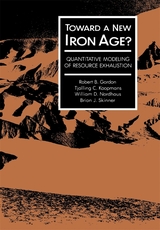
Experts agree that the earth will eventually run out of certain low-cost, nonrenewable resources, possibly as early as a century from now. Will the transition to reliance on other, more abundant resources be smooth or discontinuous? Might industrial societies experience a marked decline in living standards—a radically different kind of society from the one we now know? Geologists maintain that once inexpensive high-grade resources are exhausted, economic growth will slow. Economists are more optimistic: they believe that new technologies and materials will be substituted rapidly enough to prevent minor economic dislocations.
Toward a New Iron Age? takes an important step toward reconciling these divergent views. It is the most comprehensive study of the economic consequences of resource depletion—in particular, it is a thorough exploration of the prospects for one key metal, copper. The authors draw on geological and engineering data to calculate the resources now available and to assess the feasibility of substituting alternatives. Using linear programming and a range of hypothetical base conditions, they are able to estimate the course, through the next century and beyond, of several crucial factors: the rate at which copper resources will be used and when they will be depleted; how the price of the metal will fluctuate; when alternative materials will be substituted, in what patterns, and at what costs. By the late twenty-first century, the authors believe, low-cost copper will no longer be available. Industrial societies will have to operate on more abundant resources such as iron, silica, and aluminum. They will enter, in short, a New Iron Age.
READERS
Browse our collection.
PUBLISHERS
See BiblioVault's publisher services.
STUDENT SERVICES
Files for college accessibility offices.
RECENTLY PUBLISHED







UChicago Accessibility Resources
home | accessibility | search | about | contact us
BiblioVault ® 2001 - 2025
The University of Chicago Press