front cover of Tales of Love, Cleverness, and Violence in Tomaso Costo’s
Tales of Love, Cleverness, and Violence in Tomaso Costo’s "Fuggilozio" (1596)
Translated into English
Tommaso Astarita
Arc Humanities Press, 2024

This selection from Tomaso Costo’s Fuggilozio (The Cure for Indolence, 1596) translates entertaining, dramatic, or witty examples of the over four hundred stories and anecdotes of the original. Together, they offer an engaging window into the lively culture and society of Naples and Italy generally. Though the story-tellers are all from the city’s elite, the characters in the stories they tell run the social and professional gamut, from peasants to emperors, and the variety and brevity of the tales offers something for all readers who can smile at human foibles, silliness, and naughtiness, and admire cleverness and guile. Costo, in spite of his introductory claim that the book is meant to guide its audience to virtue and away from vice, also at times indulges in blunt innuendos and jokes that can still surprise us today.

[more]

front cover of Tanegashima
Tanegashima
The Arrival of Europe in Japan
Olof Lidin
National University of Singapore Press, 2002
The year 1543 marked the beginning of a new global consciousness in Japan with the arrival of storm-blown Portuguese merchants in Tanegashima Island in southern Japan. Other Portuguese rapidly followed and Japan became aware of a world beyond India. The Portuguese brought with them the musket, which was quickly copied and began to change Japanese warfare. Francis Xavier arrived in 1549 and other Christian missionaries soon after. This is not a new story but it is the first time that Japanese, Portuguese and other European accounts have been brought together and presented in English.
[more]

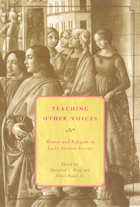
front cover of Teaching Other Voices
Teaching Other Voices
Women and Religion in Early Modern Europe
Edited by Margaret L. King and Albert Rabil Jr.
University of Chicago Press, 2007
The books in The Other Voice in Early Modern Europe series chronicle the heretofore neglected stories of women between 1400 and 1700 with the aim of reviving scholarly interest in their thought as expressed in a full range of genres: treatises, orations, and history; lyric, epic, and dramatic poetry; novels and novellas; letters, biography, and autobiography; philosophy and science. Teaching Other Voices: Women and Religion in Early Modern Europe complements these rich volumes by identifying themes useful in literature, history, religion, women's studies, and introductory humanities courses. The volume's introduction, essays, and suggested course materials are intended as guides for teachers--but will serve the needs of students and scholars as well.

[more]

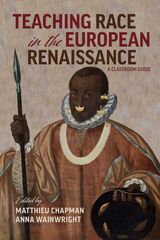
front cover of Teaching Race in the European Renaissance
Teaching Race in the European Renaissance
A Classroom Guide
Edited by Anna Wainwright and Matthieu Chapman
Arizona Center for Medieval and Renaissance Studies, 2023
A multidisciplinary guide to classroom discussion of race in the European Renaissance.
 
Teaching Race in the European Renaissance: A Classroom Guide provides both educators and students the tools they need to discuss race in the European Renaissance both in its unique historical contexts and as part of a broader continuum with racial thinking today. The volume gathers scholars of the English, French, Italian, and Iberian Renaissances to provide exercises, lesson plans, methodologies, readings, and other resources designed to bring discussions of race into a broad spectrum of classes on the early modern period, from literature to art history to the history of science. This book is designed to help educators create more diverse and inclusive syllabi and curricula that engage and address a diverse, twenty-first-century student body composed of students from a growing variety of cultural, national, ethnic, and racial backgrounds. By providing clear, concise, and diverse methodologies and analytical focuses, Teaching Race in the European Renaissance: A Classroom Guide will help educators in all areas of Renaissance Studies overcome the anxiety and fear that can come with stepping outside of their expertise to engage with the topic of race, while also providing expert scholars of race in the Renaissance with new techniques and pedagogies to enhance the classroom experience of their students.
[more]

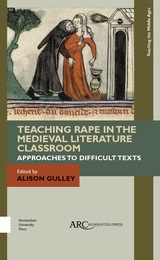
front cover of Teaching Rape in the Medieval Literature Classroom
Teaching Rape in the Medieval Literature Classroom
Approaches to Difficult Texts
Alison Gulley
Arc Humanities Press, 2018
Teachers of medieval literature help students bridge the temporal, contextual, and linguistic gulfs between the Middle Ages and the twenty-first century. When episodes involving rape are thrown into the mix, that task becomes even more difficult. The essays in this volume approach these difficult texts in ways that are both academically and ethically sound, recognizing that students and teachers bring a variety of experiences to the classroom that necessarily color the reception of a given work. At a time when colleges and universities are tasked with finding new solutions to the problem of sexual violence, this volume proposes ways educators can help students navigate the perceived divide between in- and out-of-class experiences. The contributors—from community colleges, small liberal arts colleges, and large state universities—offer suggestions for classroom activities and assignments for a range of medieval texts, as well as insight into the concerns of students in various settings.
[more]

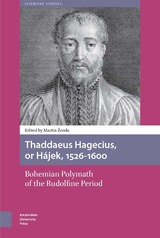
front cover of Thaddaeus Hagecius, or Hájek, 1526-1600
Thaddaeus Hagecius, or Hájek, 1526-1600
Bohemian Polymath of the Rudolfine Period
Martin Zemla
Amsterdam University Press, 2025
Tadeas Hajek of Hajek (1526–1600), Latinized as Thaddaeus Hagecius ab Hagek/Hayek, was a key figure in early scientific debates not only in his native Bohemia. A versatile scholar and polymath, he was prolific in medicine, botany, mathematics and astronomy. Modern interpreters tended to point out his astronomical interpretations to emphasize his greatest achievements and his “modernity.” However, Hajek also drew extensively on traditional arts such as alchemy, astrology and metoposcopy. In this volume, the contributors study various aspects of Hayek’s thought to present a less tendentious intellectual portrait of him in the context of his times. Even from this more adequate perspective, he remains an important figure in the dialectical process of transmitting ideas whose influence extended far beyond the Czech lands.
[more]

front cover of Theaters of Translation
Theaters of Translation
Cosmopolitan Vernaculars in Shakespeare's England
Andrew S. Keener
University of Alabama Press, 2025

Explores the profound influence of multilingual dictionaries, dialogues, and grammars on English Renaissance playwrights

In Theaters of Translation, Andrew S. Keener offers a fascinating account of the ways that plays by Thomas Kyd, Mary Sidney Herbert, Ben Jonson, and their fellow English contemporaries were shaped by and part of a multilingual Europe where dictionaries, grammars, and language-learning materials circulated widely. He proposes a fresh, multilingual approach to English Renaissance drama that challenges the histories of early modern European languages as sites of national and linguistic cohesion.

Covering the period between 1570 and 1640, when England’s drama and the English language itself were evolving, Keener uses the term “cosmopolitan vernaculars” to examine how nonclassical European languages modeled transnational forms of belonging for playgoers, readers, and authors in Renaissance England. Combining recent contributions to cosmopolitan theory and transnational studies of early modern literature and culture, Keener highlights both the ways in which cosmopolitanism manifests through Europe’s vernacular languages—in print and performance—and the ways languages themselves can exhibit cosmopolitanism for those who encounter them on the page or on the stage.

Theaters of Translation opens up new transnational interpretations of English Renaissance plays and casts fresh light on historical anecdotes, such as Jonson inscribing a copy of Pietro Aretino’s scandalous Italian dialogues or Shakespeare’s First Folio being advertised for sale in Germany before its London publication. It offers much of interest to readers and scholars of Renaissance Europe, early modern drama, and the development of national European languages.

[more]

logo for University of Chicago Press
Theory as Practice
Ethical Inquiry in the Renaissance
Nancy S. Struever
University of Chicago Press, 1992
There is a tendency in modern scholarship to describe the Renaissance Humanists merely as readers—as interpreters happily absorbed within the bounds of their chosen classical texts. In Theory as Practice, Nancy Struever contests this accepted notion; by focusing on ethical inquiry, she presents the Humanists as engaged in subtle, innovative moral work.

Struever argues that the accomplishment of five major Renaissance figures—Petrarch, Nicolaus Cusanus, Lorenzo Valla, Machiavelli, and Montaigne—was to consider theory as practice and thus engage the ethics of inquiry. She notes three stages of investigation, the first represented by Petrarch, who "relocated" ethical inquiry from a theoretical realm to a familiar practice responsive to daily experience.
 
Next, Struever describes how Cusanus and Valla assume Petrarch's relocation, yet confect ethics into discursive disciplines. Finally, while both Machiavelli and Montaigne produced strong revisions of discipline, they considered the problems of addressing the non-inquirer as well. Struever urges modern readers to employ both rhetorical and philosophical analysis to reveal these Humanists' aggressive tactics of presentation as well as their novel disciplinary reorientation. By doing so, she suggests, we discover how Renaissance ethical inquiry illuminates, and is illuminated by, the modern ethical theory of such philosophers as Peirce, Wittgenstein, Bernard Williams, and Quine.
 
[more]

logo for University of Minnesota Press
The Theory of German Word Order from the Renaissance to the Present
Aldo Scaglione
University of Minnesota Press, 1981

The Theory of German Word Order from the Renaissance to the Present was first published in 1981. Minnesota Archive Editions uses digital technology to make long unavailable books once again accessible, and are published unaltered from the original University of Minnesota Press editions.

The uniquely systematic character of German word order and sentence structure has long been recognized as an important feature of the language and of its literary uses. This book is the first comprehensive survey of the way theorists and stylists have interpreted these features through the centuries. Aldo Scaglione contends that the story of this theoretical awareness is part of the emerging cultural and literary consciousness of the German nation, as well as a testing ground for contemporary linguistic typology.

German speculation on the nature of a national language is, to Scaglione, best understood as a dialogue with the prevailing models of Latin, Italian, French, and English. His account of the debates over German word order is thus grounded in the complex historical circumstances from which they emerge: Renaissance grammarians took stock of German divergencies from the Latin cultural model, and those in the seventeenth century faced the challenges of French rationalism, nineteenth-century Romanticism and the many linguistic movements of the twentieth century have all cast new light upon the peculiarities of German sentence structure. Readers interested in historical syntax, rhetorical traditions, and the history of the German language will value both Scaglione's wide-ranging knowledge and his lively style.
[more]

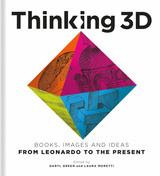
front cover of Thinking 3D
Thinking 3D
Books, Images and Ideas from Leonardo to the Present
Edited by Daryl Green and Laura Moretti
Bodleian Library Publishing, 2019
During the Renaissance, artists and illustrators developed the representation of truthful three-dimensional forms into a highly skilled art. As reliable illustrations of three-dimensional subjects became more prevalent, they also influenced the ways in which disciplines developed: architecture could be communicated much more clearly, mathematical concepts and astronomical observations could be quickly relayed, and observations of the natural world moved towards a more realistic method of depiction.

Through essays on some of the world’s greatest artists and thinkers—such as Leonardo da Vinci, Luca Pacioli, Andreas Vesalius, Johann Kepler, Galileo Galilei, William Hunter, and many more—this book tells the story of how of we learned to communicate three-dimensional forms on the two-dimensional page. It features some of Leonardo da Vinci’s ground-breaking drawings now in the Royal Collections and British Library as well as extraordinary anatomical illustrations, early paper engineering such as volvelles and flaps, beautiful architectural plans, and even views of the moon. With in-depth analysis of more than forty manuscripts and books, Thinking 3D also reveals the impact that developing techniques had on artists and draftsmen throughout time and across space, culminating in the latest innovations in computer software and 3D printing.
 
[more]

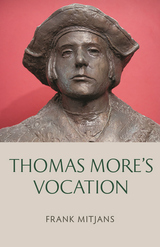
front cover of Thomas More's Vocation
Thomas More's Vocation
Frank Mitjans
Catholic University of America Press, 2022
The book considers Thomas More’s early life-choices. An early letter is cited by biographers but most miss More’s reference to the market place. More’s great-grandson, Cresacre, a Londoner, understood it correctly, and that gives reason to trust him on other aspects of More’s youth. This study is based on early testimonies, those of Erasmus, Roper, Harpsfield, Stapleton and Cresacre More, as well as More’s early writings, the Pageant Verses, and his additions / omissions to the Life of Pico; evidence drawn from authors he recommended, like Hilton and Gerson; and finally, his epitaph. Attention is given to his lectures on St Augustine’s City of God, and to St John Chrysostom. It is argued More studied Chrysostom’s Homilies on the Gospel of St Matthew,/i> from a Greek manuscript. Chrysostom, in the introductory homily, spoke of the city and the market place, as the setting in which Christians practice the teaching of Christ. More practiced law and taught it. He was attracted to becoming a Christian humanist alongside Grocyn, Colet, Linacre, and Lily. With them he studied Greek, the classics and Fathers of the Church. Helped by them he became a man of prayer, aware of the need to seek holiness in the midst of the world as a layman. Faced with the dilemma of the humanist in choosing between the contemplative life of the philosopher and an active life of engagement with the world, he deliberately chose the active life in service to society, and the contemplative life of the Christian as a married man. This awareness and choice is what is called vocation, implying determination to persevere throughout life: More saw his life as a pilgrimage towards heaven as described in the last chapter focusing on More’s last work, De tristitia, tedio, pavore, et oratione christi ante captionem eius.
[more]

front cover of Three Lectures on Leonardo
Three Lectures on Leonardo
Aby Warburg
University of London Press, 2020
In 1899 the young Aby Warburg gave a series of lectures in his hometown of Hamburg on the life and work of Leonardo da Vinci. At this time, Warburg lived and researched in Florence, and the lecture series was designed to raise his profile as a private scholar back home, but also, as Warburg’s brother Max put it, to give something back to the community. The Leonardo lectures, as they came to be known, are unique in the oeuvre of this scholar who tended to engage with very specific research problems.

With an average attendance of more than 400, Warburg’s lectures were a great success, and a fourth meeting, accompanied by original Leonardo drawings and photographic prints in the Hamburg Kunsthalle, had to be repeated. Marking the fifth centenary of Leonardo’s death and the 120th anniversary of Warburg’s first public lecture series, this volume contains the full translated text of Warburg’s previously unpublished lectures. This translation, which is based on the texts as they survive in Warburg’s three manuscripts located in the Warburg Institute Archive, will bring these groundbreaking lectures to a new audience.
[more]

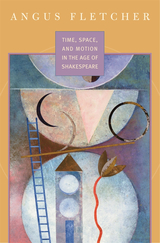
front cover of Time, Space, and Motion in the Age of Shakespeare
Time, Space, and Motion in the Age of Shakespeare
Angus Fletcher
Harvard University Press, 2006

Theirs was a world of exploration and experimentation, of movement and growth--and in this, the thinkers of the Renaissance, poets and scientists alike, followed their countrymen into uncharted territory and unthought space. A book that takes us to the very heart of the enterprise of the Renaissance, this closely focused but far-reaching work by the distinguished scholar Angus Fletcher reveals how early modern science and English poetry were in many ways components of one process: discovering and expressing the secrets of motion, whether in the language of mathematics or verse.

Throughout his book, Fletcher is concerned with one main crisis of knowledge and perception, and indeed cognition generally: the desire to find a correct theory of motion that could only end with Newton's Laws. Beginning with the achievement of Galileo--which changed the world--Time, Space, and Motion identifies the problem of motion as the central cultural issue of the time, pursued through the poetry of the age, from Marlowe and Shakespeare to Ben Jonson and Milton, negotiated through the limits and the limitless possibilities of language much as it was through the constraints of the physical world.
[more]

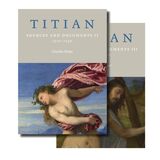
front cover of Titian
Titian
Sources and Documents
Charles Hope
Paul Holberton Publishing, 2021
This ambitious work collects all known documents related to the painter Titian dating from his era.

Titian was one of the most famous, successful, and long-lived of the Renaissance painters. Much of his output was for rulers or institutions whose archives have been largely preserved, and many of his family papers have also survived. Titian: Sources and Documents includes all known documents relating to Titian and his work dating from his lifetime, along with all known references to Titian in contemporaneous publications. The relevant section of each text is transcribed in full, preceded by a short summary in English, with extensive annotation and, where necessary, a commentary. The collection also includes all biographical material published before 1700 and all other texts that could realistically be thought to reflect first- or second-hand anecdotal information about him. The particular strengths and limitations of the principal early printed sources and the circumstances in which they were produced are discussed in a substantial introduction, which also includes an overview of the main archival collections consulted in the preparation of the book.
[more]

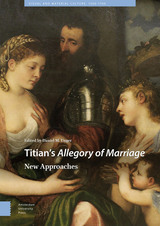
front cover of Titian's Allegory of Marriage
Titian's Allegory of Marriage
New Approaches
Daniel M. Unger
Amsterdam University Press, 2022
This book offers nine new approaches toward a single work of art, Titian’s Allegory of Marriage or Allegory of Alfonso d’Avalos, dated to 1530/5. In earlier references, the painting was named simply Allegory, alluding to its enigmatic nature. The work follows in a tradition of such ambiguous Venetian paintings as Giovanni Bellini’s Sacred Allegory and Giorgione’s Tempest. Throughout the years, Titian’s Allegory has engendered a range of diverse interpretations. Art historians such as Hans Tietze, Erwin Panofsky, Walter Friedlaender, and Louis Hourticq, to mention only a few, promoted various explanations. This book offers novel approaches and suggests new meanings toward a further understanding of this somewhat abstruse painting.
[more]

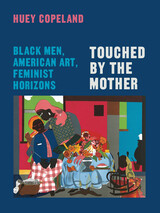
front cover of Touched by the Mother
Touched by the Mother
Black Men, American Art, Feminist Horizons
Huey Copeland
University of Chicago Press, 2026
Writings on black men’s cultural production and black masculinity by one of today’s leading historians of modern and contemporary art.
 
Collecting twenty years of incisive essays, articles, and interviews—including four published here for the first time—by art historian Huey Copeland, this book affirms the extraordinary depth of black men’s cultural production and the diversity of artistic practices that explore visual black masculinity in the United States. Part history, part memoir, part critical manifesto, Touched by the Mother offers a multi-faceted look at American art and discourse of the past fifty years, a personal meditation on navigating the world as a black gay man, and a feminist perspective on the ways transatlantic slavery continues to mark African and African diasporic men. Focusing on how the black maternal shapes black masculinity, Copeland confronts the dynamics that position African-American men—after their mothers—as sites of violence, creativity, and contestation in the cultural imagination.
 
Richly illustrated throughout, Touched by the Mother considers an exciting range of assemblage, painting, performance, photography, sculpture, and video works by more than twenty renowned practitioners, along with interviews featuring Hilton Als, Thelma Golden, Frank B. Wilderson, III, and other influential figures in contemporary art, culture, and criticism. Works by artists including Mark Bradford, Theaster Gates, David Hammons, Barkley L. Hendricks, Arthur Jafa, Glenn Ligon, Kerry James Marshall, Howardena Pindell, Sun Ra, and Lorna Simpson represent modes of making and thinking that are uniquely “touched by the mother,” Copeland argues, moving us toward the promise of black feminist futures.
 
[more]

front cover of Tough Love
Tough Love
Amazon Encounters in the English Renaissance
Kathryn Schwarz
Duke University Press, 2000
In Tough Love Kathryn Schwarz takes up a range of literary, historical, and theoretical texts in order to examine the relationship between Amazon myth and the social conventions that governed gender and sexuality during the early modern period. Imagined as embodiments of female masculinity, amazonian figures stimulated both homoerotic and heteroerotic response, and Schwarz shows that their appearance in narratives disrupted assumptions concerning identity, gender, domesticity, and desire.
Despite seeming to function as signs for what is outside the social—the alien, the exotic, the other—Amazons in sixteenth- and seventeenth-century texts were often represented in conventionally domestic roles, as mothers and lovers, wives and queens, Schwarz demonstrates. She traces this pattern in works by Shakespeare, Spenser, Sidney, Raleigh, and Jonson, as well as in such materials as conduct manuals, explorers’ accounts, court spectacles, and political tracts. Through readings of these texts, Schwarz shows that the Amazon myth provided a language both for setting forth and for challenging the terms of social logic. In representations of Amazon encounters, she argues, homosocial bonds became indistinguishable from heterosexual desires, masculine agency attached itself as logically to women as it did to men, and sexual difference was made nearly impossible to sustain or define. Schwarz’s analysis unveils the Amazon as a theoretical term, one that illuminates the tensions and paradoxes through which ideologies of the domestic take shape.
Tough Love contributes to the ongoing discussion of gendered identity and sexual desire in the early modern period. It will interest students of queer theory, cultural studies, early modern history, feminism, and literature.
[more]

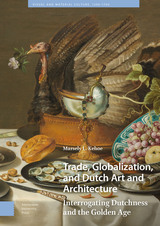
front cover of Trade, Globalization, and Dutch Art and Architecture
Trade, Globalization, and Dutch Art and Architecture
Interrogating Dutchness and the Golden Age
Marsely Kehoe
Amsterdam University Press, 2023
We all look to our past to define our present, but we don’t always realize that our view of the past is shaped by subsequent events. It’s easy to forget that the Dutch dominated the world’s oceans and trade in the seventeenth century when our cultural imagination conjures up tulips and wooden shoes instead of spices and slavery. This book examines the Dutch so-called “Golden Age” though its artistic and architectural legacy, recapturing the global dimensions of this period by looking beyond familiar artworks to consider exotic collectibles and trade goods, and the ways in which far-flung colonial cities were made to look and feel like home. Using the tools of art history to approach questions about memory, history, and how cultures define themselves, this book demonstrates the centrality of material and visual culture to understanding history and cultural identity.
[more]

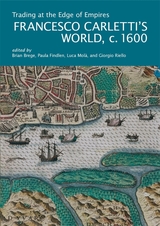
front cover of Trading at the Edge of Empires
Trading at the Edge of Empires
Francesco Carletti's World, ca. 1600
Brian Brege, Paula Findlen, Luca Molà, and Giorgio Riello
Harvard University Press
In narrating his circumnavigation of the world at the turn of the seventeenth century, the Florentine Francesco Carletti became the first European merchant to leave an account of travel on existing commercial routes. A repentant ex-slave trader and smuggler turned dealer in Chinese goods, Carletti travelled “at the edge of empires,” providing a unique perspective on the promise and peril of a connected globe. With his long stays in Lima, Mexico City, Manila, Nagasaki, Macao, and Goa, as well as travels across the Americas, the Pacific, and Asia, Carletti documents a changing world in which European powers and traders interacted and often clashed with other empires and polities. Trading at the Edge of Empires brings together 24 scholars to situate and unpack how Carletti’s travels illuminate our understanding of trade, slavery, empire, religion, language, ethnography, cartography, cosmography, and material culture in the early modern world.
[more]

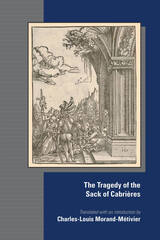
front cover of The Tragedy of the Sack of Cabrières
The Tragedy of the Sack of Cabrières
Translated by Charles-Louis Morand-Métivier
Arizona Center for Medieval and Renaissance Studies, 2022
A critical edition and the first English translation of the French play.

April 1542 saw a massacre of epic proportions in the Luberon, in southeastern France, of its Waldensian population, who had been peacefully living there after they settled in a few centuries before. This massacre foreshadowed the wars of religion, which tore apart the kingdom for almost forty years. The Tragédie du Sac de Cabrières is the only play devoted to these events. This is a critical edition and English translation of the French play. Three critical editions of the play have been published in 1927, 1928, and 1998, and this new edition complements the previous works. This is the first English translation of the play and makes it available to an international audience of scholars and students of the early modern period.

This edition “translates” the moment of the play's creation, the representation of the event, and its importance in the narrative of religious persecutions in sixteenth-century France. It explains how history is dramatized through the creation of the scenic story and scenic play of Cabrières. and how the specific retelling of the events of Cabrières makes this a tool of historical narration, thus allowing the audience to participate in the unfolding of history before their eyes. Therefore, they become part of history, because it is played before their eyes so that they can not only witness it but also propagate the glory of the martyrs for future generations. This is not only a translation and a work of literary scholarship, it is an analysis of the literary, political, and religious production of this period, and a multidisciplinary analysis of Waldensianism in southeastern France.
[more]

front cover of Transformations of Memory and Forgetting in Sixteenth-Century France
Transformations of Memory and Forgetting in Sixteenth-Century France
Marguerite de Navarre, Pierre de Ronsard, Michel de Montaigne
Nicolas Russell
University of Delaware Press, 2011

This book proposes that in a number of French Renaissance texts, produced in varying contexts and genres, we observe a shift in thinking about memory and forgetting. Focusing on a corpus of texts by Marguerite de Navarre, Pierre de Ronsard, and Michel de Montaigne, it explores several parallel transformations of and challenges to traditional discourses on the human faculty of memory.

Throughout Classical Antiquity and the Middle Ages, a number of influential authors described memory as a powerful tool used to engage important human concerns such as spirituality, knowledge, politics, and ethics. This tradition had great esteem for memory and made great efforts to cultivate it in their pedagogical programs. In the early sixteenth century, this attitude toward memory started to be widely questioned. The invention of the printing press and the early stages of the scientific revolution changed the intellectual landscape in ways that would make memory less important in intellectual endeavors. Sixteenth-century writers began to question the reliability and stability of memory. They became wary of this mental faculty, which they portrayed as stubbornly independent, mysterious, unruly, and uncontrollable–an attitude that became the norm in modern Western thought as is illustrated by the works of Descartes, Locke, Freud, Proust, Foucault, and Nora, for example.

Writing in this new intellectual landscape, Marguerite de Navarre, Ronsard, and Montaigne describe memory not as a powerful tool of the intellect but rather as an uncontrollable mental faculty that mirrored the uncertainty of human life. Their characterization of memory emerges from an engagement with a number of traditional ideas about memory. Notwithstanding the great many differences in concerns of these writers and in the nature of their texts, they react against or transform their classical and medieval models in similar ways. They focus on memory’s unruly side, the ways that memory functions independently of the will. They associate memory with the fluctuations of the body (the organic soul) rather than the stability of the mind (the intellectual soul). In their descriptions of memory, these authors both reflect and contribute to a modern understanding of and attitude towards this mental faculty.

Published by University of Delaware Press. Distributed worldwide by Rutgers University Press.
 
[more]

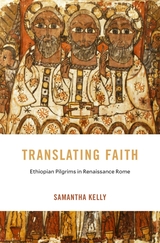
front cover of Translating Faith
Translating Faith
Ethiopian Pilgrims in Renaissance Rome
Samantha Kelly
Harvard University Press, 2024

A revealing account of the lives and work of Ethiopian Orthodox pilgrims in sixteenth-century Rome, examining how this African diasporic community navigated the challenges of religious pluralism in the capital of Latin Christianity.

Tucked behind the apse of Saint Peter’s Basilica in Rome is the ancient church of Santo Stefano. During the sixteenth century, Santo Stefano hosted an unusual community: a group of Ethiopian Orthodox pilgrims whose faith and culture were both like and unlike those of Latin Europe. The pilgrims of Santo Stefano were the only African community in premodern Europe to leave extensive documents in their own language (Gǝʿǝz). They also frequently collaborated with Latin Christians to disseminate their expert knowledge of Ethiopia and Ethiopian Christianity, negotiating the era’s heated debates over the boundaries of religious belonging.

Translating Faith is the first book-length study of this community in nearly a century. Drawing on Gǝʿǝz and European-language sources, Samantha Kelly documents how pilgrims maintained Ethiopian Orthodox practices while adapting to a society increasingly committed to Catholic conformity. Focusing especially on the pilgrims’ scholarly collaborations, Kelly shows how they came to produce and share Ethiopian knowledge—as well as how Latin Christian assumptions and priorities transformed that knowledge in unexpected ways. The ambivalent legacies of these exchanges linger today in the European tradition of Ethiopian Studies, which Santo Stefano is credited with founding.

Kelly’s account of the Santo Stefano pilgrim community is a rich tale about the possibilities and pitfalls of ecumenical dialogue, as well as a timely history in our own age marked by intensive and often violent negotiations of religious and racial difference.

[more]

front cover of A Translator’s Defense
A Translator’s Defense
Giannozzo Manetti
Harvard University Press, 2016
Giannozzo Manetti (1396–1459) was an Italian diplomat and a celebrated humanist orator and scholar of the early Renaissance. Son of a wealthy Florentine merchant, he turned away from a commercial career to take up scholarship under the guidance of the great civic humanist, Leonardo Bruni. Like Bruni he mastered both classical Latin and Greek, but, unusually, added to his linguistic armory a command of Biblical Hebrew as well. He used his knowledge of Hebrew to make a fresh translation of the Psalms into humanist Latin, a work that implicitly challenged the canonical Vulgate of St. Jerome. His Apologeticus (1455–59) in five books was a defense of the study of Hebrew and of the need for a new translation. As such, it constituted the most extensive treatise on the art of translation of the Renaissance. This ITRL edition contains the first complete translation of the work into English.
[more]

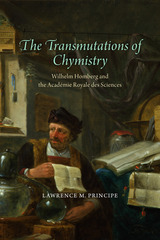
front cover of The Transmutations of Chymistry
The Transmutations of Chymistry
Wilhelm Homberg and the Académie Royale des Sciences
Lawrence M. Principe
University of Chicago Press, 2020
This book reevaluates the changes to chymistry that took place from 1660 to 1730 through a close study of the chymist Wilhelm Homberg (1653–1715) and the changing fortunes of his discipline at the Académie Royale des Sciences, France’s official scientific body. By charting Homberg’s remarkable life from Java to France’s royal court, and his endeavor to create a comprehensive theory of chymistry (including alchemical transmutation), Lawrence M. Principe reveals the period’s significance and reassesses its place in the broader sweep of the history of science.

Principe, the leading authority on the subject, recounts how Homberg’s radical vision promoted chymistry as the most powerful and reliable means of understanding the natural world. Homberg’s work at the Académie and in collaboration with the future regent, Philippe II d’Orléans, as revealed by a wealth of newly uncovered documents, provides surprising new insights into the broader changes chymistry underwent during, and immediately after, Homberg. A human, disciplinary, and institutional biography, The Transmutations of Chymistry significantly revises what was previously known about the contours of chymistry and scientific institutions in the early eighteenth century.
[more]

front cover of Transregional Lordship and the Italian Renaissance
Transregional Lordship and the Italian Renaissance
René de Challant, 1504-1565
Matthew Vester
Amsterdam University Press, 2020
René de Challant, whose holdings ranged from northwestern Italy to the Alps and over the mountains into what is today western Switzerland and eastern France, was an Italian and transregional dynast. The spatially dispersed kind of lordship that he practiced and his lifetime of service to the house of Savoy, especially in the context of the Italian Wars, show how the Sabaudian lands, neighboring Alpine states, and even regions further afield were tied to the history of the Italian Renaissance. Situating René de Challant on the edge of the Italian Renaissance helps us to understand noble kin relations, political networks, finances, and lordship with more precision. A spatially inflected analysis of René’s life brings to light several themes related to transregional lordship that have been obscured due to the traditional tendencies of Renaissance studies. It uncovers an ‘Italy’ whose boundaries extend not just into the Mediterranean, but into regions beyond the Alps.
[more]

logo for Harvard University Press
Travel and Discovery in the Renaissance, 1420–1620
Boies Penrose
Harvard University Press

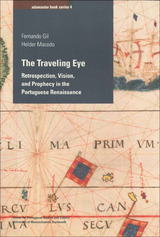
front cover of The Traveling Eye
The Traveling Eye
Retrospection, Vision, and Prophecy in the Portuguese Renaissance
Fernando Gil
Tagus Press, 2009
The idea for The Traveling Eye came as a new departure in an old dialogue between the two authors, one a literary scholar, the other a philosopher. Our focus was initially centered on a philosophical hypothesis concerning evidence, with specific reference to the prophetic writings of Father António Vieira, but it occurred to us that this perspective could be applied to literary works, particularly those of the Portuguese Renaissance. The studies that one of us had dedicated to the initiatory aspects of The Lusiads and to the codification of esoteric meanings in the work of Bernardim Ribeiro suggested a possible convergence of our two lines of research. But there are other issues raised by the Portuguese Renaissance: voyages, the new, the encounter with difference and how to understand it. The most obvious and direct expression of these issues is found in the chronicles of voyage and empire, whose importance is duly noted in the study by Luís de Sousa Rebelo included in Chapter III of this book. The literary treatment of this material seems to us no less revealing. Seeing ("seeing clearly seen" as Camões says in The Lusiads) poses the problem of simultaneously seeing "what is there" and of how what is there could be seen. This questioning from the outside by "the traveling eye" went hand in hand with new ways of relating to oneself and to others. Three key Renaissance authors, Luís de Camões (1525?-1580), Francisco de Sá de Miranda (1481?-1558?) and Bernardim Ribeiro (b.1480s?), address the human subject's relationship as a perplexing issue. Their works transform the feeling of love into a multifaceted investigation that questions the identity of the individual. A recurring theme in this book is the metamorphoses of the self brought about by love.
[more]

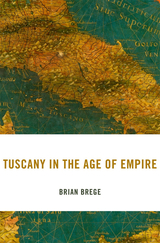
front cover of Tuscany in the Age of Empire
Tuscany in the Age of Empire
Brian Brege
Harvard University Press, 2021

Winner of the American Association for Italian Studies Book Prize

A new history explores how one of Renaissance Italy’s leading cities maintained its influence in an era of global exploration, trade, and empire.

The Grand Duchy of Tuscany was not an imperial power, but it did harbor global ambitions. After abortive attempts at overseas colonization and direct commercial expansion, as Brian Brege shows, Tuscany followed a different path, one that allowed it to participate in Europe’s new age of empire without establishing an empire of its own. The first history of its kind, Tuscany in the Age of Empire offers a fresh appraisal of one of the foremost cities of the Italian Renaissance, as it sought knowledge, fortune, and power throughout Asia, the Americas, and beyond.

How did Tuscany, which could not compete directly with the growing empires of other European states, establish a global presence? First, Brege shows, Tuscany partnered with larger European powers. The duchy sought to obtain trade rights within their empires and even manage portions of other states’ overseas territories. Second, Tuscans invested in cultural, intellectual, and commercial institutions at home, which attracted the knowledge and wealth generated by Europe’s imperial expansions. Finally, Tuscans built effective coalitions with other regional powers in the Mediterranean and the Islamic world, which secured the duchy’s access to global products and empowered the Tuscan monarchy in foreign affairs.

These strategies allowed Tuscany to punch well above its weight in a world where power was equated with the sort of imperial possessions it lacked. By finding areas of common interest with stronger neighbors and forming alliances with other marginal polities, a small state was able to protect its own security while carving out a space as a diplomatic and intellectual hub in a globalizing Europe.
[more]

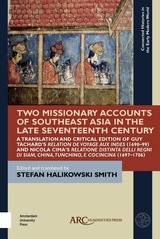
front cover of Two Missionary Accounts of Southeast Asia in the Late Seventeenth Century
Two Missionary Accounts of Southeast Asia in the Late Seventeenth Century
A Translation and Critical Edition of Guy Tachard’s Relation de Voyage aux Indes (1690–99) and Nicola Cima’s Relatione Distinta delli Regni di Siam, China, Tunchino, e Cocincina
Stefan Halikowski Smith
Arc Humanities Press, 2019
This volume presents critical editions of two previously unpublished missionary accounts of Ayutthaya and the East Indies scene after the "National" Revolution of 1688 in Thailand. The texts presented are Relation de Voyage aux Indes, 1690-99, by Guy Tachard, a French Jesuit; and Relatione Distinta delli Regni di Siam, China, Tunchino, e Cocincina (ca. 1707), by Nicola Cima, an Italian Augustinian. These interesting, substantial texts tell us a lot both about the Europeans who were writing them, and about Southeast Asia in a period when information was in much shorter supply than prior to 1688, and when kingdoms across Southeast Asia tended to retract from outward engagement and to become what historians have christened "hermit kingdoms." They are coloured by delusional thinking: in Tachard’s case of an active French colonial presence in that part of the world irrespective of the lessons of 1688-89, or in Cima’s case, of a revived Venetian maritime trade to the East Indies in an unlikely partnership with the Danish East Indies Company. Including a substantial introduction to contextualize the accounts, this book makes available in English some primary source material addressing important and overlooked aspects of the European missionary mentality.
[more]

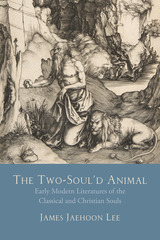
front cover of The Two-Soul'd Animal
The Two-Soul'd Animal
Early Modern Literatures of the Classical and Christian Souls
James Jaehoon Lee
Northwestern University Press, 2019
The Two-Soul’d Animal illuminates an early modern debate that recognized the troubling extent to which Christian thought had defined the human in terms of two incompatible models of soul. As the sixteenth century progressed, Christian and humanist thinkers began to realize that these two souls fundamentally contradicted each other. On the one hand, Christian theology had a great debt to Aristotle’s tripartite model of the soul based on three organic faculties: intellection, sensation, and nutrition. On the other, the Christian soul was defined by its immortal, immaterial, and transcendental substance. The sixteenth-century acknowledgement of the two souls provoked a great deal of anxiety, leading Christian thinkers to ask: How can we, as God’s perfect design, have two redundant and yet contradictory souls? And how could the core of the religious subject possibly be defined by a psychological paradox? As a result, the “soul” was an intrinsically unstable term being renegotiated in Renaissance culture. 

The English writers studied in The Two-Soul’d Animal place two prevailing interpretations of the soul’s faculties—one rhetorical on the plane of aesthetics, the other theological on the plane of ethics—into contact as a way to construct a new mode of Christian agency.
 
[more]


Send via email Share on Facebook Share on Twitter