logo for American Library Association
Web 2.0 Tools and Strategies for Archives and Local History Collections
American Library Association
American Library Association, 2010

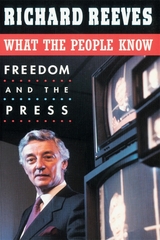
front cover of What the People Know
What the People Know
Freedom and the Press
Richard Reeves
Harvard University Press, 1998

The power and status of the press in America reached new heights after spectacular reporting triumphs in the segregated South, in Vietnam, and in Washington during the Watergate years. Then new technologies created instantaneous global reporting which left the government unable to control the flow of information to the nation. The press thus became a formidable rival in critical struggles to control what the people know and when they know it. But that was more power than the press could handle--and journalism crashed toward new lows in public esteem and public purpose.

The dazzling new technologies, profit-driven owners, and celebrated editors, reporters, and broadcasters made it possible to bypass older values and standards of journalism. Journalists reveled in lusty pursuit after the power of politics, the profits of entertainment and trespass into privacy. Richard Reeves was there at the rise and at the fall, beginning as a small-town editor, becoming the chief political correspondent of the New York Times and then a best-selling author and award-winning documentary filmmaker. He tells the story of a tribe that lost its way. From the Pony Express to the Internet, he chronicles what happened to the press as America accelerated into uncertainty, arguing that to survive, the press must go back to doing what it was hired to do long ago: stand as outsiders watching government and politics on behalf of a free people busy with their own affairs.

[more]

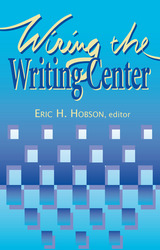
front cover of Wiring The Writing Center
Wiring The Writing Center
Eric Hobson
Utah State University Press, 1998
Published in 1998, Wiring the Writing Center was one of the first few books to address the theory and application of electronics in the college writing center. Many of the contributors explore particular features of their own "wired" centers, discussing theoretical foundations, pragmatic choices, and practical strengths. Others review a range of centers for the approaches they represent. A strong annotated bibliography of signal work in the area is also included.
[more]

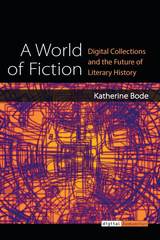
front cover of A World of Fiction
A World of Fiction
Digital Collections and the Future of Literary History
Katherine Bode
University of Michigan Press, 2018
Proposes a new basis for data-rich literary history
[more]

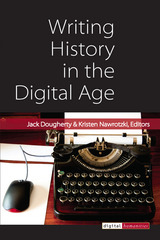
front cover of Writing History in the Digital Age
Writing History in the Digital Age
Jack Dougherty and Kristen Nawrotzki, editors
University of Michigan Press, 2013

Writing History in the Digital Age began as a “what-if” experiment by posing a question: How have Internet technologies influenced how historians think, teach, author, and publish? To illustrate their answer, the contributors agreed to share the stages of their book-in-progress as it was constructed on the public web.

To facilitate this innovative volume, editors Jack Dougherty and Kristen Nawrotzki designed a born-digital, open-access, and open peer review process to capture commentary from appointed experts and general readers. A customized WordPress plug-in allowed audiences to add page- and paragraph-level comments to the manuscript, transforming it into a socially networked text. The initial six-week proposal phase generated over 250 comments, and the subsequent eight-week public review of full drafts drew 942 additional comments from readers across different parts of the globe.

The finished product now presents 20 essays from a wide array of notable scholars, each examining (and then breaking apart and reexamining) if and how digital and emergent technologies have changed the historical profession.


[more]

front cover of Writing New Media
Writing New Media
Theory and Applications for Expanding the Teaching of Composition
Anne Frances Wysocki, Johndan Johnson-Eilola, Cynthia L. Selfe, & Geoffrey Sirc
Utah State University Press, 2004

As new media mature, the changes they bring to writing in college are many and suggest implications not only for the tools of writing, but also for the contexts, personae, and conventions of writing. An especially visible change has been the increase of visual elements-from typographic flexibility to the easy use and manipulation of color and images. Another would be in the scenes of writing-web sites, presentation "slides," email, online conferencing and coursework, even help files, all reflect non-traditional venues that new media have brought to writing. By one logic, we must reconsider traditional views even of what counts as writing; a database, for example, could be a new form of written work.

The authors of Writing New Media bring these ideas and the changes they imply for writing instruction to the audience of rhetoric/composition scholars. Their aim is to expand the college writing teacher's understanding of new media and to help teachers prepare students to write effectively with new media beyond the classroom. Each chapter in the volume includes a lengthy discussion of rhetorical and technological background, and then follows with classroom-tested assignments from the authors' own teaching.

[more]


Send via email Share on Facebook Share on Twitter