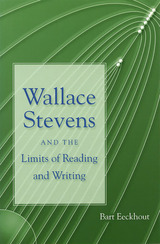
Often considered America’s greatest twentieth-century poet, Wallace Stevens is without a doubt the Anglo-modernist poet whose work has been most scrutinized from a philosophical perspective. Wallace Stevens and the Limits of Reading and Writing both synthesizes and extends the critical understanding of Stevens’s poetry in this respect. Arguing that a concern with the establishment and transgression of limits goes to the heart of this poet’s work, Bart Eeckhout traces both the limits of Stevens’s poetry and the limits of writing as they are explored by that poetry.
Stevens’s work has been interpreted so variously and contradictorily that critics must first address the question of limits to the poetry’s signifying potential before they can attempt to deepen our appreciation of it. In the first half of this book, the limits of appropriating and contextualizing Stevens’s “The Snow Man,” in particular, are investigated. Eeckhout does not undertake this reading with the negative purpose of disputing earlier interpretations but with the more positive intention of identifying the intrinsic qualities of the poetry that have been responsible for the remarkable amount of critical attention it has received.
Having identified the major sources of Stevens’s polysemy and of the seeming free-for-all of his critical afterlife, Eeckhout then deals with ten of the poet’s shorter works, including “The Idea of Order at Key West,” and proceeds to analyze some of the important limits of writing explored by the poetry. These limits all revolve around the nexus of perception, thought, and language that constitutes the core dynamic out of which Stevens’s poetry is generated and to which it continually returns.
Stevens’s work presents one of the most poignant opportunities for letting the reader feel the ever-problematic relationship between specificity and generality that is at the heart of all literary writing. By negotiating between the particularity of poetic detail and the universality of philosophical ideas, Wallace Stevens and the Limits of Reading and Writing seeks to contribute both to the study of Stevens and to the fields of literary theory and philosophy.