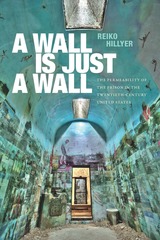
front cover of A Wall Is Just a Wall
A Wall Is Just a Wall
The Permeability of the Prison in the Twentieth-Century United States
Reiko Hillyer
Duke University Press, 2024
Throughout the twentieth century, even the harshest prison systems in the United States were rather porous. Incarcerated people were regularly released from prison for Christmas holidays; the wives of incarcerated men could visit for seventy-two hours relatively unsupervised; and governors routinely commuted the sentences of people convicted of murder. By the 1990s, these practices had become rarer as politicians and the media—in contrast to corrections officials—described the public as potential victims who required constant protection against the threat of violence. In A Wall Is Just a Wall Reiko Hillyer focuses on gubernatorial clemency, furlough, and conjugal visits to examine the origins and decline of practices that allowed incarcerated people to transcend prison boundaries. Illuminating prisoners’ lived experiences as they suffered, critiqued, survived, and resisted changing penal practices, she shows that the current impermeability of the prison is a recent, uneven, and contested phenomenon. By tracking the “thickening” of prison walls, Hillyer historicizes changing ideas of risk, the growing bipartisan acceptance of permanent exile and fixing the convicted at the moment of their crime as a form of punishment, and prisoners’ efforts to resist.
[more]

front cover of Way Down in the Hole
Way Down in the Hole
Race, Intimacy, and the Reproduction of Racial Ideologies in Solitary Confinement
Angela J. Hattery
Rutgers University Press, 2023
Based on ethnographic observations and interviews with prisoners, correctional officers, and civilian staff conducted in solitary confinement units, Way Down in the Hole explores the myriad ways in which daily, intimate interactions between those locked up twenty-four hours a day and the correctional officers charged with their care, custody, and control produce and reproduce hegemonic racial ideologies. Smith and Hattery explore the outcome of building prisons in rural, economically depressed communities, staffing them with white people who live in and around these communities, filling them with Black and brown bodies from urban areas and then designing the structure of solitary confinement units such that the most private, intimate daily bodily functions take place in very public ways. Under these conditions, it shouldn’t be surprising, but is rarely considered, that such daily interactions produce and reproduce white racial resentment among many correctional officers and fuel the racialized tensions that prisoners often describe as the worst forms of dehumanization. Way Down in the Hole concludes with recommendations for reducing the use of solitary confinement, reforming its use in a limited context, and most importantly, creating an environment in which prisoners and staff co-exist in ways that recognize their individual humanity and reduce rather than reproduce racial antagonisms and racial resentment.

Way Down the Hole Video 1 (https://youtu.be/UuAB63fhge0)
Way Down the Hole Video 2 (https://youtu.be/TwEuw1cTrcQ)
Way Down the Hole Video 3 (https://youtu.be/bOcBv_UnHIs​)
Way Down the Hole Video 4 (https://youtu.be/cx_l1S8D77c)
[more]

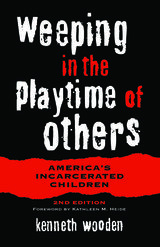
front cover of Weeping in the Playtime of Others
Weeping in the Playtime of Others
America’s Incarcerated Children. 2nd edition.
Written by Kenneth Wooden with a foreword by Kathleen M. Heide
The Ohio State University Press, 2000

Kenneth Wooden’s Weeping in the Playtime of Others—first published in 1976 and an enduring work of investigative journalism and criminology that was nominated for a Pulitzer Prize—exposes the harsh realities faced by children in the American juvenile justice system. Wooden’s extensive research and firsthand accounts highlight the systemic abuse, neglect, and violence that incarcerated youth endure. Investigative reporter Wooden journeyed across thirty states to document brutal conditions in juvenile detention centers and training schools. His work revealed in stark detail how these institutions regularly failed to provide the rehabilitation they promised, perpetuating cycles of violence and criminality, and presented a devastating picture of the detrimental effects on of solitary confinement, physical punishment, and inadequate educational and psychological support.

Wooden’s many case studies include that of a young Charles Manson, illustrating how early institutionalization can presage lifelong criminal behavior. Wooden also critiques the political and economic forces that sustain these abusive systems, calling for comprehensive reforms.
[more]

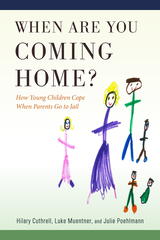
front cover of When Are You Coming Home?
When Are You Coming Home?
How Young Children Cope When Parents Go to Jail
Hilary Cuthrell
Rutgers University Press, 2023
As the United States approaches its 50th year of mass incarceration, more children than ever before have experienced the incarceration of a parent. The vast majority of incarceration occurs in locally operated jails and disproportionately impacts families of color, those experiencing poverty, and rural households. However, we are only beginning to understand the various ways in which children cope with the incarceration of a parent – particularly the coping of young children who are most at risk for the adversity and also the most detrimentally impacted. When Are You Coming Home?  helps answer questions about how young ones are faring when a parent is incarcerated in jail. Situated within a resilience model of development, the book presents findings related to children’s stress, family relationships, health, home environments, and visit experiences through the eyes of the children and families. This humanizing, social justice-oriented approach discusses the paramount need to support children and their families before, during, and after a parent’s incarceration while the country simultaneously grapples with strategies of reform and decarceration.
 
[more]

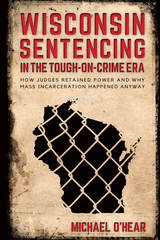
front cover of Wisconsin Sentencing in the Tough-on-Crime Era
Wisconsin Sentencing in the Tough-on-Crime Era
How Judges Retained Power and Why Mass Incarceration Happened Anyway
Michael O'Hear
University of Wisconsin Press, 2021
The dramatic increase in U.S. prison populations since the 1970s is often blamed on the mandatory sentencing required by "three strikes" laws and other punitive crime bills. Michael O'Hear shows that the blame is actually not so easily assigned. His meticulous analysis of incarceration in Wisconsin—a state where judges have considerable discretion in sentencing—explores the reasons why the prison population has ballooned nearly tenfold over the past forty years.

O'Hear tracks the effects of sentencing laws and politics in Wisconsin from the eve of the imprisonment boom in 1970 up to the 2010s. Drawing on archival research, original public-opinion polling, and interviews with dozens of key policymakers, he reveals important dimensions that have been missed by others. He draws out lessons from the Wisconsin experience for the United States as a whole, where mass incarceration has cost taxpayers billions of dollars and caused untold misery to millions of inmates and their families.

[more]

logo for University of Chicago Press
Women Guarding Men
Lynn Zimmer
University of Chicago Press, 1986
The hiring of women as guards in men's prisons represents a major breakthrough in women's efforts to achieve full sexual equality in the workplace. This dramatic social change has required great flexibility on the part of the women guards as well as substantial adjustments by their male counterparts, prison administrators, and the inmates themselves. In the first comprehensive study of this phenomenon, Lynn Zimmer examines the experiences of the women and men involved in the painful process of transition from a segregated to an integrated prison environment. Women Guarding Men is significant not only for its vivid depiction of their trials, but for its contribution to a general theory of women's occupational and organizational behavior.
[more]

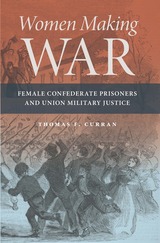
front cover of Women Making War
Women Making War
Female Confederate Prisoners and Union Military Justice
Thomas F. Curran
Southern Illinois University Press, 2020
Partisan activities of disloyal women and the Union army’s reaction
 
During the American Civil War, more than four hundred women were arrested and imprisoned by the Union Army in the St. Louis area. The majority of these women were fully aware of the political nature of their actions and had made conscious decisions to assist Confederate soldiers in armed rebellion against the U.S. government. Their crimes included offering aid to Confederate soldiers, smuggling, spying, sabotaging, and, rarely, serving in the Confederate army. Historian Thomas F. Curran’s extensive research highlights for the first time the female Confederate prisoners in the St. Louis area, and his thoughtful analysis shows how their activities affected Federal military policy.
 
Early in the war, Union officials felt reluctant to arrest women and waited to do so until their conduct could no longer be tolerated. The war progressed, the women’s disloyal activities escalated, and Federal response grew stronger. Some Confederate partisan women were banished to the South, while others were held at Alton Military Prison and other sites. The guerilla war in Missouri resulted in more arrests of women, and the task of incarcerating them became more complicated.
 
The women’s offenses were seen as treasonous by the Federal government. By determining that women—who were excluded from the politics of the male public sphere—were capable of treason, Federal authorities implicitly acknowledged that women acted in ways that had serious political meaning. Nearly six decades before U.S. women had the right to vote, Federal officials who dealt with Confederate partisan women routinely referred to them as citizens. Federal officials created a policy that conferred on female citizens the same obligations male citizens had during time of war and rebellion, and they prosecuted disloyal women in the same way they did disloyal men.
 
The women arrested in the St. Louis area are only a fraction of the total number of female southern partisans who found ways to advance the Confederate military cause. More significant than their numbers, however, is what the fragmentary records of these women reveal about the activities that led to their arrests, the reactions women partisans evoked from the Federal authorities who confronted them, the impact that women’s partisan activities had on Federal military policy and military prisons, and how these women’s experiences were subsumed to comport with a Lost Cause myth—the need for valorous men to safeguard the homes of defenseless women.
 
[more]

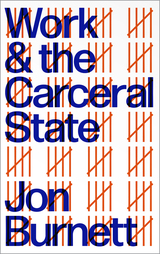
front cover of Work and the Carceral State
Work and the Carceral State
Jon Burnett
Pluto Press, 2022
 
'Revolutionises our understanding of the carceral state' - Fidelis Chebe, Director of Migrant Action

During 2019-20 in England and Wales, over 17 million hours of labor were carried out by more than 12,500 people incarcerated in prisons, while many people in immigration detention centers were also put to work. These people constitute a sub-waged, captive workforce who are frequently discarded by the state when done with.

Work and the Carceral State examines these forms of work as part of a broader exploration of the relationship between criminalization, criminal justice, immigration policy and labor, tracing their lineage through the histories of transportation and banishment, of houses of correction and prisons, to the contemporary production of work.

Criminalization has been used to enforce work and to discipline labor throughout the history of England and Wales. This book demands that we recognise the carceral state as operating at the frontier of labor control in the 21st century.
[more]

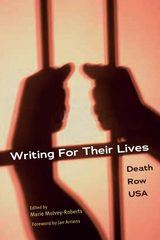
front cover of Writing for Their Lives
Writing for Their Lives
Death Row USA
Edited by Marie Mulvey-Roberts. Foreword by Jan Arriens
University of Illinois Press, 2007
Going well beyond graphic descriptions of death row's madness and suicide-inducing realities, Writing for Their Lives offers powerful, compassionate, and harrowing accounts of prisoners rediscovering the value of life from within the brutality and boredom of the row. Editor Marie Mulvey-Roberts brings together the writings of prisoners (many of whom are also prize-winning authors) and the words of those who work in the field of capital punishment, whose roles have included defense attorney, prison psychiatrist, chaplain and warden, spiritual advisor, abolitionist and executioner, as well as a Nobel Prize nominee and a murder victim family member. The material is presented through articles, journal extracts, letters, short stories, and poems.

Exposing little-known facts about the five modes of execution practiced in the United States today, Writing for Their Lives documents the progress of life on death row from a capital trial to execution and beyond, through the testimony of the prisoners themselves as well as those who watch, listen, and write to them. What emerges are stories of the survival of the human spirit under even the most unimaginable circumstances, and the ways in which some prisoners find penitence and peace in the most unlikely surroundings. In spite of the uniformity of their prison life and its nearly inevitable conclusion, prisoners able to read and write letters are shown to retain and develop their individuality and humanity as their letters become poems and stories.

Writing for Their Lives serves ultimately as an affirmation of the value of life and provides bountiful evidence that when a state executes a prisoner, it takes a life that still had something to give.

This edition features an introduction by the editor as well as a foreword by Jan Arriens. Dr. Mulvey-Roberts will be donating her profits from the sale of this volume to the legal charity Amicus, which assists in capital defense in the United States."

[more]


Send via email Share on Facebook Share on Twitter