
 A SCHOLARLY BOOK REPOSITORY
148 scholarly books by Karolinum Press and 5
start with L
148 scholarly books by Karolinum Press and 5
148 scholarly books by Karolinum Press
5 start with L start with L
5 start with L start with L
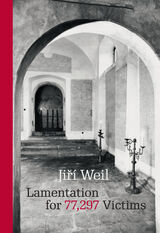
Lamentation for 77,297 Victims
Jirí Weil
Karolinum Press, 2020
“Smoke from nearby factories shrouds a countryside as flat as a table, a countryside stretching off to infinity. Covering it are the ashes of millions of dead. Scattered throughout are fine pieces of bone that ovens were not able to burn. When the wind comes, ashes rise to the heavens, bone fragments remain on the ground. And rain falls on the ashes, and rain turns them to good fertile soil, as befits the ashes of martyrs. And who can find the ashes of those from my native land, of whom there were 77,297? I gather some ashes with my hand, for only a hand can touch them, and I pour them into a linen sack, just as those who once left for a foreign country would gather their native soil so as never to forget, so as always to return to it.”
So begins Jiří Weil’s unforgettable prose poem, Lamentation for 77, 297 Victims, his literary monument to the Czech Jews killed during the Holocaust. A Czech-Jewish writer who worked at Prague’s Jewish Museum both during and after the Nazi Occupation—he survived the Holocaust by faking his own death and hiding out until the war had ended—Weil wrote Lamentation while he served as the museum’s senior librarian in the 1950s. This remarkable literary experiment presents a number of innovative approaches to writing about a horror many would deem indescribable, combining a narrative account of the Shoah with newspaper-style reportage on a handful of the lives ended by the Holocaust and quotes from the Hebrew Bible to create a specific and powerful portrait of loss and remembrance. Translated by David Lightfoot, Lamentation for 77,297 Victims is a startling and singular introduction to a writer whose works have been acclaimed by Philip Roth, Michiko Kakutani, and Siri Hustvedt.
So begins Jiří Weil’s unforgettable prose poem, Lamentation for 77, 297 Victims, his literary monument to the Czech Jews killed during the Holocaust. A Czech-Jewish writer who worked at Prague’s Jewish Museum both during and after the Nazi Occupation—he survived the Holocaust by faking his own death and hiding out until the war had ended—Weil wrote Lamentation while he served as the museum’s senior librarian in the 1950s. This remarkable literary experiment presents a number of innovative approaches to writing about a horror many would deem indescribable, combining a narrative account of the Shoah with newspaper-style reportage on a handful of the lives ended by the Holocaust and quotes from the Hebrew Bible to create a specific and powerful portrait of loss and remembrance. Translated by David Lightfoot, Lamentation for 77,297 Victims is a startling and singular introduction to a writer whose works have been acclaimed by Philip Roth, Michiko Kakutani, and Siri Hustvedt.
[more]
Lectures on Quantum Field Theory
Jirí Horejší
Karolinum Press, 2024
Twenty years of lectures on the quantum world by an esteemed physicist.
This book covers the material of the two-semester quantum field theory course that Jirí Horejší has taught at Charles University and Czech Technical University in Prague for over two decades. In the individual chapters, one may find the discussion of selected topics in relativistic quantum mechanics and relativistic quantum field theory; the dominant theme is quantum electrodynamics. The technique of Feynman diagrams is described in detail, along with methods of regularization and renormalization, including some basic applications.
The selection of topics presented in the book is intended to provide the reader with the technical skills necessary for the subsequent study of theoretical particle physics. In keeping with the author’s typical lecture style, the text contains many detailed explicit calculations to a degree not entirely typical in other available sources. With primary appeal for university students specializing in theoretical physics or nuclear and particle physics, it may also be useful for any scientifically minded reader seriously interested in the foundations of modern physics.
This book covers the material of the two-semester quantum field theory course that Jirí Horejší has taught at Charles University and Czech Technical University in Prague for over two decades. In the individual chapters, one may find the discussion of selected topics in relativistic quantum mechanics and relativistic quantum field theory; the dominant theme is quantum electrodynamics. The technique of Feynman diagrams is described in detail, along with methods of regularization and renormalization, including some basic applications.
The selection of topics presented in the book is intended to provide the reader with the technical skills necessary for the subsequent study of theoretical particle physics. In keeping with the author’s typical lecture style, the text contains many detailed explicit calculations to a degree not entirely typical in other available sources. With primary appeal for university students specializing in theoretical physics or nuclear and particle physics, it may also be useful for any scientifically minded reader seriously interested in the foundations of modern physics.
[more]
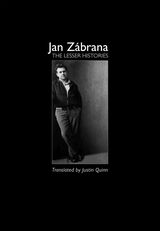
The Lesser Histories
Jan Zábrana
Karolinum Press, 2022
The first collection of poetry in English by an acclaimed twentieth-century Czech writer.
From the eighth floor of a tower block in Central Europe, Jan Zábrana surveyed the twentieth century. He had been exiled from his own life by Communism. His parents were imprisoned, their health was broken, and he was not allowed to study languages in college. Refusing both to rebel outright or to cave in, he thought of himself as a dead man walking. “To all those who keep asking me to do things for them, I sometimes feel like saying: ‘But I’m dead. I died long ago. Why do you keep treating me as if I were one of the living?’”
Yet during some of Europe’s most difficult years, he wrote The Lesser Histories, a collection of sixty-four sonnets that range through themes of age, sex, and political repression—a radiant testament to his times. The lines are emptied both of personal pathos and political stridency. Often Zábrana’s own voice segues into those of poets he had translated over the years, leaving only a bare shimmer of subjectivity—humorous, oblique, pained—with which to view his own works and days. The poems document a splendid and bitter isolation, and are immersed in the humor, hatreds, and loves of the everyday. Published in Czech in the ill-fated year of 1968, they subsequently fell into neglect. After the fall of Communism in 1989, Zábrana’s collected poems and selected diaries were published in Czech, and he was acclaimed as a major twentieth-century writer. Now, with this collection, he can begin to reach English-language readers for the first time.
From the eighth floor of a tower block in Central Europe, Jan Zábrana surveyed the twentieth century. He had been exiled from his own life by Communism. His parents were imprisoned, their health was broken, and he was not allowed to study languages in college. Refusing both to rebel outright or to cave in, he thought of himself as a dead man walking. “To all those who keep asking me to do things for them, I sometimes feel like saying: ‘But I’m dead. I died long ago. Why do you keep treating me as if I were one of the living?’”
Yet during some of Europe’s most difficult years, he wrote The Lesser Histories, a collection of sixty-four sonnets that range through themes of age, sex, and political repression—a radiant testament to his times. The lines are emptied both of personal pathos and political stridency. Often Zábrana’s own voice segues into those of poets he had translated over the years, leaving only a bare shimmer of subjectivity—humorous, oblique, pained—with which to view his own works and days. The poems document a splendid and bitter isolation, and are immersed in the humor, hatreds, and loves of the everyday. Published in Czech in the ill-fated year of 1968, they subsequently fell into neglect. After the fall of Communism in 1989, Zábrana’s collected poems and selected diaries were published in Czech, and he was acclaimed as a major twentieth-century writer. Now, with this collection, he can begin to reach English-language readers for the first time.
[more]
Lexical and Semantic Aspects of Proverbs
František Cermák
Karolinum Press, 2019
This book is linguistic in nature, offering a number of aspects of contemporary languages and their proverbs. Focusing mostly on lexical, semantic and pragmatic aspects, the book also explores language corpora findings. Apart from collecting data on proverbs from dozens of languages, there is an effort to map proverbs within a language in a systematic and reliable way. The book will prove useful to paremiologists, lexicographers, and comparative linguists.
[more]
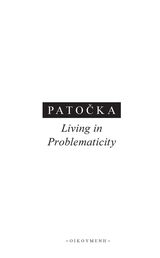
Living in Problematicity
Jan Patocka
Karolinum Press, 2020
Spanning his entire career, this selection of texts by influential philosopher Jan Patočka illustrates his thoughts on the appropriate manner of being and engagement in the world. The writings assembled in Living in Problematicity examine the role of the philosopher in the world, how the world constrains us through ideology, and how freedom is possible through the recognition of our human condition in the problems of the world. These views outline Patočka’s political philosophy and how his later engagement in the political sphere with the human rights initiative Charter 77 corresponds with the ideas he maintained throughout his life. This short and engaging book—published in conjunction with the prestigious philosophy press OIKOYMENH—is an ideal English-language introduction to the most significant Czech philosopher in recent history.
[more]
READERS
Browse our collection.
PUBLISHERS
See BiblioVault's publisher services.
STUDENT SERVICES
Files for college accessibility offices.
RECENTLY PUBLISHED


UChicago Accessibility Resources
home | accessibility | search | about | contact us
BiblioVault ® 2001 - 2024
The University of Chicago Press