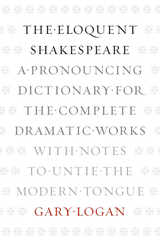
front cover of The Eloquent Shakespeare
The Eloquent Shakespeare
A Pronouncing Dictionary for the Complete Dramatic Works with Notes to Untie the Modern Tongue
Gary Logan
University of Chicago Press, 2008
An actor’s deepest desire is to be understood. But when asked to pronounce such words as “chanson,” “phantasime,” or “quaestor,” many otherwise unflappable actors can be rendered speechless.
 
The Eloquent Shakespeare aims to untie those tongues and help anyone speak Shakespeare’s language with ease. More than 17,500 entries make it the most comprehensive pronunciation guide to Shakespeare’s words, from the common to the arcane. Each entry is written in the International Phonetic Alphabet (IPA) and represents standard American pronunciations, making this dictionary perfect for North American professionals or non-native speakers of American English.
 
Renowned Shakespearean voice and text coach Gary Logan has spent years teaching Shakespeare’s works to some of the best actors in the world. His book includes proper names, foreign words and phrases, as well as an extensive introduction that covers everything from how to interpret the entries to scansion dynamics. Designed especially for actors, directors, stage managers, and teachers, The Eloquent Shakespeare is a one-of-a-kind resource for performing Shakespeare’s dramatic works.

[more]

logo for University of Minnesota Press
Essaying Shakespeare
Karen Newman
University of Minnesota Press, 2009

A pioneering scholar of Shakespeare and early modern letters provides an overview of work in the field

For more than twenty-five years, Karen Newman has brought her critical acumen to bear on early modern studies. In this collection of her essays on Shakespeare—some acknowledged classics and others never before published—Newman shows how changing theoretical trends have shaped Shakespeare studies, from new historicism and gender studies to critical race studies and globalization.

Central to Newman’s work is social exchange, or the circulation of people and objects. At least two of these essays have had a powerful and lasting impact on Shakespeare studies: “Renaissance Family Politics and Shakespeare’s The Taming of the Shrew” and “‘And wash the Ethiop White’: Femininity and the Monstrous in Othello.” Three essays appear in print for the first time: an examination of clothing of the poor and the portrayal of the king as a beggar in Richard II; a stinging review of Harold Bloom’s book Shakespeare: The Invention of the Human; and a rethinking of claims about the globalization of culture and cultural translation.Essaying Shakespeare chronicles Newman’s own critical development to provide a significant map of critical work on Shakespeare.
[more]

front cover of The Evolution of Shakespeare’s Comedy
The Evolution of Shakespeare’s Comedy
A Study in Dramatic Perspective
Larry S. Champion
Harvard University Press, 1970

The evolution of Shakespeare's comedy, in Larry Champion's view, is apparent in the expansion of his comic vision to include a complete reflection of human life while maintaining a comic detachment for the audience. Like the other popular dramatists of Elizabethan England, Shakespeare used the diverse comic motifs and devices which time and custom had proved effective. He went further, however, and created progressively deeper levels of characterization and plot interaction, thereby forming characters who were not merely devices subordinated to the needs of the plot.

Shakespeare's development as a comic playwright, suggests Champion, was “consistently in the direction of complexity or depth of characterization.” His earliest works, like those of his contemporaries, are essentially situation comedies: the humor arises from action rather than character. There is no significant development of the main characters; instead, they are manipulated into situations which are humorous as a result, for example, of mistaken identity or slapstick confusion. The ensuing phase of Shakespeare's comedy sets forth plots in which the emphasis is on identity rather than physical action, a revelation of character which occurs in one of two forms: either a hypocrite is exposed for what he actually is or a character who has assumed an unnatural or abnormal pose is forced to realize and admit the ridiculousness of his position. In the final comedies involving sin and sacrificial forgiveness, however, character development is concerned with a “transformation of values.”

Although each of the comedies is discussed, Champion concentrates on nine, dividing them according to the complexity of characterization. He pursues as well the playwright's efforts to achieve for the spectator the detached stance so vital to comedy. Shakespeare obtained this perspective, Champion observes, through experimentation with the use of material mirroring the main action—mockery, parody, or caricature—and through the use of a “comic pointer” who is himself involved in the action but is sufficiently independent of the other characters to provide the audience with an omniscient view.

[more]


Send via email Share on Facebook Share on Twitter