
 A SCHOLARLY BOOK REPOSITORY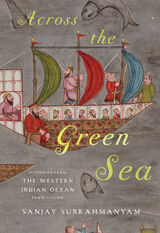
A history of two centuries of interactions among the areas bordering the western Indian Ocean, including India, Iran, and Africa.
Beginning in the mid-fifteenth century, the regions bordering the western Indian Ocean—“the green sea,” as it was known to Arabic speakers—had increasing contact through commerce, including a slave trade, and underwent cultural exchange and transformation. Using a variety of texts and documents in multiple Asian and European languages, Across the Green Sea looks at the history of the ocean from a variety of shifting viewpoints: western India; the Red Sea and Mecca; the Persian Gulf; East Africa; and Kerala.
Sanjay Subrahmanyam sets the scene for this region starting with the withdrawal of China's Ming Dynasty and explores how the western Indian Ocean was transformed by the growth and increasing prominence of the Ottoman Empire and the continued spread of Islam into East Africa. He examines how several cities, including Mecca and the vital Indian port of Surat, grew and changed during these centuries, when various powers interacted until famines and other disturbances upended the region in the seventeenth century. Rather than proposing an artificial model of a dominant center and its dominated peripheries, Across the Green Sea demonstrates the complexity of a truly dynamic and polycentric system through the use of connected histories, a method pioneered by Subrahmanyam himself.
A fresh English translation of five Alberti works that illuminate new aspects of the literary aims and development of the first “Renaissance man.”
Leon Battista Alberti (1404–1472) was one of the most famous figures of the Italian Renaissance. His extraordinary range of abilities as a writer, architect, art theorist, and even athlete earned him the controversial title of the first “Renaissance man.”
The works collected in Biographical and Autobiographical Writings reflect Alberti’s lived experiences and his interests in the genre. This volume includes On the Advantages and Disadvantages of Literature, which partly reflects his experiences as a student in Bologna; The Life of St. Potitus, the biography of a Christian martyr, which also contains autobiographical projections and was to have been the first in a series of lives of saints; My Dog, a mock funeral oration for his dead dog; My Life, one of the first autobiographies of the early modern period and the main source for Jacob Burckhardt’s portrait of Alberti; and a comic encomium, The Fly. In particular, the last three works—My Dog, My Life, and The Fly—constitute a kind of trilogy, as the humanist finds one of his main themes, the portrait of the ideal life, with a strong emphasis on humor.
This edition presents the first collected English translations of these works alongside an authoritative Latin text.
This child, scion of a family of power and privilege at Venice's time of greatness, left his father in a state of despair so profound and so public that it occasioned an outpouring of consoling letters, orations, treatises, and poems. In these documents, we find a firsthand account, richly colored by humanist conventions and expectations, of the life of the fifteenth-century boy, the passionate devotion of his father, the feelings of his brothers and sisters, the striking absence of his mother. The father's story is here as well: the career of a Venetian nobleman and scholar, patron and soldier, a participant in Venice's struggle for dominion in the north of Italy.
Through these sources also King traces the cultural trends that made Marcello's century famous. Her work enlarges our view of the literature of consolation, which had a distinctive tradition in Venice, and shifting attitudes toward death from the late Middle Ages onward.
For the depth and acuity of its insights into political, cultural, and private life in fifteenth-century Venice, this book will be essential reading for students of the Renaissance. For the grace and drama of its storytelling, it will be savored by anyone who wishes to look into life and death in a palace, and a city, long ago.
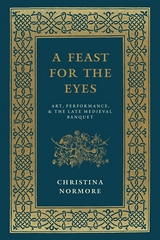
A Feast for the Eyes is the first book-length study of the court banquets of northwestern Europe in the fourteenth and fifteenth centuries. Christina Normore draws on an array of artworks, archival documents, chroniclers’ accounts, and cookbooks to re-create these events and reassess the late medieval visual culture in which banquets were staged. Feast participants, she shows, developed sophisticated ways of appreciating artistic skill and attending to their own processes of perception, thereby forging a court culture that delighted in the exercise of fine aesthetic judgment.
Challenging modern assumptions about the nature of artistic production and reception, A Feast for the Eyes yields fresh insight into the long history of multimedia work and the complex relationships between spectacle and spectators.
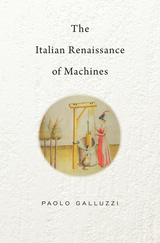
The Renaissance was not just a rebirth of the mind. It was also a new dawn for the machine.
When we celebrate the achievements of the Renaissance, we instinctively refer, above all, to its artistic and literary masterpieces. During the fifteenth and sixteenth centuries, however, the Italian peninsula was the stage of a no-less-impressive revival of technical knowledge and practice. In this rich and lavishly illustrated volume, Paolo Galluzzi guides readers through a singularly inventive period, capturing the fusion of artistry and engineering that spurred some of the Renaissance’s greatest technological breakthroughs.
Galluzzi traces the emergence of a new and important historical figure: the artist-engineer. In the medieval world, innovators remained anonymous. By the height of the fifteenth century, artist-engineers like Leonardo da Vinci were sought after by powerful patrons, generously remunerated, and exhibited in royal and noble courts. In an age that witnessed continuous wars, the robust expansion of trade and industry, and intense urbanization, these practitioners—with their multiple skills refined in the laboratory that was the Renaissance workshop—became catalysts for change. Renaissance masters were not only astoundingly creative but also championed a new concept of learning, characterized by observation, technical know-how, growing mathematical competence, and prowess at the draftsman’s table.
The Italian Renaissance of Machines enriches our appreciation for Taccola, Giovanni Fontana, and other masters of the quattrocento and reveals how da Vinci’s ambitious achievements paved the way for Galileo’s revolutionary mathematical science of mechanics.

More than forty years ago in the state archives of Lucca, Italy, musicologist Reinhard Strohm noticed that bindings on some of the books were unusual: they consisted of the pages of a centuries-old music manuscript. In the following years, Strohm worked with the archivists to remove these leaves and reassemble as much as possible of the original manuscript, a major cultural recovery now known as The Lucca Choirbook.
The recovered volume comprises what remains of a gigantic cathedral codex commissioned in Bruges around 1463 and containing English, Franco-Flemish, and Italian sacred music of the fifteenth century—including works by the celebrated composers Guillaume Du Fay and Henricus Isaac.
This facsimile of the choirbook includes all the known leaves, ordered according to their proper placement in the original codex. In the introduction, Strohm tells the fascinating story of this choirbook, identifying its early users and reconstructing its travel from Bruges to Lucca.
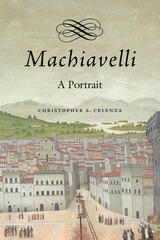
“Machiavellian”—used to describe the ruthless cunning of the power-obsessed and the pitiless—is never meant as a compliment. But the man whose name became shorthand for all that is ugly in politics was more engaging and nuanced than his reputation suggests. Christopher S. Celenza’s Machiavelli: A Portrait removes the varnish of centuries to reveal not only the hardnosed political philosopher but the skilled diplomat, learned commentator on ancient history, comic playwright, tireless letter writer, and thwarted lover.
Machiavelli’s hometown was the epicenter of the Italian Renaissance in the fifteenth century, a place of unparalleled artistic and intellectual attainments. But Florence was also riven by extraordinary violence. War and public executions were commonplace—Machiavelli himself was imprisoned and brutally tortured at the behest of his own government. These experiences left a deep impression on this keen observer of power politics, whose two masterpieces—The Prince and The Discourses—draw everywhere on the hard-won wisdom gained from navigating a treacherous world. But like many of Machiavelli’s fellow Florentines, he also immersed himself in the Latin language and wisdom of authors from the classical past. And for all of Machiavelli’s indifference to religion, vestiges of Christianity remained in his thought, especially the hope for a redeemer—a prince who would provide the stability so rare in Machiavelli’s worldly experience.
Donated in the late fifteenth century to the papal choir, the musical manuscript Cappella Sistina14 reflects a new style of mass composition used by some of the era’s most noted composers. Masses for the Sistine Chapel makes the complete contents of the Cappella Sistina14—held in the Vatican Library—available for the first time.
Featuring fifteen masses and four mass fragments, this volume includes works by such composers as Guillaume Du Fay, Johannes Ockeghem, and Antoine Busnoys. In a comprehensive introduction and critical commentary on each work, Richard Sherr places the choirbook in its historical context, describing its physical makeup as well as the repertory. Sherr’s critical edition of this celebrated manuscript finally provides the insight necessary to inform future performances and recordings of its influential contents.

A beautifully designed selection of the finest Italian Renaissance drawings from the British Museum, the Louvre and other French public collections, giving remarkable insight into the creative processes of some of the greatest artists in history.
This book features masterpieces of Italian Renaissance drawings from the British Museum, the Louvre and other French public collections in Lille, Rennes and Chantilly.
Beginning with an examination of drawing as part of the creative process, and showing how it reveals the artist's mind at work, the author explains in detail the materials and techniques used in Renaissance drawings. It also considers how drawings were used, how they changed stylistically through the period and how they varied in different regions of Italy. It concludes with a brief look at connoisseurship and collecting.
The main body of the book showcases 112 of the finest drawings by more than 40 Italian Renaissance masters, including Michelangelo, Leonardo, Botticelli, Raphael and Andrea del Sarto, accompanied by a concise sketch of the life and work of each artist. Arranged chronologically, they reveal stylistic and geographical trends as well as personal interactions between the artists themselves, and provide an extraordinary insight in to the artistic world of Renaissance Italy.
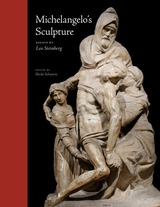
For half a century, Steinberg delved into Michelangelo’s work, revealing the symbolic structures underlying the artist’s highly charged idiom. This volume of essays and unpublished lectures explicates many of Michelangelo’s most celebrated sculptures, applying principles gleaned from long, hard looking. Almost everything Steinberg wrote included passages of old-fashioned formal analysis, but here put to the service of interpretation. He understood that Michelangelo’s rendering of figures as well as their gestures and interrelations conveys an emblematic significance masquerading under the guise of naturalism. Michelangelo pushed Renaissance naturalism into the furthest reaches of metaphor, using the language of the body and its actions to express fundamental Christian tenets once expressible only by poets and preachers—or, as Steinberg put it, in Michelangelo’s art, “anatomy becomes theology.”
Michelangelo’s Sculpture is the first in a series of volumes of Steinberg’s selected writings and unpublished lectures, edited by his longtime associate Sheila Schwartz. The volume also includes a book review debunking psychoanalytic interpretation of the master’s work, a light-hearted look at Michelangelo and the medical profession and, finally, the shortest piece Steinberg ever published.
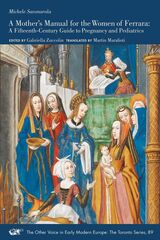
Around 1460, Michele Savonarola produced the extraordinary Mother’s Manual for the Women of Ferrara, a gynecological, obstetrical, and pediatric treatise composed in the vernacular so that it could be read not only by the learned but also by pregnant and nursing mothers and the midwives and wet nurses who presided over childbirth. Savonarola’s work is not merely a trivial set of instructions, but the work of a learned scholar who drew on, among others, the ancient Greek physicians Hippocrates and Galen, and Avicenna’s Canon of Medicine. The first of its kind, Savonarola’s Mother’s Manual helps readers understand both the development of late-medieval and early-modern obstetrics and gynecology, as well as the experiences of women who turn to advice books for help with reproductive issues. This book also provides a key to understanding why and how a new genre of book—the midwifery manual or advice book for pregnant women—arose in sixteenth-century Italy and eventually became a popular genre all over Europe from the early modern period to the present day.
"Professor Lowinsky's method is the only kind of 'writing about music' that I value."—Igor Stravinsky
A new history of one of the foremost printers of the Renaissance explores how the Age of Print came to Italy.
Lorenz Böninger offers a fresh history of the birth of print in Italy through the story of one of its most important figures, Niccolò di Lorenzo della Magna. After having worked for several years for a judicial court in Florence, Niccolò established his business there and published a number of influential books. Among these were Marsilio Ficino’s De christiana religione, Leon Battista Alberti’s De re aedificatoria, Cristoforo Landino’s commentaries on Dante’s Commedia, and Francesco Berlinghieri’s Septe giornate della geographia. Many of these books were printed in vernacular Italian.
Despite his prominence, Niccolò has remained an enigma. A meticulous historical detective, Böninger pieces together the thorough portrait that scholars have been missing. In doing so, he illuminates not only Niccolò’s life but also the Italian printing revolution generally. Combining Renaissance studies’ traditional attention to bibliographic and textual concerns with a broader social and economic history of printing in Renaissance Italy, Böninger provides an unparalleled view of the business of printing in its earliest years. The story of Niccolò di Lorenzo furnishes a host of new insights into the legal issues that printers confronted, the working conditions in printshops, and the political forces that both encouraged and constrained the publication and dissemination of texts.
In 1482, the Florentine humanist and statesman Francesco Berlinghieri produced the Geographia, a book of over one hundred folio leaves describing the world in Italian verse, inspired by the ancient Greek geography of Ptolemy. The poem, divided into seven books (one for each day of the week the author “travels” the known world), is interleaved with lavishly engraved maps to accompany readers on this journey.
Sean Roberts demonstrates that the Geographia represents the moment of transition between printing and manuscript culture, while forming a critical base for the rise of modern cartography. Simultaneously, the use of the Geographia as a diplomatic gift from Florence to the Ottoman Empire tells another story. This exchange expands our understanding of Mediterranean politics, European perceptions of the Ottomans, and Ottoman interest in mapping and print. The envoy to the Sultan represented the aspirations of the Florentine state, which chose not to bestow some other highly valued good, such as the city’s renowned textiles, but instead the best example of what Florentine visual, material, and intellectual culture had to offer.
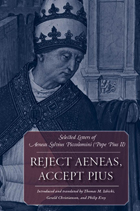
Often called the musical equivalent of the Dead Sea Scrolls, the Trent codices have dramatically broadened our understanding of Renaissance music. Much has been written about this collection of fifteenth-century music manuscripts, most of which were discovered in the Cathedral at Trent, but none of the seven codices--generally called Trent 87 through Trent 93--has ever been published in its entirety. Thus Rebecca Gerber’s edition of Trent 88, which took more than a decade to prepare, will be the first to appear. As such, this volume is a landmark in the publication of early music.
Trent 88 comprises an extensive anthology of 145 compositions tailored to the ceremonial and daily religious services of the period. The international scope of the collection is both impressive and significant: early English, French, German, and Spanish mass cycles appear alongside simple hymns and Magnificats. Music by renowned composers—including Guillaume Du Fay, Johannes Ockeghem, Johannes Cornago, and John Bedingham—is joined here by an even larger repertory of anonymous compositions with great aesthetic and historical value. Edited to accommodate both scholars and performers, and augmented with Gerber’s expert introduction, this volume will significantly deepen existing knowledge of a crucial period in the history of music.
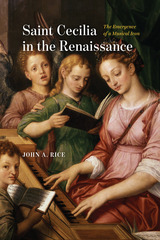
Until the fifteenth century, Saint Cecilia was not connected with music. She was perceived as one of many virgin martyrs, with no obvious musical skills or interests. During the next two centuries, however, she inspired many musical works written in her honor and a vast number of paintings that depicted her singing or playing an instrument.
In this book, John A. Rice argues that Cecilia’s association with music came about in several stages, involving Christian liturgy, visual arts, and music. It was fostered by interactions between artists, musicians, and their patrons and the transfer of visual and musical traditions from northern Europe to Italy. Saint Cecilia in the Renaissance explores the cult of the saint in Medieval times and through the sixteenth century when musicians’ guilds in the Low Countries and France first chose Cecilia as their patron. The book then turns to music and the explosion of polyphonic vocal works written in Cecilia’s honor by some of the most celebrated composers in Europe. Finally, the book examines the wealth of visual representations of Cecilia especially during the Italian Renaissance, among which Raphael’s 1515 painting, The Ecstasy of Saint Cecilia, is but the most famous example. Thoroughly researched and beautifully illustrated in color, Saint Cecilia in the Renaissance is the definitive portrait of Saint Cecilia as a figure of musical and artistic inspiration.
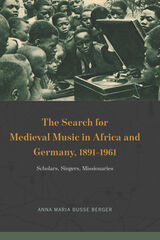
The book unfolds in three parts. Busse Berger starts with the origins of comparative musicology circa 1900, when early proponents used ideas from comparative linguistics to test whether parallels could be drawn between nonwestern and medieval European music. She then turns to youth movements of the era—the Wandervogel, Jugendmusikbewegung, and Singbewegung—whose focus on joint music making influenced many musicologists. Finally, she considers case studies of Protestant and Catholic mission societies in what is now Tanzania, where missionaries—many of them musicologists and former youth-group members—extended the discipline via ethnographic research and a focus on local music and communities. In highlighting these long-overlooked transnational connections and the role of global music in early musicology, Busse Berger shapes a fresh conception of music scholarship during a pivotal part of the twentieth century.
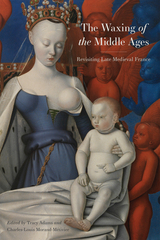
The Waxing of the Middle Ages sets out to provide a rich, complex, and diverse study of these developments and to reassert that late medieval France is crucial in its own right. The collection argues for an approach that views the late medieval period not as an afterthought, or a blind spot, but as a period that is key in understanding the fluidity of time, traditions, culture, and history. Each essay explores some “cultural form,” to borrow Huizinga’s expression, to expose the false divide that has dominated modern scholarship.
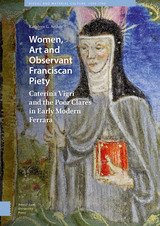
These essays explore the involvement of women in religious life throughout northern and central Italy and trace the evolution of communities of pious women as they tried to achieve their devotional goals despite the strictures of the ecclesiastical hierarchy. The contributors examine relations between holy women, their devout followers, and society at large.
Including contributions from leading figures in a new generation of Italian historians of religion, this book shows how women were able to carve out broad areas of influence by carefully exploiting the institutional church and by astutely manipulating religious percepts.
READERS
Browse our collection.
PUBLISHERS
See BiblioVault's publisher services.
STUDENT SERVICES
Files for college accessibility offices.
RECENTLY PUBLISHED


UChicago Accessibility Resources
home | accessibility | search | about | contact us
BiblioVault ® 2001 - 2024
The University of Chicago Press