
 A SCHOLARLY BOOK REPOSITORY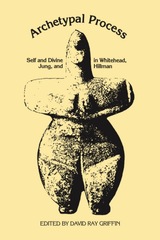
Archetypal Process examines the importance of cosmological thinking and the need to ground archetypal psychology in a metaphysical, philosophical framework. It treats the necessity for symbol and myth, the nature of the spirit, and language as a metaphorical vehicle of thought, and finally, it adds a much-needed feminist perspective to the debate.
Praise for the first edition:
"A fascinating book [and] a sympathetic look at the man who glued General Motors together and in the process made Flint one of the great industrial centers of America."
---Detroit Free Press
"It is refreshing to report that Billy Durant is one of the best researched books dealing with an automotive giant."
---Antique Automobile
"Billy Durant fills in a masterly way the only important void remaining concerning the work of the motorcar pioneers."
---Richard Crabb, author of Birth of a Giant: The Men and Incidents That Gave America the Motorcar
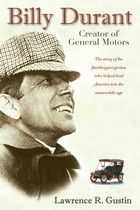
What explains Billy Durant's powerful influence on the auto industry during its early days? And why, given Durant's impact, has he been nearly forgotten for decades?
In search of answers to these questions, Lawrence Gustin interviewed Durant's widow, who provided a wealth of previously unpublished autobiographical notes, letters, and personal papers. Gustin also interviewed two of Durant's personal secretaries and others who had known and worked with the man who created General Motors. The result is the amazing account of the mastermind behind what would become, as the twentieth century progressed, the world's largest company.
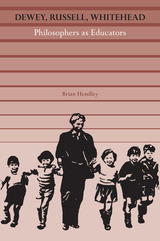
In Philosophers as Educators Brian Patrick Hendley argues that philosophers of education should reject their preoccupation with defining terms and analyzing concepts and embrace the philosophical task of constructing general theories of education. Hendley discusses in detail the educational philosophies of John Dewey, Bertrand Russell, and Alfred North Whitehead. He sees in these men excellent role models that contemporary philosophers might well follow. Hendley believes that, like these mentors, philosophers should take a more active, practical role in education. Dewey and Russell ran their own schools, and Whitehead served as a university administrator and as a member of many committees created to study education.
A central concern of nearly every environmental ethic is its desire to extend the scope of direct moral concern beyond human beings to plants, nonhuman animals, and the systems of which they are a part. Although nearly all environmental philosophies have long since rejected modernity’s conception of individuals as isolated and independent substances, few have replaced this worldview with an alternative that is adequate to the organic, processive world in which we find ourselves. In this context, Brian G. Henning argues that the often overlooked work of Alfred North Whitehead has the potential to make a significant contribution to environmental ethics. Additionally inspired by classical American philosophers such as William James, John Dewey and Charles Sanders Pierce and environmental philosophers such as Aldo Leopold, Peter Singer, Albert Schweitzer, and Arne Naess, Henning develops an ethical theory of which the seminal insight is called “The Ethics of Creativity.”
By systematically examining and developing a conception of individuality that is equally at home with the microscopic world of subatomic events and the macroscopic world of ecosystems, The Ethics of Creativity correctly emphasizes the well-being of wholes, while not losing sight of the importance of the unique centers of value that constitute these wholes. In this way, The Ethics of Creativity has the potential to be a unique voice in contemporary moral philosophy.
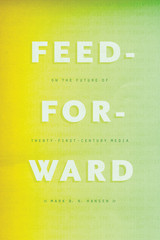
Drawing on the speculative empiricism of philosopher Alfred North Whitehead, Hansen reveals how new media call into play elements of sensibility that greatly affect human selfhood without in any way belonging to the human. From social media to data-mining to new sensor technologies, media in the twenty-first century work largely outside the realm of perceptual consciousness, yet at the same time inflect our every sensation. Understanding that paradox, Hansen shows, offers us a chance to put forward a radically new vision of human becoming, one that enables us to reground the human in a non-anthropocentric view of the world and our experience in it.
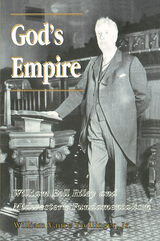
More than any other individual, William Bell Riley, pastor of the First Baptist Church of Minneapolis, inspired the resurgence of Protestant fundamentalism in 1930s America. Trollinger explores the development of Riley’s theology and social thought, examining in detail the rise of the Northwestern Bible and Missionary Training School and other similar institutions. He sheds light upon the nature, successes, and failures of fundamentalist crusades and makes it clear that, to understand fundamentalist religion in America, one must focus upon its regional and local roots.

Martin Heidegger’s Being and Time can be broadly termed a transcendental inquiry into the structures that make human experience possible. Such an inquiry reveals the conditions that render human experience intelligible. Using Being and Time as a model, I attempt to show that Alfred North Whitehead’s Process and Reality not only aligns with Being and Time in opposing many elements of traditional Western philosophy but also exhibits a similar transcendental inquiry.
With this reading, Process and Reality contains concepts much like Being-in-the-world, ecstatic temporality, and others found in Being and Time. More important, this interpretation considers Whitehead’s treatment of human experience paradigmatic for understanding his cosmological scheme in general. Finally, the results of this study are employed to sketch a phenomenology of holy experience.
— Prefatory Note to Heidegger and Whitehead
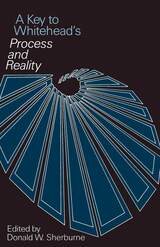
"The Key renders Process and Reality pedagogically accessible for the first time."—Journal of Religion
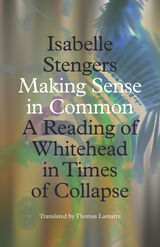
A leading philosopher seeks to recover “common sense” as a meeting place to reconcile science and philosophy
With her previous books on Alfred North Whitehead, Isabelle Stengers not only secured a reputation as one of the premier philosophers of our times but also inspired a rethinking of critical theory, political thought, and radical philosophy across a range of disciplines. Here, Stengers unveils what might well be seen as her definitive reading of Whitehead.
Making Sense in Common will be greeted eagerly by the growing group of scholars who use Stengers’s work on Whitehead as a model for how to think with conceptual precision through diverse domains of inquiry: environmentalism and ecology, animal studies, media and technology studies, the history and philosophy of science, feminism, and capitalism. On the other hand, the significance of this new book extends beyond Whitehead. Instead, it lies in Stengers’s recovery of the idea of “common sense” as a meeting place—a commons—where opposed ideas of science and humanistic inquiry can engage one another and help to move society forward. Her reconciliation of science and philosophy is especially urgent today—when climate disaster looms all around us, when the values of what we thought of as civilization and modernity are discredited, and when expertise of any kind is under attack.


Alfred North Whitehead has never gone out of print, but for a time he was decidedly out of fashion in the English-speaking world. In a splendid work that serves as both introduction and erudite commentary, Isabelle Stengers—one of today’s leading philosophers of science—goes straight to the beating heart of Whitehead’s thought. The product of thirty years’ engagement with the mathematician-philosopher’s entire canon, this volume establishes Whitehead as a daring thinker on par with Gilles Deleuze, Felix Guattari, and Michel Foucault.
Reading the texts in broadly chronological order while highlighting major works, Stengers deftly unpacks Whitehead’s often complicated language, explaining the seismic shifts in his thinking and showing how he called into question all that philosophers had considered settled after Descartes and Kant. She demonstrates that the implications of Whitehead’s philosophical theories and specialized knowledge of the various sciences come yoked with his innovative, revisionist take on God. Whitehead’s God exists within a specific epistemological realm created by a radically complex and often highly mathematical language.
“To think with Whitehead today,” Stengers writes, “means to sign on in advance to an adventure that will leave none of the terms we normally use as they were.”
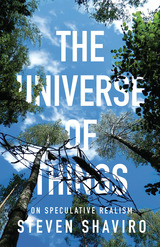
From the rediscovery of Alfred North Whitehead’s work to the rise of new materialist thought, including object-oriented ontology, there has been a rapid turn toward speculation in philosophy as a way of moving beyond solely human perceptions of nature and existence. Now Steven Shaviro maps this quickly emerging speculative realism, which is already dramatically influencing how we interpret reality and our place in a universe in which humans are not the measure of all things.
The Universe of Things explores the common insistence of speculative realism on a noncorrelationist thought: that things or objects exist apart from how our own human minds relate to and comprehend them. Shaviro focuses on how Whitehead both anticipates and offers challenges to prevailing speculative realist thought, moving between Whitehead’s own panpsychism, Harman’s object-oriented ontology, and the reductionist eliminativism of Quentin Meillassoux and Ray Brassier.
The stakes of this recent speculative realist thought—of the effort to develop new ways of grasping the world—are enormous as it becomes clear that our inherited assumptions are no longer adequate to describe, much less understand, the reality we experience around us. As Shaviro acknowledges, speculative realist thought has its dangers, but it also, like the best speculative fiction, holds the potential to liberate us from confining views of what is outside ourselves and, he believes, to reclaim aesthetics and beauty as a principle of life itself.
Bringing together a wide array of contemporary thought, and evenhandedly assessing its current debates, The Universe of Things is an invaluable guide to the evolution of speculative realism and the provocation of Alfred North Whitehead’s pathbreaking work.
READERS
Browse our collection.
PUBLISHERS
See BiblioVault's publisher services.
STUDENT SERVICES
Files for college accessibility offices.
RECENTLY PUBLISHED



UChicago Accessibility Resources
home | accessibility | search | about | contact us
BiblioVault ® 2001 - 2024
The University of Chicago Press