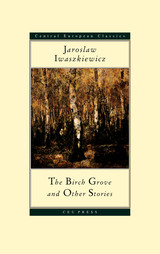
front cover of The Birch Grove and Other Stories
The Birch Grove and Other Stories
Jaroslaw Iwaszkiewicz
Central European University Press, 2002
Jaroslaw Iwaszkiewicz's work is familiar to every Polish reader, yet remains unknown to the outside world. The stories in this selection were all written in the 1930s, and provide an extraordinary evocation of Poland's first brief era of independence between the wars. They are also timeless sonatas of love and loss. In 'A New Love', Iwaszkiewicz uses masterful brevity to take a wry, comical look at the illusion of romance from the viewpoint of a jaded, cynical lover. One of his best-known works, 'The Wilko Girls', tells of a middle-aged man's quest to recover his lost youth in the aftermath of the First World War, which has left him psychologically scarred. He travels to the scene of his pre-war summer holidays in the eastern borderlands, where he renews his friendship with the fascinating sisters whom he knew when they were girls. But no one is the same and nothing can be as it was. 'The Birch Grove' is the moving story of a woodsman who, spiritually destroyed by the death of his wife, has buried himself away in an isolated forest. When his lively younger brother unexpectedly comes to stay, his self-centred peace is disrupted. But his brother has come home to die. The lives of two young men, one a deeply religious poet, the other a sceptical, worldly estate owner, are touchingly contrasted in 'The Mill on the River Utrata'. Confirming these stories' central place in Polish cultural history, 'The Wilko Girls' and 'The Birch Grove' were made into classic films by Andrzej Wajda, Poland's leading director.
[more]

front cover of The Ethics of Witnessing
The Ethics of Witnessing
The Holocaust in Polish Writers' Diaries from Warsaw, 1939-1945
Rachel Feldhay Brenner
Northwestern University Press, 2014

Winner, 2015 USC Book Award in Literary and Cultural Studies, for outstanding monograph published on Russia, Eastern Europe or Eurasia in the fields of literary and cultural studies

The Ethics of Witnessing investigates the reactions of five important Polish diaristswriters—Jaroslaw Iwaszkiewicz, Maria Dabrowska, Aurelia Wylezynska, Zofia Nalkowska, and Stanislaw Rembek—during the period when the Nazis persecuted and murdered Warsaw’s Jewish population. The responses to the Holocaust of these prominent prewar authors extended from insistence on empathic interaction with victims to resentful detachment from Jewish suffering. Whereas some defied the dehumanization of the Jews and endeavored to maintain intersubjective relationships with the victims they attempted to rescue, others selfdeceptively evaded the Jewish plight. The Ethics of Witnessing examines the extent to which ideologies of humanism and nationalism informed the diarists’ perceptions, proposing that the reality of the Final Solution exposed the limits of both orientations and ultimately destroyed the ethical landscape shaped by the Enlightenment tradition, which promised the equality and fellowship of all human beings.
 
[more]

front cover of Ink
Ink
The Indelible J. Mayo Williams
Clifford R. Murphy
University of Illinois Press, 2024
<p>The product of a hardscrabble childhood, J. Mayo “Ink” Williams parlayed an Ivy League education into unlikely twin careers as a foundational producer of Black music and pioneering Black player in the early NFL. Clifford R. Murphy tells the story of an ambitious, upwardly mobile life affected, but never daunted, by white society’s racism or the Black community’s class tensions. Williams caroused with Paul Robeson, recorded the likes of Ma Rainey and Blind Lemon Jefferson, and lined up against Chicago Bears player-coach George Halas. Though resented by the artists he exploited, Williams combined a rock-solid instinct for what would sell with an ear for music that put him at the forefront of finding, recording, and blending blues and jazz. Murphy charts Williams’s wide-ranging accomplishments while providing portraits of the cutthroat recording industry and the possibilities, however constrained, of Black life in the 1920s and 1930s.</p>

<p>Vivid and engaging, <i>Ink</i> brings to light the extraordinary journey of a Black businessman and athlete.</p>
[more]


Send via email Share on Facebook Share on Twitter