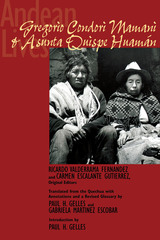
front cover of Andean Lives
Andean Lives
Gregorio Condori Mamani and Asunta Quispe Huamán
Ricardo Valderrama Fernández and Carmen Escalante Gutiérrez, Original Editors
University of Texas Press, 1996

Gregorio Condori Mamani and Asunta Quispe Huamán were runakuna, a Quechua word that means "people" and refers to the millions of indigenous inhabitants neglected, reviled, and silenced by the dominant society in Peru and other Andean countries. For Gregorio and Asunta, however, that silence was broken when Peruvian anthropologists Ricardo Valderrama Fernández and Carmen Escalante Gutiérrez recorded their life stories. The resulting Spanish-Quechua narrative, published in the mid-1970s and since translated into many languages, has become a classic introduction to the lives and struggles of the "people" of the Andes.

Andean Lives is the first English translation of this important book. Working directly from the Quechua, Paul H. Gelles and Gabriela Martínez Escobar have produced an English version that will be easily accessible to general readers and students, while retaining the poetic intensity of the original Quechua. It brings to vivid life the words of Gregorio and Asunta, giving readers fascinating and sometimes troubling glimpses of life among Cuzco's urban poor, with reflections on rural village life, factory work, haciendas, indigenous religion, and marriage and family relationships.


[more]

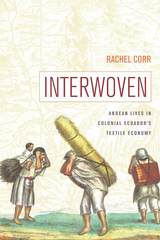
front cover of Interwoven
Interwoven
Andean Lives in Colonial Ecuador’s Textile Economy
Rachel Corr
University of Arizona Press, 2018
In the 1600s, Marcos Cunamasi, an indigenous man in Pelileo, Ecuador, hid his child to protect him from officials who would put the boy to work in the textile mill. Cunamasi was forced to turn him over. Because his young son couldn’t keep up with spinning his quota of wool per day, Cunamasi helped so the child wouldn’t be whipped. After working a year, Cunamasi was paid a shirt and a hat.

Interwoven is the untold story of indigenous people’s historical experience in colonial Ecuador’s textile economy. It focuses on the lives of Native Andean families in Pelileo, a town dominated by one of Quito’s largest and longest-lasting textile mills. Quito’s textile industry developed as a secondary market to supply cloth to mining centers in the Andes; thus, the experience of indigenous people in Pelileo is linked to the history of mining in Bolivia and Peru.

Although much has been written about colonial Quito’s textile economy, Rachel Corr provides a unique perspective by putting indigenous voices at the center of that history. Telling the stories of Andean families of Pelileo, she traces their varied responses to historical pressures over three hundred years; the responses range from everyday acts to the historical transformation of culture through ethnogenesis. These stories of ordinary Andean men and women provide insight into the lived experience of the people who formed the backbone of Quito’s textile industry.
 
[more]


Send via email Share on Facebook Share on Twitter