
 A SCHOLARLY BOOK REPOSITORY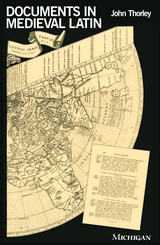
Documents in Medieval Latin will be useful to students of medieval history, literature, and philosophy and those interested in reading more about the Middle Ages. Thorley's cheerful approach, the lively and representative selections of tests, and the documentary and epigraphic focus will prove valuable for those wishing to explore these vital original sources.
John Thorley teaches medieval Latin at Lancaster University.
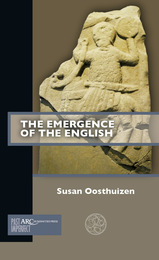
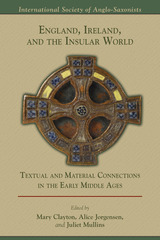
ISAS Dublin 2013. England, Ireland and the Insular World: Textual and Material Connections in the Early Middle Ages is a collection of twelve essays related to the theme of the 2013 conference of the International Society of Anglo-Saxonists, ‘Insular Cultures’. Contributors cover a broad range of topics, from early medieval agriculture in Ireland and England, to sculpture, manuscript illumination and script, homilies, hagiography, aristocratic gift-giving, relics, calendars, Beowulf, and Anglo-Saxon perceptions of the Celtic peoples, considering connections, parallels and differences between Anglo-Saxon England and its insular neighbors. The volume will be of interest to all those working on Early Medieval history, literature, archaeology, liturgy, art, and manuscripts.

When the BBC ran a poll in 2001 to name the greatest Briton, Alfred, a ninth-century monarch, was the only king to make the top 20. Also the only English sovereign to be called "the Great," Alfred used to be remembered as much through folklore as through his accomplishments.
Horspool sees Alfred as inextricably linked to the legends and stories that surround him, and rather than attempting to separate the myth from the "reality," he explores how both came together to provide a historical figure that was all things to all men. This book offers a vivid picture of Alfred's England, but also of the way that history is written, and how much myth has had to do with that.
A thousand years of English history, encapsulating invasions, the rise and fall of kings, and religious events
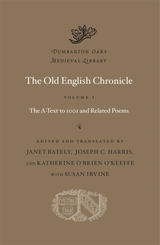
Among the vernacular historical writings of early medieval England, the Old English Chronicle holds a prominent place, providing not only a backbone of English history from the fifth through the twelfth centuries but also a record of language development and geography. The seven texts in the Chronicle, known as manuscripts A through G, offer a brief year-by-year summary of important national events.
The Old English Chronicle: The A-Text to 1001 is the earliest and most interesting of these manuscripts. It covers more than a thousand years, with entries written throughout the tenth century by different scribes. Although many entries are spare, noting only the death of a king or church official, others offer detailed accounts and interpretations of events such as the movement of viking armies against King Alfred or the narrative of treachery, retribution, and loyalty widely known today as “Cynewulf and Cyneheard.” In addition to the A-Text, this edition contains two highly political poems, The Death of Alfred and The Death of Edward, as well as The Battle of Maldon, a brilliant verse rendering of a defeat against Scandinavian invaders in 991.
The Old English Chronicle, Volume I contains newly edited Old English texts and expert translations of key works of medieval historical writing.
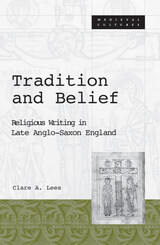
Looks at early religious texts and their influence on medieval literature and culture.
Looks at early religious texts and their influence on medieval literature and culture.
In this major study of Anglo-Saxon religious texts-sermons, homilies, and saints’ lives written in Old English-Clare A. Lees reveals how the invention of preaching transformed the early medieval church, and thus the culture of medieval England. By placing Anglo-Saxon prose within a social matrix, her work offers a new way of seeing medieval literature through the lens of culture.To show how the preaching mission of the later Anglo-Saxon church was constructed and received, Lees explores the emergence of preaching from the traditional structures of the early medieval church-its institutional knowledge, genres, and beliefs. Understood as a powerful rhetorical, social, and epistemological process, preaching is shown to have helped define the sociocultural concerns specific to late Anglo-Saxon England.The first detailed study of traditionality in medieval culture, Tradition and Belief is also a case study of one cultural phenomenon from the past. As such-and by concentrating on the theoretically problematic areas of history, religious belief, and aesthetics-the book contributes to debates about the evolving meaning of culture.ISBN 0-8166-3002-X Cloth £34.50 $49.95xxISBN 0-8166-3003-8 Paper £14.00 $19.95x232 Pages 5 7/8 x 9 NovemberMedieval Cultures Series, volume 19Translation inquiries: University of Minnesota PressREADERS
Browse our collection.
PUBLISHERS
See BiblioVault's publisher services.
STUDENT SERVICES
Files for college accessibility offices.
RECENTLY PUBLISHED



UChicago Accessibility Resources
home | accessibility | search | about | contact us
BiblioVault ® 2001 - 2025
The University of Chicago Press