
 A SCHOLARLY BOOK REPOSITORY
Results by Title
3 books about Arctic peoples
3 books about Arctic peoples
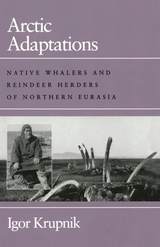
Arctic Adaptations
Native Whalers and Reindeer Herders of Northern Eurasia
Igor Krupnik
Dartmouth College Press, 2002
The common view of indigenous Arctic cultures, even among scholarly observers, has long been one of communities continually in ecological harmony with their natural environment. In Arctic Adaptations, Igor Krupnik dismisses the textbook notion of traditional societies as static. Using information from years of field research, interviews with native Siberians, and archaeological site visits, Krupnik demonstrates that these societies are characterized not by stability but by dynamism and significant evolutionary breaks. Their apparent state of ecological harmony is, in fact, a conscious survival strategy resulting from "a prolonged and therefore successful process of human adaptation in one of the most extreme inhabited environments in the world." As their physical and cultural environment has changed—fluctuating reindeer and caribou herds, unpredictable weather patterns, introduction of firearms and better seacraft—Arctic communities have adapted by developing distinctive subsistence practices, social structures, and ethics regarding utilization of natural resources. Krupnik's pioneering work represents a dynamic marriage of ethnography and ecology, and makes accessible to Western scholars crucial findings and archival data previously unavailable because of political and language barriers.
[more]

Ice Geographies
The Colonial Politics of Race and Indigeneity in the Arctic
Jen Rose Smith
Duke University Press, 2025
Ice animates the look and feel of climate change. It is melting faster than ever before, causing social upheaval among northern coastal communities and disrupting a more southern, temperate world as sea levels rise. Economic, academic, and activist stakeholders are increasingly focused on the unsettling potential of ice as they plan for a future shaped by rapid transformation. Yet, in Ice Geographies, Jen Rose Smith demonstrates that ice has always been at the center of making sense of the world. Ice as homeland is often at the heart of Arctic and sub-Arctic ontologies, cosmologies, and Native politics. Reflections on ice have also long been a constitutive element of Western political thought, but it often privileges a pristine or empty “nature” stripped of power relations. Smith centers ice to study race and indigeneity by investigating ice relations as sites and sources of analysis that are bound up with colonial and racial formations as well as ice geographies beyond those formations. Smith asks, How is ice a racialized geography and imaginary, and how does it also exceed those frameworks?
[more]
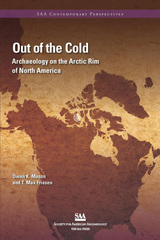
Out of the Cold
Archaeology on the Arctic Rim of North America
Owen K. Mason
University Press of Colorado, 2018
The Arctic rim of North America presents one of the most daunting environments for humans. Cold and austere, it is lacking in plants but rich in marine mammals-primarily the ringed seal, walrus, and bowhead whale. In this book in the SAA Press Current Perspectives Series, the authors track the history of cultural innovations in the Arctic and Subarctic for the past 12,000 years, including the development of sophisticated architecture, watercraft, fur clothing, hunting technology, and worldviews. Climate change is linked to many of the successes and failures of its inhabitants; warming or cooling periods led to periods of resource abundance or collapse, and in several instances to long-distance migrations. At its western and eastern margins, the Arctic also experienced the impact of Asian and European world systems, from that of the Norse in the East to the Russians in the Bering Strait.
[more]
READERS
Browse our collection.
PUBLISHERS
See BiblioVault's publisher services.
STUDENT SERVICES
Files for college accessibility offices.
RECENTLY PUBLISHED





UChicago Accessibility Resources
home | accessibility | search | about | contact us
BiblioVault ® 2001 - 2025
The University of Chicago Press