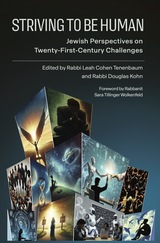
front cover of Striving to Be Human
Striving to Be Human
Jewish Perspectives on Twenty-First-Century Questions
Rabbi Leah Cohen Tenenbaum and Rabbi Douglas Kohn
Central Conference of American Rabbis, 2025
In his clarion call for ethical behavior, Rabbi Hillel tells us, “In a place where there is no humanity, strive to be human.” But what exactly does it mean to be human, especially in an age of rapid transformation? Striving to Be Human: Jewish Perspectives on Twenty-First-Century Challenges
confronts this question with boldness, hope, and a foundation of Jewish wisdom. The volume begins with “Challenges from Within Us,” addressing such topics as moral justice, belonging, queer theology, and good and evil. In part two, “Challenges from Beyond Us,” the authors delve into artificial intelligence, robotics, reproductive technologies, and the animal-human relationship. The result is a profound conversation about Jewish values and human dignity in our evolving landscape.
[more]


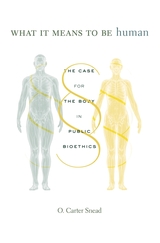
front cover of What It Means to Be Human
What It Means to Be Human
The Case for the Body in Public Bioethics
O. Carter Snead
Harvard University Press, 2020

A Wall Street Journal Top Ten Book of the Year
A First Things Books for Christmas Selection
Winner of the Expanded Reason Award


“This important work of moral philosophy argues that we are, first and foremost, embodied beings, and that public policy must recognize the limits and gifts that this entails.”
Wall Street Journal

The natural limits of the human body make us vulnerable and dependent on others. Yet law and policy concerning biomedical research and the practice of medicine frequently disregard these stubborn facts. What It Means to Be Human makes the case for a new paradigm, one that better reflects the gifts and challenges of being human.

O. Carter Snead proposes a framework for public bioethics rooted in a vision of human identity and flourishing that supports those who are profoundly vulnerable and dependent—children, the disabled, and the elderly. He addresses three complex public matters: abortion, assisted reproductive technology, and end-of-life decisions. Avoiding typical dichotomies of conservative-liberal and secular-religious, Snead recasts debates within his framework of embodiment and dependence. He concludes that if the law is built on premises that reflect our lived experience, it will provide support for the vulnerable.

“This remarkable and insightful account of contemporary public bioethics and its individualist assumptions is indispensable reading for anyone with bioethical concerns.”
—Alasdair MacIntyre, author of After Virtue

“A brilliantly insightful book about how American law has enshrined individual autonomy as the highest moral good…Highly thought-provoking.”
—Francis Fukuyama, author of Identity

[more]


Send via email Share on Facebook Share on Twitter