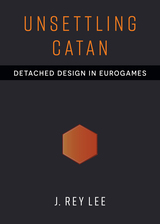
Unsettling Catan
Detached Design in Eurogames
J. Rey Lee
University of Michigan Press, 2025
Most revolutions don’t start with nineteen cardboard hexagons, but Klaus Teuber’s game about settling a hexagonal island quietly revolutionized boardgaming. Catan’s commercial success selling over 40 million copies certainly catalyzed a modern boardgaming boom. More importantly, its playful experiments set a new tone for game design. By making its cutthroat gameplay feel peaceful and pastoral, Catan helped a fledgling eurogame tradition forge its distinctive style and was heralded by Wired for “changing the American idea of what a board game can be.”
Although peaceful revolutions are usually the best kind, it’s worth questioning how these games cultivate peaceful feelings. Today, peaceful-feeling eurogames often settle into detached design—a mindset of making conflict feel peaceful by dampening conflicted feelings. Unsettling Catan questions how peaceful-feeling eurogames can make implicitly imperialist themes palatable by cultivating a detached mindset that imagines power as peaceful, neutral, and abstract. To ask the hard questions that eurogames often look away from, the book walks through each aspect of Catan’s gameplay (placing hexes, rolling the dice, robbing and trading, collecting resources, building and scoring) to explore how simple design decisions can play out, or play with, cultural ideas and ideals. As the first entry in the Tabletop Games book series, Unsettling Catan introduces key concepts for thinking about board games as a medium and offers accessible game analyses and personal reflections to help players, creators, and scholars reimagine what board games can be and become.
[more]