
 A SCHOLARLY BOOK REPOSITORY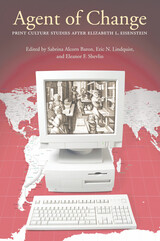
Joining together leading voices in the field of print scholarship, this collection of twenty essays affirms the catalytic properties of Eisenstein's study as a stimulus to further inquiry across geographic, temporal, and disciplinary boundaries. From early modern marginalia to the use of architectural title pages in Renaissance books, from the press in Spanish colonial America to print in the Islamic world, from the role of the printed word in nation-building to changing histories of reading in the electronic age, this book addresses the legacy of Eisenstein's work in print culture studies today as it suggests future directions for the field.
In addition to a conversation with Elizabeth L. Eisenstein, the book includes contributions by Peng Hwa Ang, Margaret Aston, Tony Ballantyne, Vivek Bhandari, Ann Blair, Barbara A. Brannon, Roger Chartier, Kai-wing Chow, James A. Dewar, Robert A. Gross, David Scott Kastan, Harold Love, Paula McDowell, Jane McRae, Jean-Dominique Mellot, Antonio Rodr'guez-Buckingham, Geoffrey Roper, William H. Sherman, Peter Stallybrass, H. Arthur Williamson, and Calhoun Winton.
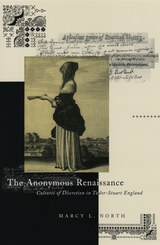
The Renaissance was in many ways the beginning of modern and self-conscious authorship, a time when individual genius was celebrated and an author's name could become a book trade commodity. Why, then, did anonymous authorship flourish during the Renaissance rather than disappear? In addressing this puzzle, Marcy L. North reveals the rich history and popularity of anonymity during this period.
The book trade, she argues, created many intriguing and paradoxical uses for anonymity, even as the authorial name became more marketable. Among ecclesiastical debaters, for instance, anonymity worked to conceal identity, but it could also be used to identify the moral character of the author being concealed. In court and coterie circles, meanwhile, authors turned name suppression into a tool for the preservation of social boundaries. Finally, in both print and manuscript, anonymity promised to liberate an authentic female voice, and yet made it impossible to authenticate the gender of an author. In sum, the writers and book producers who helped to create England's literary culture viewed anonymity as a meaningful and useful practice.
Written with clarity and grace, The Anonymous Renaissance will fill a prominent gap in the study of authorship and English literary history.
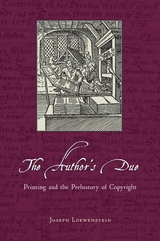
As Loewenstein shows, copyright is a form of monopoly that developed alongside a range of related protections such as commercial trusts, manufacturing patents, and censorship, and cannot be understood apart from them. The regulation of the press pitted competing interests and rival monopolistic structures against one another—guildmembers and nonprofessionals, printers and booksellers, authors and publishers. These struggles, in turn, crucially shaped the literary and intellectual practices of early modern authors, as well as early capitalist economic organization.
With its probing look at the origins of modern copyright, The Author's Due will prove to be a watershed for historians, literary critics, and legal scholars alike.

From the marginalia of their readers to the social and cultural means of their production, books bear the imprint of our humanity. Embodying the marks, traces, and scars of colonial survival, Indigenous books are contested spaces. A constellation of nontextual components surrounded Native American–authored publications of the long nineteenth century, shaping how these books were read and understood—including illustrations, typefaces, explanatory prefaces, appendices, copyright statements, author portraits, and more.
Centering Indigenous writers, Book Anatomy explores works from John Rollin Ridge, Sarah Winnemucca Hopkins, Pretty Shield, and D’Arcy McNickle published between 1854 and 1936. In examining critical moments of junction between Indigenous books and a mainstream literary marketplace, Amy Gore argues that the reprints, editions, and paratextual elements of Indigenous books matter: they embody a frontline of colonization in which Native authors battle the public perception and reception of Indigenous books, negotiate representations of Indigenous bodies, and fight for authority and ownership over their literary work.

Individually, the essays advance our understanding of play reading as a practice with distinct material forms, discourses, social settings, and institutional affiliation. Part One, "Real and Imagined Communities," includes four essays on play-reading communities and the terms in which they are distinguished from the reading public at large. Cyndia Clegg surveys the construction of readers in prefaces to published plays; Lucy Munro traces three separate readings of a single play, Edward Sharpham's The Fleer; Marta Straznicky studies women as readers of printed drama; and Elizabeth Sauer describes how play reading was mobilized for political purposes in the period of the civil war.
In Part Two, "Play Reading and the Book Trade," five essays consider the impact of play reading on the public sphere through the lens of publishing practices. Zachary Lesser offers a revisionist account of black-letter typeface and the extent to which it may be understood as an index of popular culture; Alan Farmer examines how the emerging news trade of the 1620s and 1630s affected the marketing of printed drama; Peter Berek traces the use of generic terms on title pages of plays to reveal their intersection with the broader culture of reading; Lauren Shohet demonstrates that the Stuart masque had a parallel existence in the culture of print; and Douglas Brooks traces the impact print had on eclipsing performance as the medium in which the dramatist could legitimately lay claim to having authored his text.
The individual essays focus on selected communities of readers, publication histories, and ideologies and practices of reading; the collection as a whole demonstrates the importance of textual production and reception to understanding the place of drama in the early modern public sphere.

Sibao today is a cluster of impoverished villages in the mountains of western Fujian. Yet from the late seventeenth through the early twentieth century, it was home to a flourishing publishing industry. Through itinerant booksellers and branch bookshops managed by Sibao natives, this industry supplied much of south China with cheap educational texts, household guides, medical handbooks, and fortune-telling manuals.
It is precisely the ordinariness of Sibao imprints that make them valuable for the study of commercial publishing, the text-production process, and the geographical and social expansion of book culture in Chinese society. In a study with important implications for cultural and economic history, Cynthia Brokaw describes rural, lower-level publishing and bookselling operations at the end of the imperial period. Commerce in Culture traces how the poverty and isolation of Sibao necessitated a bare-bones approach to publishing and bookselling and how the Hakka identity of the Sibao publishers shaped the configuration of their distribution networks and even the nature of their publications.
Sibao's industry reveals two major trends in print culture: the geographical extension of commercial woodblock publishing to hinterlands previously untouched by commercial book culture and the related social penetration of texts to lower-status levels of the population.

A fascinating analysis of anonymous publication centuries before the digital age
Everywhere and Nowhere considers the ubiquity of anonymity and mediation in the publication and circulation of eighteenth-century British literature—before the Romantic creation of the “author”—and what this means for literary criticism. Anonymous authorship was typical of the time, yet literary scholars and historians have been generally unable to account for it as anything more than a footnote or curiosity.
Mark Vareschi shows the entangled relationship between mediation and anonymity, revealing the nonhuman agency of the printed text. Drawing richly on quantitative analysis and robust archival work, Vareschi brings together philosophy, literary theory, and media theory in a trenchant analysis, uncovering a history of textual engagement and interpretation that does not hinge on the known authorial subject.
In discussing anonymous poetry, drama, and the novel along with anonymously published writers such as Daniel Defoe, Frances Burney, and Walter Scott, he unveils a theory of mediation that renews broader questions about agency and intention. Vareschi argues that textual intentionality is a property of nonhuman, material media rather than human subjects alone, allowing the anonymous literature of the eighteenth century to speak to contemporary questions of meaning in the philosophy of language. Vareschi closes by exploring dubious claims about the death of anonymity and the reexplosion of anonymity with the coming of the digital. Ultimately, Everywhere and Nowhere reveals the long history of print anonymity so central to the risks and benefits of the digital culture.
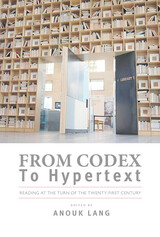
In From Codex to Hypertext, scholars from multiple disciplines engage with both of these strands. This volume includes essays that consider how changes such as the mounting ubiquity of digital technology and the globalization of structures of publication and book distribution are shaping the way readers participate in the encoding and decoding of textual meaning. Contributors also examine how and why reading communities cohere in a range of contexts, including prisons, book clubs, networks of zinesters, state-funded programs designed to promote active citizenship, and online spaces devoted to sharing one's tastes in books.
As concerns circulate in the media about the ways that reading—for so long anchored in print culture and the codex—is at risk of being irrevocably altered by technological shifts, this book insists on the importance of tracing the historical continuities that emerge between these reading practices and those of previous eras.
In addition to the volume editor, contributors include Daniel Allington, Bethan Benwell, Jin Feng, Ed Finn, Danielle Fuller, David S. Miall, Julian Pinder, Janice Radway, Julie Rak, DeNel Rehberg Sedo, Megan Sweeney, Joan Bessman Taylor, Molly Abel Travis, and David Wright.
Throughout, the sociology of organizations and of culture serves as Powell's interpretive framework. Powell shows how scholarly publishers help define what is "good" social science research and how the history and tradition of a publishing house contribute to the development of an organizational identity. Powell's review of actual correspondence, from outside letters proposing projects to internal "kill" letters of rejection, suggests that editors and authors at times form their own quasi-organization with external allegiances and bonds beyond those of the publishing house.
"This is a welcome addition to the literature on the life of the organizations that produce our science and our culture. Powell's intimate look at two scholarly publishing companies has an insider's appreciation of the book business and an outsider's eye for questions the editors are not asking themselves."—Michael Schudson, University of California at San Diego
"Getting Into Print will long be the book about how academic editors choose the titles they sponsor. Even experienced editors and authors will find new insights here and revealing comparisons with decision-making in other kinds of organizations."—Edward Tenner, Los Angeles Times Book Review
"Getting Into Print is an unusually outstanding ethnographic study in that it reflects the evocative richness of detail associated with the ethnographic approach while simultaneously maintaining a clear-headed, analytical distance from the subject that allows for a meaningful theoretical contribution. Powell is an astute ethnographer who presents a vital and compelling 'insider's view' of the decision-making process in scholarly publishing, making this book fascinating reading for all those involved in the 'publish-or-perish' syndrome."—Barbara Levitt, American Journal of Sociology
By examining alternative literary publications, Griffin recasts the seventeen-year Pinochet dictatorship as a time of editorial experimentation despite widespread cultural oppression and shows how grassroots cultural activism has challenged government-approved corporate publishing models throughout the postdictatorship period. Griffin's work also points to the growing importance of autogestión, or do-it-yourself cultural production, where individuals combine artisanal forms with new technologies to make and share creative work on a global scale.
Linking the study of business and politics, Christine Haynes reconstructs the passionate and protracted debate over the development of the book trade in nineteenth-century France. While traditionalists claimed that the business of literature required tight state regulation, an increasingly influential group of reformers argued that books were ordinary commodities whose production and distribution were best left to the free market.
The French Revolution overthrew the system of guilds and privileges that had governed the trade under the Old Regime. In the struggle that followed, the new men known as éditeurs (publishers) pushed for increased liberalization of the market. They relied on collective organization, especially a professional association known as the Cercle de la Librairie, to advocate for abolition of licensing requirements and extension of literary rights. Haynes shows how publishers succeeded in transforming the industry from a tightly controlled trade into a free enterprise, with dramatic but paradoxical consequences for literature in France.
The modern literary marketplace was the outcome of a political struggle both within the publishing world and between the book trade and the state. In tracing the contest over literary production in France, Haynes emphasizes the role of the Second Empire in enacting—but also in limiting—press freedom and literary property.
Making Meaning reflects McKenzie's virtuosity as a traditional bibliographer and reveals how his thought-provoking scholarship made him a driving force in the genesis and development of the new interdisciplinary field of book history. His refusal to recognize the traditional boundary between bibliography and literary history re-energized the study of the social, political, economic, and cultural aspects of book production and reception.
The editors' introduction and headnotes situate McKenzie's innovative and controversial thinking in the debates of his time.
From the eleventh through the seventeenth centuries, the publishers of Jianyang in Fujian province played a conspicuous role in the Chinese book trade. Unlike the products of government and educational presses, their publications were destined for the retail book market. These publishers survived by responding to consumer demands for dictionaries, histories, geographies, medical texts, encyclopedias, primers, how-to books, novels, and anthologies. Their publications reflect the varied needs of the full range of readers in late imperial China and allow us to study the reading habits, tastes, and literacy of different social groups. The publishers of Jianyang were also businessmen, and their efforts to produce books efficiently, meet the demands of the market, and distribute their publications provide a window on commerce and industry and the growth of regional and national markets.
The broad cultural, historical, and geographical scope of the Jianyang book trade makes it an ideal subject for the study of publishing in China. Based on an extensive study of Jianyang imprints, genealogies of the leading families of printers, local histories, documents, and annotated catalogs and bibliographies, Lucille Chia has written not only a history of commercial printing but also a wide-ranging study of the culture of the book in traditional China.
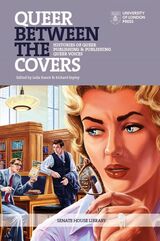
Queer Between the Covers presents a history of radical queer publishing and literature from 1880 to the modern day. Chronicling the gay struggle for acceptance and liberation, the book demonstrates how the fight for representation was often waged between the covers of books in a world where spaces for queer expression were taboo. The chapters provide an array of voices and histories from the famous, Derek Jarman and Oscar Wilde, to the lesser known and underappreciated, such as John Wieners and Valerie Taylor. It includes firsthand accounts of seminal moments in queer history, including the birth of Hazard Press and the Defend Gay’s the Word Bookshop campaign in the 1980s.
Queer Between the Covers demonstrates the importance of the book and how the queer community could be brought together through shared literature. The works discussed show the imaginative and radical ways in which queer texts have fought against censorship and repression and could be used as a political tool for organization and production. This study follows key moments in queer literary history, from the powerful community wide demonstrations for Gay’s the Word during their battle with the British government, to the mapping of Chicago’s queer spaces within Valerie Taylor’s pulp novels, or the anonymous but likely shared authorship of the nineteenth century queer text Teleny. Queer publishing also often involved fascinating creative tactics for beating the censor, from the act of self-publishing to anonymous authorship as part of a so-called “cloaked resistance.” Collage and repurposing found images and texts were key practices for many queer publishers and authors, from Derek Jarman to the artworks created by the Hazard Press.
This is a fascinating and topical book on publishing history for those interested in how queer people throughout modernity have used literature as an important forum for self-expression and self-actualization when spaces and sites for queer expression were outlawed.
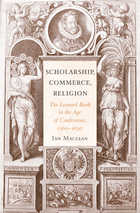
A decade ago in the Times Literary Supplement, Roderick Conway Morris claimed that “almost everything that was going to happen in book publishing—from pocket books, instant books and pirated books, to the concept of author’s copyright, company mergers, and remainders—occurred during the early days of printing.” Ian Maclean’s colorful survey of the flourishing learned book trade of the late Renaissance brings this assertion to life.
The story he tells covers most of Europe, with Frankfurt and its Fair as the hub of intellectual exchanges among scholars and of commercial dealings among publishers. The three major religious confessions jostled for position there, and this rivalry affected nearly all aspects of learning. Few scholars were exempt from religious or financial pressures. Maclean’s chosen example is the literary agent and representative of international Calvinism, Melchior Goldast von Haiminsfeld, whose activities included opportunistic involvement in the political disputes of the day. Maclean surveys the predicament of underfunded authors, the activities of greedy publishing entrepreneurs, the fitful interventions of regimes of censorship and licensing, and the struggles faced by sellers and buyers to achieve their ends in an increasingly overheated market.
The story ends with an account of the dramatic decline of the scholarly book trade in the 1620s, and the connivance of humanist scholars in the values of the commercial world through which they aspired to international recognition. Their fate invites comparison with today’s writers of learned books, as they too come to terms with new technologies and changing academic environments.

In Taking Books to the World, Amanda Laugesen tells the story of this purposeful enterprise, demonstrating the mix of goodwill and political drive behind its efforts to create modern book industries in developing countries. Examining the project through a clarifying lens, she reveals the ways Franklin's work aligned with cultural currents, exposing the imperial beliefs, charitable hopes, and intellectual reasoning behind this global experiment.
READERS
Browse our collection.
PUBLISHERS
See BiblioVault's publisher services.
STUDENT SERVICES
Files for college accessibility offices.
RECENTLY PUBLISHED



UChicago Accessibility Resources
home | accessibility | search | about | contact us
BiblioVault ® 2001 - 2024
The University of Chicago Press