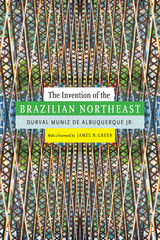
front cover of The Invention of the Brazilian Northeast
The Invention of the Brazilian Northeast
Durval Muniz de Albuquerque Jr.
Duke University Press, 2014
Brazil's Northeast has traditionally been considered one of the country's poorest and most underdeveloped areas. In this impassioned work, the Brazilian historian Durval Muniz de Albuquerque Jr. investigates why Northeasterners are marginalized and stereotyped not only by inhabitants of other parts of Brazil but also by nordestinos themselves. His broader question though, is how "the Northeast" came into existence. Tracing the history of its invention, he finds that the idea of the Northeast was formed in the early twentieth century, when elites around Brazil became preoccupied with building a nation. Diverse phenomena—from drought policies to messianic movements, banditry to new regional political blocs—helped to consolidate this novel concept, the Northeast. Politicians, intellectuals, writers, and artists, often nordestinos, played key roles in making the region cohere as a space of common references and concerns. Ultimately, Albuqerque urges historians to question received concepts, such as regions and regionalism, to reveal their artifice and abandon static categories in favor of new, more granular understandings.
 
[more]

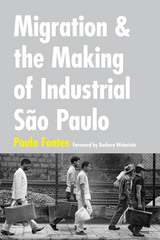
front cover of Migration and the Making of Industrial São Paulo
Migration and the Making of Industrial São Paulo
Paulo Fontes
Duke University Press, 2016
Published in 2008 and winner of the 2011 Thomas E. Skidmore Prize, Paulo Fontes's Migration and the Making of Industrial São Paulo is a detailed social history of São Paulo's extraordinary urban and industrial expansion. Fontes focuses on those migrants who settled in the suburb of São Miguel Paulista, which grew from 7,000 residents in the 1940s to over 140,000 two decades later. Reconstructing these migrants' everyday lives within a broad social context, Fontes examines the economic conditions that prompted their migration, their creation of an integrated identity and community, and their efforts to gain worker rights. Fontes challenges the stereotypes of Northeasterners as culturally backward, uneducated, violent, and unreliable, instead seeing them as a resourceful population with considerable social and political resolve. Fontes's investigations into Northeastern life in São Miguel Paulista yield a fresh understanding of São Paulo's incredible and difficult growth while outlining how a marginalized population exercised its political agency.
[more]

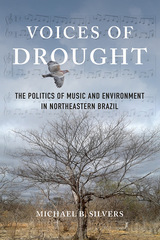
front cover of Voices of Drought
Voices of Drought
The Politics of Music and Environment in Northeastern Brazil
Michael B. Silvers
University of Illinois Press, 2018
In Voices of Drought, Michael B. Silvers proposes a scholarship focused on environmental justice to understand key questions in the study of music and the environment. His ecomusicological perspective offers a fascinating approach to events in Ceará, a northeastern Brazilian state affected by devastating droughts. These crises have a profound impact on social difference and stratification, and thus on forró music in the sertão (backlands) of the region. At the same time, the complex interactions of popular music and social conditions also help create the environment.

Silvers offers case studies focused on the sertão that range from the Brazilian wax harvested in Ceará for use in early wax cylinder sound recordings to the drought- and austerity-related cancellation of Carnival celebrations in 2014-16. Unearthing links between music and the environmental and social costs of drought, his daring synthesis explores ecological exile, poverty, and unequal access to water resources alongside issues like corruption, prejudice, unbridled capitalism, and expanding neoliberalism.
[more]

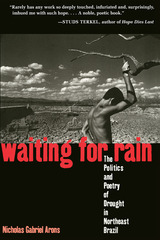
front cover of Waiting for Rain
Waiting for Rain
The Politics and Poetry of Drought in Northeast Brazil
Nicholas Gabriel Arons
University of Arizona Press, 2004
When droughts hit northeastern Brazil, thousands of rural workers are forced to abandon their homes for the cities in search of work. The double impact of drought and corruption—with politicians taking advantage of drought to buy votes and pilfer government accounts—contributes to an endless cycle of human suffering.
 
In order to understand the impact of drought and the phenomenon of drought politics, Nicholas Gabriel Arons goes beyond traditional social-science scholarship to sources such as novels, poetry, popular art, and oral history. For many people in the region, these artistic renditions of life are, ironically, a better reflection of reality than political rhetoric, government archives, and newspaper accounts—even though they are infused with myth or hyperbole.
 
Drawing on interviews with artists and poets and on his own experiences in the Brazilian Northeast, Arons has written a poignant account of how drought has impacted the region’s culture. He intertwines ecological, social, and political issues with the words of some of Brazil’s most prominent authors and folk poets to show how themes surrounding drought—hunger, migration, endurance, nostalgia for the land—have become deeply embedded in Nordeste identity. Through this tapestry of sources, Arons shows that what is often thought of as a natural phenomenon is actually the result of centuries of social inequality, political corruption, and unsustainable land use.
 
Waiting for Rain dramatically depicts a region still suffering from austere social and political realities, where drought—even during rainy seasons—is ubiquitous in the hearts and minds of its residents. A book of hope and resistance, myth and reality, and suffering and salvation, it is also a personal narrative of self-discovery, tracing a young man’s struggle to understand how human tragedy on a grand scale can exist alongside natural beauty.
[more]


Send via email Share on Facebook Share on Twitter