
 A SCHOLARLY BOOK REPOSITORY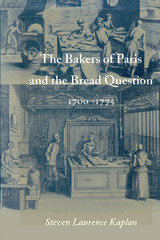
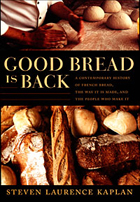
Despite the overpowering salience of bread in public and private life, Kaplan’s is the first inquiry into the ways bread exercised its vast and significant empire. Bread framed dreams as well as nightmares. It was the staff of life, the medium of communion, a topic of common discourse, and a mark of tradition as well as transcendence. In his exploration of bread’s materiality and cultural meaning, Kaplan looks at bread’s fashioning of identity and examines the conditions of supply and demand in the marketplace. He also sets forth a complete history of the bakers and their guild, and unmasks the methods used by the authorities in their efforts to regulate trade.
Because the bakers and their bread were central to Parisian daily life, Kaplan’s study is also a comprehensive meditation on an entire society, its government, and its capacity to endure. Long-awaited by French history scholars, The Bakers of Paris and the Bread Question, 1700–1775 is a landmark in eighteenth-century historiography, a book that deeply contextualizes, and thus enriches our understanding of one of the most important eras in European history.
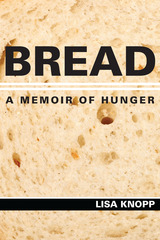
When she was 54, Lisa Knopp’s weight dropped to a number on the scale that she hadn’t seen since seventh grade. The severe food restricting that left her thin and sick when she was 15 and 25 had returned. This time, she was determined to understand the causes of her malady and how she could heal from a condition that is caused by a tangle of genetic, biological, familial, psychological, cultural, and spiritual factors. This compelling memoir, at once a food and illness narrative, explores the forces that cause eating disorders and disordered eating, including the link between those conditions in women, middle-aged and older, and the fear of aging and ageism.
Winner of the 2017 Nebraska Book Award for Memoir
2017 Choice Outstanding Academic Title
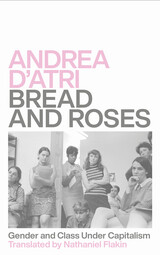
<i>Named Best Social Science Book, LASA Southern Cone Studies Section</i>
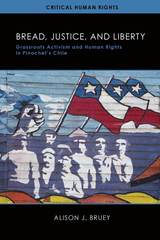
In Santiago, Chile, poverty and state violence have often led to grassroots resistance movements among the poor and working class. Alison J. Bruey offers a compelling history of the struggle for social justice and democracy during the Pinochet dictatorship. Deeply grounded by both extensive oral history interviews and archival research, Bread, Justice, and Liberty provides innovative contributions to scholarship on Chilean history, social movements, popular protest and democratization, neoliberal economics, and the Cold War in Latin America.

"Camporesi is as much a poet as a historian. . . . His appeal is to the senses as well as to the mind. . . . Fascinating in its details and compelling in its overall message."—Vivian Nutton, Times Literary Supplement
"It is not often that an academic monograph in history is also a book to fascinate the discriminating general reader. Bread of Dreams is just that."—Kenneth McNaught, Toronto Star
"Not religion but bread was the opiate of the poor, Mr. Camporesi argues. . . . Food has always been a social and mythological construct that conditions what we vainly imagine to be matters of personal taste. Our hunger for such works should tell us that food is not only good but essential to think and to read as if our lives depended on it, which they do."—Betty Fussell, New York Times Book Review

Williams weaves a tight net of historical circumstances, iconographic traditions, exegetical implications, political motivations, and liturgical functions to explain the imagery in the windows of the trades. Her account of changing social relationships in thirteenth-century Chartres focuses on the bakers, tavern keepers, and money changers whose bread, wine, and money were used as means of exchange, tithing, and offering throughout medieval society. Drawing on a wide variety of original documents and scholarly work, this book makes important new contributions to our knowledge of one of the great monuments of Western culture.
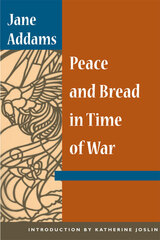
Addams's unyielding pacifism during the Great War drew criticism from politicians and patriots who deemed her the "most dangerous woman in America." Even those who had embraced her ideals of social reform condemned her outspoken opposition to U.S. entry into World War I or were ambivalent about her peace platforms. Turning away from the details of the war itself, Addams relies on memory and introspection in this autobiographical portrayal of efforts to secure peace during the Great War. "I found myself so increasingly reluctant to interpret the motives of other people that at length I confined all analysis of motives to my own," she writes. Using the narrative technique she described in The Long Road of Women's Memory, an extended musing on the roles of memory and myth in women's lives, Addams also recalls attacks by the press and defends her political ideals.
Katherine Joslin's introduction provides additional historical context to Addams's involvement with the Woman's Peace Party, the Women's International League for Peace and Freedom, and her work on Herbert Hoover's campaign to provide relief and food to women and children in war-torn enemy countries.
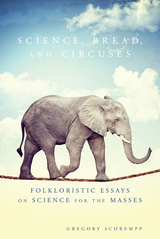
In Science, Bread, and Circuses, Gregory Schrempp brings a folkloristic viewpoint to the topic of popular science, calling attention to the persistence of folkloric form, idiom, and worldview within the increasingly important dimension of popular consciousness defined by the impact of science.
Schrempp considers specific examples of texts in which science interpreters employ folkloric tropes—myths, legends, epics, proverbs, spectacles, and a variety of gestures from religious traditions—to lend credibility and appeal to their messages. In each essay he explores an instance of science popularization rooted in the quotidian round: variations of proverb formulas in monumental measurements, invocations of science heroes like saints or other inspirational figures, the battle of mythos and logos in parenting and academe, the meme's involvement in quasi-religious treatments of the problem of evil, and a range of other tropes of folklore drafted to serve the exposition of science.
Science, Bread, and Circuses places the relationship of science and folklore at the very center of folkloristic inquiry by exploring a range of attempts to rephrase and thus domesticate scientific findings and claims in folklorically imbued popular forms.
READERS
Browse our collection.
PUBLISHERS
See BiblioVault's publisher services.
STUDENT SERVICES
Files for college accessibility offices.
RECENTLY PUBLISHED




UChicago Accessibility Resources
home | accessibility | search | about | contact us
BiblioVault ® 2001 - 2024
The University of Chicago Press