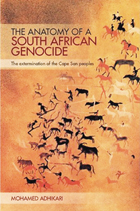
front cover of The Anatomy of a South African Genocide
The Anatomy of a South African Genocide
The Extermination of the Cape San Peoples
Mohamed Adhikari
Ohio University Press, 2011
In 1998 David Kruiper, the leader of the ‡Khomani San who today live in the Kalahari Desert in South Africa, lamented, “We have been made into nothing.” His comment applies equally to the fate of all the hunter-gatherer societies of the Cape Colony who were destroyed by the impact of European colonialism. Until relatively recently, the extermination of the Cape San peoples has been treated as little more than a footnote to South African narratives of colonial conquest. During the eighteenth and nineteenth centuries, Dutch-speaking pastoralists who infiltrated the Cape interior dispossessed its aboriginal inhabitants. In response to indigenous resistance, colonists formed mounted militia units known as commandos with the express purpose of destroying San bands. This ensured the virtual extinction of the Cape San peoples. In The Anatomy of a South African Genocide, Mohamed Adhikari examines the history of the San and persuasively presents the annihilation of Cape San society as genocide.
[more]

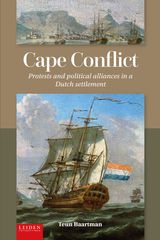
front cover of Cape Conflict
Cape Conflict
Protest and Political Alliances in a Dutch Settlement
Teun Baartman
Leiden University Press, 2019
From 1652 until 1795, the Cape of Good Hope was a Dutch settlement marked by tensions, often portrayed as antagonism between the oppressive Dutch East India Company (VOC) and the Cape’s aggrieved burghers. However, by comparing the political structures, institutions and dynamics of the Dutch Republic and its overseas settlement, the Teun Baartman demonstrates that this relationship was more cooperative and that the Cape burghers were able to influence policies in their favor similar to the way burghers in the Dutch Republic did by forming political factions. Using the Cape Conflict of the later eighteenth century as a case study, Baartman illustrates that it was in fact a fight for power between factions within the ruling elite, which consisted of both VOC officials and burghers. This book offers new evidence, a variety of interpretations, and an innovative narrative about where burghers came from, what their position was, and how the Cape political world operated.
 
[more]

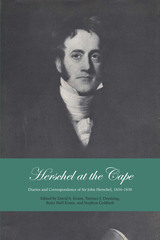
front cover of Herschel at the Cape
Herschel at the Cape
Diaries and Correspondence of Sir John Herschel, 1834-1838
Edited by David S. Evans, Terence J. Deeming, Betty Hall Evans, and Stephen Goldfarb
University of Texas Press, 1969

Sir John Herschel, one of the founders of Southern Hemisphere astronomy, was a man of extraordinarily wide interests. He made contributions to botany, geology, and ornithology, as well as to astronomy, chemistry, and mathematics. Throughout his scientific career he kept a diary, recording his public and private life. The diaries from 1834 to 1838, years he spent making astronomical observations at the Cape of Good Hope, are reproduced in this book and prove to be much more than an ordinary scientist’s logbook. They present personal and social history, literary commentaries, the results of close observations of nature and numerous scientific experiments, the excitement of travel, political intrigues, gossip, and philosophical reflections—all interpreted through an alert and versatile mind. In the present transcription, the material has been enriched with selected correspondence of Sir John and his wife Lady Herschel (née Margaret Brodie Stewart).

Sir John devoted his working time at the Cape primarily to a systematic observation of the southern sky, complementing his earlier “sweeping” of the northern sky at Slough, England. He later became one of the founders of photography, but at the Cape he used a simple optical device, the camera lucida, in the production of numerous landscape drawings. Many of these, along with reproductions of sketches contained in the diaries and botanical drawings made by Sir John and Lady Herschel, are used to illustrate this book. Sir John was also a leading figure in the foundation of the educational system of the Cape and a supporter of exploratory expeditions into the interior.

As the son of Sir William Herschel, in his day the most famous British astronomer and the discoverer of the planet Uranus, Sir John was already celebrated when he arrived from England. Every individual of note, resident at the Cape or visiting, went to see him. He was supported in his work by his wife, who ran an enormous establishment and bore a huge family, but who nevertheless found time to travel in the country around the western Cape with him and to assist in his observations.

The diaries and letters are supplemented by especially valuable editorial notes that provide much needed and highly interesting information concerning persons and events mentioned and described by Sir John. All the original manuscript material used in this volume is archived at the Harry Ransom Center at the University of Texas at Austin. Sir John’s camera lucida drawings are from the South African Public Library in Cape Town.
[more]

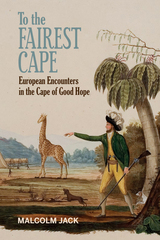
front cover of To the Fairest Cape
To the Fairest Cape
European Encounters in the Cape of Good Hope
Jack, Malcolm
Bucknell University Press, 2019
Crossing the remote, southern tip of Africa has fired the imagination of European travellers from the time Bartholomew Dias opened up the passage to the East by rounding the Cape of Good Hope in 1488. Dutch, British, French, Danes, and Swedes formed an endless stream of seafarers who made the long journey southwards in pursuit of wealth, adventure, science, and missionary, as well as outright national, interest. Beginning by considering the early hunter-gatherer inhabitants of the Cape and their culture, Malcolm Jack focuses in his account on the encounter that the European visitors had with the Khoisan peoples, sometimes sympathetic but often exploitative from the time of the Portuguese to the abolition of slavery in the British Empire in 1833. This commercial and colonial background is key to understanding the development of the vibrant city that is modern Cape Town, as well as the rich diversity of the Cape hinterland.

Published by Bucknell University Press. Distributed worldwide by Rutgers University Press.
[more]


Send via email Share on Facebook Share on Twitter